

Search results for "harjunpää/2010/10/mikko-rimminen-nenapaiva-nose-day/2011/04/matti-suurpaa-parnasso-1951–2011-parnasso-1951–2011/2009/09/what-god-said"
Between two loves
31 December 1999 | Archives online, Fiction, Prose
From Se tapahtui täällä (’It happened here’, Otava, 1999). Introduction and interview by Nina Paavolainen
She thought of the period between two loves as a spacious room, full of light, outside whose windows the seasons change unhurriedly. On the walls are reflections of the morning light. There is the sound of piano music; and the number of rooms grows. Somewhere, far away, a young girl, dressed in white, is at the piano; the wind fans the curtains. Slow awakening, the soft rocking of time, the sound of bare feet on a wooden floor. In the air there is the scent of flowers, apples, and the gentle morning breeze, and perfume, and the scent of clean, ironed clothes and furniture wax. The afternoon shadows are long and cool; the pages of a book rustle slowly. Now the music pauses.
A day at the zoo
23 December 2009 | Children's books, Fiction
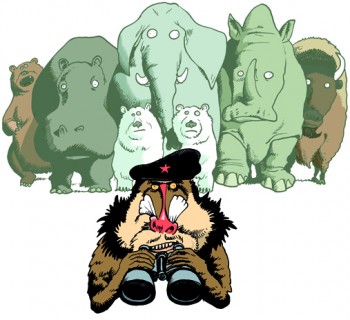
Extracts from the children’s book Zoo – eläimellinen tarina (‘Zoo – a bestial story’, WSOY, 2009, illustrated by Pertti Jarla)
The place: A zoo, once the property of the city, now privatised and accountable to corporate stockholders
The characters: The animals of the zoo, in particular Gandhi, a Sumatran tiger (false-teeth, poor vision, pacifist), Che, a male mandrill baboon (militant), and Mother Teresa, a hammer-headed bat (elderly); the zookeeper Sihvonen (stands up for the animals, recently fired); the new zoo director (whose main goal is to maximise profits); the shareholders’ committee (awaiting their earnings)
The action: after a demonstration in which all the animals played dead, the animals are staging a revolution to demand that Sihvonen be reinstated

The animals crowded into the foyer. The hallway was full of every kind of creature, with all of their skin, fur and feathers steaming in the warm indoor air. Che stood at the top of the the stairs, looked down at his troops, and gave the order in mime for everybody to be quiet.
‘Reconnaissance?’ he said, his voice subdued.
‘Ready!’ the leaf-tailed geckos announced.
‘Head in!’ Che commanded. More…
Finlandia Prize for Non-Fiction 2011
24 November 2011 | In the news
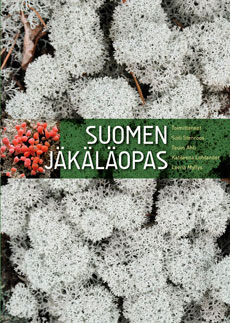 ‘Scientific, aesthetic, timely: the work is all of these. A work of non-fiction can be both precisely factual and emotional, full of both information and soul. A good non-fiction book will surprise. I did not expect to be enthused by lichens, their variety and colours,’ declared Professor Alf Reen in announcing the winner of this year’s Finlandia Prize for Non-Fiction on 17 November.
The winning work is Suomen jäkäläopas (‘Guidebook of lichens in Finland’), edited by Soili Stenroos & Teuvo Ahti & Katileena Lohtander & Leena Myllys (The Botanical Museum / The Finnish Museum of Natural History). The prize is worth €30,000.
The other works on the shortlist of six were the following: Kustaa III ja suuri merisota. Taistelut Suomenlahdella 1788–1790 [(‘Gustav III and the great sea war. Battles in the Gulf of Finland 1788–1790’, John Nurminen Foundation), written by Raoul Johnsson, with an editorial board consisting of Maria Grönroos & Ilkka Karttunen &Tommi Jokivaara & Juhani Kaskeala & Erik Båsk; Unihiekkaa etsimässä. Ratkaisuja vauvan ja taaperon unipulmiin (‘In search of the sandman. Solutions to babies’ and toddlers’ sleep problems’ ) by Anna Keski-Rahkonen & Minna Nalbantoglu (Duodecim); Operaatio Hokki. Päämajan vaiettu kaukopartio (‘Operation Hokki. Headquarters’ silenced long-distance patrol’), an account of a long-distance patrol strike in eastern Karelia during the Continuation War in 1944, by Mikko Porvali (Atena); Trotski (‘Trotsky’, Gummerus; biography) by Christer Pursiainen; and Lintukuvauksen käsikirja (‘Handbook of bird photography’) by Markus Varesvuo & Jari Peltomäki & Bence Máté (Docendo).
The mistake
30 September 2008 | Archives online, Fiction, Prose
A short story (‘Erehdys’, 1956, last published in the collection Lukittu laatikko ja muita kertomuksia, ‘A locked box and other stories’, WSOY, 2003). Introduction by Markéta Hejkalová
My feet are smarter than my head. On an April night in Naples they carried me along the Via Roma past the royal palace and the giant illuminated dome of the church. The people of Naples walked up and down the immortal street like the cool of evening, looking at each other and at the brightly lit display windows. I had nothing against that, but at the comer of Via San Brigida my feet turned to the right. The snow-cold breath of my homeland radiated toward me from Saint Bridget Street.
When I had turned the corner I could see a restaurant window still lit, with its fruit baskets, dead fish and red lobsters. The most hurried diners had already finished their meals. I stepped into the long dining room of the restaurant, the sawdust on the floor stuck to my shoes, a frighteningly icy stare pierced me from behind the counter, but I gathered my courage and whispered bravely, ‘Buona sera, signora.’ More…
Nine lives
30 September 1994 | Archives online, Fiction, Prose
Entire lives flash by in half a page in this selection of very short short stories. Extracts from Elämiä (‘Lives’, Otava, 1994)
Silja
Silja was born in 1900. The home farm had been sub-divided many times. Silja threw a piece of bread on the floor. ‘Don’t sling God’s corn,’ said grandmother. Silja got up to go to school at four. In the cart, her head nodded; when the horse was going downhill its shoes struck sparks in the darkness. Silja’s brother drove to another province to go courting. Silja sat in the side-car. ‘The birches were in full leaf there,’ she said at home. Silja went to Helsinki University to read Swedish. She saw the famous Adolf Lindfors playing a miser on the big stage at the National Theatre. Silja got a senior teaching post at the high school. With a colleague, she travelled in Gotland. Silja donated her television set to the museum. It was one of the first Philips models. ‘Has this been watched at all?’ they asked Silja. Silja learned to drive after she retired. She called her car ‘The Knight’. The teachers’ society made a theatre trip to Tampere. Silja looked up her colleague in the telephone directory in the interval. There was no one of that name. More…
Losing it
31 March 2002 | Archives online, Fiction, Prose
An extract from the novel Jalat edellä (‘Feet first’, Otava 2001). Introduction by Kanerva Eskola
Once he had sat in the car for a while Risto could feel his thoughts slowly becoming clearer. Tero had been killed by a lorry. He couldn’t think particularly actively about it but perhaps he could have said it out loud. After all, people often say all kinds of things that they don’t think. Maybe even too often, he wondered and decided to have a go.
‘Tero is dead,’ he said and the words tasted of preserved cherries.
In the changing room at the swimming pool Risto noticed that his swimming trunks and towel were mouldy. He had forgotten to hang them up to dry after the last time he went swimming. That was a thousand years ago and now a bluish grey fur was growing on them. He examined the bitter smelling mould on his trunks; the fur was beautiful, smooth and silky like a rabbit’s coat. He gently stroked his trunks. I can use these for ice swimming, he decided, and began to chuckle quietly to himself.
Renaissance man
30 September 1990 | Archives online, Fiction, Prose
An extract from the novel Bruno (WSOY, 1990)
Since her first collection of poems, which appeared in 1975, Tiina Kaila (born 1951 [from 2004, Tiina Krohn]) has published four children’s books and three volumes of poetry. Her novel Bruno is a fictive narrative about the Italian philosopher Giordano Bruno, who was burned at the stake in 1600. It is the conflict inherent in her main character that interests Kaila: his philosophical and scientific thought is much closer to that of the present day than, for example, that of Copernicus, and it is this that led him to the stake; and yet he did never abandon his fascination for magic.
The novel follows Bruno on his journeys in Italy; France, Germany and England, where he is accompanied by the French ambassador, Michel de Castelnau. Bruno finds England a barbaric place: ‘…These people believe that it is enough that they know how to speak English, even though no one outside this little island understands a word. No civilised language is spoken here’
In the extract that follows, Bruno, approaching the chalk cliffs of Dover by sea, makes what he feels to be a great discovery: ‘Creation is as infinite as God. And life is the supremest, the vastest and the most inconceivable of all.’
I was leaning on the foredeck handrail, peering into a greenish mist. The bow was thrashing between great swells, blustering and hissing and shuddering like some huge wheezing animal: Augh – aagh – ho-haugh! Augh – aagh – ho-haugh!
Plenty of space had been reserved for our use on this new two-master cargo boat. Castelnau was transferring his whole family from France – his wife, his daughter, his servants, his library, his furniture, his past and me – to London, where, as you know, he had been appointed Ambassador of France. More…
The way to heaven
30 June 1996 | Archives online, Fiction
Extracts from the novel Pyhiesi yhteyteen (‘Numbered among your saints’, WSOY, 1995). Interview with Jari Tervo by Jari Tervo
The wind sighs. The sound comes about when a cloud drives through a tree. I hear birds, as a young girl I could identify the species from the song; now I can no longer see them properly, and hear only distant song. Whether sparrow, titmouse or lark. Exact names, too, tend to disappear. Sometimes, in the old people’s home, I find myself staring at my food, what it is served on, and can’t get the name into my head. The sun came to my grandson’s funeral. It rose from the grave into which my little Marzipan will be lowered. I don’t remember what the weather did when my husband was buried.
A plate. Food is served on a plate. There are deep plates and shallow plates; soups are ladled into the deep ones. More…
The show must go on
30 June 2007 | Archives online, Fiction, Prose
Extracts from the novel Piru, kreivi, noita ja näyttelijä (‘The devil, the count, the witch and the actor’, Gummerus, 2007). Introduction by Anna-Leena Ekroos
‘I hereby humbly introduce the maiden Valpuri, who has graciously consented to join our troupe,’ Henrik said.
A slight girl thrust herself among us and smiled.
‘What can we do with a somebody like her in the group? A slovenly wench, as you see. She can hardly know what acting is,’ Anna-Margareta snapped angrily.
‘What is acting?’ Valpuri asked.
Henrik explained that acting was every kind of amusing trick done to make people enjoy themselves. I added that the purpose of theatre was to show how the world worked, to allow the audience to examine human lives as if in a mirror. Moreover, it taught the audience about civilised behavior, emotional life, and elegant speech. Ericus thought that the deepest essence of theatre was to give visible incarnation to thoughts and feelings. None of us understood what he meant by this, but we nodded enthusiastically. Anna-Margareta insisted that, say what you will, in the end acting was a childish game. Actors were being something they were not, just like children pretending to be little pigs or baby goats. More…
Out of this world
31 December 1996 | Archives online, Fiction, Prose
Extracts from the novel Virkamatka (‘Business travel’, Otava, 1996). Introduction by Jyrki Kiiskinen
I spent a couple of weeks alone at home that summer. My brother was at camp and my father on a business trip. Bored one rainy day, I opened up their last game on the computer. They had been going on about it for weeks.
I began from the beginning, A splendid start: texts backed by imaginative visions, Then darkness. In the middle of it a gold-coloured, glimmering dot. Nothing else. I waited for a long time. Nothing else, I waited. Nothing. Then I pressed the computer’s space-bar. The dot exploded and the explosion filled the entire screen. From its centre swarmed familiar patterns, Diagrams of atomic nuclei, electrons, radiation. More…
In Darwin’s garden
3 September 2009 | Authors, Interviews
Interview with Kristina Carlson, author of Herra Darwinin puutarhuri(‘Mr Darwin’s gardener’, 2009)
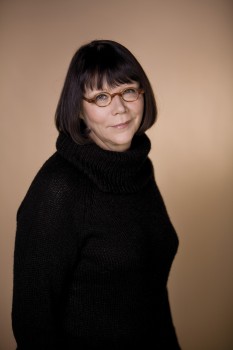
Kristina Carlson. Photo: Tommi Tuomi
Time: late 1870s. November. Place: the village of Downe, Kent, England. Villagers gather in the church on a rainy Sunday. Thomas Davies stays at home with his two children.
After the death of his wife, Thomas has been unable to get over his grief and anxiety. The villagers don’t approve of Thomas’s way of living – he isn’t sociable, keeps to himself, doesn’t go to church, and reads too many books. His employer is Charles Darwin: a famous – or notorious – man who writes too many books. ‘Mr Darwin lives here, and atheism is a worse threat than in the neighbouring villages,’ says Stuart Wilkes, voicing the views of the villagers.
Thomas is the central character in Kristina Carlson’s new novel, Herra Darwinin puutarhuri (‘Mr Darwin’s gardener’, Otava, 2009). Ten years ago her previous novel, Maan ääreen (‘To the end of the earth’), set in 19th-century Siberia, won the Finlandia Prize for Fiction.
As 2009 is the second centenary of Charles Darwin, the author of On the Origin of Species (published in 1859), the first question that comes to mind is whether this is coincidental or not… More…
The 101-year anniversary celebration
30 September 1989 | Archives online, Fiction, Prose
From the collection of short stories, Saksalainen vävy (‘The German son-in-law’) , 1988. Interview by Erkka Lehtola
Järvinen thought he must have turned up at the wrong place when he saw an iron cross on a grey concrete wall. Surely the library couldn’t be holding its celebration here?
He groped in his breast pocket for the map the librarian had sent him. No: there the landmarks were, he’d followed them, he was at the right place.
He drove on a bit and saw there were cars parked behind the building. He parked next to them and got out. All the other cars were shiny, as if they’d just been washed; his was the only dirty one, its chassis a dusty grey. Rosinante came into his head, and he started wondering what Rosinante’s colour was supposed to have been: just the sort of knowledge he could fit in somewhere. Grey, he guessed – just as General Sandels’ horse in the Runeberg poem was white. And what colour was Pegasus? Didn’t know that either – it hadn’t ever even occurred to him to wonder. Almost certainly it would be there in the mythology. More…
In the wars
31 March 2005 | Archives online, Fiction, Prose
A short story from Jussi ja Lassi (‘Jussi and Lassi’, WSOY, 1921). Introduction by Pekka Tarkka
One winter evening, Lassi, who was six, asked: ‘Can’t we go out, mother?’
‘It’s late already,’ she said.
‘We’ve been inside the whole day practically,’ said Jussi, who was seven. ‘It gets on my nerves.’
‘Gets on your nerves, does it? Well, boys, you’ll soon be off in bed,’ she said, ‘so you won’t need to get nervy.’
‘Not off to bed – not yet, it’s not yet, not…’ Lassi broke off, trying to work it out.
‘It’s not six yet,’ Jussi said.
‘No, it isn’t,’ their mother said; ‘but you’ll have to stay in your room and not go charging about here, because visitors are coming.’ More…
Is this all?
10 October 2013 | Extracts, Non-fiction
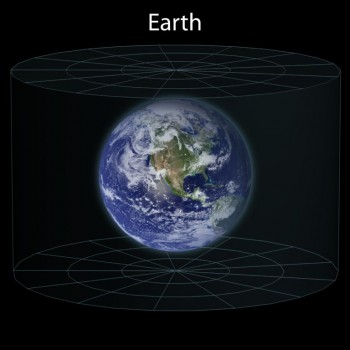
Earth. Andrew Z. Colvin/Wikimedia
In today’s world, many people find that it is not the lack of something that is problematic, but excess: the same goes for knowledge. According to professor of space astronomy, Esko Valtaoja, knowledge should contribute to the creation of a better world. His latest book is a contribution to the sum of all knowledge; over the course of two hundred pages Valtaoja delves deep into the inner space of man by taking his reader on a brief tour of the universe. Extracts from Kaiken käsikirja. Mitä jokaisen tulisi tietää (‘A handbook to everything. What everybody should know’, Ursa, 2012)
Whatever god you bow down to, you’re probably worshipping the wrong god.
The above is almost the only completely certain thing that can be said about religion, and even it does not encompass any deep truth; it’s just a simple mathematical statement. The world’s biggest religion is Roman Catholicism, which is confessed, at least nominally, by 1.1 billion people. If the Roman Catholic god were the true god, the majority of people in the world are therefore worshipping a false god. (According to the official stance of the Catholic church, the other Christian denominations are heresies, and their believers will be condemned to perdition: extra ecclesiam nulla salus. This inconvenient truth is, understandably, politely bypassed in ecumenical debate. But even if all those who call themselves Christians were counted as worshipping the same god, two thirds of the world’s population are still knocking at the wrong door.)
If you’re a religious person, don’t worry; I’m not blaspheming. And if you’re a campaigning atheist, hang on a minute: all I want to do is to find a clear and undisputed starting point to consider what it is we’re talking about when we speak of religion. More…