

Search results for "harjunpää/2010/10/mikko-rimminen-nenapaiva-nose-day/2011/04/matti-suurpaa-parnasso-1951–2011-parnasso-1951–2011/2009/09/what-god-said"
See the big picture?
9 November 2012 | Extracts, Non-fiction
Details from the cover, graphic design: Työnalle / Taru Staudinger
In his new book Miksi Suomi on Suomi (‘Why Finland is Finland’, Teos, 2012) writer Tommi Uschanov asks whether there is really anything that makes Finland different from other countries. He discovers that the features that nations themselves think distinguish them from other nations are often the same ones that the other nations consider typical of themselves…. In Finland’s case, though, there does seem to be something that genuinely sets it apart: language. In these extracts Uschanov takes a look at the way Finns express themselves verbally – or don’t
Is there actually anything Finnish about Finland?
My own thoughts on this matter have been significantly influenced by the Norwegian social scientist Anders Johansen and his article ‘Soul for Sale’ (1994). In it, he examines the attempts associated with the Lillehammer Winter Olympics to create an ‘image of Norway’ fit for international consumption. Johansen concluded at the time, almost twenty years ago, that there really isn’t anything particularly Norwegian about contemporary Norwegian culture.
There are certainly many things that are characteristic of Norway, but the same things are as characteristic of prosperous contemporary western countries in general. ‘According to Johansen, ‘Norwegianness’ often connotes things that are marks not of Norwegianness but of modernity. ‘Typically Norwegian’ cultural elements originate outside Norway, from many different places. The kind of Norwegian culture which is not to be found anywhere else is confined to folk music, traditional foods and national costumes. And for ordinary Norwegians they are deadly boring, without any living link to everyday life. More…
One hell of a time
31 December 1997 | Archives online, Fiction, Prose
Extracts from Lanthandlerskans son (‘Country shopkeeper’s son’, Söderströms, 1997). Brooklyn Bridge, Christmas Eve: Otto, a Finland-Swede, attempts to start a new life in 1930s America, where swindlers and even gangsters can, he finds, be duped – even Al Capone. Otto’s grandson listens to his story on tape
I have always loved that sight. A city that you see from the air at night, all lit up. It’s’ beautiful – and at the same time so frightening. I don’t really know how to describe it.
Well, it was Christmas Eve. I was wandering around New York. I had eaten at an automat. Do you know what that is? They don’t exist any more, but in the Twenties and Thirties they were common in America. It’s a cafe, but they didn’t have any staff or waiters, instead the walls were full of little glass boxes where the food was on display. You could select what you wanted – sandwiches and pies and salads, anything. Then you put your nickels and dimes in a slot beside the box and the glass opened and’all you had to do was take out the plate. I was fond of the automats. I liked just sitting there and watching other people eat, no one bothered about you, you were left alone and that suited me. When I’d finished eating I went outside again and somehow or other I wandered upon to Brooklyn Bridge. There was a lot of traffic, people were on their way home. Well, just as I was walking there alone in the company of my thoughts I heard someone shouting ‘Help! Help me!’ More…
The life of a lonely friend
30 September 1986 | Archives online, Fiction, Prose
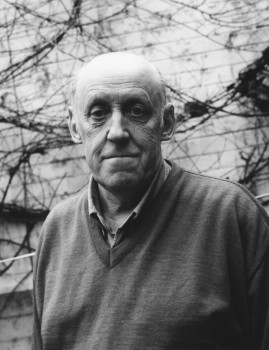
Bo Carpelan. Photo: Charlotta Boucht
Extracts from Bo Carpelan‘s novel Axel, ‘a fictional memoir’ (1986). In his preface to the novel Bo explains how he ‘found’ Axel.
Preface
In the 1930s I came across the name of Axel Carpelan (1858-1919), my paternal grandfather’s brother, in Karl Ekman’s Jean Sibelius and His Work (1935). In the bibliography, the author briefly mentions quotes from letters in the book addressed to Axel Carpelan, ‘who belonged to the Master’s most intimate circle of friends, and in musical matters was his constant confidant. Sibelius commemorated their friendship by dedicating his second symphony to him’. I had never heard Axel’s name mentioned in my own family.
Many years after Karl Ekman, the original incentive for the novel about Axel arose through Erik Tawaststjerna’s biography of Sibelius, in which Axel is portrayed in the second volume (1967) of the Finnish edition, and whose life came to an end in Part IV (1978). From early 1970s onwards, I started notes for Axel’s fictional diary from to 1919. It is not known whether Axel himself ever kept a diary. I relied as muchas possible on all the available facts. These increased when I was given access to letters exchanged between Axel and Janne from the year 1900 onwards. It became the story of the hidden strength a very lonely and sick man, and of a friendship in which the give and take both sides was far greater than Axel himself could ever have imagined.
Hagalund, June 1st, 1985
Bo Carpelan

1878, Axel’s diary
15.1.
On my twentieth birthday, I remember the young Wolfgang; ‘Little Wolfgang has no time to write because he has nothing to do. He wanders up and down the room like a dog troubled by flies’. However, that dog achieved a paradise. I have learnt yet one more piece of wisdom: ‘It is my habit to treat people as I find them; that is the most rewarding in the long run’. More…
What about me?
30 September 2008 | Fiction, Prose
Extracts from the novel Mitä onni on (‘What happiness is’, Otava, 2008)
I was lying on the sofa watching Sports Roundup. The ski jumpers were flying at Zakopane. When I go one day, I want the cantor to play the Sports Roundup theme on the harmonium and the pallbearers to look on like skiing judges down into the pit.
‘I have an idea,’ Liisa said, sitting down at the other end of the sofa. I muted the television and adopted a focused expression. I focused on thinking about my expression.
‘Finnish happiness,’ Liisa pronounced solemnly. ‘I’ll illustrate, and you write.’
‘A book again,’ I said and turned the sound back on. They were reading off the women’s basketball scores now. Liisa waited patiently. I was disarmed enough by this that I turned the television off. More…
Mary Bloom
31 December 1983 | Archives online, Drama, Fiction
Introduction by Väinö Vainio
‘Is Mary Bloom about a revivalist religious meeting, a party political conference at which a new leader is born, or a rock concert? These are among the things that have been suggested. I don’t know. I don’t hope for restraint in the imaginations of those who choose.to interpret my work, although I observe it myself. The work of a writer is a part of life, it is an individual and collective experience that seeks, finds, takes and uses its materials like a motor machine. For those who create it the drama is real, as in the theatre, for the duration of the performance.’ Jussi Kylätasku
Characters
Mary Bloom
Martha, a doctor
Otto, a preacher
Disabled veteran
Serenity, his wife
Alcoholic
Cold Cal, a prisoner
Blind man, Deaf Wife More…
Man and boy
31 December 2006 | Archives online, Fiction, Prose
Extracts from the novel Kansallismaisema (‘National landscape’ Tammi, 2006). Introduction by Tuomas Juntunen
Plans were afoot to establish boys’ camps across the country. This was an experiment, a chance to test the water, to be a pioneer. Here was the opportunity to be the first in line to conquer the Wild West, just as many a brave cowboy had done in years gone by. The Ministry of General Affairs planned to put all 15-year-olds to work for the duration of the summer holidays. Casual labourers were often even younger. Our task was to ascertain a suitable minimum age. In addition, special camps were planned for those not suited to normal work camps. In the summers to come the youth of Finland would be fully employed. Weren’t we in fact driven by the same desire, Tikka had wondered. We both cared about the next generation. We wanted to root out their deficiencies so that they would be able to face life’s challenges to the full. More…
Finlandia Prize for Fiction 2011
1 December 2011 | In the news
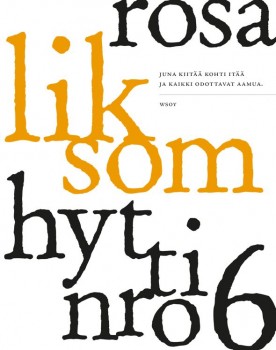 The winner of the Finlandia Prize for Fiction 2011, worth €30,000, is Rosa Liksom, for her novel Hytti no 6 (‘Compartment number 6’, WSOY): read translated extracts and an introduction of the author here on this page.
The prize was awarded on 1 December. The winner was selected by the theatre manager Pekka Milonoff from a shortlist of six.
‘Hytti nro 6 is an extraordinarily compact, poetic and multilayered description of a train journey through Russia. The main character, a girl, leaves Moscow for Siberia, sharing a compartment with a vodka-swilling murderer who tells hair-raising stories about his own life and about the ways of his country. – Liksom is a master of controlled exaggeration. With a couple of carefully chosen brushstrokes, a mini-story, she is able to conjure up an entire human destiny,’ Milonoff commented.
Author and artist Rosa Liksom (alias Anni Ylävaara, born 1958), has since 1985 written novels, short stories, children’s book, comics and plays. Her books have been translated into 16 languages.
Appointed by the Finnish Book Foundation, the prize jury (journalist and critic Hannu Marttila, journalist Tuula Ketonen and translator Kristiina Rikman) shortlisted the following novels: Kallorumpu (‘Skull drum’, Teos) by Eeva-Kaarina Aronen, William N. Päiväkirja (‘William N. Diary’, Otava) by Kristina Carlson, Huorasatu (‘Whore tale’, Into) by Laura Gustafsson, Minä, Katariina (‘I, Catherine’, Otava) by Laila Hirvisaari, and Isänmaan tähden (‘For fatherland’s sake’, first novel; Teos) by Jenni Linturi.
Rosa Liksom travelled a great deal in the Soviet Union in the 1980s. She said she hopes that literature, too, could play a role in promoting co-operation between people, cultures and nations: ‘For the time being there is no chance of some of us being able to live on a different planet.’
Jacob’s Dream
30 September 1986 | Archives online, Fiction, Prose
An extract from Hänen olivat linnut (‘Hers were the birds’, 1967). Introduction by Pirkko Alhoniemi
‘It was Jacob’s Dream, Alma.’
How could she put it so Alma wouldn’t get hurt. Alma had ruined the surface of the painting. The pastor’s widow stood nervously in front of the window and tried to say what she’d had on her mind for several days but couldn’t quite come out with. When Alma went out of the house, the pastor’s widow would wander through the rooms and check on things. And the painting wasn’t the only object in danger, but also the birds. Their feathers were ruffled because Alma kept wiping them with a wet rag. How could she put it.
‘Alma.’
Alma turned to look at her.
‘It’s called Jacob’s Dream.’ More…
A roof with a view
27 August 2009 | Fiction, Prose
Extracts from the novel Mistä on mustat tytöt tehty? (‘What are black girls made of?’, Tammi, 2009) Introduction by Tuomas Juntunen
I’m a chimney sweep’s daughter, born October 1962 as a gift, a light to a darkened world. I’ve had lots of mothers, but none of them ever stuck around for good. One of them gave birth to me, so she’s Mother, not mother. Her name is Dewdrop, because water has spilled over the only photograph of My Mother and now her face has dissolved into a single translucent droplet; her nose, cheeks and chin are now a fat, shiny blob that looks like it’s about to fall out of the bottom of the picture. More…
A toast before dying
30 June 2005 | Archives online, Fiction, Prose
Extracts from the novel Voin jo paljon paremmin. Tšehov Badenweilerissa (‘I already feel much better. Chekhov in Badenweiler’, Loki, 2004). Introduction by Hannu Marttila
I went to meet them Friday and I did not plan to take other patients that week. They had a small but comfortable room with striped wallpaper.
The Russian was a tall man, but stooped. It soon became apparent that his wife spoke fluent German because she was of German descent. That made it much easier to take care of things.
Of course I knew who the patient was. I have always enjoyed literature and other forms of art. I could play several pieces rather well on the piano. When I was younger I had even written a couple of stories set in the mountains, though I had never offered them for publication. As for Chekhov, I had read a couple of his stories that had just come out in German translation, and I had liked them quite a lot in a way, even though they of course reflected that characteristic Russian nature, with its vodka and untidiness.
The patient’s wife seized both my hands when I entered. It was a bit confusing, but not necessarily unpleasant.
‘Our name is Chekhov. We have come from Russia,’ the woman said in a strong, carrying voice. ‘I trust you’ve been told?’ More…
Government Prize for Translation 2011
24 November 2011 | In the news
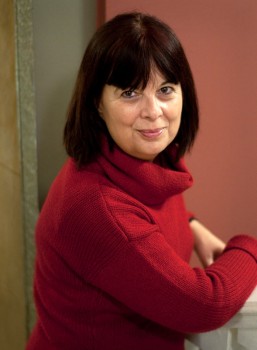
María Martzoúkou. Photo: Charlotta Boucht
The Finnish Government Prize for Translation of Finnish Literature of 2011 – worth € 10,000 – was awarded to the Greek translator and linguist María Martzoúkou.
Martzoúkou (born 1958), who lives in Athens, where she works for the Finnish Institute, has studied Finnish language and literature as well as ancient Greek at the Helsinki University, where she has also taught modern Greek. She was the first Greek translator to publish translations of the Finnish epic, the Kalevala: the first edition, containing ten runes, appeared in 1992, the second, containing ten more, in 2004.
‘Saarikoski was the beginning,’ she says; she became interested in modern Finnish poetry, in particular in the poems of Pentti Saarikoski (1937–1983). As Saarikoski also translated Greek literature into Finnish, Martzoúkou found herself doubly interested in his works.
Later she has translated poetry by, among others, Tua Forsström, Paavo Haavikko, Riina Katajavuori, Arto Melleri, Annukka Peura, Pentti Saaritsa, Kirsti Simonsuuri and Caj Westerberg.
Among the Finnish novelists Martzoúkou has translated are Mika Waltari (five novels; the sixth, Turms kuolematon, The Etruscan, is in the printing press), Väinö Linna (Tuntematon sotilas, The Unknown Soldier) and Sofi Oksanen (Puhdistus, Purge).
María Martzoúkou received her award in Helsinki on 22 November from the minister of culture and sports, Paavo Arhinmäki. Thanking Martzoúkou for the work she has done for Finnish fiction, he pointed out that The Finnish Institute in Athens will soon publish a book entitled Kreikka ja Suomen talvisota (‘Greece and the Finnish Winter War’), a study of the relations of Finland and Greece and the news of the Winter War (1939–1940) in the Greek press, and it contains articles by Martzoúkou.
The prize has been awarded – now for the 37th time – by the Ministry of Education and Culture since 1975 on the basis of a recommendation from FILI – Finnish Literature Exchange.
The Onlookers
30 September 1978 | Archives online, Fiction, Prose
A short story from Naisten vuonna (‘In women’s year’, 1975). Introduction by Pekka Tarkka
The two elks came out on to the road through a gap between timber sheds. They began to cross the road, and the larger one was very nearly run into by a car. Cars stopped and horns tooted, till the elks turned and made off towards the harbour. Several cars swung round and drove along the cinder track in pursuit of the animals.
The elks headed across the rubble towards the power station; after circling some stacks of railway sleepers, they ended up on the flank of a coalheap sixty feet high. The cars pulled up and their occupants poured out, shouting that the elks wouldn’t go that way, it was a dead end. The elder of the two elks had indeed sensed this, and they moved off to the right, skirting the coal-heap and emerging among the timber-stacks. By this time the first cyclists and pedestrians had arrived on the scene.
“They’ll break their legs,” said a pedestrian to a motorist. “There’s all kinds of junk lying about.” More…
Picture this
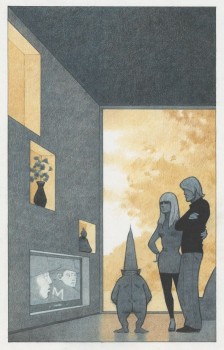 Accompanied by one or two sentences of the most gnomic kind, architect Mikko Metsähonkala’s illustrations speak volumes. The picture-stories in his book Toisaalta / (P)å andra sidan / In Other Wor(l)ds blend the real and the surreal using fairy tales, references to historical or fictional characters and episodes from everyday life.
(The Finnish composer Lauri Supponen was inspired by Metsähonkala’s ‘humaphone’ – see below –, and his composition The Dordrecht Humaphone was first performed at the Cheltenham Festival, England, in 2012, to favourable reviews.) More…
On Daniel Katz
31 December 1980 | Archives online, Authors
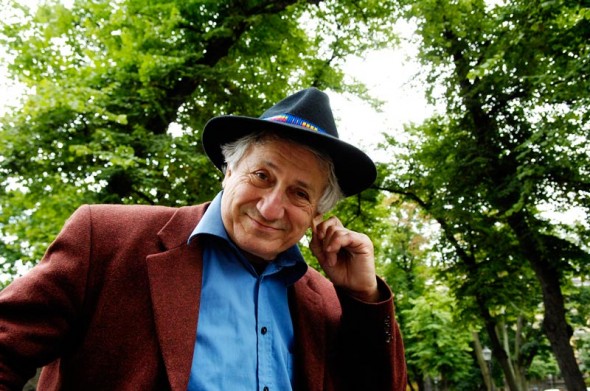
Daniel Katz. Photo: Veikko Somerpuro/WSOY.
Daniel Katz (born 1938) is a member of Finland’s small Jewish community and the first Finnish writer to emerge from that background. The publication of his first book coincided roughly with the appearance in America of a wealth of Jewish literature. Katz has much in common with American Jewish writers, particularly in his parodies of conventional religious practices, but the Jewish community he writes about relates to the general social environment in a very different way. Writers like Philip Roth are concerned with a social group that is tightly hemmed in by its own claustrophobic boundaries, whereas Katz’s Jews, living alongside the reserved and at times withdrawn Finns, stand out as exceptionally extroverted and sociable beings; their Jewishness is not a fetter but their innate key to freedom. More…