

Search results for "harjunpää/2010/10/mikko-rimminen-nenapaiva-nose-day"

A dictionary of human destinies

31 March 2001 | Fiction, Prose

Short stories from Av blygsel blev Adele fet (‘It was embarrasment that made Adele fat’, Söderström & Co., 2000)

Adele

It was embarrassment that made Adele fat. It wasn’t from hunger that her fridge-fumbling fingers began to grow nimble, but from confusion. And it was never knowing what her tongue ought to say that led her to the concrete business of the fridge. Her tongue certainly knew all about tasting. It could feel her teeth chewing even if it didn’t know how to speak. It became a better and better judge of brussels sprouts and speckled sausage. The rest was just good morning and thanks, thanks and goodbye and nice day. More…

Troubled by joy?

30 September 1998 | Fiction, poetry

Poems from Boxtrot (WSOY, 1998)

Nine lives

So far nine lives only, and
all mine, like my head in my hands.
My first was curled up at the foot of a fir tree
in the autumn forest just at day-dawn
in nighttime's raindrops.
The resin's still in my fingernails.
My second was the scent of split wood by the shed,
and the circular-saw blade's horrific disc.
The gruel, track shoes too large, and President Kekkonen,
ink spreading across my notebook, and
the clank of the railway under my dreams.
Mayday's red flags, the neighbour's daughter
naked, and dead pigeons lying on the gravel.
My third life was the discovery of anger, blind rage
turning and turning me in its leather bag,
wearing the edges of my day down. Sitting at our schooldesks
being forced towards a goal that can't be named.
Seeing how they start drinking, drinking
into their eyes that black impotent rebellion.
I'm on the point of drowning, someone's traversing
the Atlantic in a reed boat. And if I did die,
it wouldn't matter who sneered. The stars in the sky
                     are watching us in horror.

More…

A fifth season

30 December 2000 | Fiction, poetry

Poems from Elävän mieli (‘A mind alive’, WSOY, 1999). Introduction by Lauri Otonkoski

In sparser gusts of wind
metaphors sough through the mind,
spinning as on the much-frequented
boulevards of a great park.
Even one’s most private thoughts are as common
as public transport, what a relief,
as shared as our anatomies and our bacteria,
for there is only one thread in the skein of the Norns
and the same fabric is always being woven
from the whims of fate: is that not a relief?
Treacherous individuality suffices only
for a fingerprint.
Metaphors always the same,
but constantly born anew
like a mind alive. More…

Take, eat

30 September 1994 | Archives online, Authors, Extracts, Interviews, Non-fiction

Annika Idström interviewed by Tuva Korsström; from Berättelsernas återkomst (The return of the narratives, Söderströms, 1994), a series of interviews, by Tuva Korsström, with contemporary European writers

Tuva Korsström: If one looks at what you have written, it’s had to do with things that no one talks about: mother-hatred, father-fixation, incest-fantasies; child-abuse and maltreatment of women… In general it’s always the unpleasant and depressing things that are made taboo: all our effort goes into normalising life according to a norm of niceness. Yet all these terrible things are there in our subconscious. You bring them out into the light, and it just can’t be very nice. You talk about what we’ve kept secret. Your method can perhaps be compared to psychoanalysis.

Annika Idström: My most recent book is about love, or rather about the possibility of love. It takes its origin not in an image but in my intensive reading of the Swedish psychoanalyst Jurgen Reeder’s book Begär och etik (‘Desire and ethics’).

It’s surprising that psychoanalysis wants to stubbornly cling to the simple idea that love is something the subject in a teleological sense ‘matures’ into unless its path of development has been hedged around by too many difficulties and disappointments. It’s surprising that people go in search of a discourse about love’s fundamental or innate harmony, when instead it ought to be obvious that what we call love is in the best case a ‘symptom’, behind which the individual finds himself torn apart by disparate forces.

Begär och etik

More…

Food for thought

31 March 2006 | Archives online, Articles, Authors, Non-fiction

Are thrillers the junk food of literature – or is there any haute cuisine in the genre of crime? And who cares anyway, if the books make you tum the page? Pia Ingström takes a look at some Finnish whodunits

Finnish crime fiction has kept itself largely free of the illusions of grandeur which have made the same genre in neighbouring Sweden begin to seem ever more pretentious and ridiculous. In the recent past, Sweden has exported blockbusters by Henning Mankell, Liza Marklund and Åke Edwardson to the international crime Fiction market, followed by a great flood of successors totally lacking in originality but presented as important literary contributions to some vaguely defined ‘contemporary debate’.

In Finland, detective stories and thrillers are sensibly treated simply as detective stories and thrillers crafted according to a recognisable formula, avoiding the sort of monstrosities characteristic of Sweden which mix scenes of brutal violence clearly intended as entertainment with claims to social relevance. Finnish crime novels tend to be less pretentious, and can sometimes happily surprise the reader by their high quality.

Take for example the flashy new doorstopper by Ilkka Remes, or a rather clumsily executed but at times bizarrely original private-eye story by Anja Angel, or a bittersweet tale of Russian-Karelian blood-and-crime-brotherhood by Matti Rönkä, or a feminist offering from Leena Lehtolainen. None of these makes any great claim to the status of art – they are honestly, at times brilliantly, crafted products of the genre that here and there reveal a glimpse of one or another of the true signs of real literature – originality, pain, and individuality – even if this is not necessarily presented with consummate technical skill.

Ilkka Remes’ thirteenth book Nimessä ja veressä (‘In the name and the blood’, WSOY, 2005) is strictly speaking the product of neither art nor craft so much as of a kind of industrial design. The writer’s name is a pseudonym and he makes very few public appearances, which perfectly matches the polished anonymity of his books. His themes are international terrorism, chemical warfare and political conspiracy. His plots teem with extra-powerful secret agents from a variety of security services, and he seasons the mix with a dose of competently researched local colour. In his latest offering, Nimessä ja veressä, the story moves be­tween fundamentalist Christians in the Bible belt of northern Finland, entrepreneurs in the tourist business, and the deserts of Iraq. Its action scenes are more convincing than those in some of his earlier novels in which a surfeit of heavy artillery, explosives and scrap metal sometimes confused the picture and made it difficult to understand which of the characters survived (not that knowing this was necessarily of vital importance). Reviewers have not praised Remes for creating interesting characters. But since his latest offering has sold 119,000 copies – an astonishing number and the highest figure among last year’s bestselling books in Finland – who cares if his books don’t exactly lead the field in psychological insight?

The success of the Da Vinci Code has proved that God, Jesus and all that is hot stuff these days, and Remes surfs the trend skilfully. His main character, a Bible scholar from the dark winters of the far north, is on the trail of something unique that has cast new light on the Dead Sea Scrolls, St Thomas’s Gospel and some discoveries in Qumran and attracted the attention not only of her old schoolmates and sisters-in-belief in the northern village of Pudasjoki but of the Israeli intelligence service Mossad, too. The discoveries are then lost.

Now that he has a religious subject safely under his belt, Remes is already no doubt well advanced with his research into the avian flu pandemic that is now on its way to us.

The novels of Leena Lehtolainen are as easy to classify as the thrillers of Remes: socially-and gender-sensitive detective stories with wholesome human interest. Her plot construction is a little uneven – sometimes her motives and characters are believable, at others they seem forced. There is not much to say about her literary style – but for whatever reason, like many other people (her most recent book sold 50,000 copies in 2005). I have read all her crime novels with profit. In recent years she has alternated between a series built round the police officer Maria Kallio, and other novels in which violent crime within intimate family relationships is seen from a grassroots perspective. Possibly her family novels – Tappava Säde (‘Lethal Ray’), Kun luulit unohtaneesi (‘When you thought you’d forgotten’) and Jonakin onnellisena päivänä (‘One happy day’; Tammi) are her best, with their interesting prickly characters and greater feeling for sorrow and suffering.

However, Inspector Maria Kallio brings to the novels in which she appears a pleasant stability and fullness. Her children have now been born and her career is firmly established, but marriage complications remain and a little whiff of predictability is beginning to creep into the domestic scenes, something the reader can often identify with. Lehtolainen is quick to react to topical subjects. In her thirteenth novel Rivo Satakieli (‘Naughty Nightingale’, 2005), a prosperous prostitute is murdered as she is about to enter a television studio to take part in a live talk show. Just before this one of her associates, a young Ukrainian woman, is found on a forest path wearing nothing but a fur coat and boots with stiletto heels with her genitals brutally slashed. And one of Kallio’s female underlings, who has problems with female solidarity, becomes involved in shady business while planning her career.

If Lehtolainen is perhaps excessively politically correct from a feminist point of view, Anja Angel leans firmly in a trendier direction. Laitinen, Angel’s fat and ferocious female private detective and Laitinen’s assistant Marco in Marokkolainen makeinen (‘A Moroccan sweetmeat’, Otava, 2oo4) are both in their way queer and the relationship between them is described with warmth and sympathy, even playfully. Marco becomes rather lice besotted with a young Moroccan he’s supposed to be shadowing; their interaction is much more interesting than the strained plot. Angel is pleasantly different.

Matti Rönkä works as a news editor for Finnish television and has written three books centred on businessman and fixer called Viktor Kärppä. In Ystävät kaukana (‘Friends far away’, Gummerus, 2005), Rönkä’s fantasies of conspiracy have an altogether different and more intimate international flavour than those of Remes. Rönkä’s subject is what is popularly known in Finland as ‘eastern crime’, which includes everything from shady everyday business deals involving fake icons and old fridges to prostitution, drugs and contract murder.

Rönkä’s hero Viktor Kärppä belongs to the category ‘returning emigrant by grace of Koivisto’, i.e. he’s one of those former Soviet citizens of more or less Finnish stock who after the fall of the Soviet Union were granted Finnish citizenship and the right to ‘return’ to a homeland where they had never lived and whose language they couldn’t speak, by the President of the time, Mauno Koivisto (in office 1982­–94). Kärppä has built up a respectable building business in Finland. The sources of his original capital may not bear close inspection, but he no longer has links with drugs and prostitution, lives with a steady partner in a house of their own, and is determined to keep any unpleasant tastes or smells well away from his middle-class Finnish suburb. One day he gets an unwelcome visit from two well-dressed Russian gangsters who scare the wits out of his confused secretary and burn down his house. Someone is about to take over his firm, and it’s high time to find out who.

Rönkä’s two earlier Kärppä books, Tappajan näköinen mies (‘The man who looked like a killer’) and Hyvä veli, paha veli (‘Good brother, bad brother’) are somewhat hampered by tangled plots and a confusing cast of characters. Ystävät kaukana has a better balance between narrator and action, and the course of events is easier to grasp. Rönkä likes his principal characters. He manages to give them personality and individual dialogue, even feelings. The story is a sort of combination of melancholy road movie and picaresque novel, though normal human affections find a place in it too. The evil is not metaphysical but everyday, and the base human motives that lead to crime and deceit sit extremely well within the greater framework.

The border between Finland and Russia is one of the sharpest frontiers between prosperity and poverty in Europe, even in the whole world, and has long been a setting for undercover transactions. Rönkä presents this world with imagination and ingenuity through the story of this small-scale criminal, and the background is thoroughly researched and presented without fuss. Ystävät kaukana is a much smarter, warmer and more truthful book than it claims to be.

But no brief overview of Finnish crime fiction would be complete, however, without a mention of Matti Yrjänä Joensuu. After a career as a policeman spanning three decades and 11 novels, he is still writing though he publishes infrequently and is periodically afflicted by writer’s block. His more recent books have increasingly slipped into a kind of muffled, melancholy prose not normally associated with detective stories and thrillers. In fact, Harjunpää ja rakkauden nälkä (Harjunpää and the hunger for love’, Otava 1993) and Harjunpää ja pahan pappi (Harjunpää and the priest of evil’, 2003) are really meditations over various kinds of major deprivation, whether specifically within the family or the wider society, or more generally and existentially.

Concrete features – parts of dead bodies, crime scenes, victims and wrongdoers alike – have a marked tendency to blend into heavy metaphors for evil, want and suffering, though simultaneously preserving their original concrete quality. No one who has read Harjunpää ja pahan pappi will ever again be able to travel on the Helsinki Metro without being aware of the mysterious potential menace of the underground tunnel system and the shabby lives of those who live in it and never really belong to the daylight world.

Two of Joensuu’s book have been shortlisted for the Finlandia Prize. His concern with the requirements of the crime genre has diminished in inverse proportion to the growth of his obsession with affliction and deprivation. His innovative method of using trivial criminal material as a basis for heavily loaded symbols is literary in an individual and unpredictable way. None of the other books discussed here is unashamedly literary to the same extent.

If we were to arrange these samples of Finnish crime writing on a scale from the most formulaic to the most individual we should get: Remes – Lehtolainen – Angel – Rönkä, with Joensuu a few steps behind Rönkä, the most individual of all.

Remes’s writing is about as memorable as fish fingers, and one may well ask why any of us should be satisfied with such grub in a world that has oysters, goose liver and fresh aparagus to offer. For myself, I’m sure I could do without Remes for the rest of my life, and without fish fingers too.

But the safe comfort food of the intellect can sometimes contain surprises, so it would be rash to consider myself too fine for writers in this genre. Sometimes they have the courage to deviate from the standard recipe, and, losing themselves in some strange byway that really interests them, they may come up with something highly original.

Translated by Silvester Mazzarella

Eight novels by Matti Yrjänä Joensuu have been translated into 13 languages; his Harjunpää ja pahan pappi (‘Harjunpää and the priest of evil’, 2004) was published in England in 2006 by Arcadia Books, translated by David Hackston. Crime novels by Leena Lehtolainen have been translated into ten languages .The first translation of a thriller by Ilkka Remes, Ikiyö (‘Eternal night’, 2004), was published in Germany by dtv in 2005 under the title Ewige Nacht, translated by Stefan Moster.

Between good and evil

30 June 2004 | Archives online, Authors, Reviews

There are some wounds which take far longer than three generations to heal. In 1918 the great grandfathers of today’s Finns fought a bloody war, and touching the scars that conflict left behind still hurts.

The Finnish Civil War erupted in the aftermath of the Russian revolution. The reasons for the war were nonetheless deeply embedded in Finland’s internal problems, issues of land ownership and the weak position of the working classes. The workers formed the Red Guard and their opponents the White Guard, resulting ultimately in 30,000 deaths, mostly on the side of the Reds, who lost the war.

Amongst the Whites there served a group of officers called Jägers, who had been trained in Germany. They had been smuggled out of the country in order that they would one day return to lead Finnish troops in the struggle for independence against the tsar’s army. When they returned, however, the tsar had been overthrown and Finland had gained independence. Thus the Jägers ended up fighting their own compatriots, the insurgents of the workers’ uprising. The heroic Jägers have become one of the many myths surrounding the Civil War, but so have the Red Guard women who fought like beasts, Leena Lander (born 1955) explores these myths in her novel Käsky (‘Command’). More…

Oedipus Cleverclogs

30 September 1997 | Archives online, Fiction, Prose

 A short story from Ammattimies (‘The professional’, Tammi, 1997)

I had just pounded the life out of a couple of Germans when mother appeared at the door of my room, her blonde hair in a bun, in her white nightdress, through which I could clearly see the outline of her figure. She looked at me a little pityingly and suggested that we should go out for a meal at the weekend, just the two of us. I nodded and went back to concentrating on my acts of heroism.

And mother did not break her promise. Although she did not earn much as the junior cook at the children’s home, that did not stop us eating out. She took me to a good restaurant that was right on the harbour, in the shadow of the old steamships. The night before, she had ironed my only white shirt and hung it on a hanger with my terylene trousers. My mother had dressed me in the same outfit on my first day at school. I was decidedly over-dressed that day, but I put a good face on it. Mother’s men must always look their best. More…

Petri Pietiläinen: Koirien Suomi. Kansanperinnettä ja historiaa [Dogs in Finland. Folk tradition and history]

12 March 2015 | Mini reviews, Reviews
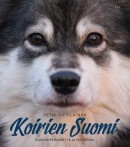
koiriensuomiKoirien Suomi. Kansanperinnettä ja historiaa
[Dogs in Finland. Folk tradition and history]
Helsinki: Finnish Literature Society, 2014. 239 pp., ill.
ISBN 978-952-222-540-5
€32, hardback

Non-fiction writer Petri Pietilä is the author of the award-winning book Koirien maailmanhistoria (‘Dogs in world history’), which deals with the general cultural history of the dog. In the first half of this lively and fascinating new book he discusses the dog in Finnish folk tradition, while in the second half he gives an account of the history of the dog in Finland to the present day. Dogs have been domesticated in the North European region for thousands of years. In folk poetry, such as the national epic, the Kalevala, the dog is first and foremost a house guard and a partner in hunting. In Finnish folk tradition, the dog is viewed more leniently than in other countries, and stories about hellhounds are rare. Yet the attitude towards dogs in Finnish proverbs is not an exclusively positive one. Pietilä also says that the dog’s change of status has been linked to its becoming a helper and beloved pet, and today there are more than half a million of them in Finland. In addition, they are increasingly being used in various work and service roles. The book also presents the six Finnish dog breeds, and includes a dog name day calendar.

Translated by David McDuff

Decade of youth: the 1950s revisited

30 January 2014 | Reviews
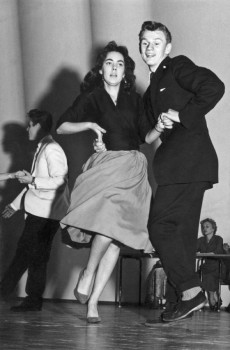
Rock around the clock! Photo from Rasvaletti, by unknown, 1958

Rock around the clock in Helsinki, too! All photos here from Rasvaletti; photographer unknown, 1958

Rasvaletti. Valokuvia 1950-luvun Helsingistä /
Fotografier från 1950-talets Helsingfors
[Hair-grease. Photographs from 1950s Helsinki]
Työryhmä [working group]: Yki Hytönen, Tuomas Myrén, Riitta Pakarinen, Aki Pohjankyrö, Hilkka Vallisaari
Helsinki: Helsingin kaupunginmuseo, Helsinki City Museum,
2013. 211 pp., ill.
ISBN 978-952-272-499-1
€45, hardback
Onnen aika? Valoja ja varjoja 1950-luvulla
[Time of happiness? Light and shadow in the 1950s]
Toimittaneet [Ed. by]: Kirsi-Maria Hytönen & Keijo Rantanen
Jyväskylä: Atena, 2013. 249 pp., ill.
ISBN 978-951-796-924-6
38€, hardback

The 1950s rocked! They literally did – that is when the world got rhythm: Blue Suede Shoes by Elvis and the film Blackboard Jungle, with Bill Haley’s hit Rock Around the Clock, for example.

The development of new sound reproduction – long-playing records and tape recorders – was essential to the spreading of the gospel of rock and pop here, there and everywhere.

In Finland, the shocking new music was a smash hit among a group of young urban men called lättähatut, flathats, who also wore tight trousers, black overcoats and pointed shoes. Their girls dressed in angora sweaters and tight trousers or skirts. These teenagers, who hung around together very late in the evenings, were largely considered not only a nuisance but also a possible danger to the peaceful development of society (not only in Finland…). More…

Gorgonoids

31 March 1993 | Archives online, Fiction, Prose

From Matemaattisia olioita tai jaettuja unia (‘Mathematical creatures, or shared dreams’, WSOY, 1992). Introduction by Soila Lehtonen

The egg of the gorgonoid is, of course, not smooth. Unlike a hen’s egg, its surface texture is noticeably uneven. Under its reddish, leather skin bulge what look like thick cords, distantly reminiscent of fingers. Flexible, multiply jointed fingers, entwined – or, rather, squeezed into a fist.

But what can those ‘fingers’ be?

None other than embryo of the gorgonoid itself.

For the gorgonoid is made up of two ‘cables’. One forms itself into a ring; the other wraps round it in a spiral, as if combining with itself. Young gorgonoids that have just broken out of their shells are pale and striped with red. Their colouring is like the peppermint candies you can buy at any city kiosk. More…

A life at the front

30 September 2001 | Archives online, Fiction, Prose

Extracts from the novel Marsipansoldaten (‘The marzipan soldier’, Söderström & Co., 2001). Introduction by Maria Antas

[Autumn 1939]

Göran goes off to the war as a volunteer and gives the Russians one on the jaw. Well, then. First there is training, of course.

Riihimäki town. Recruit Göran Kummel billeted with 145 others in Southern elementary school. 29 men in his dormitory. A good tiled stove, tolerably warm. Tea with bread and butter for breakfast, substantial lunch with potatoes and pork gravy or porridge and milk, soup with crispbread for dinner. After three days Göran still has more or less all his things in his possession. And it is nice to be able to strut up and down in the Civil Guard tunic and warm cloak and military boots while many others are still trudging about in the things they marched in wearing. The truly privileged ones are probably attired in military fur-lined overcoats and fur caps from home, but the majority go about in civilian shirts and jackets and trousers, the most unfortunate in the same blue fine-cut suits in which they arrived, trusting that they would soon be changing into uniform. More…

Poems

30 September 1979 | Archives online, Fiction, poetry

Introduction by Thomas Warburton

1

What about going up into the birch tree together
so high till it bends with our weight
and we’re thrown, two seeds on one dandelion chute
down into the lake and its quaking looking glass
There we wash around together without
a stitch on our feelings
We let ourselves sink down to the lakefloor and set up
house there for a time
Among the fakirs the watercolourists and the alcoholics
we can hear the water sprite fluting, all out of tune
like a gipsy band gone down with the ship. More…

Shards from the empire

5 February 2010 | Fiction, Prose

‘Imperiets skärvor’, ‘Shards from the empire’, is from the collection of short stories, Lindanserskan (‘The tightrope-walker’, Söderströms, 2009; Finnish translation Nuorallatanssija, Gummerus, 2009)

Gustav’s greatest passion is for genealogy. He dedicates his free time to sketching coats of arms; masses of colourful, noble crests.

Gustav asked me to do a translation. I sat for ten days trying to decipher a couple of pages from a Russian archive dating from the 1830s. Sentences like, With this letter, we hereby give notice of our gracious decision.‘

The intricate handwriting belonged to some collegiate registrar or other. Perhaps Gogol’s Khlestakov. More…

Decisions, decisions: the fate of virtual literature

28 November 2013 | Articles, Non-fiction
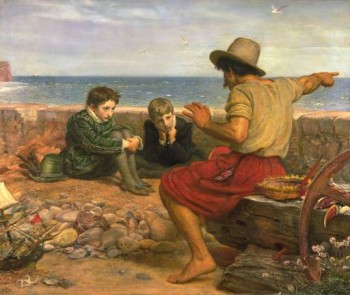
Storytelling: ‘Boyhood of Raleigh’ by J.E. Millais (1871). Wikipedia

Once upon a time: ‘Boyhood of Raleigh’ by J.E. Millais (1871). Wikipedia

In an era of ‘liveblogging’‚ we are all storytellers. But what’s the story, asks Teemu Manninen

One score of years ago, when the internet was new, the cultural critics of the time were fond saying that it would usher in a new utopia of free distribution of information: we would be able to read everything, know everything and share everything anywhere and every day.

Truly, they told us, we would become enriched by the internet to the point of not knowing what to do with all that wealth of knowledge, the amount of connections between us and the ever-increasing online availability of anyone with everyone, every waking hour.

Now that we really do have this always-on connectivity, you will indeed be available every waking hour: you will update your status, check your inbox, post pics and be available for chatting, texting, a quick email and a message or two, just to make sure no one is offended by your unreachability, since – from experience – a week’s worth of not tweeting or facebooking can make someone think that something serious has happened, or that you don’t even exist anymore. More…

Midsummer madness

31 December 2005 | Archives online, Fiction, Prose

An extract from the novel Voimattomuus (‘Powerlessness’, WSOY, 2005). Introduction by Maila-Katriina Tuominen

Cast:
a man
a woman
a boy

Midsummer Eve. A cabin.Outside it’s raining a little, but the blanket of clouds is already breaking up.
It’s bright in the cabin, like daylight. The table is set.
A bunch of wild violets, torn from its means of support, droops in the middle of the table, surrounded by stemmed glasses and paper napkins folded into the shape of swans. The champagne, aquavit and white wine are still chilling.
A man and a woman walk into the cabin wearing bathrobes. She has a terrycloth towel wound around her head like a turban. They’re coming from the sauna. He looks at the table with surprise. The table is set for three.
She notices the man’s gaze and hurries into the bedroom to get dressed.
He takes a beer out of the refrigerator and sits down at the table in his bathrobe.
A long silence. More…