

Search results for "harjunpää/2010/10/mikko-rimminen-nenapaiva-nose-day"
Chill climates
30 June 1984 | Archives online, Authors, Interviews
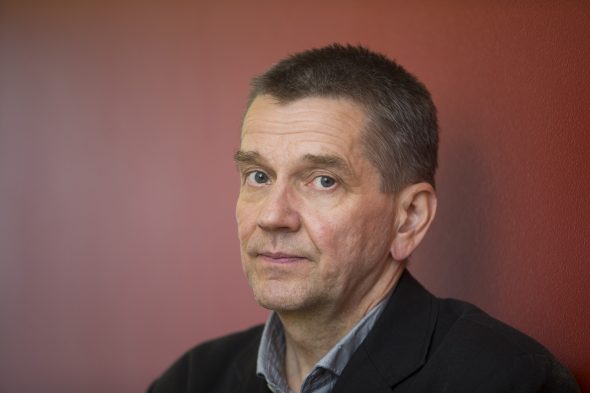
Olli Jalonen. Photo: Pekka Nieminen.
Olli Jalonen was born in 1954 and lives in Hämeenlinna. His first work, a collection of short stories entitled Unien tausta (‘The background of dreams’, 1978) and two later novels, Sulkaturkki (‘Feather coat’, 1979) and Ilo ja häpeä (‘Joy and shame’, 1981) were reviewed with exceptional warmth by the critics. His latest novel, Hotelli eläville (‘Hotel for the living’, 1983) brought him a State Prize for Literature in 1984. The awarding committee commented that the novel is ‘a representative of that rare genre in Finnish literature, the grotesque novel’. Jalonen also received the ‘Spurs of Criticism’, the annual prize awarded by the Finnish Critics’ Association. The hotel for the living is the book’s ironic name for a nuclear shelter that is being quarried into the living rock of Finland; Jalonen sets up a situation that allows him to examine the crevices of his characters’ personalities. He studies their attitudes to life with cool satire – they live in the bleak climate of buying and selling, the struggle for power and material goods, the domination of others, and submission to their fates. Interview by Markku Huotari
‘Poetry in a world under threat’ was the headline for a survey of Finnish poetry by poet and critic Väinö Kirstina that appeared in the Tampere daily newspaper Aamulehti in 1981.
Two years later that headline is just as bitingly relevant. Only one alteration is necessary: to poetry must be added prose, for prose, too, is addressing itself to that future, difficult enough to imagine, in which the threat of nuclear war may involve Finland, living in the shadow of the super powers, in a conflict in which she wishes no part.
One of the scenes in Olli Jalonen’s novel Hotelli eläville (‘Hotel for the living’) is set in a nuclear shelter that is being built inside the living rock on which Helsinki stands. Even now the planners of that ‘shelter’ use the fear of other people to their own ends, and divide them into those who will be saved and those who will perish.
A sermon on the day of judgement? Cliche? Milking of a fashionable subject? More…
The Earth is a snowball
31 March 1995 | Archives online, Prose
A short story from Resa runt solen (‘Journey round the sun’, Schildts, 1994). Introduction by Ann-Christine Snickars
It is a day in August and even though I can sense that the end of the summer is nearer than the beginning, my hours are still as long as days. I am a child and live in the midst of summer’s eternity.
This morning I wake up earlier than anyone else. It isn’t usually that way. Usually Mårten is the first of us two to get up, but now he is asleep with his face turned to the wall. I stay in bed for a while, listening. It is also quiet in the other room, where Mama is asleep. Now I remember that it’s today Papa is coming out to see us after working in the town all week.
I open the curtain a little and see that the sky is blue and not grey with heavy rainclouds as it has been these past few days. I quickly put on my few clothes, a thin striped cotton sweater, my shorts and my brown plimsolls. I push the door open, stand on the steps and breathe a morning air that still smells more of summer than of autumn. I listen to the familiar sounds: twittering birds, the wind in the treetops and crying gulls over the bay. More…
L’Amour à la Moulin Rouge
Extracts from the novella Yksin (‘Alone’, 1890). Introduction by Jyrki Nummi
After dining at the Duval on the Left Bank I take the same route back and drop in at the Café Régence to flick through the Finnish papers they have there.
I find my familiar café almost empty. The waiters are hanging about idly, and the billiard tables are quiet under their covers. The habitués are of course at home with their families. Anyone who has a friend or acquaintance is sharing their company this Christmas Eve. Only a few elderly gentlemen are seated there, reading papers and smoking pipes. Perhaps they’re foreigners, perhaps people for whom the café is their only home, as for me.
A little way off at the other end of the same table is a somewhat younger man. He was there when I came in. He’s finished his coffee and appears to be waiting. He’s restless and keeps consulting his watch. An agreed time has obviously passed. He calms himself and lights a cigarette. A moment later I can see a woman through the glass door. She’s hurrying across the street in front of a moving bus and running straight here. Now the man notices her too, and he cheers up and signals to the waiter for the bill. The woman slips through the door and goes straight across to him. They altercate for a moment, come to an understanding and depart hand in hand. More…
Too much or too little love
31 March 1987 | Archives online, Authors, Reviews
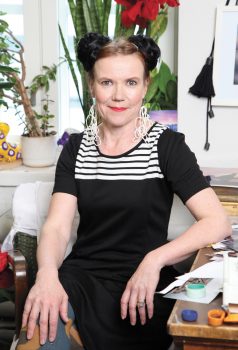
Rosa Liksom. Photo: Pekka Mustonen.
On the October day last year on which Rosa Liksom‘s second collection of short stories, Unohdettu vartti (‘The forgotten quarter’), was published, she also opened an art exhibition of her own work. The occasion took the form of a kind of cross between performance art and a practical joke. Young women dressed in Finnish military uniforms carried out body searches on every newcomer, changed the guard and drilled, while crackers exploded in the gallery. Many people were of the opinion that it was all no more than a silly joke. Even the art critics were not enthusiastic: they felt that Rosa Liksom’s felt pen work was derivative of a certain Danish artist who himself had copied the cartoon-like stick-men of the so-called Chicago school. But all the same, there emerged from the pictures a funny story about the artist’s adventures among the underground youth of Russia from Leningrad to Vladivostock.
Only her closest friends knew which of the soldiers in the gallery was Rosa Liksom, which her clones. Rosa Liksom is a pseudonym, and her little game of hide and seek has already lasted a couple of years. We know of her that she was born in Lapland, studied anthropology, has travelled in both East and West and lived for a long time in Copenhagen. Her writing was published for the first time in an anthology of the work of young authors, Kalenteri 84 (‘Calendar 84’, 1984). Her first work, the short story collection Yhden yön pysäkki (‘One-night stand’) was published in 1985 and achieved considerable success. More…
Animal magic
3 June 2014 | Extracts, Non-fiction
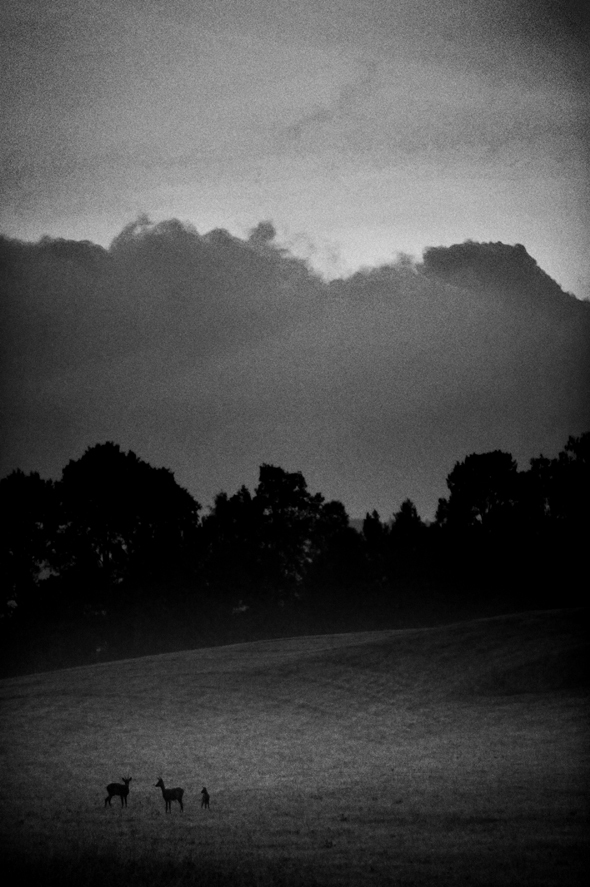
Roe deer, Sweden. Photo: Mats Andersson
A day in the life of an elk, of a lynx? Nature photographers venture into the depths of forests, in pursuit of the inhabitants – predator and prey, mythical and real. Photographs from Kohtaamisia (‘Encounters’), by Mats Andersson and Heikki Willamo, text by Willamo (Maahenki & Musta Taide [Black Art], 2014)
The feelings in our dreams. They well from depths – from those layers of awareness that the mind does not shackle. In sleep we handle and organise the events of our lives in a way which is impossible when awake, when we are conscious of ourselves and our limitations. That is why animals can come into my dreams as friends, equal partners, like me, and therefore I so often dream of having their abilities and skills.
When awake we think all the time. We think about past events and worry about the future or dream of something better. Very seldom do we live in the moment. Photographs are passing moments, often only a thousandth of a second long, but sometimes lasting minutes or even hours. In finished photographs the beholder can see much more – he adds his memories or dreams of the future. The picture-taking moment vanishes, something else comes in its stead. More…
When sleeping dogs wake
31 December 1994 | Archives online, Fiction, Prose
Extracts rom the novel Tuomari Müller, hieno mies (‘Judge Müller, a fine man’, WSOY, 1994). Introduction by Soila Lehtonen
In due course the door to the flat was opened, and a stoutish, quiet-looking woman admitted the three men, showed them where to hang their coats, indicated an open door straight ahead of them, and herself disappeared through another door.
After briefly elbowing each other in front of the mirror, the visitors took a deep breath and entered the room. The gardener was the last to go in. The home help, or whatever she was, brought in a pot of coffee and placed it on a tray, on which cups had already been set out, within reach of her mistress. The widow herself remained seated. They shook hands with her in tum. The mayor was greeted with a smile, but the bank manager and the gardener were not expected, and their presence came as a shock. She pulled herself together and invited the gentlemen to seat themselves, side by side, facing her across the table. They heard the front door slam shut: presumably the home help had gone out. More…
Keeping up with the Joneskis
17 April 2009 | Extracts, Non-fiction
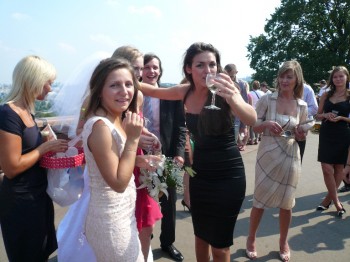
Toasting the bride: cheerful wedding parties drive up to the Sparrow Hills in Moscow in summer
Moscow-based journalist Anna-Lena Laurén finds the new Russia a promised land of materialism – a place where appearances are everything, and how you pay for maintaining them is a matter of strictly secondary interest
‘I want to go to the nightclub by boat! Come on, let’s hire one,’ Ilya says, heading towards the shore where a boat for at least twenty people is moored. There are six of us.
After two minutes of negotiation, he takes up his position alongside the gangway. He welcomes us onboard with a chivalrous gesture. We step onto the boat and are gently taken off down the Moyka canal in the white night of St Petersburg in June. The sky is pale pink and dark blue-lilac, the air damp and cold, but the captain hands out rugs to keep us warm. The ornamented bridges and pastel-coloured façades of St Petersburg glide past in a faint glow, it’s just light enough to make out the colours, powdery pink, vanilla yellow, pale blue. More…
Coolness and warmth
21 April 2011 | Reviews
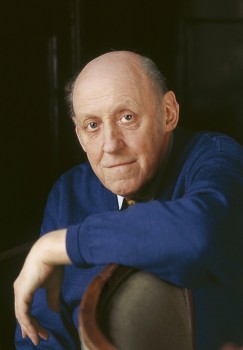
Bo Carpelan. Photo: Irmeli Jung
The coolness on the mountain
streams of water, black forests
in the west a growing light
foreboding sleep
These lines are from Gramina, the twenty-second and last collection of verse by the Finland-Swedish poet Bo Carpelan, which appeared last summer.
The short poem captures much of what was typical of Carpelan’s poetic style: a visually sharp and objective image which juxtaposes the world we see with a sense of something different, undefined. Time the unstoppable, which changes everything, was his central theme, and it also figures here.
Carpelan (1926–2011) made his debut in 1946 and was hailed early on as a renewer of the modernist tradition that in Finland began in the early 20th century with Edith Södergran (1892–1923) and Elmer Diktonius (1896–1961). He combined the Finnish-Swedish heritage of reflective nature poetry with imagistic stimuli from Swedish- and English-language modernism. More…
So many words
25 April 2012 | Articles, Non-fiction
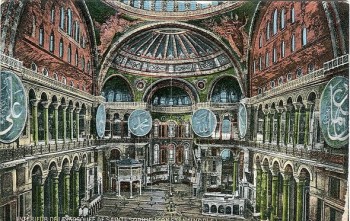
Hagia Sofia, Istanbul: from basilica to cathedral to mosque to museum. Postcard, c. 1914. Photo: Wikipedia/Xenophon
Sacred spaces, repositories of free speech, places of healing? Teemu Manninen awaits the day when libraries become virtual, enabling anybody to visit them, without having to travel across land and sea
The Bodleian Library in Oxford, the Vatican Library, the Bibliotheque Nationale in Paris, New York Public Library, the British Museum Reading Room, the Real Gabinete Portugues De Leitura in Rio De Janeiro, the Library of Congress and the National Library of Finland.
What do all of these have in common, except the obvious fact that they are all famous libraries? To put it another way: why are these famous libraries so famous?
It is not because they have books in them, although that has become one of the main tasks of the library system in the modern world. But a library is not simply an archive. If we in the West are a culture of the book – a culture of the freedom of information and expression – then a library is the architectural incarnation of our way of life: a church built for reading. More…
I am a happy person
30 March 1997 | Archives online, Fiction, poetry
Poems from En lycklig mänska (‘A happy person’, Söderströms, 1996). Introduction by Rika Lesser
Why shouldn't Johann Sebastian Bach be good enough
      even in this my 59th summer.
I contemplate the apple tree in the middle of the field.
The continuo branches out just above the earth into four
      trunks, which, in turn, divide
into arms more slender, where the fruits ripen.
The foliage patterns the sky, hands plait the voices
      into a basket.
Under the earth, where the roots rehearse, I wait for
      the succulent, faintly sour fruit.

*  More...
Nothing but air
31 December 1994 | Archives online, Fiction, poetry
Poems from Ankkuripaikka (‘Anchorage’; WSOY, 1994) and Sormenjälkiä tyhjässä (‘Fingerprints in the void’, WSOY, 1992)
Images from nature
A sick fox recoils to the deepest corner of his hideout.
His coat’s moulting in tufts, rain’s drenching him, death’s on the way.
A pine stands sentry on the pile of stones, its bright green needles
adorned with dew for this last day. Somehow it’s a celebration.
A crow drops in, and sings a note. ‘Goodbye,’ the forest sighs, and
so does the whole world. A soul’s ecloding from its cellular pupa.
It yelps as it exits: ‘Why? Why are there still stars? Why must I fall so deep?’ More…
Letters from Klara
31 March 1992 | Archives online, Fiction, Prose
A short story from Brev från Klara (‘Letters from Klara’, Söderström & Co, 1991)
Dear Matilda,
you are hurt because I forgot your ancient birthday: that is unreasonable of you. To put it bluntly, you have expected my particular devotion all these years merely because I am three years younger. But let me now at last tell you that the passage of the years An Sich is no feather in one’s hat.
You pray for Higher Guidance – excellent. But until you receive it, it might perhaps be as well to discuss certain bad habits which are, as a matter of fact, not foreign to me, either. More…