

Search results for "harjunpää/2010/10/mikko-rimminen-nenapaiva-nose-day"
Not so weird?
12 December 2013 | Non-fiction, Reviews
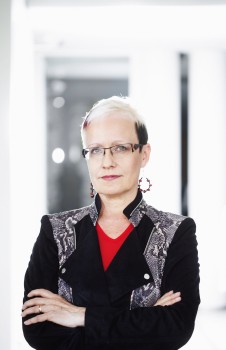
Johanna Sinisalo. Photo: Katja Lösönen
Johanna Sinisalo’s new novel Auringon ydin (‘The core of the sun‘, Teos, 2013), invites readers to take part in a thought experiment: What if a few minor details in the course of history had set things on a different track?
If Finnish society were built on the same principle of sisu, or inner grit, as it is now but with an emphasis on slightly different aspects, Finland in 2017 might be a ‘eusistocracy’. This term comes from the ancient Greek and Latin roots eu (meaning ‘good’) and sistere (‘stop, stand’), and it means an extreme welfare state.
In the alternative Finland portrayed in Auringon ydin, individual freedoms have been drastically restricted in the name of the public good. Restrictions have been placed on dangerous foreign influences: no internet, no mobile phones. All mood-enhancing substances such as alcohol and nicotine have been eradicated. Only one such substance remains in the authorities’ sights: chilli, which continues to make it over the border on occasion. More…
Bring on the white light
12 December 2013 | Fiction, Prose
Extracts from the novel Auringon ydin (‘The core of the sun’, Teos, 2013). Introduction by Outi Järvinen
Jare, March 2017
‘We call the chilli the Inner Fire that we try to tame, just as our forefathers tamed the Worldly Fire before it.’
Mirko pauses dramatically, and Valtteri interrupts. ‘Eusistocratic Finland offers us unique opportunities for experimentation and development. Once all those intoxicants affecting our neurochemistry and the nervous system have been eradicated from society, we will be able to conduct our experiments from a perfectly clean slate.’
‘We fully understand the need to ban alcohol and tobacco. These substances have had significant negative societal impact. And though in hedonistic societies it is claimed that drinks such as red wine can, in small amounts, promote better health, there is always the risk of slipping towards excessive use. All substances that cause states of restlessness and a loss of control over the body have been understandably outlawed, because they can cause harm not only to abusers themselves but also to innocent bystanders,’ Mirko continues.
This is nothing new to me, but I must admit that the criminalisation of chillies has always been a mystery to me. By all accounts it is extremely healthy and contains all necessary vitamins and antioxidants. A dealer that I met once told me that people in foreign countries think eating chillies can lower blood pressure and cholesterol levels – and even prevent cancer. If someone makes a pot of tom yam soup, sweats and pants over it and enjoys the rush it gives him, how is that a threat, either to society or to our health? More…
Riina Katajavuori & Salla Savolainen: Pentti ja kitara [Pentti and the guitar]
9 January 2014 | Mini reviews, Reviews
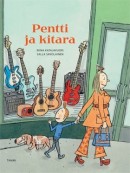 Pentti ja kitara
[Pentti and the guitar]
Kuvitus [Ill. by]: Salla Savolainen
Helsinki: Tammi, 2013. 32 pp., ill.
ISBN 978-951-31-6646-5
€22.90, hardback
Even early-years education is packed with activities these days. Pentti has a large extended family who really know how to have fun. He wants to learn how to play the guitar as well as his uncle Jaska. His mum tries to suggest an instrument she thinks would be more appropriate, but Pentti will not be put off. The Pentti picture book series is attractive for its nostalgic style; you can never be quite sure whether the era depicted is in the past or the present day. In this story, Riina Katajavuori focuses on what’s essential, yet still manages to convey the basics of playing the guitar – including dissonance and Jimi Hendrix. Salla Savolainen’s illustrations effectively capture the excitement of a child’s new hobby.
Translated by Ruth Urbom
Self-made man
1 April 2009 | Extracts, Non-fiction
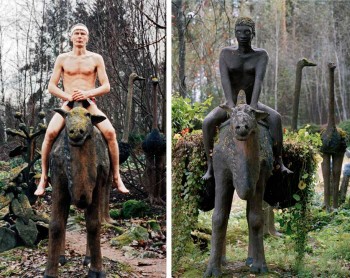
On camelback: in the exotic part of Veijo Rönkkönen’s concrete cosmos there are animals and palm trees, side by side with the living plants of the northerly latitudes. - Photo, left: Veijo Rönkkönen; right: Veli Granö.
Extracts and photographs from Veijo Rönkkösen todellinen elämä / The real life of Veijo Rönkkönen (Maahenki, 2007. Translation: Kirsti Nurmela-Knox)
Veijo Rönkkönen (born 1944) has lived all his life on an isolated, small farm in eastern Finland, Parikkala, less than a kilometre from the Russian border, where he has quietly built a garden inhabited by nearly five hundred human figures made of concrete. Entrance is free.
The way to anywhere
30 September 2003 | Archives online, Fiction, poetry
Poems from Parittelun jälkeinen selkeys (‘Post-coital clarity’, WSOY, 2003). Introduction by Matti Saurama
Enlightenment needs no tools
1.   And I laughed at everything
           and didn’t want to see anything old
there was a fingernail-sized buddha and I walked by it
in the room, trying to find the ceiling,
                           camping out in life, fag in mouth
the soft letters of the clouds, and a blowing skysign
         oh sky
2.    I stand on the street corner
       illuminated like a phone box.
       On the way to anywhere
       and always there already.  More...
What have brains got to do with it?
17 October 2013 | Columns, Tales of a journalist
Illustration: Joonas Väänänen
Pondering his changing profession once again, columnist and media critic Jyrki Lehtola feels compelled to present a brief history of the media
Not long ago a certain media company invited me to participate in a panel on brainprints.
I didn’t know what they were talking about, so I agreed. At most I thought it was about the engram left in our collective psyche that yes, we used to have this sort of print media thing that told us what the world was like.
And then we didn’t – look at this picture of print media on my iPad, kids, isn’t it cute?
That wasn’t what it was about at all. Brainprint means all the ways the media can influence us as consumers. In other words, this is one more conversation the media has with itself to convince itself that it has a role to play.
There we sat around a long table once again talking about whether the media is a mirror or a window when maybe we should have been talking about the pile of glass on the ground and whether someone shouldn’t clean it up before someone hurts themselves. More…
The Storm • September
30 September 1982 | Archives online, Fiction, Prose
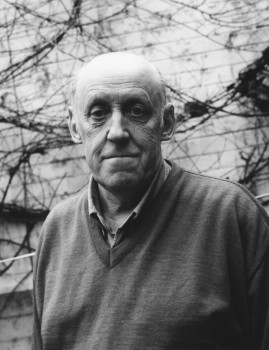
Bo Carpelan. Photo: Charlotta Boucht
Extracts from Jag minns att jag drömde (‘I remember dreaming’, 1979)
The Storm
I remember dreaming about the great storm which one October evening over forty years ago shook our old schoolhouse by the park. My dream is filled with racing clouds and plaintive cries, of roaring echoes and strange meetings, a witch’s brew still bubbling and hissing in the memory of those great yellow clouds.
Our maths teacher – a small sinewy woman who seemed to have swallowed a question mark and was always wondering where the dot had gone, so she directed us in a low voice and with downcast eyes as if we didn’t exist – and yet her little black eyes saw everything that happened in the class, and weasel-like, were there if anyone disobeyed her – was writing the seven times table on the blackboard, when a peculiar light filled our classroom. We looked across at the window; the whole schoolhouse seemed to have been suddenly transformed into a railway station, shaking and trembling, a whistling sound penetrating the cold thick stone walls, and at raging speed, streaky clouds of smoke were sliding past the window, hurtling our classroom forward as if we were in an aeroplane. Our teacher stopped writing and raised her narrow dark head. Without a word, she went over to the window and stood looking out at the racing clouds. More…
Living inside language
23 February 2010 | Essays, Non-fiction
Jyrki Kiiskinen sets out on a journey through seven collections of poetry that appeared in 2009. Exploring history, verbal imagery and the limits of language, these poems speak – ironically or in earnest – about landscapes, love and metamorphoses
The landscape of words is in constant motion, like a runner speeding through a sweep of countryside or an eye scaling the hills of Andalucia.
The proportions of the panorama start to shift so that sharp-edged leaves suddenly form small lakeside scenes; a harbour dissolves into a sheet of white paper or another era entirely. Holes and different layers of events begin to appear in the poems. Within each image, another image is already taking shape; sensory experiences develop into concepts, and the text progresses in a series of metamorphoses. More…
Secret lives
30 September 2002 | Fiction, Prose
From Piiloutujan maa (‘The land of the hider’, Otava, 2002)
When we look for a good apartment, a good café, a good place to be, we are looking for a childhood hideaway. We are looking for the wardrobe we used to retreat into when we had been hurt. We will always remember what being there feels like. We yearn for that same illumination, felt by the baby Jesus in Mary’s womb, as the world’s light shone in through the hymen. More…
The return of Orpheus
31 December 1992 | Archives online, Fiction, poetry
from Hid (‘Coming here’, Söderströms, 1992). A Valley in the Midst of Violence, a selection of poems by Gösta Ågren translated by David McDuff, was published by Bloodaxe Books of Newcastle-upon-Tyne in 1992. Introduction by David McDuff
No poet can endure
being dead, a sojourn without
meaning and method. He needs
order and rhythm. His poems
are really laws. He
always turns back
from the underworld, which resembles
the everyday.
The darkness hides the screams
around him, when
the way begins. The sun is
only black heraldry, only
a cavern in the sky
of stone, and he sees
it, without being blinded. More…
Truth or hype: good books or bad reviews?
8 November 2013 | Letter from the Editors
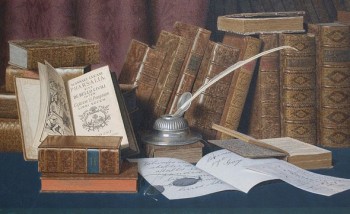
‘The Bibliophile’s Desk’: L. Block (1848–1901). Wikipedia
More and more new Finnish fiction is seeing the light of day. Does quantity equal quality?
Fewer and fewer critical evaluations of those fiction books are published in the traditional print media. Is criticism needed any more?
At the Helsinki Book Fair in late October the latest issue of the weekly magazine Suomen Kuvalehti was removed from the stand of its publisher, Otavamedia, by the chief executive officer of Otava Publishing Company Ltd. Both belong to the same Otava Group.
The cover featured a drawing of a book in the form of a toilet roll, referring to an article entitled ‘The ailing novel’, by Riitta Kylänpää, in which new Finnish fiction and literary life were discussed, with a critical tone at places. CEO Pasi Vainio said he made the decision out of respect for the work of Finnish authors.
His action was consequently assessed by the author Elina Hirvonen who, in her column in the Helsingin Sanomat newspaper, criticised the decision. ‘The attempt to conceal the article was incomprehensible. Authors are not children. The Finnish novel is not doing so badly that it collapses if somebody criticises it. Even a rambling reflection is better for literature than the same old articles about the same old writers’ personal lives.’ More…
Hiding the soul
30 September 2002 | Authors

Photo Irmeli Jung
The world makes people anxious, is the thesis of the writer Petri Tamminen in his new book, Piiloutujan maa (‘The land of the hider’). Well, if this is true, what do you do then? Rage and fight – or go into hiding?
The people in Tamminen’s world choose a hiding place. Fortunately, the world is full of them, and they are not only places, but also states of mind and modes of behaviour.
The writer and freelance reporter Petri Tamminen (born 1966) made his debut with a volume of short prose entitled Elämiä (‘Lives’, see Books from Finland 3/1994), in which people’s life stories are presented in about 200 words; entire decadesflash by in a sentence, or lives are summed up in a single event, often an apparently insignificant one. The comic and the tragic lie side by side, and are often not reached by language, but what the author does not choose to say. Next came the short story book Miehen ikävä (‘Male blues’, 1997) and the novel Väärä asenne (‘The wrong attitude’, 2000), which described the nightmares of a new father, plagued with a horror of bacteria. More…
Renaissance man
30 September 1990 | Archives online, Fiction, Prose
An extract from the novel Bruno (WSOY, 1990)
Since her first collection of poems, which appeared in 1975, Tiina Kaila (born 1951 [from 2004, Tiina Krohn]) has published four children’s books and three volumes of poetry. Her novel Bruno is a fictive narrative about the Italian philosopher Giordano Bruno, who was burned at the stake in 1600. It is the conflict inherent in her main character that interests Kaila: his philosophical and scientific thought is much closer to that of the present day than, for example, that of Copernicus, and it is this that led him to the stake; and yet he did never abandon his fascination for magic.
The novel follows Bruno on his journeys in Italy; France, Germany and England, where he is accompanied by the French ambassador, Michel de Castelnau. Bruno finds England a barbaric place: ‘…These people believe that it is enough that they know how to speak English, even though no one outside this little island understands a word. No civilised language is spoken here’
In the extract that follows, Bruno, approaching the chalk cliffs of Dover by sea, makes what he feels to be a great discovery: ‘Creation is as infinite as God. And life is the supremest, the vastest and the most inconceivable of all.’

I was leaning on the foredeck handrail, peering into a greenish mist. The bow was thrashing between great swells, blustering and hissing and shuddering like some huge wheezing animal: Augh – aagh – ho-haugh! Augh – aagh – ho-haugh!
Plenty of space had been reserved for our use on this new two-master cargo boat. Castelnau was transferring his whole family from France – his wife, his daughter, his servants, his library, his furniture, his past and me – to London, where, as you know, he had been appointed Ambassador of France. More…
Among the ice floes
30 September 1985 | Archives online, Fiction, Prose
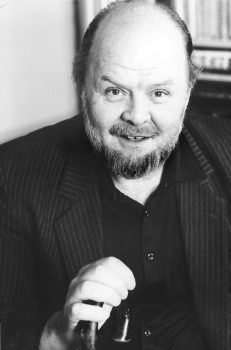
Alpo Ruuth. Photo: Sakari Majantie / Tammi
Alpo Ruuth came across the diary of a member of the Finnish crew of ten men in the Whitbread Round-the-World sailboat race of 1981-1982, and Ruuth, a sailor himself, used that diary as the basis for his novel, 158 vuorokautta (‘158 days’, 1983). It is the story of a great adventure which takes place with the help of ultra-modern equipment and yet involves confrontation with elemental nature, the dangerous power of the southern seas. Ruuth does not use the actual names of the crew, but has taken the view of the fictional crew member who is able to offer ironic comments on what he observes. The book portrays the relationships among the crew under the cramped and difficult conditions of the long voyage. As the extract begins the yacht is in the Southern Ocean, close to the Antarctic coast, making its way towards Auckland, New Zealand.
An extract from 158 vuorokautta (‘158 days’)
Around noon we run into a blizzard. On deck they shout down that a wind has got up. Below, we wake hurriedly from our afternoon naps and start pulling on clothes against the tough weather outside. It’s quite a business in our cramped quarters, and every now and then someone loses his footing and falls as the boat pitches. Cursing is the only medicine for bruises. One by one the boys go up to help change sails; at the bottom of the steps there are excesses of politeness: after you, sir; no no, after you. Up they go, all the same. More…