

Search results for "harjunpää/2010/10/mikko-rimminen-nenapaiva-nose-day"
Monikulttuurisen maamme kirja. Suomen kielen ja kulttuurin lukukirja [The book of our multicultural land. A reader of Finnish language and culture]
23 October 2014 | Mini reviews, Reviews
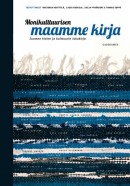 Monikulttuurisen maamme kirja. Suomen kielen ja kulttuurin lukukirja
[The book of our multicultural land. A reader of Finnish language and culture]
Toim. [Ed. By] Marjukka Kenttälä, Lasse Koskela, Saija Pyhäniemi, Tuomas Seppä
Helsinki: Gaudeamus, 2013. 252 pp.
ISBN 978-952-495-253-8
€ 34, hardback
This book opens a fascinating, often entertaining and eminently readable perspective on Finnishness and Finnish culture. It contains short Finnish texts supplied with introductions, from the Kalevala and the writings of Finland’s national author Aleksis Kivi to the present day. There are also Finnish translations of the work of Finnish-Swedish authors. The older texts are drawn from the literary ‘canon’, in works by J.L. Runeberg, Z. Topelius, Juhani Aho, Maria Jotuni, Eino Leino, F.E. Sillanpää, Väinö Linna and Tove Jansson. Among the excerpts that date from more recent times there are even pop and rock lyrics. The writing often throws light on some aspect of Finnishness, sometimes with a critical or ironic note. There is also writing by immigrants. Interspersed with the literary examples are short essays giving the views of experts on subjects like Finnish history, language or sport. Some of the texts conclude with a glossary of unfamiliar words and terms. The explanations are arranged in order of their appearance in the text: for the casual reader seeking the meaning of a word, alphabetical order would have been more practical, though even then some phrases might have remained unnoticed.
Translated by David McDuff
Poems
31 December 1977 | Archives online, Fiction, poetry
Poems from Tanssilattia vuorella (’The dancing-floor on the mountain’). Introduction by Pekka Tarkka
I
Having studied
Krinagoras
the flower of Philippos’ wreath
under the vaults in a cool library far away in silence
I have gone to see the boat how it is coming on
whether it will be in working order next summer
we have no strong men
have sat on the beach-hut steps thinking of him
the politician the negotiator:
poetry is a holding of council, an art of negotiation More…
Vesa Puuronen: Rasistinen Suomi [Racist Finland]
6 July 2011 | Mini reviews, Reviews
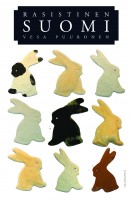 Rasistinen Suomi
[Racist Finland]
Helsinki: Gaudeamus, 2011. 286 p., ill.
ISBN 978-952-495-196-8
€ 36, paperback
Multiculturalism, immigration and racism have become more frequent subjects of discussion in Finland, particularly as a result of the 2008 local elections and the subsequent speeches and writings by people critical of immigration. This book aims to move the discussion forward by describing and defining racism, presenting developments in research into racism, racism perpetrated by Finns against Sámi and Russians, and the history of Finnish enmity towards Russians from the early 20th century to the present day. The author considers the use of shaming and subjugation as tools of exterminating Sámi culture, as well as linguistic discrimination and denial of land ownership rights against the Sámi. The book also examines the development of hate crimes since the 1990s, racism in Finnish politics and the politics of multiculturalism as practised in Finland, which studies have shown treat different minority groups in different ways. Vesa Puuronen is a sociologist and a researcher into racism who works at the University of Eastern Finland.
Translated by Ruth Urbom
Genuine beauty
14 February 2013 | Fiction, Prose
Erään ihailijan päiväkirjasta (‘From the diary of an admirer’), a story published in the collection of short prose Taskunovellit (‘Pocket stories’, edited by Vilja-Tuulia Huotarinen; Karisto, 2013)
10.6.
Dear Diary, I have met a wonderful man. He is tender, handsome and clever. It is a real piece of luck that fate didn’t throw us together until now: I’m embarrassed at the very thought that he might have seen me a couple of years ago, as an immature and childish sixth-former. His name is Petri Tamminen and he’s a writer. Writers are gorgeous. Not all of them, of course, some of them think too much of themselves and appear e.g. on television, but Petri is gorgeous.
15.6.
Dear Diary, he has shown me the road to a new world: we went to the Åland islands. Petri doesn’t like Helsinki, he wants to get away from the beaten track of everyday life. The sun sank into the horizon at Eckerö, and my soul floated up into the summer night. This is love. In the morning, in the hotel bed, he recited a poem for me. I have read all his novels and I know that one day they will receive the recognition they deserve, but in his deepest self he is a poet.
16.6.
Dear Diary, we went fishing. Petri caught a sea-trout. It was enormous. He gathered herbs from a shoreline meadow, seasoned the fish and baked it over the embers. We ate with our fingers, fed each other. Delicious. Certain much weaker chefs try to make their names by preparing food e.g. on television. Losers. More…
Winging it
6 June 2013 | This 'n' that
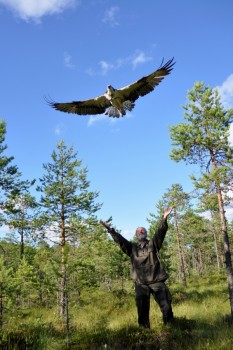
From Finland to Africa: Ilmari takes off in 2012. Photo: Juhani Koivu
Ilmari is back!
Last October we brought you the story of a winged traveller who left his home in southern Finland for Africa. Ilmari is a nine-year old osprey who spent his winter in Cameroon; as he and his family are fish-eaters, they have to foresake their frozen homeland for about five months of the year.
It’s a long way to Cameroon, around 6,500 kilometres, and the return trip is a dangerous one. But Ilmari made it: his satellite transmitter reported that he returned to his native landscape on 21 April, after flying 7,351 kilometres, which took him 23 days – an average of 320 kilometres per day. He took a couple of days off on Crete and in Serbia.
Now satellite transmitters and live cameras reveal all the intimate secrets of birds of prey (and bears, hibernating in their lairs). On this British site osprey Lizzie babysits as her chicks flap their tiny wings in early June.
Now it’s time for Ilmari to concentrate on fishing, hopefully in order to feed his offspring – until October, when he will take to the skies again.
Humankind in disguise
30 September 2002 | Authors, Reviews

Thomas Warburton
Thomas Warburton (born 1918) has for sixty years tossed off words, poems, narratives, translations, literary histories and articles. He transforms Finnish and English literature into Swedish (he has also has translated several of Tove Jansson’s Moomin stories into English) and writes about ancient Japanese culture.
It comes as no surprise that Thomas Warburton’s latest book is called Förklädnader (‘Disguises’). Having such a long experience he knows how to get under the skin of so many literary characters in order to draw forth their stories. More…
Lucky strikes
12 August 2010 | This 'n' that
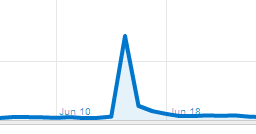
Stumbled upon: readers find Tommi Musturi's comic strip (June 10–June 18)
When Books from Finland was a printed journal, it was relatively easy to define its readership – now it is different: we are a part of the internet’s ecosystem, its surging and multifarious mass of knowledge.
Those who visit our pages may have the most diverse motives for wanting to read our articles – and they may travel surprising itineraries before arriving on Books from Finland’s pages, as we found out recently: StumbleUpon is still a fairly little-known service in Finland. Thus it took a while before we realised why so many of the comments about our piece on Tommi Musturi’s wordless comic strip, on colour and friendship, began with the words ‘I stumbled upon’… More…
You thought Finnish was weird?
9 April 2015 | This 'n' that
You thought Finnish was weird?
Just listen to it get a whole lot weirder…
Ever since she burst on to our computer screens a year ago, we’ve been fans of Smokahontas, also known as Sara Forsberg.
Then aged 19, Forsberg shot to fame with her YouTube video What Languages Sound Like to Foreigners, in which she demonstrated a mastery of fluent gibberish in 14 languages including Japanese, estuarine English, French, Italian, Arabic…. She followed this up with One Girl, 14 Genres, where she bent her considerable talents for mimicry to performances in fourteen musical genres, from R ‘n’ B to musical, from traditional Indian to hipster indie.
An appearance on the Ellen de Generes show, and much media attention, followed, and Forsberg moved to California to pursue her career… where, one rainy day, thinking of home, she turned her attention to the Finnish language.
The result is Learn Finnish with Sara, a hilarious exploration of some of the sillier aspects of Finnish. It’s one of the most difficult languages in the world to learn, says Forsberg, and she goes on to prove it with some wacky examples. Vihdoin vihdoin vihdoin means ‘I finally whipped myself with boughs of silver birch; for Kokko, kokoo koko kokko kokoon, you’ll just have to watch the video. Not to mention hurskastelevaisehkollaismaiselllisuuksissaankohan hän toimii…
We’re predicting a big career. In whatever language.
https://www.youtube.com/watch?v=nPr-fGm8l9k
Volgan mutkasta Siperiaan. Sukulais-kansat tämän päivän Venäjällä / From the Volga to Siberia. The Finno-Ugric Peoples in Today’s Russia
17 August 2012 | Mini reviews, Reviews
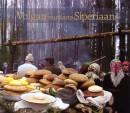 Volgan mutkasta Siperiaan. Sukulaiskansat tämän päivän Venäjällä
Toim. [Ed. by] Ildikó Lehtinen
Helsinki: Finnish Literature Society, 2012. 190 p, ill.
ISBN 978-952-222-345-6
€48, paperback
English-language edition:
From the Volga to Siberia. The Finno-Ugric Peoples in Today’s Russia
ISBN 978-952-222-346-3
€57, paperback
Finno-Ugric peoples make up 2.4 million of Russia’s inhabitants. This book examines the Khanty, Komi, Mari, Mordvins and Udmurt who live on the western side of the Urals, between the Volga River Bend and Western Siberia. The focus is on their ethnic identity, recent history and present-day life. Various points of view are represented in articles by expert scholars, and the subjects include language, literature, theatre, social life, and the status of the family and of women. These national cultures recovered after the most difficult part of the Soviet period, but in today’s Russia they and their languages are increasingly at risk of dying out. Russification is advancing not only because of government, but also as a result of industrialisation and urbanisation. Half of the population of these groups live in rural areas where traditions and folk beliefs are particularly strong. Photographs from different eras and drawings by Udmurt children depict the story of the indigenous cultures and the changes they have undergone. Some of the articles also shed light on the harsh situation of other Finnic peoples in Russia.
Translated by David McDuff

Malin Kivelä & Linda Bondestam: Bröderna Pixon och TV:ns hemtrevliga sken [The Pixon brothers and the homely shimmer of the telly]
9 January 2014 | Mini reviews, Reviews
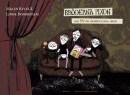 Bröderna Pixon och TV:ns hemtrevliga sken
[The Pixon brothers and the homely shimmer of the telly]
Helsingfors: Schildts & Söderströms, 2013. 38 pp.
Illustrerad av [Illustrated by] Linda Bondestam
ISBN 978-951-523-124-6
€22, hardback
Finnish translation:
Pixonin pojat ja TV:n kotoisa kajo
Suomentanut [translated by] Maarit Halmesarka
Helsinki: Teos, 2013. 38 pp.
ISBN 978-951-851-524-4
€27.90, hardback
The four Pixon brothers spend their time watching the telly and eating cereals and sweets. Their mother, in desperation, constantly demands that they go out and play, but they just don’t. The thin brothers’ teeth are bad as they have no vitamins in their blood: indeed they are as fit as 90-year-olds. One day the telly goes bust and the brothers end up in their neighbours’ home, where the two ladies cook them a good meal. They finally do go out and play – until the point of exhaustion: the story presents the reader with sinister turns à la Grimm brothers or Hoffmann, which the gloomy, dark pictures, suddenly devoid of colours, comically illustrate. But colours return to the pictures as well as to the brothers, who are now as fit as any 64-year old! This is the authors’ second book for children. Kivelä’s lesson takes the mickey out of didacticism but does not lose the point, so fun is had by all. Bondestam’s detailed, graphic pictures spice the story with amusing horror.
Blind man’s buff
31 March 2002 | Fiction, Prose
An extract from the novel Laituri matkalla mereen (‘A jetty to the sea’, WSOY, 2001)
Ten steps along the path marked out by the poet
In a gravel pit illegally dug by the sand-king Gropius and later abandoned, the colonel and Henry were shooting at tin cans with pistols. The pit neighboured the Colonel’s home, and he was in the habit of carrying out target practice there with the help of Jovan, to keep his hand in.
The cans were placed at twenty-metre intervals in front of a sandbank and were raised on coil springs, so they swayed freely in the air. Each of them was attached to a long line; this, when pulled, swayed the cans, rattling stones inside them. Following the sound, the colonel identified the can’s position, aimed and fired. The hits he heard himself, the misses usually struck the pieces of hardboard behind the cans. These were divided up dartboard-fashion into sectors and rings, and Jovan used binoculars to spot the hits on them and announce the points of impact as clock-numbers and distances from the can’s central position, enabling the colonel to correct his aim. This he did with the aid of a rake. He held the rake upright, prongs downwards, so that its handle stood roughly perpendicular to the ground. Moving the handle sideways with careful estimation, and sliding his pistol hand up or down on the handle, he was able to make corrections with reasonable accuracy and determine his aim. More…
Smarty pants?
9 January 2014 | This 'n' that
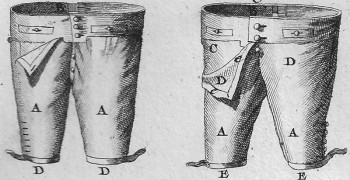
Culottes: 18th-century smartwear. Picture from ‘L’art du tailleur’ by Diderot & d’Alembert. Wikipedia
Eat your heart out, Angry Birds? Ever since the global success story of the Nokia phone company, Finns have been trying to rule the world with global electronic products. Among the latest achievements are analytical undies. The Finnish company Myontec has invented underwear embedded with electromyographic sensors, which measure the workings of your muscles and send the data to a computer.
Last year The New York Times gave the pants third place on their list of ‘32 Innovations that Will Change Your Tomorrow’.
What, you’re not athletic? You might stir from your sedentary slumber if your pants let you know how pathetically little you work out for your own good.
In late January Myontec’s smartshorts won the Sport & Fitness category at the Wearable Technology Innovations World Cup 2013/2014 in Munich. Who knows how far, globally, this will go? Smartpants, smartphones: perhaps your knickers will start talking one day – thus combining the advantages of two electronic appliances in which the Finns have expertise.
Paris 2
30 September 1987 | Archives online, Fiction, Prose
An extract from the novel Paholaispoika (‘The devil boy’, 1987). Introduction by Austin Flint
You must sit down, sayes Love, and taste my meat:
So I did sit and eat.
(George Herbert)
The city was the sum of the whole century, the capital of the eighteen hundreds, of no particular country. Like millions of others, I passed time reading the newspapers and keeping up with what was happening in Europe. Acorns would get crushed. There were many omens of how everything would turn out.
There were still a few remnants of the World’s Fair over by the Palais Royal. Not very many. The latest and most shocking incident was that the Lipschitz sculpture, ‘Prometheus Strangling the Vulture’, had been chopped to bits. Then it was put into storage, in some secret place. Crumbling rough grey stone that gave no idea of its shape. Rumour had it that the statue had offended official policy, and all sorts of things were certainly in the air. There was no longer any sign of the sculpture near the Palais Royal. More…
Finlands svenska litteratur 1900–2012 [Finland’s Swedish literature 1900–2012]
6 November 2014 | Mini reviews, Reviews
 Finlands svenska litteratur 1900–2012
[Finland’s Swedish literature 1900–2012]
Red. [Edited by] Michel Ekman
Helsingfors: Svenska litteratursällskapet i Finland / Stockholm: Atlantis, 2014. 376 pp., ill.
ISBN 978-951-583-272-6
€35.90, paperback
This history of Finland-Swedish literature is an updated version of the second volume of Finlands svenska litteraturhistoria (eds. Johan Wrede and Clas Zilliacus, 1999–2000), and it concentrates on the period from 1900 to 2012, with much new critical material relating to the years after 1975. Some 20 contributors under the editorship of Michel Ekman provide a diverse and inclusive overview of a literature that embraces poetry, prose fiction, children’s writing, essays and drama. The book traces the story of Finland-Swedish literature from the ‘fresh start’ of the turn of the 19th century, through the experiments of modernists like the poets Edith Södergran and Elmer Diktonius, to the work of present-day novelists like Monika Fagerholm and Kjell Westö. However, the emphasis throughout is on general lines of development rather than on individual authors’ careers. The authors discuss the relationship between the work of Finland’s Swedish-language writers and their Finnish-language counterparts in a perspective that not only views the minority literature as a part of the Finnish whole, but also considers it as a bridge between the literatures of Sweden and Finland – the subject of a concluding essay by Clas Zilliacus. The material is presented in essays subdivided in a readable way that combines factual information with critical and historical analysis.