

Search results for "harjunpää/2010/10/mikko-rimminen-nenapaiva-nose-day"
Child of chaos
10 September 2010 | Comics, Fiction
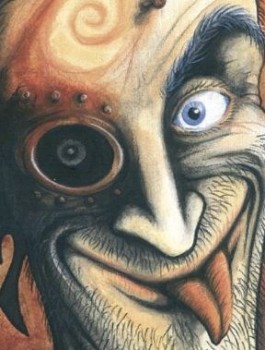
Kullervo the (anti)hero by Gene Kurkijärvi
A cornucopia of exciting plots and strange characters, the mythic epic Kalevala has inspired innumerable artists since its first publication in the 1830s. A recent interpretation of the story of an extremely tragic hero named Kullervo takes the form of a graphic novel by Gene Kurkijärvi: his urban Kullervo lives in a grim environment – not unlike Helsinki, but carrying with dystopian overtones – where the heroes and/or villains are steely androids and hairy weirdos who shoot drugs and use foul language. This 21st-century Kullervo is a surrealist cyberpunk tragedy – laced with pitch-black comedy.
Extracts from the graphic novel Kullervo by Gene Kurkijärvi (Like, 2009; captions translated by Owen Witesman) More…
Kullervo: to be, or not?
10 September 2010 | Articles, Non-fiction
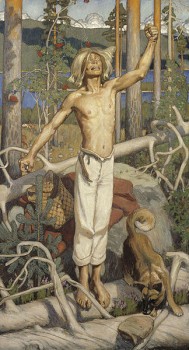
The curse of Kullervo by Akseli Gallen-Kallela (1899, in the Finnish Art Museum Ateneum)
A young man is born a slave under stars that augur ill for him. He is maltreated and betrayed from birth. He cannot control his physical power, his aggression or his thirst for revenge and, finally, after fatal errors and deliberate acts of violence, his remaining desire is to die. What, in the end, did life hold for him?
The cruelly tragic story of Kullervo in the Kalevala was largely the creation of the national epic’s compiler, Elias Lönnrot (1802–1884), who put together a number of originally unconnected folk-epic fragments collected in disparate localities throughout the north and east of Finland. This process involved many stages and went on for decades. The first version was published in 1835; for a shorter version for schools in 1862 Lönnrot cut the most violent and erotic scenes – including those involving Kullervo and his sister in an incestuous encounter. More…
Landscapes of the mind
30 June 1986 | Archives online, Fiction, poetry
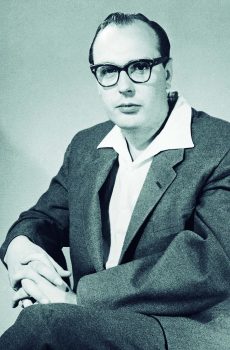
Tuomas Anhava. Photo: Otava
In his book Suomalaisia nykykirjailijoita (‘Contemporary Finnish writers’), Pekka Tarkka describes Tuomas Anhava’s development as a poet as follows: In his first work, Anhava appears as an elegist of death and loneliness; and this classical temperament remains characteristic in his later work. Anhava is a poet of the seasons and the hours of the day, of the ages of man; and his scope is widened by the influence of Japanese and Chinese poetry. As well as his miniature, crystalclear, imagist nature poems, Anhava writes, in his Runoja 1961 (‘Poems 1961’), brilliant didactic poems stressing the power of perception and rebuffing conceptual explanation. The mood in Kuudes kirja (‘The sixth book’, 1966) is of confessionary resignation and intimate subjectivity.
Anhava’s literary inclinations reflect his most important translations, which include William Blake’s The Marriage of Heaven and Hell (1959), selections of Japanese tanka poetry (1960, 1970, 1975), Saint John Perse’s Anabasis (1960), a selection from the works of Ezra Pound, published under the title Personae, and selections from the work of the Finland-Swedish poets Gunnar Björling and Bo Carpelan.

Song of the black
My days must be black,
to make what I write stand out
on the bleached sheets of life,
my rage must be the colour of death, to make my black love stand out,
my nights must be summer white and snow white,
to make my black grief burn far,
since you're grieving and I love you
for your undying grief.
Let the sun's rolled gold gild dunghills,
let the moon's blue milk leak out till it's empty,
              we're not short of those.
The obscure black darkness of the cosmic night
glitters on us enough.
From Runoja (1955)
Your heart on your sleeve
7 October 2011 | This 'n' that
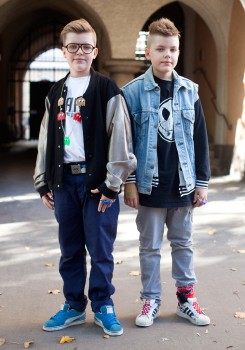
Street cred of Hel Looks: Josua and Julius. Photo: Sampo Karjalainen
The founder of Hel Looks, which charts clothing styles of Helsinki denizens (which we featured here on the Books from Finland website), has been talking to Finnish television (programme in Finnish) about her website.
Established in 2005, the site – which has an eye for the weird and wonderful rather than the classically stylish – attracts an average of 10,000 visitors a day, two thirds of them from outside Finland.
Fashion editor Liisa Jokinen says she got the idea for the site while on holiday in Sweden. ‘I think a lot of Finns admire the Swedes’ fashion sense and in particular their stylishness. But in fact the range of styles is greater in Helsinki, and Finns have the courage to be different,’ she says.
Recent images from the site bear her comments out, and chart the sheer range of costume that she and the photographer Sampo Karjalainen set out to document. Take the 13-year-old fashionistas Josua and Julius (left), snapped on Bulevardi in central Helsinki on 1 October, for example: ‘We dance hip hop and house. It inspires our style. We try not to dress up like all other boys’; or Noel Coward fan Janne, 51, seen on 3 September: ‘I’m wearing an English tweed suit tailor-made in London. I live in Mexico, where I normally wear a white linen suit.’
Best of all, says Jokinen, is when she comes across someone for a second time without realising that she took their picture a year or so back. The image of Helsinki reflected by Hel Looks is made up of people, not buildings. ‘I believe people and their clothes contribute much more to a city than its buildings do,’ Jokinen says.
The photos on the Hel Looks site, currently numbering some 1,200, offer us visions of how people want to be seen; in this selection, few dress to play a role. People wear what they think is fun or/and stylish, and we, the onlookers, enjoy being the judges of this city catwalk.
Juhani Niemi on Väinö Linna
31 December 1980 | Archives online, Authors
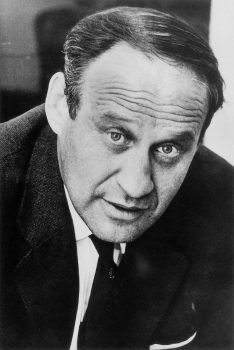
Väinö Linna. Photo: WSOY
Väinö Linna fits squarely into one of the dominant patterns of twentieth century literary development in Scandinavia. Like many writers of the period, Linna came from a working class background and struggled to free himself from that environment through self-education. He had no special interest in politics but his natural leanings were moderately left-wing. He isn’t a ‘political’ writer as such, and it would be simplistic to apply labels to his views. His central interests, which directly affect his style, are a concentration on firstly, acute social observation and, secondly, social analysis. Through novels in this genre – and Linna is without doubt a master – the reader finds a world and all its influences, from the personal to the historical and economic dissected, the casings laid back, the true juxtapositions revealed.
The process can be powerful and effective and Linna’s major works Tuntematon Sotilas (‘The Unknown Soldier’, 1954, English translation 1957) and the trilogy Täällä Pohjantähden alla (‘Here beneath the North Star’, 1960-62) have struck deep into the Finnish national consciousness radically influencing the way events in recent Finnish history have been viewed by a wide audience of readers. Both works have been enormously popular: the characters have so accurately caught the Finnish personality that they have become part of the nation’s mythology. More…
Ho-ho-no!
10 December 2010 | This 'n' that
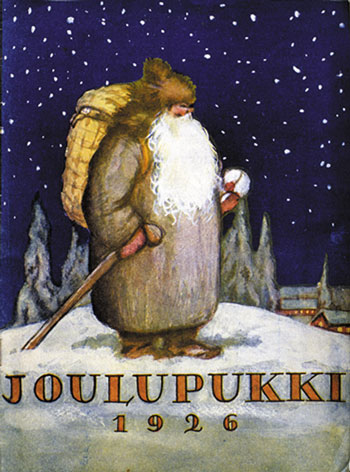
In the olden days: Father Christmas dressed in grey. A Christmas magazine illustration, 1926. Picture: Helsinki City Museum
St Nicholas, Father Christmas, Santa Claus? According to Finns, the benevolent, bearded, reindeer-driving, present-giving figure lives on Korvatunturi fell in Lapland (not at the North Pole, not anywhere else!).
In Finnish his name is Joulupukki, ‘Yule goat’ (or ‘buck’, Old English, bucca). Joulupukki developed from pagan traditions where his predecessor was a creature called Nuuttipukki, ‘Knut’s goat’, which referred to St Knut’s day, originally on 7 January.
The end of Christmas was celebrated by itinerant groups of people visiting houses playing for food and, in particular, booze. Leading them was the scary ‘Knut’s goat’ disguised in horns, a face mask and lambskins, frightening children. If he wasn’t given beer, he could steal the spigot from the beer barrel or beat people with a bunch of twigs.
This tradition was popular until the beginning of the 20th century, when the good Joulupukki replaced his old bad post-Christmas counterpart, shedding his horns and mask. However, when he came to people’s homes on Christmas Eve to bring presents, he still wore a fur coat, was heavily bearded and might still carry both twigs and gifts – so children had indeed better watch out how they behaved all year.
Naughty or nice? A new full-length Finnish film directed by Jalmari Helander entitled Rare Exports: A Christmas Tale was released internationally in early December.
In this Yuletide film the central figure of the mundane Christmas celebrations is not the red-dressed, jolly Santa we know, but ‘a sinister old codger who chews off ears and whose demon minion kidnaps innocent children. Ho ho no!’, as Jeannette Catsoulis reported in the New York Times.
‘Rare Exports is an enormously entertaining and unpredictable Yuletide romp packed with sly wit, solid scares and naked geriatrics,’ said Tom Huddleston of Time Out London.
Frank Lovece, in Film Journal International, wrote: ‘Some human and reindeer gore make this inappropriate for young children, as much as the movie’s boy-hero denouement may suggest otherwise. But for anyone who needs an inoculation of humbug to counter artificial sentiment, or who simply likes to smoke their Christmas cheer or put it in brownies, this off-kilter return to roots is a welcome gift.’
The plot involves a mysterious block of ice that has been unearthed in Lapland, sprouting a pair of horns. Children begin to disappear, reindeer are found killed. A ten-year-old boy finds out what’s happening, and he and his dad take up fighting back. ‘Wicked fun in the manner of a 21st century Grimm’s fairy-tale,’ said Chris Barsanti of filmcritic.com. ‘Exuberantly pagan images,’ wrote Jeannette Catsoulis.

Santa's place: 360° panorama from Korvatunturi, Lapland. Photo: Wikimedia/Panoramio
Well, Rare Exports was in fact filmed in Norway: Finnish fells are low and unimpressive in comparison to the higher Norwegian fells and mountains. Joulupukki’s home on Korvatunturi is particularly difficult to access, as the Russian border cuts through this formation of fells, which is also a part of a nature conservation area.
Santa’s red, fur-lined outfit is a comparatively recent invention, by the way: it became popular in the United States in an advertising campaign for Coca-Cola in 1931. By a trick of fate, though, the image was designed by one Haddon Sundblom who was of Finnish (Åland) origin.
So, what’s the truth about Joulupukki ? Could it be that an incarnation of the ancient horned shaman-like creature might still dwell in the depths of that faraway Lapland fell, and that the Coca-Cola man on whose lap your kid is sitting, listing his or her wishes, is just some commercial impostor?
Reima Luoto & al: Suomen sota 1808–1809 [The Finnish War of 1808–1809]
27 March 2009 | Mini reviews
 Luoto, Reima T.A. & Talvitie, Heikki & Visuri, Pekka:
Suomen sota 1808–1809: taustat, tapahtumat, muistomerkit
[The Finnish War of 1808–1809: background, events, memorials]
Espoo: Fenix-Kustannus, 2008. 260 p., ill.
ISBN 978-951-862-183-9
€ 36, hardback
As a result of the 1808–1809 Russian-Swedish war, Finland, which had until then belonged to Sweden, was annexed to the Russian Empire, and Finland was established as an autonomous grand duchy. In this 200th anniversary year, several books about the war have already appeared. In its introduction, this book examines the birth and development of the idea of Finnish independence from the reign of Sweden’s King Gustav III onwards. Articles in the volume discuss the place of Finland and Sweden in Europe during the period of the Napoleonic war, and in an article which includes a survey of the present day, Finland’s OSCE envoy Ambassador Heikki Talvitie shows how Sweden has consistently adhered to the foreign policy it formed in the year 1812. Finally, there is a presentation of the real and fictional heroes of J.L. Runeberg’s Fänrik Ståls sägner (‘The Tales of Ensign Stål’, 1848–60), and a guide to the monuments in Finland and Sweden which commemorate the war.
Our fellow creatures
30 June 2004 | Authors, Reviews

Photo: Tiina Itkonen
Hannele Huovi is a compelling story-teller (see page 98) but, again and again, she makes us realise what a strange place our world is – how easily we can slip out of it into dream or psychosis, or cross some concealed frontier into a parallel universe.
Hers is a readable form of surrealism – the art of defamiliarising familiar things by putting them in anomalous environments. The results are absorbing for children but fascinating and entertaining for adults too, an essential of good children’s literature. Because it can be serious without being solemn and can expand consciousness, the genre has engaged very great wits from Jonathan Swift to Lewis Carroll. Eeva-Liisa Manner’s stories (see Books from Finland 1/2004) are another obvious point of contact, but Huovi is brilliantly inventive and completely original. More…
Science book of the year
13 January 2011 | In the news
 A book on Islamic cuisine and food culture by Helena Hallenberg and Irmeli Perho has won the prize for the Finnish science book of the year (Vuoden tiedekirja), worth €10,000. The prize is awarded by the Suomen Tiedekustantajien Seura, Finnish Science Publishers’ Association, and Tieteellisten seurain valtuuskunta, Federation of Finnish Learned Societies.
Ruokakulttuuri islamin maissa (‘Food culture in Islamic countries’, Gaudeamus) explores both cultural and culinary history in the Near East and other Islamic countries since the sixth century, from the Prophet Muhammad to this day – and yes, the book also contains recipes. Both the authors are academics: Hallenberg is a scholar of Islamic saints and Chinese Muslims’ ideas of health, while Perho specialises in Islamic history of ideas and society.

Cimex lectularius: the bedbug. Photo: Wikipedia
And a honorary mention, worth €2,500, was awarded to a large work, with excellent illustrations, on Heteroptera, an extensive family of bugs, one of which is the bedbug – luckily unknown to most of us. The vast majority of people have no idea, either, of the fact that there are 22 endangered species of these bugs in Finland, the home of 507 different representatives of the Heteroptera family. So, Suomen luteet – johdatus luteiden mielenkiintoiseen maailmaan by Teemu Rintala and Veikko Rinne (‘The bugs of Finland – an introduction to the interesting world of the Heteroptera’, Tibiale) is a lively proof of the amazing biodiversity of Finland.
Last resorts
31 March 1999 | Authors, Interviews

Photo: Irmeli Jung
The novelist Pirjo Hassinen’s subjects are men, women and death. Particularly, in her novel Viimeinen syli (‘The last embrance’, Otava, 1998), death. Interview by Leena Härkönen
The blizzard to end all blizzards is tearing Finland apart. The railway system is in a mess, and the heating system in our building has stopped working. There is no way I can leave Helsinki for Jyväskylä, the town in central Finland, 300 kilometres away, where Pirjo Hassinen lives. I am obliged to interview her on the telephone, although she says she loathes talking on the phone, and I too would prefer to meet her face to face.
The day I ring Hassinen, Lapland achieves a record low of -51 Celsius. Even on the south coast the mercury sinks well below -20°C, and a freezing wind makes the frost almost unbearable. The entire country is as white and cold as – death. It is an easy comparison, for it is death that is the theme of Pirjo Hassinen’s latest novel. The main character of Viimeinen syli is an undertaker, transporting bodies. There is a lot of death in the book: two suicides plus an accidental one. According to Hassinen, her subject matter is the conclusion of a logical development.
‘I deal with whatever concerns me most at a given moment and whatever I feel I can say something about.’ More…
High above the years
23 September 2011 | Fiction, poetry
In Gösta Ågren’s poetry austere aphorisms alternate with concrete observations of life in a small village that was and again is his home, and with portraits of people he has met on his journey in the world. Introduction by David McDuff
Poems from the collection I det stora hela (’On the whole’, Söderströms, 2011)
Father’s hands
(1945)
Father’s hands were like stiff
gloves; a furious
kettle had bewitched them
in his childhood. We ride
from the church’s tall letter
along the river’s long sentence
to the parenthesis of the bridal house,
and the thunder of three hundred hooves
fills the space beneath the clouds.
I saw father driving through
his life with those numbly
gripped reins, and later,
right now, I think of the
life-long body in which a man
comes, is wounded, and goes. More…