

Search results for "harjunpää/2010/10/mikko-rimminen-nenapaiva-nose-day"
When the viewer vanishes
26 May 2015 | Essays, Non-fiction
 For the author Leena Krohn, there is no philosophy of art without moral philosophy
I lightheartedly promised to explain the foundations of my aesthetics without thinking at any great length about what is my very own that could be called aesthetics. Now I am forced to think about it. The foundations of my possible aesthetics – like those of all aesthetics – lie of course somewhere quite different from aesthetics itself. They lie in human consciousnesses and language, with all the associated indefiniteness.
It is my belief that we do not live in reality, but in metareality. The first virtual world, the simulated Pretend-land is inherent in us.
It is the human consciousness, spun by our own brains, which is shared by everyone belonging to this species. Thus it can be called a shared dream, as indeed I have done. More…
Geneswing
30 June 2001 | Fiction, poetry
Poems from Tuulen vilja (‘Windcrop’, WSOY, 2000)
Longbeaked birds
created for the deepfunnelled gloxinia – everything exactly right.
The sport of colours, survival (though I always felt I was
sunset in the morning).
I walk over the living, the playful swing of genes,
uniqueness in splinters: capsules,
family trees, root systems, leafage.
In the geneswing little deviations of dimension,
as if I were perpetually outlining waves with my finger.
The primal miracle of seeds: I press
a mixture of summer flowers in the soil, exploding
a serial miracle. More…
Kidult culture
4 April 2012 | Non-fiction, Tales of a journalist
Illustration: Joonas Väänänen
Life is hard, and then you grow up. Except that you don’t really, at least if you keep watching television. Jyrki Lehtola takes a look at entertainment for the Peter Pan generation – which, he argues, is pretty much all of us
When did we start making television for children? I mean, in theory for adults (believe me, advertises, believe me: for adults!) but in practice for children?
Theoretically television is a wonderful, flexible medium less dependent on big money than the film business. Why did we let it slip out of our hands as a form of expression?
Why did we start making adult programmes for children and children’s programmes for adults? In other words, why do we make exactly the same TV programmes for everyone? More…
Death of a poet
31 December 1989 | Archives online, Articles
Over the last two decades, contemporary Finnish opera has not only become popular at home but has emerged as a significant force on the international music scene. Aulis Sallinen’s The Horseman, The Red Line and The King Goes Forth to France, and Joonas Kokkonen’s The Last Temptations all had their premieres in the 1970s and 1980s and have already earned respected places in the repertory of the Finnish National Opera and the Savonlinna Opera Festival, where performances are sold out months in advance.
The visit by the National Opera to New York’s Metropolitan Opera House in 1983 attracted widespread attention from press and public alike, and its productions of The Red Line and The Last Temptations were for the most part enthusiastically received. Finnish opera earned further international prestige from the joint commissioning of Sallinen’s The King by the Royal Covent Garden Theatre in London and the Savonlinna Festival, and from later performances by companies in Germany and the United States. More…
The ruins of civilisation
31 August 2012 | Authors, Reviews
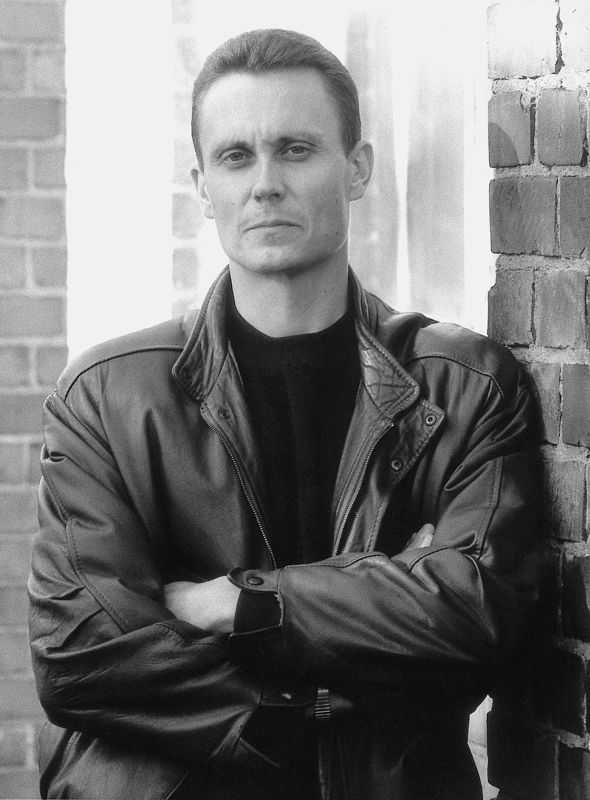
Juha Seppälä. Photo: WSOY
The eponymous central character of Juha Seppälä’s new novel Mr. Smith (WSOY, 2012) is almost an omnipotent man who moves freely in time and space, from Tsarist Russia to contemporary Los Angeles. He claims that he is a ‘sovereign individual’; sovereignty and individuality are traits that Seppälä’s protagonists have always striven towards.
On the other hand, he also says that he is a ‘necessary evil’ fulfilling the role of a protagonist in a novel. His name refers to anyone and everyone; he is, in a way, a minimalist relic of an individual.
On one level there is the suggestion that he is the alter ego of his creator: the author’s surname refers to a smith (seppä). More…
Mole’s hole
31 March 1992 | Archives online, Fiction, Prose
Extracts from Pikku karhun talviunet (‘The little bear’s winter dreams’, published posthumously in 1974, edited by Mirkka Rekola), prose fragments and fairy-tales. (See commentary by Soila Lehtonen)
Vauveli-Vau had grown up. She went round to Mole Hill and went into Mole’s Hole, so she could work in peace. As there are a lot of Mole’s Holes in the earth, no one had any idea where Vauveli-Vau had gone. They weren’t all that keen to know, as there’s always rather a lot to do in Mole’s Hole: pine cones and branches to be collected, trips to be made to the spring in the forest, an eye kept on Dottypot in the fire-embers, and at night you have to get up to see which bird it is that’s singing in the old rotten tree. But still more laboursome are the thick books in foreign languages and the pile of blank paper.
Quite a few days and nights had gone by before Vauveli-Vau was used to being in Mole’s Hole. During those days a lot of remarkable things occurred. A slug flourished his horns and muttered: ‘Who on earth would want to lie about in his cottage in fine weather like this?’ More…
What’s so great about paper?
17 September 2009 | Articles, Non-fiction
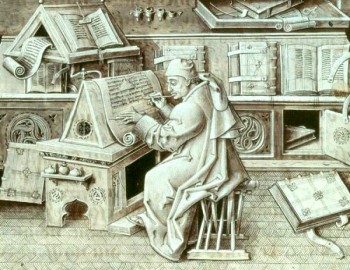
High-tech: the ultimate gadgets of the 15th century, parchment and pen. A portrait of Jean Miélot, the Burgundian author and scribe, by Jan Tavernier (ca. 1456)
The day will soon come when commuters sit on a bus or train with their noses buried in electronic reading devices instead of books or newspapers. Teemu Manninen takes a look at the digital future
Most people interested in books are aware of the arrival of electronic reading devices such as the Amazon Kindle, a kind of iPod — the immensely popular portable music listening device made by the company Apple — for electronic books. For a literary geek like me, the Kindle and e-readers should be the ultimate gadget: a whole library in a small, paperback-sized device. However, I’ve been wondering why digital reading hasn’t become as popular as digital listening. I myself have not invested in an e-reader, although I ought to be exactly the desired kind of customer. After all, I read all the time. Even the mp3 player I have is mostly used for listening to audio books. More…
Inventing reality
30 June 2001 | Authors
 Changes of self and perspective – and even of gender – fascinate the chameleon-like writer, dramatist and actress Pirkko Saisio. Set in Helsinki in the 1950s and 1960s, her autobiographical novel Pienin yhteinen jaettava (‘Lowest common multiple’, 1998) was on the shortlist for the Finlandia Prize. ‘We look into the mirror,’ she says in this introduction to her writing, ‘to wonder at the fact that we have the ability to divide in two, into she who looks and she who is looked at’.
Extracts from Miten kirjani ovat syntyneet (‘How my books have been born’, edited by Ritva Haavikko, WSOY, 2000)
On the top shelf of the bookshelf in my childhood home were about thirty volumes of the collected works of Vladimir Ilyich Lenin. On the bottom shelf were the same number of the collected Stalin. Between them were A Young Woman’s Cookbook and Dale Carnegie’s How to Win Friends and Influence People, which my father had had to study in order to graduate from correspondence school as a commercial technician. More…
In praise of idleness (and fun)
21 December 2012 | Letter from the Editors
As the days grow shorter, here in the far north, and we celebrate the midwinter solstice, Christmas and the New Year, everything begins to wind down. Even here in Helsinki, the sun barely seems to struggle over the horizon; and the raw cold of the viima wind from the Baltic makes our thoughts turn inward, to cosy evenings at home, engaging in the traditional activities of baking, making handicrafts, reading, lying on the sofa and eating to excess.
It is a time to turn to the inner self, to feed the imagination, to turn one’s back on the world of effort and achievement. To light a candle and perhaps do absolutely nothing – which can in itself be a form of meditation.
That’s what we at Books from Finland will be trying to do, anyway. Support in our endeavour comes from an unlikely quarter. In 1932 the British philosopher Bertrand Russell published an essay entitled ‘In Praise of Idleness’, in which he argued cogently for a four-hour working day. ‘I think that there is far too much work done in the world,’ he wrote; ‘that immense harm is caused by the belief that work is virtuous’.
Russell was no slouch, as his list of publications alone shows. But his argument was a serious one, and we mean to put it into practice, at least over the twelve days of Christmas. ‘The road to happiness and prosperity,’ he wrote, ‘lies in an organised diminution of work.’ More…
Do not be afraid
30 June 1998 | Archives online, Fiction, poetry
Poems from Älä pelkää (‘Do not be afraid’, WSOY, 1997). Introduction by Jyrki Kiiskinen
Travel preparations
Late Friday night. Strange noises in the yard, someone
bangs on the door to the next stairway. Electricity hums.
I have just come back from the U.S. and France, from Sweden too.
On their channels, people laugh. They are having fun.
They are, nowadays, strange, young, and handsome, each and every one.
We did not have that when I was young. We limped.
We did not talk. We stammered tortuous phrases
and, while embracing, were afraid to be seen.
We did embrace. We clung to one another, expecting
to drown alone in every ninth wave.
I know my place is not here where I am. I think, I try
to construct conclusions. Someone looks over my shoulder.
Slowly the universe was born out of my mother s womb.
I am not responsible for its sudden extinction. On a Friday night.
I let them rule, the beauties and young lovers. My ticket has been written.
it is ready. I have had my shots against fear. I have my passport.
Bulldog
No European he who does not every morning
put on a tie. This morning, European
as I am, I looked at myself in the mirror
and noted that, incontrovertibly, more
and more every day, I resemble a
sad bulldog. Who has ever seen a bulldog smile?
We know we were born into the wrong world,
born to struggle. My bloodshot eyes tell me
I would like nothing better than to bed down m the straw
with my adversary, the bull, and ponder the stars.
Paradise apple
Consciousness is anchored to dark matter
as are the swells to the ocean. It is a quality
of matter, darkness glittering darkness. No need for words,
the overarching multidimensional web is one seamless
thought, not verifiable by observations or signs.
As soon as light penetrates the ambiguity of being,
the fruit falls outside the bounds of paradise.
The first sense
For another moment, you are incomprehensibly close,
you are mental image, you are voice, almost scent.
Only touch is missing, the most elementary of sensations
but precisely the one with which God tested the clay
with which the worm knows itself
with which there is hurt in torture and love,
and with which I miss your retreating appearance,
your tender groin, your rough hand.
(Written after a telephone conversation.)
Translated by Anselm Hollo