

Search results for "jarkko laine prize/2010/10/mikko-rimminen-nenapaiva-nose-day/2010/02/let-us-eat-cake/2009/2009/09/what-god-said"
Fiat Lux!
31 December 2014 | This 'n' that
 Time for Lux Helsinki light event again: the January 2014 festival (see photos here) brought 150,000 visitors from Helsinki, the rest of Finland and around the world to the city. It is organised by the City of Helsinki.
The artworks – 17 of them – will be on display in 13 places around the centre of Helsinki, from the courtyard of the Tori Quarters to Finlandia Hall. The light and media artists and sound designers come from Finland, Germany, France, Belgium and Japan.
Lux Helsinki is also part of as the International Year of Light and Light-based Technologies of the United Nations in 2015.
Darkness will slowly diminish, and there will be more light: it’s great that Helsinki winter – at times white with snow, at times not – will again (thanks to artists and the latest technology) be filled with colour for a while. Let light be made!
Angels and devils
11 June 2015 | This 'n' that
A new website explores the work of artist Hugo Simberg
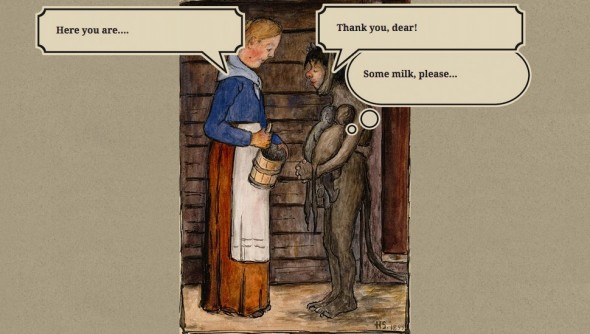
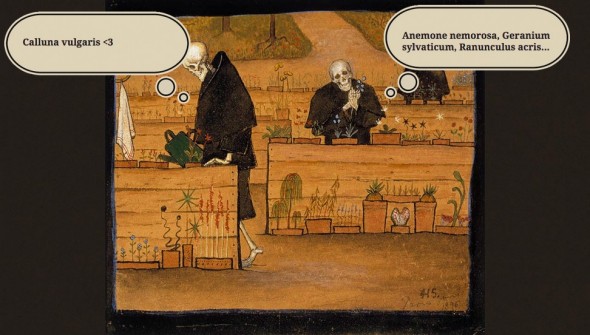
Two small boys carry a wounded angel; a farmer’s wife gives milk to a little devil and her twins; skeletons tend the plants in the Garden of Death. The mythical figures that populate the paintings of the symbolist artist Hugo Simberg (1873-1917) have a wayward and macabre charm that is all their own.
The Helsinki Ateneum Art Museum’s new website, The Other World of Hugo Simberg, offers an opportunity to explore Simberg’s life and work. Showcasing twelve of his best-known paintings, it lays a trail through associated visual and textual material – different versions of the works, photographs, sketches, letters….
If you’ve ever wondered what Simberg’s characters might be thinking or saying, the website also gives you the opportunity to provide thought or speech bubbles, which can then be uploaded to the website.
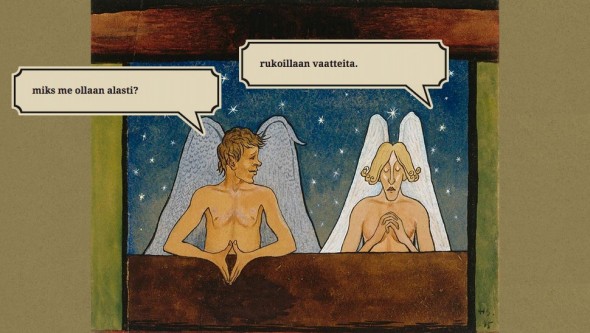
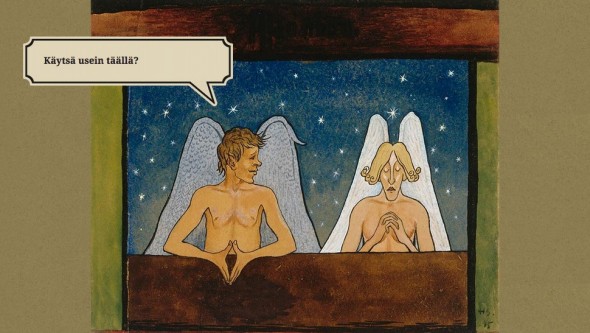
Angelic meetings: ‘Why are we naked?’ ‘Let’s pray for clothes!’ (above); ‘Do you come here often?’ (below).
Homeward bound!
29 March 2014 | This 'n' that
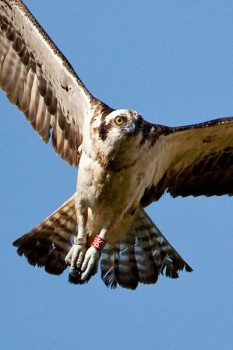
Jukka the osprey: sadly, his fate remains unknown. Photo: Hannu Vainiopekka
Snow is now, unusually for so early in the year, long gone from more than half of Finland. Bears are waking up and emerging from their winter lairs: spring is definitely in the air!
So are birds: the latest news from Cameroon is that on 26 March Ilmari caught his last African fishes and started winging his way to southern Finland.
Ilmari is an osprey: you may remember him – we reported his endeavour to cross continents on his way to Africa in 2012, asking you to watch this space. Well, the raptor is still doing fine, and his journey can be followed on the Finnish Museum of Natural History’s Luomus website. More than six thousand kilometres and a month later he will hopefully be spotted fishing on his home lakes in Hattula.
Let’s keep our fingers crossed for Ilmari. The fates of his compadres Pete, Eikka and Jukka are unfortunate: these great travellers perished on their particularly long and dangerous migration routes. Their stories are reported here.
Tritonus
30 September 1976 | Archives online, Fiction, poetry
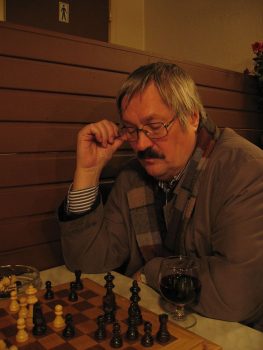
Pentti Saaritsa playing chess. Photo by Otso Kantokorpi, 2006.
Pentti Saaritsa (born 1941), author of six collections of poetry, is one of Finland’s leading left-wing poets, who writes about a wide range of individual and social themes. An outstanding translator, he has had a major role in making Latin American literature, especially the work of Miguel Angel Asturias and Pablo Neruda, known and admired in Finland. He also translates from Russian. The first five poems below have been taken from his latest collection Tritonus (‘Tritone’, Kirjayhtymä 1976), and the last two from his Syksyn runot (‘Autumn poems’, Kirjayhtymä 1973). His poems have appeared in various anthologies abroad and are now being translated into Swedish, English and French. Pentti Saaritsa is a member of the editiorial board of Books from Finland.

1
From the bowels of each apartment house
always that one unknown sound is borne.
Sometimes like drily dripping water, sometimes
as a stone might bite a lump out of itself,
Or a child awake in the dark might learn the word hair.
And a tenant listens, makes a note of it
perhaps to punctuate the interrupted writing of his consciousness
when it makes him restless:
What now, again so soon, is it coming from me
or from the dead building.
An alarm-bell. Did anyone else hear? More…
Literary glory and basketball
23 November 2012 | This 'n' that
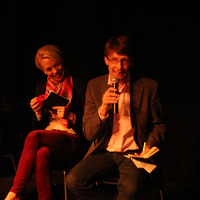
Fights with words: Baba Lybeck and Markus Nummi. Photo: Literary Death Match
Fans of new writing and competitive reading out loud converged on Korjaamo in Helsinki on October 25th for the second Finnish ‘episode’ of Literary Death Match. LDM (as it’s known to regulars) is a series of events created in the USA and hosted by Adrian Todd Zuniga in which authors perform live readings of their recent work and receive critical assessments from a panel of judges in a manner familiar to viewers of trashy TV talent shows.
The winners of the evening’s initial reading rounds advance to the final, where the ultimate victor is decided in a game show-style battle involving skills that are perhaps more tangential to the work of most authors.
In his shiny jacket, LDM co-founder Adrian Todd Zuniga certainly looked the part of the cheesy game show host. He was an enthusiastic compère and got the bilingual evening under way by introducing the panel of judges. Author Markus Nummi was to be responsible for assessing the competitors on literary merit, while Baba Lybeck, a radio journalist and host of Uutisvuoto (the Finnish TV version of the BBC’s topical panel show Have I Got News for You), would be awarding points for performance. The third member of the panel was journalist and author Ari Lahdenmäki, who was assigned the category of ‘Intangibles’, i.e. anything that didn’t fall under the other two headings. More…
Face to face
24 June 2010 | This 'n' that
 You can now keep up with what’s new at Books from Finland on Facebook.
And remember: you can also get Books from Finland articles delivered straight to your inbox or smartphone by signing up to our RSS feed, or subscribing to our regular newsletter – the new one is, as we used to say, currently in the typewriter and will be with you soon.
Let’s keep in touch!
A soul on the train
In one of Heli Laaksonen’s poems the narrator buys a ticket for her soul and herself in a train’s pet carriage. Her capricious poetry features new potatoes, woodpeckers, weasels, and even a pig in fox’s clothing. Introduction by Mervi Kantokorpi
Poems from Peippo vei (‘The chaffinch took it’, Otava, 2011)
First early
From the potato patch there rose a human seedling, too.
Winston, I called it
as it was Winstons I’d sowed in this row
Whole,
beautiful,
unmarked by hoe or blight.
I put it in the basket with the others.
It sat there in the quiet pile, at the edge,
looked on while I slogged away,
gnawing a little bit out of the side of a potato.
What was it thinking?
What could it be that earlies think about?
The first summer sparrows are fresh out of the oven.
I so wish they’d only think about nice things.
I try to look happy
to give them a good start. More…
Practically public
31 December 2002 | Archives online, Fiction, poetry
Poems from Koko tarina (‘The whole story’, Tammi, 2002). Introduction by Anselm Hollo
Pan shot
A whitewashed wall, small windows
advent calendar peepholes at the end of darkness,
                               lit-up squares
One two three kitchens awake at 7
each tenant bends over a kettle of porridge
in the gurgling coffeemaker’s soundscape,
opens the refrigerator
see the hunter in action: let’s spear this yoghurt
and the building across the way testifies to all of this
practically public activity
the evening’s closure of curtains, turnings-off of the light,
nocturnal breastfeedings. Talking windows. A light comes on at: 2:54 AM
– what’s up now?
Is someone thinking about a bird she encountered at the cemetery? More…
Playing games
30 March 2007 | Authors, Reviews

Photo: Lauri Mannermaa / Tammi
‘The world’s complete but we’ll make new ones,’ says the poet, and fulfils his project with whatever speech is to hand.
Aki Salmela (born 1976) is among the most promising of the young Finnish poets who are searching for new ways of expression. One of the most encouraging literary features of the start of the new century was the young generation making its poetic début, including Salmela. They showed a wide-ranging interest in the poetry and tradition of Finland and abroad and were well-versed in foreign languages as well as various experimental poetic techniques. More…
Damned nihilists
30 December 2008 | Extracts, Non-fiction
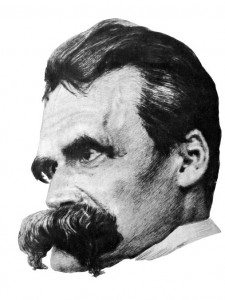
Much misunderstood: father of the superman, Friedrich Nietzsche.
The term nihilism is often bandied about, but often badly misunderstood. In extracts from his new book, Ei voisi vähempää kiinnostaa. Kirjoituksia nihilismistä (‘Couldn’t care less. Writings on nihilism’, Atena, 2008), the social scientist and philosopher Kalle Haatanen discusses the true legacy of Friedrich Nietzsche, nihilism’s high priest
The word nihilist is derived from the Latin: ‘nihil’ means, simply, ‘nothing’. When someone is labelled as nihilist or seen as representing nihilism, this has always been a curse, a mockery or an accusation, whether in philosophy, politics or everyday conversation. More recently, the word has generally been used to refer to people who do not believe in anything – people whose world-view is without principle, without ideals, barren. More…
Brainstorm
30 September 2007 | Archives online, Essays, On writing and not writing
The poet Jouni Inkala finds the words-to-be of his slowly forming poems unbribable
My little fingertip, the size of
a crocodile brain, and a turpentine-taste
on my palate monitor this moment
on the unoxygenated
planet of weariness.
One will be baptised – spray paint
suddenly swishing its message
in my brains – as often in my life,
with something darker than water
freezing in the font, and I'll recall
it's actually a donkey's-years-old
message from my own stanzas.  More...