

Search results for "tommi+musturi/2010/05/song-without-words/2009/09/what-god-said/2011/04/matti-suurpaa-parnasso-1951–2011-parnasso-1951–2011"
Season’s greetings
31 December 2002 | Archives online, Fiction, Prose
An extract from the novel Kolmastoista tuoli (‘The thirteenth chair’, Atena, 2002)
The start of the Christmas season was difficult for everybody, but it was one big upset for Ron and Dan, the twins. At Christmas, apparently, their whole world, all their schoolmates and backyard-mates, the whole gang of them, were avoiding the twins. No one seemed to be even talking to the twins, who said everyone was just concentrating on ‘being nice’.
‘Nice!’
The pain on the boys’ faces looked the real thing. They were without chums, and the reason was even more annoying.
‘They have to be nice, for they’re expecting presents from Father Christmas.’
Christmas was coming and was having a weird effect on the youngest. For the twins, effort and a reward for a good try were completely foreign concepts. At this point, their lives were sheer adventure. They were lavished with overflowing care and love – and not one Christmas present. More…
Change the words
30 March 2008 | Fiction, poetry
Poems from Bul bul (‘Bulbul’, WSOY, 2007). Introduction by Karri Kokko
Opening
Which street was it? A question in a poem doesn’t demand an answer, it’s
itself, like that accurate filter, a blood-soaked liver –
The city was a giant, budging my brains, the fireworks’
ash trailed down to earth, the clowns screeched, a book’s face
was waiting like a child’s face,
and they began swarming out, releasing themselves from signposts,
neon signs, from the pages of a closed book (smelling of a dried
ranunculus), from graves, from a woman’s abhorrent womb – More…
Marja-Leena Tiainen: Kahden maailman tyttö [The girl from two worlds]
18 January 2012 | Mini reviews, Reviews
 Kahden maailman tyttö
[The girl from two worlds]
Helsinki: Tammi, 2011. 261 p.
ISBN 978-951-31-5937-5
€ 26.65, hardback
Marja-Leena Tiainen (born 1951) has dealt with unemployment, immigration, and racism in her works, in ways that are accessible to her young readership. She researches her topics with care. The idea for this book dates back to 2004, when the author made the acquaintance of a Muslim girl who lived in a reception centre in eastern Finland; her experiences fed into Tara’s story. Tiainen’s central theme, ‘honour’ violence in the Muslim community, is surprisingly similar to Jari Tervo’s Layla (WSOY, 2011). Tiainen’s is a traditional story about a girl growing up and surviving, but the novel’s strong points are the authentic description of everyday multiculturalism, and the intensity of the narration. The reader identifies with Tara’s balancing act, which she must carry out in the crossfire of her father’s authority, family tradition, and her own dreams. In spite of everything, the community also becomes a source of security and support for Tara. The narrative arc is coherent and, despite the numerous overlapping time-frames, the tension is sustained right up to the final, conciliatory solution.
Translated by Fleur Jeremiah and Emily Jeremiah
Eeva-Kaarina Aronen: Kallorumpu [Skull drum]
23 December 2011 | Mini reviews, Reviews
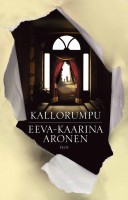 Kallorumpu
[Skull drum]
Helsinki: Teos, 2011. 390 p.
ISBN 978-951-851-413-1
€ 27.40, hardback
Eeva-Kaarina Aronen (born 1948) did not begin her writing career untill 2005, after a long career as editor of the newspaper Helsingin Sanomat. Her third novel Kallorumpu was shortlisted for the Finlandia Prize for Fiction 2011. Aronen’s interest in historical characters and themes that challenge historical truth was already evident in the of her first novel Maria Renforsin totuus (‘The truth of Maria Renfors’, Teos, 2005). At the centre of Kallorumpu is the legendary figure of Finland’s Field Marshal C.G. Mannerheim (1867–1951). The book concentrates on the description of one day in November 1935 by an old filmmaker, the narrator of the novel, who is showing his documentary to a small group of viewers in the present day. He comments on his own film, complementing it with stories about Mannerheim’s home in Helsinki. At home the Marshal’s staff – a cook, a maid and a valet – not only provide narrative twists and turns, but also an insight into the class divisions of the Finnish civil war. Aronen’s portrayal of her gallery of characters is an interesting one, and the novel’s demanding structure, with its alternating time zones, is sound.
Translated by David McDuff
In with the new?
17 December 2010 | Letter from the Editors
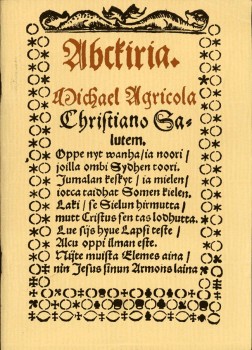
Abckiria (‘ABC book’, 1543): the first Finnish book, a primer by the Reformation bishop Mikael Agricola, pioneer of Finnish language and literature
In August 2010 the American Newsweek magazine declared Finland (out of a hundred countries) the best place to live, taking into account education, health, quality of life, economic dynamism and political environment.
Wow.
In the OECD’s exams in science and reading, known as PISA tests, Finnish schoolchildren scored high in 2006 – and as early as 2000 they had been best at reading, and second at maths in 2003.
Wow.
We Finns had hardly recovered from these highly gratifying pieces of intelligence when, this December, we got the news that in 2009 Finnish kids were just third best in reading and sixth in maths (although 65 countries took part in the study now, whereas in 2000 it had been just 32; the overall winner in 2009 was Shanghai, which was taking part for the first time.)
And what’s perhaps worse, since 2006 the number of weak readers had grown, and the number of excellent ones gone down. More…
A toast before dying
30 June 2005 | Archives online, Fiction, Prose
Extracts from the novel Voin jo paljon paremmin. Tšehov Badenweilerissa (‘I already feel much better. Chekhov in Badenweiler’, Loki, 2004). Introduction by Hannu Marttila
I went to meet them Friday and I did not plan to take other patients that week. They had a small but comfortable room with striped wallpaper.
The Russian was a tall man, but stooped. It soon became apparent that his wife spoke fluent German because she was of German descent. That made it much easier to take care of things.
Of course I knew who the patient was. I have always enjoyed literature and other forms of art. I could play several pieces rather well on the piano. When I was younger I had even written a couple of stories set in the mountains, though I had never offered them for publication. As for Chekhov, I had read a couple of his stories that had just come out in German translation, and I had liked them quite a lot in a way, even though they of course reflected that characteristic Russian nature, with its vodka and untidiness.
The patient’s wife seized both my hands when I entered. It was a bit confusing, but not necessarily unpleasant.
‘Our name is Chekhov. We have come from Russia,’ the woman said in a strong, carrying voice. ‘I trust you’ve been told?’ More…
Writers meet again in Lahti
14 May 2009 | In the news
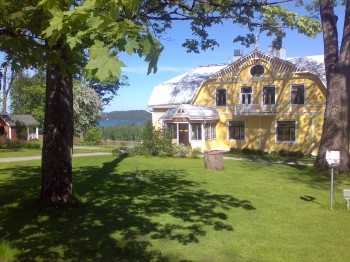
In other words: LIWRE at Messilä Manor
The Lahti International Writers’ Reunion (LIWRE; www.liwre.fi) will be held this year between 14 and 16 June.
In the politically and culturally active 1960s, marked by the confrontation between East and West, an idea was born to found an international, bi-annual rendezvous where writers from all over the world could freely engage in discussions on various themes.
Literary prizes: the Dancing Bear 2009
21 May 2009 | In the news

Sanna Karlström. - Photo: Irmeli Jung
This year’s Dancing Bear Poetry Prize, worth €3,500, has gone to Sanna Karlström (born 1975) for her third collection of poems, Harry Harlow’n rakkauselämät (‘The love lives of Harry Harlow’, WSOY, 2008). The prize is awarded every May by the Finnish Broadcasting Company to a book of poetry published the previous year. It was given this year for the 16th time.
The collection, containing short, condensed tales of love and lovelessness, forms a fragmented portrait of the American psychologist Harry Harlow who, in the 1950s, made notorious experiments with young rhesus monkeys in which he separated them from their mothers.
Chosen by a jury of three radio journalists, Barbro Holmberg, Marit Lindqvist and Tarleena Sammalkorpi, and the poet Risto Oikarinen, the other shortlisted authors were Ralf Andtbacka, Kari Aronpuro, Eva-Stina Byggmästar, Jouni Inkala and Silja Järventausta.
The guest book
30 June 1997 | Archives online, Fiction, Prose
An extract rom the novel Kenen kuvasta kerrot (‘Whose picture are you talking about’, Otava, 1996). Introduction by Pia Ingström
Late at night before going to bed An Lee had turned off all the lights, opened the large bedroom window, breathed the cool air. She had done this often. It made it easier to fall asleep. It was enough to look outside for a moment and to breathe in slowly, and at the same time the bedroom air freshened and changed for the night.
Then she had closed and locked the window, drawn the curtains, and switched on the dim wall light. It might be nice to decorate the space between the double windowpanes with wooden animals, she had thought, not for the first time. They had had some at home, her mother had been a collector of such things. Almost all of them pink and lemon yellow, a whole zoo between the windows, only the panther had been pitch-black, and on one of the elephants the pretty grey color had been scratched and splotchy on one side. More…
It takes a life to say
31 December 2007 | Archives online, Fiction, poetry
Poems, published in You go the words (Action Books, Scandinavian Series, Indiana, 2007). Introduction by Trygve Söderling
|
We go and search it is not words * You go the * And spread out To only * The song * One time I have a name * a longing * A morning’s * Words are words But word’s image Alas stay not * Fly out, my day
fly, fly day to meet
fly, fly, you the wretched's
their, everyone's
in all times
peace and day
on ground's floor
floor ground
o you
in man's name
* Suneveningspring * Dog bolts happy * And to not speak more it takes a life to say but – as the everyday moment O no beauty But your light – a smile what and to know * And allthesame The white day * |
Vi går och söker det är ej ord * Du går de * Och bredd ut Att endast * Sången * En gång Jag har ett namn * en längtan * En morgons * Ord är ord Men ords bild Ack stanna ej * Flyg ut, min dag
flyg, flyg dag till möte
flyg, flyg, du de armas
deras, allas
i alla tider
lugn och dag
på marks golv
golv mark
o du
i människans namn
* Solaftonvår * Hund skenar glad * Och att ej tala mer det tar ett liv att säga men – som vardagens stund O ingen skönhet Men ditt ljus – ett leende vad och att veta * Och alltjämt Den vita dag * |
Translated by Fredrik Hertzberg
In the early hours
31 March 1976 | Archives online, Fiction, Prose
An extract from Dyre Prins (‘Sweet Prince’, 1975). Introduction by Ingmar Svedberg
Donald Blaadh, a retired businessman, has been called to visit an influential acquaintance in the middle of the night.
He was sitting in the library, listening to Shostakovich, the Leningrad Symphony. The slow crescendo. The insistent march rhythm. Dogged endurance. Indomitability. He switched it off when I came in.
“I can’t sleep,” he said.
“Neither can I.”
He ignored the ironic undertone. “Shostakovich sharpens the decisionmaking faculties, the way chess sharpens the wits,” he said. “A sort of exercise routine … but I forgot, you don’t play chess.”
“No, but I do play the gramophone.”
“To-day I’m going to start you off with a quiz: whose immortal words were these, ‘Minerva’s owl never takes to the air till twilight is falling’?”
“I don’t know.” More…
On the waves of our skin
4 December 2009 | Fiction, poetry
The poems in Ilpo Tiihonen’s new collection, Jumalan sumu (‘God’s mist’) – about fakirs, beggars, poets, lovers and life – are tinged with a gentle sense of the ephemerality of human life (see Gatecrashing the universe)
Poems from Jumalan sumu (‘God’s mist’, WSOY, 2009)
SANTO PAN
These mornings when beggars
station themselves at church doors
and a little grace slips through
the fingers of some of us,
it seems for a moment good
That crows are flying about
and princes’ bones are clattering in huge sarcophagi
And now, with a basic shape planned
for the daily bread,
Early morning wakes up in Florence
with black flour in its fingernails More…
A poet’s perspective
31 December 1986 | Archives online, Authors, Reviews
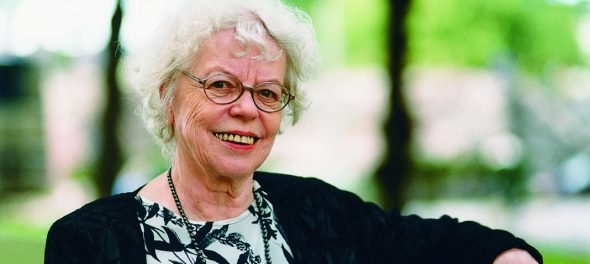
Aila Meriluoto. Photo: Pertti Nisonen
When Aila Meriluoto burst on to the world of Finnish poetry 40 years ago in the autumn of 1946 she was at once hailed as a youthful prodigy. Praised lavishly by the leading critics, the 22-year-old poet’s first collection, Lasimaalaus, sold in phenomenal numbers: in a couple of years it went through eight editions, or 25,000 copies, which in Finland is still a record figure. Today total sales are well over 30,000.
Two poems attracted particular attention. One was Kivinen Jumala (‘God of stone’), a poem of defiance unleashed by the experience of wartime bombing, in which God is portrayed as having changed into a stone statue, and people as having hardened correspondingly. It was the first reaction of the younger generation to the war – abusive, strong and inevitable, the proclamation of the death of the kind, just God.
The other central poem of the collection was Lasimaalaus (‘Stained glass’) from which the collection took its name: a taut post-symbolist vision and a dazzling synthesis of the oneness of the world. Baudelaire, master of correspondances, might well have been satisfied with it. More…
About calendars and other documents
30 June 1982 | Archives online, Fiction, Prose
An extract from Sudenkorento (‘The dragonfly’, 1970). Introduction by Aarne Kinnunen
I now have. Right here in front of me. To be interviewed. Insulin artist. Caleb Buttocks. I have heard. About his decision. To grasp his nearly. Nonexistent hair and. Lift. Himself and. At the same time. His horse. Out of the swamp into which. He. Claims. He has sunk so deep that. Only. His nose is showing. How is it now, toe dancer Caleb Buttocks. Are you. Perhaps. Or is It your intention. To explain. The self in the world or. The world. In the self. Or is It now that. Just when you. Finally have agreed to. Be interviewed by yourself. You have decided. To go. To the bar for a beer?
– Yes. Can you spare a ten?
– Yes.
– Thanks. See, what’s really happened is that. My hands have started shaking. But when I down two or three bottles of beer, that corpse-washing water as I’ve heard them call it, my hands stop shaking and I don’t make so many typing errors. If I put away six or seven they stop shaking even more and the typing mistakes turn really strange. They become like dreams: all of a sudden you notice you’ve struck it just right. Let’s say, ‘arty’ becomes ‘farty’. Or I mean to say, ‘it strikes me to the core’ I end up typing ‘score’. It’s like that. A friend of mine, an artist, once stuck a revolver in my hand. Imagine, a revolver! I’ve never shot anything with any kind of weapon except a puppy once with a miniature rifle. My God, how nicely it wagged its tail when I aimed at it, but what I’m talking about are handguns, those shiny black steelblue clumps people worship as heaven knows what symbols. It’s not as if I haven’t been hoping to all my life. And now, finally, after I’d waited over fifty years, it turned out that the revolver was a star Nagant, just the kind I’d always dreamed of. So if I ever got one of those, oh, then would sleep through the lulls between shots with that black steel clump ready under my pillow. Well, my friend the artist set out one vodka bottle with a white label and three brown beer bottles with gold labels on the edge of a potato pit – we had just emptied all of them together – stuck the fully loaded star Nagant into my hand, took me thirty yards away and said:
– Oh, Lord. More…