

Search results for "tommi+musturi/2010/05/song-without-words/2009/09/what-god-said/2011/04/matti-suurpaa-parnasso-1951–2011-parnasso-1951–2011"
Time difference
30 December 2003 | Fiction, Prose
A short story from Kalliisti ostetut päivät (Dearly bought days, Otava, 2003)
She arrived at the airport too early, as always. The reason was not that connections from the small town in which she lived were slow and difficult, or even that she liked the airport’s atmosphere of swift departures and long waits. No; she wanted to spend time at the airport to see that the planes took off and landed without anything awful happening. She wanted to see that a departing plane’s acceleration was rapid, that the plane left the asphalt of the runway elegantly, that its tail did not hit the ground as it rose, break, the plane explode, catch fire, but that, like an arrow fired into the air, following its flight path, it curved upward and, sunlight glancing off the metal of the body, disappeared from view. She wanted to see that the landing gear of a descending plane was out, as it should be, that a tyre did not burst as it hit the ground, at that there was no ice or oil on the runway; that the brakes worked, and that the fire engines at the edge of the airfield stayed in place as a sign that all was well. More…
Two men in a boat
The meaning of life, Bob Dylan, the broken thermostat of the Earth, the authors Ambrose Bierce and Aleksis Kivi…. Two severely culturally-inclined men set out to row a boat some 700 kilometres along the Finnish coastline, and there is no shortage of things to discuss. Extracts from the novel Nyljetyt ajatukset (‘Fleeced thoughts’, Teos, 2014)
The red sphere of the sun plopped into the sea.
At 23.09 official summertime Köpi announced the reading from his wind-up pocket-watch.
‘There she goes,’ commented Aimo, gazing at the sunken red of the horizon, ‘but don’t you think it’ll pop back up again in another quarter of an hour, unless something absolutely amazing and new happens in the universe and the solar system tonight!’
Aimo pulled long, accelerating sweeps with his oars, slurped the phlegm in his throat, spat a gob overboard, smacked his lips and adjusted his tongue on its marks behind his teeth. There’s a respectable amount of talk about to come out of there, thought Köpi about his old friend’s gestures, and he was right.
‘Sure thing,’ was Aimo’s opening move, ‘darkness. Darkness, that’s the thing. I want to talk about it and on its behalf just now, now in particular, while we’re rowing on the shimmering sea at the lightest point of the summer. More…
That remarkable man
31 December 1988 | Archives online, Fiction, poetry
Poems by Lauri Viita. Introduction by Kai Laitinen
Alfhild
Mothers alone, endowed
with hope, see God.
They’re given strength and given will,
to climb in dream from under the cloud,
and look from a higher hill.
Alfhild, she who gave me birth,
nightly sailed away from earth
to where her Eemeli growled his say,
coming and going, as he did in his day.
Now they walk
the bright star track,
father and mother, looking back
at the little hill and the family home,
the cats, the dogs, the people they’ve known,
waving and calling as best they can
lest any of us trip on Pispala’s stone.
On a distant planet on a garden swing
under a rowan they linger and cling
and silently remember their light and dark
as a courting couple in Tampere Park –
and if it was payday, the extra fun
of tucking away a coffee and bun. More…
An officer and a gentleman
31 December 2004 | Archives online, Authors, Reviews
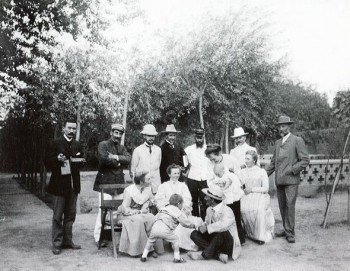
A moment in the Chinese garden: from left, Eric Macartney. Kashgar, China, 1906. Photo: C.G.E. Mannerheim
A photograph from 1906 prompted Markus Nummi to write a 500-page novel about the people of the caravan route in China. One of his characters, the Finnish photographer and spy-explorer Carl Gustaf Mannerheim, in reality later became Finland’s sixth president. Where does fiction end and history begin? Anna-Leena Nissilä investigates
The city of Kashgar in Chinese Turkestan in the year 1906: a group of French explorers and a crowd of Swedish missionaries from the local province, along with other members of the European community and their children, have gathered together in an orchard to take a picture. Midilimanglar, keep still, says the photographer, Baron Carl Gustaf Mannerheim, and presses the shutter release. The admonition is without effect; the picture turns out restless. Little Eric can’t hold still; a baby girl is grabbing at a man’s hat; the adults are looking past the camera. For some reason the host of the event, an Englishman named Macartney, is standing a pace away from the rest of the group.
Almost a century later, the author Markus Nummi (born 1959) runs across Mannerheim’s snapshot and becomes inspired. He tells how the expansive and thematically wide-ranging historical novel Kiinalainen puutarha (‘The Chinese garden’, Otava, 2004) began to form around the photograph:
‘The photograph is the starting point for everything, the intersection and blink of an eye in which all of my story’s central characters are close to another. I was fascinated by the picture’s bustle: people looking every which way, all the fumbling about. And when you look at the picture more closely, you start to see different kinds of connections; when you look at where these people were coming from and where they went in their lives, you can start to imagine what is hidden behind the picture. I started to contemplate what the photographer saw at the moment the picture was taken, maybe angels?’ More…
Favour and fame: becoming a best-seller
10 April 2014 | In the news
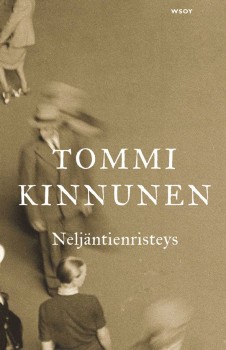 At the top of the list of best-selling books – compiled by the Finnish Booksellers’ Association – in March was the first novel by Tommi Kinnunen, a teacher of Finnish language and literature from Turku. In Neljäntienristeys (‘The crossing of four roads’, WSOY) the narrative spans a century beginning in the late 19th century and is set mainly in Northern Finland, focusing on the lives of four people related to each other. Undoubtedly well-written, it continues the popular tradition of realistic novels set in the 20th-century Finland.
Finland is a small country with one exceptionally large newspaper, Helsingin Sanomat (read by more than 800,000 people daily). The annual literary prize that carries the paper’s name is awarded to a best first work, and candidates are assessed throughout the year.
In February the paper’s literary critic Antti Majander declared in his review of Kinnunen’s book: ’Such weighty and sure-footed prose debuts appear seldom. If I were to say a couple of times in a decade, I would probably be being over-enthusiastic. But let it be. Critics’ measuring sticks are destined for the bonfire.’ More…
Encounters with a language
12 December 2014 | Articles, Non-fiction
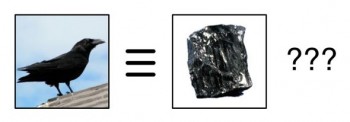
Mistranslation: illustration by Sminthopsis84/Wikimedia
Mother tongue: not Finnish. How do people become interested enough in the Finnish language in order to become translators? In the olden days some might have been greatly inspired by the music Sibelius (as were the eminent British translators of Finnish, David Barrett or Herbert Lomas, for example, back in the 1950s and 1960s). We asked contemporary translators to reminisce on how they in turn have become infatuated enough with Finnish to start studying and translating this small, somewhat eccentric northern language. Three translators into English, one into French, German and Latvian tell us why
Still selling best
8 May 2014 | In the news
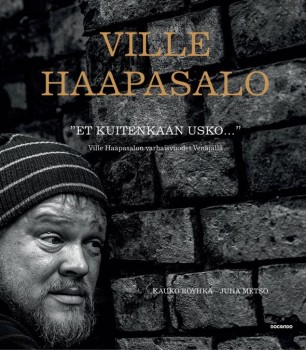
Celebrity in Russia: Ville Haapasalo on the cover of Et kuitenkaan usko… (’You won’t believe it anyway…’)
Not a lot of new titles made it to the list of the best-selling books – compiled by the Finnish Booksellers’ Association – in April, it seems. Number one on the Finnish fiction list was still Tommi Kinnunen’s first novel, Neljäntienristeys (‘The crossing of four roads’, WSOY).
In March this title reached the top after favourable reviews – in the Helsingin Sanomat daily paper in particular. The narrative spans a century beginning in the late 19th century and takes place in the Finnish countryside.
Number two – again – was another first novel about problems arising in a religious family, Taivaslaulu (‘Heaven song’, Gummerus, 2013) by Pauliina Rauhala. Number three was the latest crime/police novel by Seppo Jokinen, Mustat sydämet (‘Black hearts’, Crime Time).
On the translated fiction list, after George R.R. Martin’s A Dance with Dragons – top of the list in March too – is Donna Tartt’s The Goldfinch. Another donna (Donna Leon) was number three with her Beastly Things.
On the non-fiction list number one was a book on the Finnish actor / television journalist Ville Haapasalo’s life – and adventures during his travels in Russia, where he is a big celebrity and film star – by Haapasalo, Kauko Röyhkä and Juha Metso (Docendo). Number two was an autobiographical book by Katri Helena, a pop star who began her career in the 1960s.
The selection among the 20 best-selling books included, as usually, autobiographies and biographies, cookery, books about birds and nature. And Moomins. Books about Moomins and their creator Tove Jansson (1914–2001) certainly will rule this year – Jansson’s centenary.
The matchstick
31 March 1998 | Archives online, Children's books, Fiction
A fairy-tale, first published in the literary yearbook Svea (Stockholm) in 1879. Introduction by Esa Sironen
The matchstick lay for the first time in its new box on the factory table and thought about what had happened to it so far during its short life. It could still dimly remember how the big aspen tree had grown on the river bank, how it had been felled, sawed, and finally planed into many thousand small splinters of which the match was one. After that, it had been sorted into piles and rows with its friends, dipped in horrible melting pans, put out to dry, dipped again and finally placed in the box. This was not really a remarkable fate, nor a great heroic deed. But the match had acquired a burning desire to do something in the world. Its body was made from the timorous aspen, which is constantly a-quiver because it is afraid that the faint evening breeze might grow into a gale and tear it up by the roots. It so happened, however, that the match’s head had been dipped in stuff that makes one ambitious and want to shine in the world, and so a struggle developed, as it were, between body and head. When the inflammable head, fizzing in silence, cried: ‘Rush out now and do something!’ the cautious body always had an objection ready, and whispered: ‘No, wait a little, ask and find out if it’s time yet!’ More…
Hatefully yours
23 December 2011 | Non-fiction, Tales of a journalist
Illustration: Joonas Väänänen
In the new media it’s easy for our pet hatreds to be introduced to anyone who is interested. And of course everyone is interested, how else could it be? Jyrki Lehtola investigates
Twitter, Facebook, Twitter, Twitter, Twitter, Facebook, Twitter, how can we get the revenue model to work by using our old media, Twitter, Facebook, Twitter, Twitter, hey, what about that revenue model of ours, Twitter.
The preceding is a poignant summary of what the Finnish media was like in 2011 when the rules of the game changed like they have changed every year. And we still don’t even fully understand what the game is supposed to be. More…
Like father, like daughter
31 March 1999 | Archives online, Fiction, Prose
Extracts from Tom Tom Tom (Gummerus, 1998). Introduction by Soila Lehtonen
A father and daughter in a hospital back garden
Bits of nail flick to the ground as Kokko cuts Tom’s nails, leaving rather brittle nail-ends among the lichen. In the middle of the hospital afternoon they’ve made their way down to the little park, to care for the hands of both of them, all four.
In the days before Africa Tom used to nurse Kokko on the living-room sofa and cut the nails on her most difficult hand, pushed the cuticles back and taught her the care that ought to be taken of nails, or she’d have smarting and pain round the cuticles. Kokko used to plead to be taken into his nail cutting lap oftener than she should, even when she’d really have preferred to grow longer nails. More…
Best-selling books in September
15 October 2010 | In the news
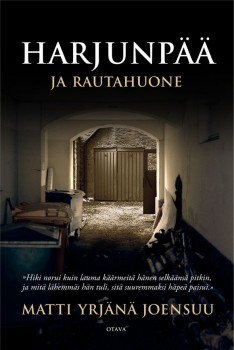 In September, Finns read crime novels. Matti Yrjänä Joensuu’s latest book featuring his police protagonist Timo Harjunpää, Harjunpää ja rautahuone (‘Harjunpää and the iron room’, Otava), topped the Booksellers’ Association of Finland’s best-seller list.
Joensuu’s Harjunpää ja pahan pappi was published in English in 2006 and reissued in 2008 under the title Priest of Evil. A film adaptation will be released in Finland in late October, directed by Olli Saarela and starring Peter Franzén in the title role.
Number two was the latest thriller from the pseudonymous Ilkka Remes, Shokkiaalto (‘Shock wave’, WSOY), and number three was Leena Lehtolainen’s Minne tytöt kadonneet (‘Where have all the young girls gone’, Tammi).
Sofi Oksanen’s record-breaking seller and critical success Puhdistus (WSOY; English edition: Purge, Atlantic Books) held strong in fourth place.
In translated fiction, Paul Auster, Diana Gabaldon ja Paulo Coelho headed the list.
The non-fiction list was topped by a study of sociability and social skills by Liisa Keltikangas-Järvinen (Sosiaalisuus ja sosiaaliset taidot, WSOY). Readers seem to be interested in survival, as the number two book was in a similar vein, Lilli Loiri-Seppä’s Selviämistarinoita (‘Stories of coping’ – also translatable as ‘Stories about getting sober’, Gummerus), about how to stop drinking.
Walt Disney was missing again from the top of the children’s list, the number one and number two spots being taken by Finnish picture books, Tatu ja Patu supersankareina (‘Tatu and Patu as superheroes’, Otava) by Aino Havukainen and Sami Toivonen, and Hurja-Harri ja pullon henki (‘Scary Harry and the genie in the bottle’, Otava) by the veteran graphic artist and children’s book author Mauri Kunnas. A new installment of the Ella storybook series by Timo Parvela, Ella ja Yön ritarit (‘Ella and the Knights of the Night’, Tammi) held the number three spot. In September, Finns read crime novels. Matti Yrjänä Joensuu’s latest book featuring his police protagonist Timo Harjunpää, Harjunpää ja rautahuone (‘Harjunpää and the iron room’, Otava), topped the Booksellers’ Association of Finland’s best-seller list.
Mirkka Lappalainen: Jumalan vihan ruoska. Suuri nälänhätä Suomessa 1695–1697 [The lash of God’s wrath. The Great Famine in Finland 1695–1697]
7 September 2012 | Mini reviews, Reviews
 Jumalan vihan ruoska. Suuri nälänhätä Suomessa 1695–1697
[The lash of God’s wrath. The Great Famine in Finland 1695–1697]
Helsinki: Siltala, 2012. 262 p., ill.
ISBN 978-952-234-140-2
€25.50, hardback
There were two major famines in Finnish history: the Great Famine of 1695–97 and the hunger years of 1867–68. Basing her work on the latest research, historian Mirkka Lappalainen has written a general study of the earliest and most deadly years of crop failure. The famine struck Europe just as it was experiencing the main phase of the so-called Little Ice Age. Finland was one of the worst affected countries, as it had only just begun to derive a living from agriculture, and nearly a third of its population died. Finland was governed by the autocratic, centralised great power Sweden; frosts and rains destroyed hundreds throughout the kingdom, but the magnitude of the disaster in Finland was increased by the bureaucratic inertia of the centre in distributing aid, as well as the emergency food (moss, for example) which caused intestinal disorders, and the spreading of disease by beggars. The aid was also distributed unequally within the regions of Finland. In her book Lappalainen describes the fates of kings, gentry and rural poor as reflected in sources that include letters and official court records.
Translated by David McDuff