

Search results for "tommi+musturi/2010/05/song-without-words/2009/09/what-god-said/2011/04/matti-suurpaa-parnasso-1951–2011-parnasso-1951–2011"
Do you remember the yellow house?
14 February 2011 | Fiction, Prose
Extracts from the novel Enkelten kirja (‘The book of angels’, Tammi, 2010)
[Tallinn, summer] The past will not go away
and the present is insurmountable. Summer vacation has begun, the newspaper hasn’t come; it doesn’t get delivered here anyway. Can you remember the Isabelline yellow house? Remember the alley with the name that means hurry? Surely you remember the home with all the maps on the shelves, the important papers and the brass objects bought from nearby antique dealers? Also the rugs from North Africa and the obligatory cedar camel figurines on the windowsill. And so many glasses and plates and empty lighters in a cardboard box on the shelf on the left hand side of the kitchen.
Tallinn, June 7th. The floors creak. One step has split in half; some of the lights have burned out. This is a lovely home. A small window upstairs is ajar to the courtyard. Tuomas had latched it behind the Virginia creepers. The fountain in the courtyard is dry. On cold nights the smoke from the fireplace grows like a statue for the crows until it wraps around over the layered rooftops like a snake eating its tail. Russian men are repairing the attic of the house across the street for wealthy people to live in; they laugh in front of the window and smoke. Tuomas waves at them, and they wave back. The courtyard is creepy when it’s empty. Soon the neighbours would go about their day and quietly close their doors behind them, and two nearby churches would divide the hours into quarters, Russians and their gossip would make their way to the Alexander Nevski Cathedral, and the Estonians and their gossip would go to their own churches where a wise and peculiar, almost human scent would rise from between the headstones. Tuomas wouldn’t smell it, Aino would and would move to stand beneath the the center tower. More…
The snake
31 March 1998 | Fiction, Prose
In this horror story by the Finland-Swedish author Kjell Lindblad (born 1951), a man believes he is wandering among art installations in an apartment block – but the reality he is experiencing turns out to be much more sinister. From the collection of short stories Oktober-mars (‘October-March’, Schildts, 1997)
I only noticed the poster on the notice board in the vegetarian restaurant because it was so obviously different from the rest of the colourful items there, with their large headlines offering everything from Atlantic meditation to Zen ping-pong, together with promises of a new and fulfilled life in harmony with the soul and the cosmos. Poster is perhaps an overstatement it was a white sheet of paper with an egg-shaped oval in the middle. Inside the oval there was a horizontal row of seven numbers. For some reason, perhaps because the row of numbers was the only information on the piece of paper, it stuck in my memory and when I got home I had a compulsive desire to find out if it was a phone number. So I dialled the number and a tape-recorded voice that could have belonged to a man but equally well to a woman, said:
‘We bid you welcome. Please don’t write down the address just memorise it….’ More…
The pursuit of happiness
30 June 1996 | Archives online, Fiction, Prose
Extracts from the novella Ilo (‘Joy’, Helsinki Media, 1995)
‘The flower is a characteristic feature of the highest group of the plant kingdom – the flowering plants – and is the name given to the association or organs, more or less leaf-like in form, which are concerned with the production of the fruit or seed.’
Encyclopaedia Britannica, 1910
The encyclopedia made us happy. But what was happiness? That the encyclopedia did not say. You had to set out to look for it. Our exploratory party represented the highest achievements of the field: it would be difficult to find a more serious or committed group.
When we waved to the people cheering on the quay, we were overcome by a strange feeling. It was as if we had already arrived. I made the mistake of speaking my thought aloud.
‘It will all end in tears,’ remarked our welfare officer, Mrs Rose. The atmosphere was ruined. What a pity that our quick-witted Doctor Stratelli was not present at that moment! For it was he who solved the problem of happiness.
Speaking with silence
26 September 2013 | Reviews
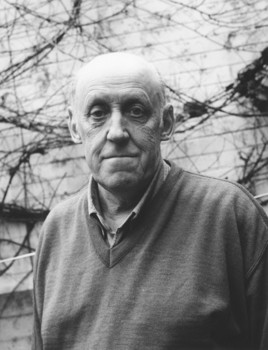
Bo Carpelan. Photo: Charlotta Boucht / Schildts & Söderströms
Bo Carpelan
Mot natten
[Towards the night. Poems 2010]
Helsinki: Schildts & Söderströms, 2013. 69 p.
ISBN 978-951-52-32-20-5
€21, paperback
‘Don’t change, grow deeper ,’ wrote Bo Carpelan: over the years he broadened his poetic range and his personal idiom evolved, but it happened organically, without sudden upheavals of style or idea.
Mot natten (‘Towards the night’) is Carpelan’s last collection of poems. This is underlined by the book’s subtitle, Poems 2010. By then Carpelan (1926–2011) was already marked by the illness that took his life in early 2011. It doesn’t show in the quality of the poems, but knowing it may make it harder for the reader to approach them with unclouded eyes. When a great poet concludes his work one wants to seek a synthesis or a concluding message, and that may encumber one’s reading. So is there such a message? In some ways there is, but Carpelan was not a man of pointed formulations. His ideals emerged without much fuss. More…
The fairest in the land
26 January 2012 | Children's books, Fiction
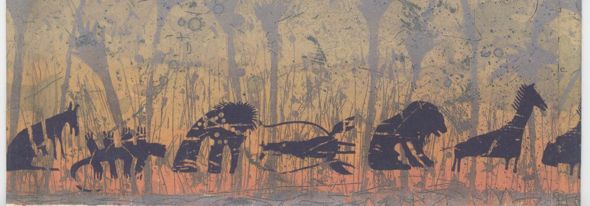 Two fables from Gepardi katsoo peiliin (‘The cheetah looks into the mirror’, Tammi, 2003). Illustrations by Kirsi Neuvonen. (More fables by Hannele Huovi here.)
Lizard
The air rippled above the pile of stones. The lizard twitched her hip and took up an s-shaped pose like an ordinary photo model. After a moment she changed her left side to a convex curve. The movement was quick and graceful; the lizard’s tail swished through a broad arc so quickly you could hardly see it. Her thin, blistery skin pressed against the surface of the stone. The lizard felt the rough, raised patterns through the thin skin of her belly. She felt unpleasant, but otherwise the place was good, and the lizard did not have the energy to look for a better one. She looked through her eyelashes at the fissured sky and saw the golden disc shining at the centre of the dome. She was happy. Everything in her life was good, the weather was pleasantly dry, the temperature exactly suitable. More…
Notes related to pharmacist Pemberton’s holy nectar
Extracts from the novel Vådan av att vara Skrake (‘The perils of being Skrake’, Söderström & Co.; Isän nimeen, Otava, 2000)
At the time of Werner’s stay in Cleveland Bruno and Maggie had already been divorced for some years, and in an irreconcilable manner. But they were still interested in their grown-up son, each in their own way; Maggie wrote often, and Werner replied, he wrote at length, and truthfully, for he knew that Bruno and Maggie no longer communicated; to Maggie he could admit that he hated corporate law and bookkeeping, and to her he dared to talk about the raw music he had found on the radio station WJW, he wrote to her that the music of the blacks had body and that he had found a great record store, it was called Rendezvous and was situated on Prospect Avenue and there he had also bought a ticket for a blues concert, wrote Werner, he thought that Maggie would understand. More…
Troubled waters
31 March 2005 | Archives online, Fiction, Prose
Extracts from the novel Den amerikanska flickan (‘The American girl’, Söderströms, 2004). Introduction by Pia Ingström
Doris Night&Sandra Day, Sandra Night&Doris Day: those were their alter ego identities for the game, which also involved the smiles they’d practised in front of the mirror at the bottom of the empty swimming pool, in the house in the muddier part of the woods.
‘We’re two clairvoyant sisters,’ said Doris Flinkenberg. ‘We got that way because of tragic circumstances. The poltergeist phenomenon. Do you know what that is?’
Sandra Wärn shook her head, but looked expectantly at Doris, the perennial crossword – solver, with dictionary to hand, who continued. ‘It’s when the innocent child has been badly abused and has developed supernatural powers in order to survive. Powers to see behind what’s there,’ Doris Flinkenberg explained. ‘To see what no one else can see.’
‘You and I, Sandra,’ Doris confirmed. ‘We were badly abused. I with my scars and you with your tragic family background, your mother and her lover, all of that. You and I, Sandra, we know what it is to suffer.’ More…
Once upon a time…
13 January 2012 | Articles, Non-fiction
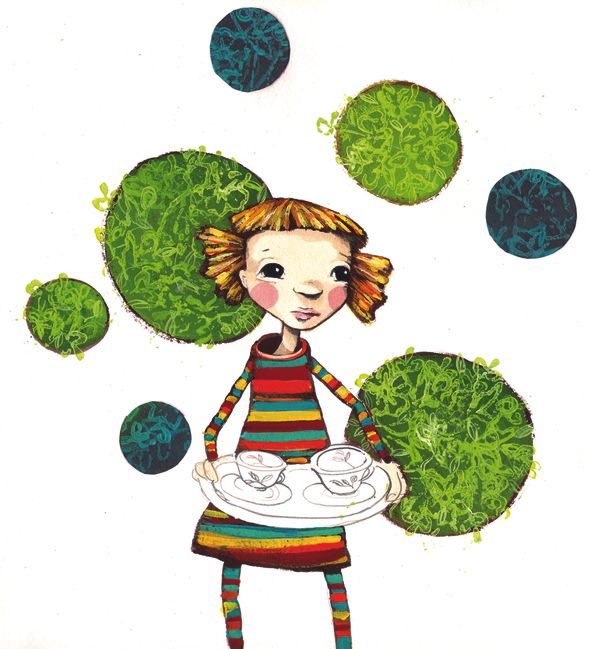
Sari Airola's illustration in Silva och teservisen som fick fötter (‘Silva and the tea set that took to its feet’, Schildts) by Sanna Tahvanainen
The future of book publishing is not easy to predict. Books for children and young people are still produced in large quantities, and there’s no shortage of quality, either. But will the books find their readers? Päivi Heikkilä-Halttunen takes a look at the trends of 2011, while in the review section we’ve picked out a selection of last year’s best titles
The supply of titles for children and young adults is greater than ever, but the attention the Finnish print media pays to them continues to diminish. Writing about this genre appears increasingly ghettoised, featuring only in specialist publications or internet chat rooms and blogs.
Yet, defying the prospect of a recession, Suomen lastenkirjakauppa, a bookshop specialising in children’s literature, was re-established in central Helsinki in autumn 2011, following a ten-year break. Pro lastenkirjallisuus – Pro barnlitteraturen ry, the Finnish society for the promotion of children’s literature, has been making efforts to found a Helsinki centre dedicated to writing and illustration for children. The society made progress in this ambition when it organised a pilot event in May 2011. More…
Manmother
31 December 2002 | Archives online, Fiction, Prose
Extracts from the novel Granaattiomena (‘Pomegranate’, WSOY, 2002). Introduction by Kristina Carlson
The journey
Mother had sent her son to the island of Rome.
She’d sent him for pleasure and recreation, and also to have a little time by herself. Even though their life together was on an even keel, it was sensible to have some time away from each other. She herself was sixty-eight, and her son an unmarried hermit in his thirties, on sickness allowance for the last couple of years. He was afflicted with chronic depression. The doctors had been unable to identify the cause. The origin of a disorder of that sort was often looked for in some infant trauma; but the boy’s childhood, from all appearances, had been harmonious. One doctor suspected the time of his father’s terminal illness, when the boy had had to nurse his father for a long while. More…
Dead calm
31 December 2007 | Fiction, Prose
Extracts from the novel En lycklig liten ö (‘A happy little island’, Söderströms, 2007)
In the beginning the computer screen was without form, and void, and the scribe’s fingers rested on the keyboard.
The scribe bit his lower lip. His gaze travelled like a fly from the workroom’s crowded bookshelves to the rocking chair in front of the window and the coloured prints of birds on the walls. He went out into the kitchen and drank some water. Then he sat down in front of the computer again.
To create from nothing a fictitious world assisted only by the tools language places at our disposal, surely that must be a great and exacting undertaking!
The scribe hesitated and racked his brains for a long time before finally typing the first word: ‘sky’. Then after long thought he typed another word: ‘sea’. More…
The show must go on
30 June 2007 | Archives online, Fiction, Prose
Extracts from the novel Piru, kreivi, noita ja näyttelijä (‘The devil, the count, the witch and the actor’, Gummerus, 2007). Introduction by Anna-Leena Ekroos
‘I hereby humbly introduce the maiden Valpuri, who has graciously consented to join our troupe,’ Henrik said.
A slight girl thrust herself among us and smiled.
‘What can we do with a somebody like her in the group? A slovenly wench, as you see. She can hardly know what acting is,’ Anna-Margareta snapped angrily.
‘What is acting?’ Valpuri asked.
Henrik explained that acting was every kind of amusing trick done to make people enjoy themselves. I added that the purpose of theatre was to show how the world worked, to allow the audience to examine human lives as if in a mirror. Moreover, it taught the audience about civilised behavior, emotional life, and elegant speech. Ericus thought that the deepest essence of theatre was to give visible incarnation to thoughts and feelings. None of us understood what he meant by this, but we nodded enthusiastically. Anna-Margareta insisted that, say what you will, in the end acting was a childish game. Actors were being something they were not, just like children pretending to be little pigs or baby goats. More…
When sleeping dogs wake
31 December 1994 | Archives online, Fiction, Prose
Extracts rom the novel Tuomari Müller, hieno mies (‘Judge Müller, a fine man’, WSOY, 1994). Introduction by Soila Lehtonen
In due course the door to the flat was opened, and a stoutish, quiet-looking woman admitted the three men, showed them where to hang their coats, indicated an open door straight ahead of them, and herself disappeared through another door.
After briefly elbowing each other in front of the mirror, the visitors took a deep breath and entered the room. The gardener was the last to go in. The home help, or whatever she was, brought in a pot of coffee and placed it on a tray, on which cups had already been set out, within reach of her mistress. The widow herself remained seated. They shook hands with her in tum. The mayor was greeted with a smile, but the bank manager and the gardener were not expected, and their presence came as a shock. She pulled herself together and invited the gentlemen to seat themselves, side by side, facing her across the table. They heard the front door slam shut: presumably the home help had gone out. More…
To live, to live, to live!
31 December 2001 | Archives online, Fiction, poetry
From Kaukainen puutarha (‘A distant garden’, WSOY, 1924). Introductions by Vesa Mauriala and Leena Krohn
Flowering earthThe earth’s spilling out purple lilac clusters, To live, to live, to live! So what if death’s coming! |
Kukkiva maaMaa kuohuu syreenien sinipunaisia terttuja. Elää, elää, elää! Mitä siitä, että kuolema tulee! |
Winning stories of alternative realities
10 February 2011 | In the news
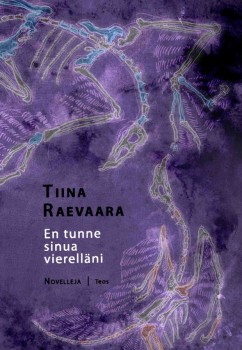 The Runeberg Prize for fiction, awarded this year for the twenty-fifth time, went to a collection of short stories by Tiina Raevaara.
Her En tunne sinua vierelläni (‘I don’t feel you beside me’, Teos, 2010) mixes fantasy and realism, dealing with, for example, animal kingdom, human mind and artificial intelligence. See the introduction and translation of a story which we ran here on the Books from Finland website.
Raevaara (born 1979) holds a doctorate in genetics; the prizewinner is her second work of fiction. The prize, worth €10,000, was awarded on 5 February – the birthday of the poet J.L Runeberg (1804–1877) – in the southern Finnish city of Porvoo.
The jury – representing the prize’s founders, the Uusimaa newspaper, the city of Porvoo, both the Finnish and Finland-Swedish writers’ associations and the Finnish Critics’ Association – chose the winner from a shortlist of eight books: a collection of poetry, Vagga liten vagabond (‘Swing, little wanderer’, Söderströms) by Eva-Stina Byggmästar, the novel Poikakirja (‘Boys’ Own Book’, Otava) by Olli Jalonen, the novel Kiimakangas (WSOY) by Pekka Manninen, two collections of essays, Kuka nauttii eniten (‘Who enjoys most’) by Tommi Melender and Halun ja epäluulon esseet (‘The essays of desire and suspicion’) by Antti Nylén (both publlished by Savukeidas), a collection of poetry, Texas, sakset (‘Texas, scissors’, Otava) by Harry Salmenniemi and another collection of short stories, Apatosauruksen maa (‘The land of the apatosaurus’, WSOY) by Miina Supinen.