

Search results for "tommi+musturi/2010/05/song-without-words/2009/09/what-god-said/2011/04/matti-suurpaa-parnasso-1951–2011-parnasso-1951–2011"
Three short stories
30 June 1987 | Archives online, Fiction, Prose
from Väärinkäsityksiä (‘Misconceptions’). Interview by Markku Huotari
Love
Kaija couldn’t understand why she felt like laughing all the time.
‘As for me, what I stand for is good old-fashioned courtesy,’ he pointed out.
He’d got a soft, low, caressing voice. He rested his hand on Kaija’s shoulder. They’d got that far already. Kaija had decided to say yes, even though he hadn’t suggested anything yet. She was beginning to picture luxurious rooms, gourmet dishes, expensive drinks, and tender, passionate lovemaking.
‘Socially I’m a radical,’ he said. ‘Culturally a liberal, but in personal things an unshakeable conservative. A woman, in my view, is to be respected – I don’t consider that damaging to her independence. Too often, in today’s world, equality’s used to justify what are quite simply bad manners.’ More…
Animals, thy neighbours
30 March 2005 | Authors, Reviews

Sirkka Turkka. Photo Tomi Kontio
‘Everyone’s always in a hurry. In the grave it stops.’
In her new volume Sirkka Turkka (born 1939) appears as an even greater and more pitiless poet. Niin kovaa se tuuli löi (‘So bitterly the wind struck’, Tammi, 2004) – her twelfth volume, the first having being published in 1973 – is an unadorned and searching portrayal of death and the grief that accompanies it. It takes a thoroughly mature poet to handle major feelings as uninhibitedly as she does, and without letting the empathetic glow fade under the documentation.
Animals have always played an important role in Turkka’s somewhat melancholy but vital verse, with its highly individualised concrete language. In 1987 she received the Finlandia Literature Prize for her Tule takaisin, pikku Sheba (‘Come back, little Sheba’, Tammi, 1986; see Books from Finland 4/1988). Little Sheba was a small dog, one of the poet’s dearest friends. Turkka has worked as a stable manager, and horses are frequently central in her work. Domestic and farm animals are always a presence, and here they appear as tokens of the fragility of life and mortality. A hare, a horse, a dog and a lamb are among the animals whose deaths are dramatised. More…
New from the archives
19 February 2015 | This 'n' that
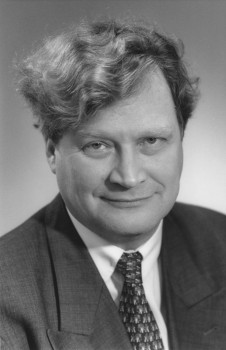
Jarkko Laine. Photo: Kai Nordberg
Our archive find this week is ‘The 101 year anniversary celebration’, a short story by Jarkko Laine.
‘Child of Marx and Coca-Cola’, ‘Nordic beatnik’, Jarkko Laine (1947-2006) published his first work, a volume of poetry entitled Muovinen Buddha (‘Plastic Buddha’) in the 1960s and was immediately hailed as the mouthpiece of his generation. He went on to make his career as a literary all-rounder – poet, writer, playwright, translator, long-time editor of the literary magazine Parnasso and chair of the Finnish Writers’ Union. His wryly ironic story, ‘The 101 year anniversary celebration’ tells the story of what every writer must dread: a guest appearance in a local library where literature from the local town, let alone further afield, is regarded with suspicion.
We’ve also unearthed a 1989 interview, by our late, genial editor-in-chief Erkka Lehtola with a grey-suited Laine who looks more like a civil servant than a 1960s radical – but still doesn’t let a day go by without writing.
*
The digitisation of Books from Finland continues apace, with a total of 360 articles and book extracts made available online so far. Each week, we bring a newly digitised text to your attention.
In memoriam Kai Laitinen 1924–2013
14 March 2013 | In the news
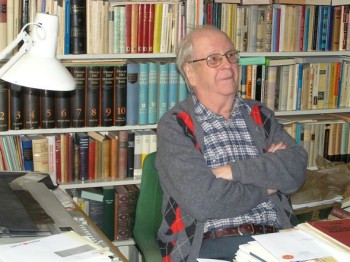
Kai Laitinen. Photo: Ilkka Välimäki (the literature archive/Finnish Literature Society, 2006)
The journalist, critic, author and professor Kai Laitinen died on 11 March in Helsinki, aged 88.
He began his literary career as a critic in the daily paper Helsingin Sanomat in 1950. As the Editor-in-Chief of the new literary journal Parnasso he was able to promote the new trends in modernist fiction and poetry which began to flourish in post-war Finland.
Laitinen’s academic career at Helsinki University involved serving as Associate Professor and Professor of Finnish literature (1975–1989). From the 1950s onwards he was actively involved in the work of dozens of literary societies, publications and organisations, both in Finland and abroad.
Among his publications are two collections of essays, a book of memoirs and two popular books on history of literature: Suomen kirjallisuus 1917–1967 (‘Finnish literature 1917–1967’) and a more concise work, Suomen kirjallisuuden historia (1981‚ Literature of Finland in Brief), which has been published in eleven languages.
Kai Laitinen was appointed Editor-in-Chief of Books from Finland in 1976 when the little magazine, then in its tenth year, began to take the form of a proper literary journal and to be published by Helsinki University Library. He held the job until 1989.
In issue 4/1977 of Books from Finland, on the theme of the 60th anniversary of Finland’s independence and the changing role of literature, Kai wrote in the editorial: ‘Literature is, and must be, much more than a chronicle of national and social history, or the mere accumulation of changing styles and genres. So often it is an author’s critical insight or his struggle against prevailing literary norms that gives birth to the works of the greatrest artistic importance. One of the main tasks of literature, both on a national and a human level, can be summed up succinctly in two lines from T.S. Eliot’s Little Gidding – “To purify the dialect of the tribe / And urge the mind to aftersight and foresight.” This comes close to describing what Finnish literature has achieved over the past sixty years.’
T.S. Eliot was the poet who perhaps had a permanent place in Kai’s personal literary cosmos – he introduced Eliot’s poetry to Finnish readership in the late 1940s. This passage, from Little Gidding, might well serve as his epitaph.
….We shall not cease from exploration
And the end of all our exploring
Will be to arrive where we started
And know the place for the first time.
In the beginning was… DNA?
8 October 2010 | Reviews
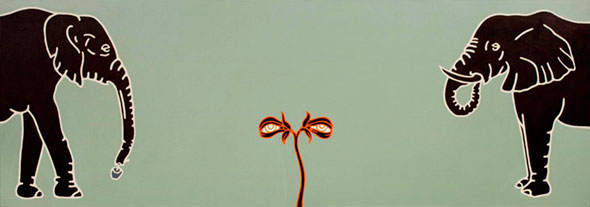
Adam and Eve, or the elephants: Osmo Rauhala’s sketch of The Fall of Man. As the bull eats the apple, evil rises from the ground in the form of a plant with eyes: a ‘misbreed’, a cross of two species alien to each other
Kuutti Lavonen – Osmo Rauhala – Pirjo Silveri
Tyrvään Pyhän Olavin kirkko – sata ja yksi kuvaa /
St Olaf’s Church in Tyrvää – One Hundred and One Paintings
Toim. / Edited by Pirjo Silveri
Translations: Silja Kudel, Jüri Kokkonen
Helsinki: Kirjapaja, 2010. 143 p., ill.
ISBN 978-952-247-103-1
€44.30, hardback
The old shingle roof of the early 16th-century stone church of St Olaf in Tyrvää, in the province of Pirkanmaa, southern Finland, was repaired by village volunteers in 1997. Three weeks after they completed their work, a drunken arsonist set the church on fire. More…
How Real is a Dead Person?
30 September 1979 | Archives online, Fiction, Prose
An Extract from the Novel Sirkus (‘Circus’). Introduction by Pekka Tarkka
Once again I seem to be moving towards a deeper understanding of these people who figure in my recollections, most of whom, by now – by this particular Friday I am now experiencing – are already dead. And this, in its turn, sets me wondering about the degree of reality, if any, that they can claim to possess. How real is a dead person? Is he, perhaps, totally unreal? In memories, of course, he is real to the extent that the memories themselves are real. But objectively, independently of memory? But here a sadness comes over me, many-headed, hard to take hold of.
And in any case I think it is time I came to a clearer understanding of the economic circus founded by my grandfather Feodisius. Uncle Ribodisius has also already made the front pages of the newspapers, and the Bilbao has published an interview.
But I have left a picture unfinished. Father’s cardboard boxes! The separation from Dianita – and from the children! And I have broken off in the middle of these curious memoirs of mine. Thinking of which, I find myself grinding to a halt again, stuck with Yellow-Handed Fred and Haius and Desmer, Lesmer and Sesmer – until I realize that instead of coming to a clearer understanding of my grandfather’s economic circus, I am on Lesmer’s estate, one evening in late May – a couple of months ago – listening to the trilling of an unusually talented song-thrush. Perched on the top of a tall spruce, he goes through the repertoire of all the other birds he has ever heard, both native and foreign – creating, however, new combinations of his own; not content with mere mimicry, he rattles, croons, wails, whistles, whirrs, twitters, flutes, sighs, chirrups and shouts his way through a complete set of variations on themes provided by the rest of the bird world: like some rather advanced medieval chronicler who, no longer content to record faithfully (if perhaps chaotically, as Auerbach points out) what he saw, heard, thought and smelt, had begun to create personal shapes and entities – thus preparing the way for the greatest miracle in the history of world literature, the advent of the perceptive reader. More…
Incident at Experience Farm
30 September 1998 | Archives online, Fiction, Prose
A short story from Pakkasyön odottaja (‘Waiting for a frosty night’, WSOY, 1997). Introduction by Jukka Petäjä
I
The round steel teapot is new. Father brought it back from Birmingham, where he went on a visit with the others from the concrete factory. In the shop, the teapot was wrapped in rustling, soft tissue paper. Pirjo was given the honour of opening the package. The pot has been used for brewing tea ever since.
At school, her sister Karoliina is proud of the fact that at home they drink only tea; they are different from other people, different in a good way, one to be proud of. They have a real teapot. Sometimes, during breaktime, a morsel of the excellence of Karoliina Kamppinen falls Pirjo’s way. ‘Yes, let’s include her, she’s Karoliina’s sister, after all.’ More…
Death of a poet
31 December 1989 | Archives online, Articles
Over the last two decades, contemporary Finnish opera has not only become popular at home but has emerged as a significant force on the international music scene. Aulis Sallinen’s The Horseman, The Red Line and The King Goes Forth to France, and Joonas Kokkonen’s The Last Temptations all had their premieres in the 1970s and 1980s and have already earned respected places in the repertory of the Finnish National Opera and the Savonlinna Opera Festival, where performances are sold out months in advance.
The visit by the National Opera to New York’s Metropolitan Opera House in 1983 attracted widespread attention from press and public alike, and its productions of The Red Line and The Last Temptations were for the most part enthusiastically received. Finnish opera earned further international prestige from the joint commissioning of Sallinen’s The King by the Royal Covent Garden Theatre in London and the Savonlinna Festival, and from later performances by companies in Germany and the United States. More…
Me and my shadow
Hotel Sapiens is a place where people are made to take refuge from the world that no longer is habitable to them; the world economy has fallen – like the House of Usher, in Edgar Allan Poe’s story – and with it, most of what is called a civilised society. A rapid synthetic evolution has taken humankind by surprise, and the world is now governed by inhuman entities called the Guardians. ‘Kuin astuisitte aurinkoon’ (‘As if stepping into the sun’) is a chapter from the novel Hotel Sapiens ja muita irrationaalisia kertomuksia (‘Hotel Sapiens and other irrational tales’, Teos, 2012), where several narrators tell their stories
The fog banks have dissipated; the sky is empty. I cannot see the sails or swells in its heights, nor the golden cathedrals or teetering towers. I would not have believed I could miss a fog bank, but that’s exactly what it’s like: its disappearance is making me uneasy. For all its flimsiness and perforations it was our protection, our shield against the sun’s fire and the stars’ stings. Now the relentlessly blazing sun has awakened colours and extracted shadows from their hiding places. The moist warmth has dried into heat and the Flower Seller’s herb spirals have dried up into skeletons. The leaves on the trees are full of bronze, sickly red and black spots. Though there is no wind and autumn is not yet here, they come loose as if of their own volition, as if they wanted to die.
This morning, as I was strolling up and down the park path as usual, I saw another shadow alongside my own.
– Ah, you’re back! I said. – I wondered what had happened to you after you lost your shadow; how did you manage to change into your own shadow yourself? More…
The Onlookers
30 September 1978 | Archives online, Fiction, Prose
A short story from Naisten vuonna (‘In women’s year’, 1975). Introduction by Pekka Tarkka
The two elks came out on to the road through a gap between timber sheds. They began to cross the road, and the larger one was very nearly run into by a car. Cars stopped and horns tooted, till the elks turned and made off towards the harbour. Several cars swung round and drove along the cinder track in pursuit of the animals.
The elks headed across the rubble towards the power station; after circling some stacks of railway sleepers, they ended up on the flank of a coalheap sixty feet high. The cars pulled up and their occupants poured out, shouting that the elks wouldn’t go that way, it was a dead end. The elder of the two elks had indeed sensed this, and they moved off to the right, skirting the coal-heap and emerging among the timber-stacks. By this time the first cyclists and pedestrians had arrived on the scene.
“They’ll break their legs,” said a pedestrian to a motorist. “There’s all kinds of junk lying about.” More…
The blow-flower boy and the heaven-fixer
31 December 1984 | Archives online, Fiction, Prose
A short story from Puhalluskukkapoika ja taivaankorjaaja (‘The blow-flower boy and the heaven-fixer’, 1983). Interview by Olavi Jama
Cold.
A chill west wind came over the blue ice. It went right to the skin through woollen clothes. Shivers ran up and down the spine, made shoulders shake.
In the bank of clouds close to the horizon, right where the icebreaker had crunched open a passage to the shore, hung a pale blotch, a substitute for the sun. It gave off more chill than warmth.
Lennu’s teeth were chattering.
He wore a buttoned-up windbreaker, a hand-me-down from Gunnar, over a heavy lambswool shirt. It couldn’t keep off the cold. More…
The many arms of Krishna
14 August 2014 | Extracts, Non-fiction
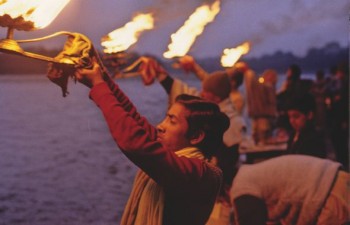
A feast by the Ganges. Photo from Pirjo Honkasalo’s film Atman
Cinematographer, camerawoman and director Pirjo Honkasalo has travelled and filmed widely – Japan, Estonia, India, Chechnya, Ingushetia, Russia – and her documentary films in particular have gained fame. American film critic John Anderson interviews Honkasalo; they talk about her documentary film Atman (1996) about a pilgrimage in India.
Edited extracts from Armoton kauneus. Pirjo Honkasalon elokuvataide (‘Merciless beauty. The film art of Pirjo Honkasalo’, Siltala, 2014; translated from English into Finnish by Leena Tamminen)
You can almost catch a whiff of the Ganges watching Atman [Hindu term, ‘self’], a documentary film in which religious pilgrimage, devotion, exhilaration and hysteria compete with tormented bodies, physical mortification, corpses, pollution and the acrid smoke of ritual cremation for domination of the viewer’s senses. The fact that it won the top prize at the International Documentary Film Festival Amsterdam in 1996 proves there is, if not justice, then good taste in the world. With all due respect to her previous work, Atman signified the full manifestation of Honkasalo’s genius.
What is it about? Eternity. Also, Jamana Lal: a member of the low-caste of Baila, a wifeless, crippled devotee of Lord Shiva whose mother has died, and who must – according to Hindu tradition – take her ashes from the ostensible mouth of the Ganges to the foothills of the Himalayas. More…
Dog
30 September 2002 | Archives online, Fiction, Prose
A short story from Afrikasta on paljon kertomatta (‘Much is still untold about Africa’, WSOY, 2002). Introduction by Maria Säntti
You’re exactly what a dog should be, I told him. You’ve a black ear and a white one. You’re not too big and you’re not all teeth.
I stroked his black-spotted coat. He wagged his curly tail.
I crouched down. He squeezed up against my chest. I sent my ball rolling along the stairway corridor. He shot after it, accidentally running over the top of it. As he braked, his claws screeched on the tiles. Sparks went flying.
He snapped the ball in his jaws, nibbled its plastic and sent it back with a snuffle. His tongue was wagging with glee. Next I wanted to roll the ball so he wouldn’t get it. It bumped against the iron banister and went off in a different direction, skidding under the dog’s belly. He turned and dashed after it. More…
Here and there
11 September 2009 | Extracts, Non-fiction
Extracts and photographs from Jotain on tapahtunut /Something happened (Musta Taide, 2009; translation by Jüri Kokkonen)
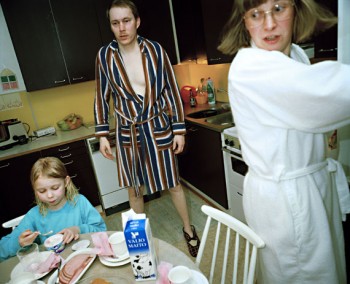 News photos document dramatic, dangerous or tragic incidents – but the photojournalist Markus Jokela is interested in documenting ordinary, domestic and everyday life, be it in Iraq, Russia, Biafra or Sri Lanka. These photographs, with commentaries, are taken from his new book, Jotain on tapahtunut / Something happened (2009), offering glimpses of life in contemporary Finland and in the United States
I’ve never been particularly enthusiastic about individual news photos, especially about taking them.
A good news photo has to state things bluntly and it has to be quite simple in visual terms. It must open up immediately to the viewer.
But the images in photo reportages do not have to scream simplified truths. They can whisper and ask, and open up gradually. One can come back to them. The reportage is something personal. Though a poor medium for telling about the complex facts of the world, it can provide experiences that survive. More…
Tchotchkes for the tsar
11 August 2011 | Reviews
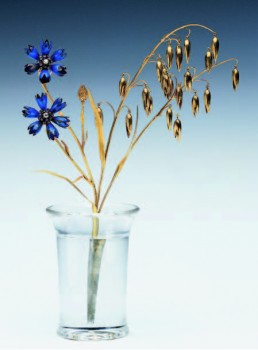
Cornflower and ear of oats: one of the several Fabergé gemstone ornaments now owned by Queen Elizabeth of England (gold, rock crystal, diamonds, enamel, ca 18 cm)
Ulla Tillander-Godenhielm
Fabergén suomalaiset mestarit
[Fabergé’s Finnish masters]
Design: Jukka Aalto/Armadillo Graphics
Helsinki: Tammi, 2011. 271 p., ill.
ISBN 978-951-31-5878-1
€57, hardback
In its online shop, the Hermitage Museum in St Petersburg sells a copy of a most delicate, enchanting little nephrite-and-opal lily of the valley that perfectly imitates nature, sitting in a vase made of rock crystal that looks like a glass of water.
These small flowers made of gold and gemstones were manufactured by the jeweller Fabergé a hundred years ago. The lily of the valley was the most frequently used floral motif in the Fabergé workshops – it was the favourite flower of Empress Alexandra (1872–1918), and the imperial family was the the foremost client of the world’s foremost jeweller.
The replica (13.5 centimetres high) is available at the Hermitage as a ‘luxury gift’ for the price of mere $3,300. (N.B. Since we published this review, the ‘luxury gift’ items seem to have disappeared from the Hermitage online shop selection, so we have removed the link. Several Fabergé egg replicas are available though, ranging in price from $200 upwards – link below.)
For those who feel the price is excessive, there is also a rather modestly-priced little bay tree (original: gold, Siberian nephrite, diamonds, amethysts, pearls, citrines, agates and rubies as well as natural feathers, about 30 centimetres tall, featuring a little bird that emerges flapping its wings and singing when a small key is turned) at just $ 219,95. Despite its form, it is classified as one of the famous imperial Easter eggs. (However, as I write, this item is unfortunately sold out…) More…