

Search results for "tommi+musturi/2010/05/song-without-words/2009/09/what-god-said/2011/04/matti-suurpaa-parnasso-1951–2011-parnasso-1951–2011"
The dog-man’s daughter
30 December 2001 | Fiction


 Extracts from the radio play Porkkalansaari (‘The island of Porkkala’, the Finnish Broadcasting Company, 1993)
The surface of the earth is the first to freeze; then the still waters. The sea freezes at the shore often at the same time, on the same night, as the slow-flowing brooks. I have watched them for many years. When you live in the same place for a long time, you notice this much: that almost everything just repeats and repeats.
It flows into a plastic tube. I suppose water flows inside it. You could drop matchsticks in on the other side of the road and wait on this side for them to swim through the drum. You’d only have to find one; that would be enough to prove it. More…
The devil has no clothes
31 December 2006 | Fiction, poetry
Poems from Idealrealisation (‘The ideal sale’, 1929)
Stockings
V
I thought:
it was a person,
but it was her clothes
and I didn't know
that it doesn't matter
and that clothes can be very
      beautiful
In the north
30 September 1988 | Archives online, Fiction, Prose
A short story from Luvaton elämä (‘Forbidden life’, 1987). Introduction by Tero Liukkonen
I
I went up north in a sleeping car. It was a relief to see that even in Tampere there was a sign on the car saying ‘Kemijärvi’. That meant I could sleep the whole way. I had the lower berth; a couple more like me were sleeping in the same compartment – just ordinary women. I was nevertheless silent and reserved, so that neither of them would want to make me into a travelling companion. And they did leave me in peace.
I read for a bit, till I began to feel more at home, and settled down to sleep with my woollen socks on. I deliberately went almost to sleep while not wanting to drop off completely; and I gradually reached a point where I didn’t know which direction the train was going in. That was liberating. It was all the same which direction we were going in. The motion of the train got through to my nerves and started releasing things. More…
Gustaf Mannerheim: Dagbok förd under min resa i Centralasien och Kina 1906–07–08 [Journal of my travels in Central Asia and China 1906–07–08]
11 February 2011 | Mini reviews, Reviews
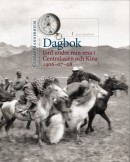 Dagbok förd under min resa i Centralasien och Kina 1906–07–08, Vol 1–3
[Journal of my travels in Central Asia and China 1906–07–08, Vol. 1–3]
Redaktör [Edited by]: Harry Halén
Bildredaktör [Photo editor]: Peter Sandberg
Helsingfors: Svenska litteratursällskapet i Finland, 2010. 1,128 p., ill.
ISBN 978-951-583-196-5 (complete set)
€ 80, hardback
Carl Gustaf Mannerheim (1867–1951), a Finnish officer in the Imperial Russian Army, later Commander-in-Chief of the Finnish Army and President of Finland, undertook a military reconnaissance mission, posing as an academic researcher, to Central Asia and China in 1906–1908. His journey on horseback across Asia to Peking also generated a wealth of ethnographic material: field notes, photographs and artefacts. In his travel diaries, Mannerheim describes the landscapes as well as his diverse encounters with the inhabitants of the areas he travelled through. During his visit to a Tibetan monastery, Mannerheim was pelted with stones by pilgrims. He gave the Dalai Lama an automatic pistol as a gift. These journals are now being published in full for the first time in their original language, Swedish, including Mannerheim’s own notes concerning his military mission. The photographs, some of which have never been published before, show that Mannerheim was a skilled photographer. Harry Halén, an expert in Central Asian languages and cultures, has contributed an extensive preface and copious notes.
Translated by Ruth Urbom
Winner of the Susan Sontag Prize
25 December 2010 | In the news
The Susan Sontag Foundation was established in New York in 2004 in memory of the celebrated author and cultural journalist Susan Sontag (1933–2004). The Foundation grants a prize to a young American who translates from other languages into English. In 2010 the prize was awarded for the third time.
Benjamin Mier-Cruz is currently pursuing his PhD in Scandinavian Languages and Literatures at University College Berkeley, with a particular interest in Finland-Swedish modernism and German expressionist poetry. His winning translation proposal is entitled Modernist Missives of Elmer Diktonius – Letters and Poetry of Elmer Diktonius.
Elmer Diktonius (1896–1961) was a rebellious Finland-Swedish avant-garde poet and composer, who was fluent in Finnish as well as his native Swedish. His letters to a wide range of European authors and critics, written between 1919 (the year of the Finnish Civil War) and 1951, reflect the political, artistic and personal developments in Finland and Europe.
The prize ceremony took place first in Helsinki on 5 November in a seminar at the Svenska litteratursällskapet i Finland (the Society of Swedish Literature in Finland), then at Scandinavia House, New York, on 12 November.
Elmo’s fire
30 June 2008 | Archives online, Fiction, Prose
Extracts from the novel Elmo (WSOY, 1978)
After returning to Finland and Kainalniemi, Elmo got to feel like a celebrity. The various sport clubs were insufferably keen on getting Elmo into their training rings, but Elmo rebuffed them. He had belonged to Kainalniemi Sweat since he was a little boy, and that was enough for him. His mind was occupied by other matters. In the end, even his mother and father began to wonder at his attitude.
‘Why don’t you just go, since they keep asking, and since you do seem to have some talent in that direction,’ his mother urged as she made Sunday coffee from the can Elmo had brought as a gift.
‘Right. Somewhere down the road you could snatch a few gold medals out from under the noses of the others, just for the hell of it,’ his father said. More…
Jorma Luhta: Tähtiyöt [Starry nights]
20 November 2009 | Mini reviews, Reviews
 Tähtiyöt
[Starry nights]
Helsinki: Maahenki, 2009. 84 p., ill.
ISBN 978-952-5652-75-8
€ 41, hardback
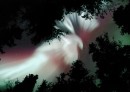
Jorma Luhta (born 1951) is an award-winning Finnish nature photographer and author. The subject material of this book is night-time in the forests of northern Finland, illuminated by the stars and the Northern Lights. The problem of light pollution means that even in sparsely populated Lapland the lights from population centres can hamper the view over a radius of two hundred kilometres. Jorma Luhta’s photographs are the result of many years of dogged effort. The most impressive images of all were taken on the coldest night in a century: temperatures fell to around –50 °C. It takes split-second precision to achieve the greatest shots, such as when Luhta’s camera records a sheet of Aurora Borealis resembling Picasso’s white dove of peace (above). In his lyrical text Luhta, a night-time walker in the woods, observes his natural surroundings and contemplates such matters as his fear of the dark and feelings of isolation.
End of the carnival
31 December 1991 | Archives online, Fiction, Prose
Extract from the novel Ottopoika (‘Otto the adopted’: Otava, 1991). Introduction by Pekka Tarkka
Verily, verily, keep peace with your God!
The way people are arranged in the courtroom means that Joseph Vissarionovich finds himself in the dock. All right, never mind, if they want to play games with Stalin: they’ll soon find out who comes off second best, very much second best.
The former politburo, led by Trotsky, has occupied the right wing of the front bench. Tanya, the girl from Petersburg, is sitting by Rykov, with her artificial leg under her arm, stuffing her pigtail in her mouth; she giggles and tries to stuff the other pigtail into Rykov’s mouth. Not succeeding, she spits in his face and pulls her skirt over her ears, revealing a small reddish quim. The 1925 politburo appears unmoved, but Trotsky jerks round enough for Stalin to see the axe sticking out of the back of his neck. Meanwhile, a susurrus of tut-tuttings goes round the courtroom. More…
The nursemaid
Lapsenpiika (‘The nursemaid’), a short story, first published in the newspaper Keski-Suomi in December, 1887. Minna Canth and a new biography introduced by Mervi Kantokorpi
‘Emmi, hey, get up, don’t you hear the bell, the lady wants you! Emmi! Bless the girl, will nothing wake her? Emmi, Emmi!’
At last, Silja got her to show some signs of life. Emmi sat up, mumbled something, and rubbed her eyes. She still felt dreadfully sleepy.
‘What time is it?’
‘Getting on for five.’
Five? She had had three hours in bed. It had been half-past one before she finished the washing-up: there had been visitors that evening, as usual, and for two nights before that she had had to stay up because of the child; the lady had gone off to a wedding, and baby Lilli had refused to content herself with her sugar-dummy. Was it any wonder that Emmi wanted to sleep? More…
Truth or hype: good books or bad reviews?
8 November 2013 | Letter from the Editors

‘The Bibliophile’s Desk’: L. Block (1848–1901). Wikipedia
More and more new Finnish fiction is seeing the light of day. Does quantity equal quality?
Fewer and fewer critical evaluations of those fiction books are published in the traditional print media. Is criticism needed any more?
At the Helsinki Book Fair in late October the latest issue of the weekly magazine Suomen Kuvalehti was removed from the stand of its publisher, Otavamedia, by the chief executive officer of Otava Publishing Company Ltd. Both belong to the same Otava Group.
The cover featured a drawing of a book in the form of a toilet roll, referring to an article entitled ‘The ailing novel’, by Riitta Kylänpää, in which new Finnish fiction and literary life were discussed, with a critical tone at places. CEO Pasi Vainio said he made the decision out of respect for the work of Finnish authors.
His action was consequently assessed by the author Elina Hirvonen who, in her column in the Helsingin Sanomat newspaper, criticised the decision. ‘The attempt to conceal the article was incomprehensible. Authors are not children. The Finnish novel is not doing so badly that it collapses if somebody criticises it. Even a rambling reflection is better for literature than the same old articles about the same old writers’ personal lives.’ More…
Air, blue and gold
16 January 2014 | Fiction, poetry
Poems. Introduction by Tuula Hökkä
The arch bridge
From Ylitse vuoren lasisen (‘Over the glass mountain’, 1949)
And God said: to others I’ll give other tasks, but the task I’ll give to you
is to make a curving bridge, my child, with an arch that’s round and true.
For everywhere around the earth human beings are laden with gloom,
and they’ll come to cross an arching bridge in their anguish and their doom.
Make a bridge that spans the precipice, a bridge over the abyss,
one that shines to my glory with radiance, sparkling like this.
I said: They will come with heavy boots, and heels caked with clay –
how can my bridge withstand their weight, yet also shine this way,
not tarnish or break apart as their crowding presence nears?
And God said: well, it can only be done by means of blood and tears.
Your heart is stronger than mountain rock, the ore that’s buried there –
Put a piece of it into the bridge support, and you’ll get the bridge to bear.
Add a piece of the hearts of those you love, and I know they won’t condemn,
but will surely grant you forgiveness if you make a bridge for them.
Make a bridge to the glory of God, my child, make a bridge with arching light
that will span the depths and shine for ever, with radiance sparkling bright.
Don’t lock the sorrow out of your heart as the bridge you make appears.
Nothing gleams more beautifully than the brilliance of pure tears. More…
The mighty word
15 November 2012 | Fiction, Prose
‘Mahtisana’, a short story from the collection Lapsia (‘Children’, 1895). Introduction by Mervi Kantokorpi
Mother and Dad hadn’t said a single word to each other since lunchtime. The children, Maija and Iikka, were quiet, too. They sat apart, Iikka on the chair at the end of the sofa, where he could see the moon through the window, and Maija next to the window looking out on the street, where children moved about on skis and sleds. They didn’t dare make a sound, not even a whisper to ask for permission to go outside. It had been so quiet all that Sunday evening that when Mother spoke, encouraging them to go out and play, both of them nearly jumped.
They left without saying a word, Maija creeping quite silently. Even out in the courtyard she and Iikka still spoke in whispers as they decided which hill to go to. They didn’t really want to go anywhere, but when they came out to the street and could hear the happy shouts of children from every direction, it refreshed their spirits. Maija sat Iikka down on the sled and set off at a run, pulling him behind her. She felt as if her gloomy mood was falling away in pieces to be trampled underfoot.
A few streets down there was a large crowd of boys on the corner. They decided to go and see what was happening. More…
Forest and fell
8 May 2013 | Reviews
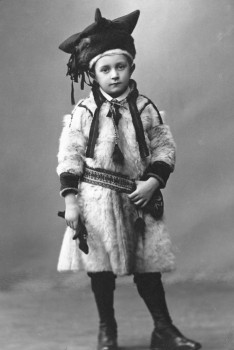
From North to South: young Heikki Soriola on his way to represent Utsjoki in Helsinki, in 1912. Photo from Saamelaiset suomalaiset
Veli-Pekka Lehtola
Saamelaiset suomalaiset: Kohtaamisia 1896–1953
[Sámi, Finns: encounters 1896–1953]
Helsinki: Suomalaisen Kirjallisuuden Seura, 2012. 528 p., ill.
ISBN 978-952-222-331-9
€53, hardback
Leena Valkeapää
Luonnossa: Vuoropuhelua Nils-Aslak Valkeapään tuotannon kanssa
[In nature, a dialogue with the works of Nils-Aslak Valkeapää]
Helsinki: Maahenki, 2011. 288 p., ill.
ISBN 978-952-5870-54-1
€40, hardback
The study of the Sámi people, like that of other indigenous peoples, has become considerably more diverse and deeper over recent decades. Where non-Sámi scholars, officials and clergymen once examined the Sámi according to the needs and values of the holders of power, contemporary scholarship starts out from dialogue, from an attempt to understand the interactions between different groups. More…
Life: facts and fiction
10 September 2014 | Extracts, Non-fiction
 In his latest book, the architect and author Arne Nevanlinna (born 1925) recalls, among other things, his Helsinki childhood and family, the wartime period, his fellow architect Alvar Aalto, various aspects of the spirit of the times, his own work and writings. His first novel Marie was published in 2008. Extracts from Arne. Oman elämän kintereillä (‘Arne. On the trail of one’s life’, Siltala, 2014)
My attitude to my own identity has developed from the unconsciousness of childhood, the uncertainty of early adulthood, the artificial arrogance of middle age and the self-analysis of approaching retirement, to my present situation.
Despite the fact that my first book had some degree of success, it took many books before I felt I was a real writer. The process continued for well over ten years, by which time I was already over eighty. Before that, I thought of writing as a way to pass the time and combat loneliness. I imagined that I was writing for a living, and that I lived in order to write. I was in the fortunate position of not to think about my income.
Even then, I knew that this was just a catchphrase for the event that it occurred to someone in the audience to ask me why I wrote. That never actually happened. No wonder, as both question and answer would have been unnecessary, to put it mildly, and stupid, to put it harshly. More…
The Monkey
30 June 1981 | Archives online, Fiction, Prose
A short story from Dockskåpet (‘The doll’s house’). Introduction and translation by W. Glyn Jones
The newspaper came at five o’clock, as it did every morning. He lit the bedside lamp and put on his slippers. Very slowly he shuffled across the smooth concrete floor, threading his way as usual between the modeling stands; the shadows they cast were black and cave-like. He had polished the floor since last making some plaster casts. There was a wind blowing, and in the light from the street lamp outside the studio the shadows were swaying to and fro, forced away from each other and then brought together again: it was like walking through a moonlit forest in a gale. He liked it. The monkey had wakened up in its cage and was hanging on to the bars, squealing plaintively. “Monk-monk,” said the sculptor as he went out into the hall to fetch his newspaper. On his way back he opened the door of the cage, and the monkey scrambled on to his shoulder and held on tight. She was cold. He put her collar on and fastened the lead to his wrist. She was a quite ordinary guenon from Tangier that someone had bought cheap and sold at a large profit: she got pneumonia now and then and had to be given penicillin. The local children made jerseys for her. He went back to bed and opened his newspaper. The monkey lay still, warming herself with her arms around his neck. Before long she sat down in front of him with her beautiful hands clasped across her stomach; she fixed her eyes on his. Her narrow, grey face betrayed a patience that was sad and unchanging. “Go on – stare, you confouded orangoutang,” the sculptor said and went on reading. When he reached the second or third page the monkey would suddenly and with lightning precision jump through the newspaper, but always through the pages he was finished with. It was a ritual act. The newspaper is torn apart, the monkey shrieks in a triumph and lies down to sleep. It can give you some relief to read about all the worthless nonsense that goes on in the world every morning at five o’clock and then to have it confirmed that it is worthless nonsense when the whole lot is made unreadable by a great hole being made through it. She helped him to get rid of it. More…