

Search results for "tommi+musturi/2010/05/song-without-words/2009/09/what-god-said/2011/04/matti-suurpaa-parnasso-1951–2011-parnasso-1951–2011"
You@me
30 September 1999 | Authors, Interviews

Photo: Liisa Takala
In Leena Krohn’s novel, Pereat mundus (1998) the central role is played by a number of characters called Håkan. All of them are different, living in different times and different places, but they are still Everymans: you and me. In the following e-mail interview, Maria Säntti asks Krohn about her relationship with language, imagination, the world – and virtual reality
Date: Fri Jul 23 18:04:24 1999 To: Leena Krohn <krohn@kaapeli.fi> From: Maria Santti <maria@kaapeli.fi> Subject: Let the interview begin!
Dear Leena,
I have just read Pereat mundus, which I like very much. I have many questions to ask you about it; I shall try to gather my thoughts, but I think I am troubled by the problem of the first sentence. I am alarmed even to contemplate the maze of questions and answers the first question will lead us to.
Over the past thirty years you have published a couple of dozen collections of poetry, short stories and essays, and, since Tainaron (1985), ‘novels, sort of’. This is how Pereat mundus defines its own genre on its title page. Sometimes your works incline toward novels, as in Umbra, 1990, sometimes toward collections of short stories – Matemaattisia olioita ja jaettuja unia (‘Mathematical creatures and shared dreams’, 1992) and sometimes collections of essays – Rapina ja muita papereita (‘Rustle and other papers’, 1989). How did you find this open ‘epistolary novel’ form for your work? More…
Letter to the wind
30 September 2002 | Archives online, Fiction, Prose
A short story from Haapaperhonen (‘The butterfly’, Gummerus, 2002). Introduction by Kristina Carlson
When Father comes to visit me, he sometimes sings a hymn. I can’t ask him not to. But when he doesn’t, I wonder why not, whether there’s something up with him. I can’t ask him to sing, but something is missing, the same thing that there seems to be too much of when he sings. It’s too much, but I miss it when it’s not there. I wonder about it after Father’s gone; my thoughts curl into dreams and I sleep.
When I sleep I don’t know I’m here, in a strange place. I’m at home, sleeping at home, in my own bed. The window is the right size, not too big like it is here; here there isn’t really a window at all, half the wall is missing and instead there’s glass. Behind a glass wall it’s not safe, everything is taken through it, including me. But sleep takes me to safety; I’m at home there. I breathe it peacefully. In the cabin there are two breathings, mine and Turo’s, and in the bedroom Father’s breathing. They are in no hurry to drive time away; time can linger, sleep, the moment of night, and when sleep withdraws there is no hurry either; I can sit in peace on the window seat and gaze at the cloudy, moonlit yard. The apple tree is asleep; it’s the only one. The fieldfares ate the apples before we could pick them, but it did not bother me or Father. It was good to look at the flock of fieldfares making a meal of the apple tree. Then they went away. More…
Ulla Jokisalo & Anna Kortelainen
Pins and needles
11 May 2011 | Essays, Non-fiction
In these pictures by Ulla Jokisalo and texts by Anna Kortelainen, truths and mysteries concerning play are entwined with pictures painted with threads and needles. Jokisalo’s exhibition, ‘Leikin varjo / Guises of play’, runs at the Museum of Photography, Helsinki, from 17 August to 25 September.
Words and images from the book Leikin varjo / Guises of play (Aboa Vetus & Ars Nova and Musta Taide, 2011)
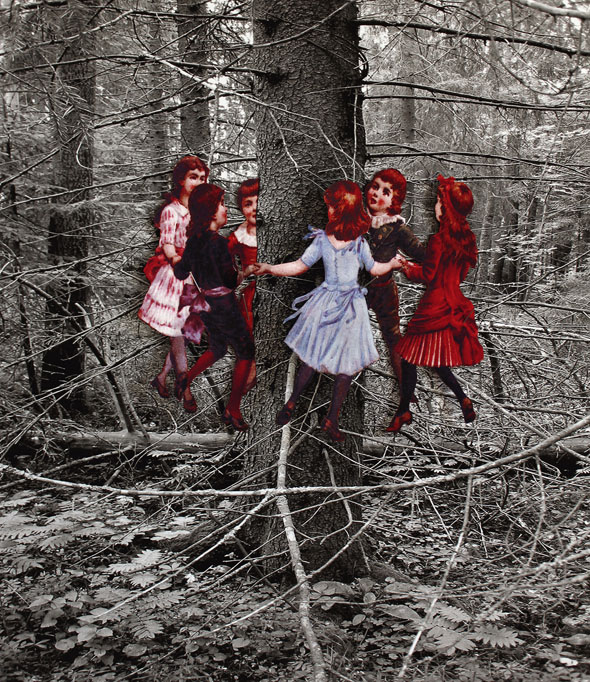
‘Ring dance’ by Ulla Jokisalo (pigment print and pins, 2009)
Words like songs
The Finnish poet Helvi Juvonen (1919–1959) often studies small things: moles, lichen, bees and dwarf trees; she ‘doesn’t often dare to look at the clouds’. But small is beautiful; her nature poems and fairy-tales mix humility and the celebration of life. Commentary by Emily Jeremiah
Cup lichen
Luke 17:21
The lichen raised its fragile cup,
and rain filled it, and in the drop
the sky glittered, holding back the wind.
The lichen raised its fragile cup:
Now let’s toast the richness of our lives.
From Pohjajäätä [‘Ground-ice’], 1952) More…
A rare bird from Fancyland
20 August 2013 | Reviews
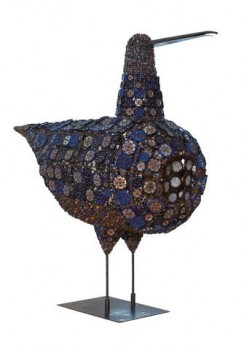
Bead-covered curlew, 1960. Height ca. 115 cm, Collection Kakkonen. Photo: Niclas Warius
Harri Kalha:
Birger Kaipiainen
Helsinki: Suomalaisen Kirjallisuuden Seura (The Finnish Literature Society), 2013. 249 p., ill.
(Summaries in Swedish and English)
ISBN 978-952-222-457-6
€46, hardback
Ceramics confectioner. Degenerate aristocrat. Ornamental criminal. These epithets can be found in Birger Kaipiainen, a new, full-length study of the ceramic artist by art historian Harri Kalha.
Throughout his artistic career Birger Kaipiainen (1915–1988) worked with forms, subjects and methods that were unfamiliar in the field of traditional ceramics, at least in mid-20th-century Finland, and made use of fantasy and ornament. As a ‘porcelain painter’ he showed little interest in the technical challenges of clay – although in his ceramic creations Kaipiainen explored three-dimensional form, montage, colour, texture and the tactile dimensions of the medium. More…
The Vatican
30 September 1986 | Archives online, Fiction, Prose
A short story from Maan ja veden välillä (‘Between land and water’, 1955). Introduction by Pirkko Alhoniemi
At the top of the hill there was a cow barn with all kinds of trash scattered along its walls: rusty pails, pottery shards, old shoes, all the stuff country people toss onto rubbish heaps. The clucking of chickens and bleating of sheep filled the air. As I was running across the barnyard I had an idea that a chicken had probably just laid an egg on the grass or was looking for some place to lay an egg, because it was letting out such sharp scolding cries.
Many of us were running across the yard and in back of the cow barn. If I hadn’t been on my way to the Vatican I would have stayed to pat a calf that was rubbing its side against a wall of the cow barn in the glow of the rising sun. But I was in a hurry. I didn’t dare let the women out of my sight because I couldn’t find the way by myself, I couldn’t even remember exactly where I had joined the crowd. I had just seen them running by and while I hadn’t intended to start off for the Vatican just that day, I went along with them anyway. More…
I, Vega Maria Eleonora Dreary
30 December 2008 | Archives online, Fiction, Prose
Extracts from the novel Chitambo (Schildts, 1933)
I was born in 1893, of course. That, as everyone knows, is the proudest year in the history of Nordic polar research. It was the year in which Fridtjof Nansen began his world-famous voyage to the North Pole aboard the Fram. Mr Dreary viewed this as a personal distinction and a sign that fate had fixed its gaze on him. He at once took it for granted that I was destined for great things, and he showed much skill in fostering the same foolish idea in me…. More…
Round and round
2 December 2011 | Essays, Non-fiction
In this essay, Olli Löytty imagines himself in a revolving door that is able to spin his old family home and its inhabitants backwards in time – as far as prehistory. In addition to his own family’s past, Löytty zooms back into the history of the world’s great changes, for a moment playing the part of a cosmic god examining our globe
An essay from Kulttuurin sekakäyttäjät (‘Culture-users’, Teos, 2011)
If a film camera had stood outside my home from the time when it was built, I would rewind the movie it made from the end to the beginning. The story would begin with my children, one autumn morning in 2011, walking backwards home from school. The speed of the rewind would be so fast that they would quickly grow smaller; I, too, would get thinner and start smoking. I would curiously seek out the point where my wife and I are seen together for the last time, stepping out of the front door, back first, and setting out on our own paths, to live our own separate young lives.
At that time my grandmother still lives in the house with her two daughters and their husbands, and lodgers upstairs. The next time I would slow the rewind would be the point where, at the age of 18, finally move out of the house. The freeze-frame reveals a strange figure: almost like me, but not quite. In the face of the lanky youth I seek my own children’s features.
When I let the film continue its backwards story, I seek glimpses of myself as a child. Even though we lived in distant Savo [in eastern Finland], we went to see my grandmother in the city of Tampere relatively often. We called her our Pispala grandmother, although her house was located to the west of the suburb limit, in Hyhky. I follow the arrival of my grown-up cousins, their transformation into children, the juvenation of my grandmother and her daughters, the changing lodgers. At some point the film becomes black-and-white. More…
And the winner is… Finlandia Prize for Fiction 2014
27 November 2014 | In the news
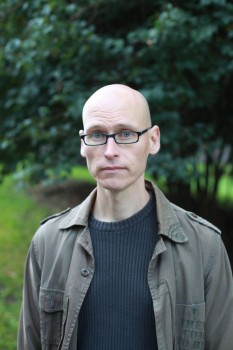
Jussi Valtonen. Photo: Markko Taina
The winner of the prize this year, worth €30,000 and awarded on 27 November, is He eivät tiedä mitä he tekevät (‘For they know not what they do’, Tammi) by Jussi Valtonen (born 1974), a psychologist and writer. The novel – 558 pages – is his third: it focuses on the relationship of science and ethics in the contemporary world, with an American professor of neuroscience, married to a Finn, as the protagonist.
Professor Anne Brunila – who has worked, among other posts, as a CEO in forest and energy industry – chose the winner. In her awarding speech she said: ‘The novel is an astonishing combination of perceptive description of human relationships, profound moral and ethical reasoning, science fiction and suspense…. I have never encountered a Finnish portrayal of our present era that is anything like it.’
The other five novels on the shortlist of six were the following:
Kaksi viatonta päivää (‘Two innocent days’, Gummerus) by Heidi Jaatinen is a story of a child whose parents are not able to take care of her; Olli Jalonen’s Miehiä ja ihmisiä (’Men and human beings’, Otava) focuses on a young man’s summer in the 1970s. Neljäntienristeys (‘The crossing of four roads’, WSOY), a first novel by Tommi Kinnunen, is a story set in the 20th-century Finnish countryside over three generations. Kultarinta (‘Goldbreast’, Gummerus) by Anni Kytömäki is a first novel about generations, set in the years between 1903 and 1937, celebrating the Finnish forest and untouched nature. Graniittimies (‘Granite man’, Otava) by Sirpa Kähkönen portrays a young, idealistic Finnish couple who move to the newly-founded Soviet Union to work in the utopia they believe in.
Daddy dear
30 June 2004 | Archives online, Fiction, Prose
Extracts from the novel Vanikan palat (‘Pieces of crispbread’, Otava, 2004). Interview by Soila Lehtonen
Dad’s at the mess again. Comes back some time in the early hours. Clattering, blubbing, clinging to some poem, he collapses in the hall.
We pretend to sleep. It’s not a bad idea to take a little nap. After a quarter of an hour Dad wakes up. Comes to drag us from our beds. Crushes us four sobbing boys against his chest as if he were afraid that a creeping foe intended to steal us. We cry too, of course, but from pain. Four boys belted around a non-commissioned officer is too much. It hurts. And the grip only tightens. Dad whines:
‘Boys, I will never leave you. Dad will never give his boys away. There will be no one who can take you from me.’ More…
The Paradox Archive
30 September 1991 | Archives online, Fiction, Prose
Extracts from the novel Umbra (WSOY, 1990). Introduction by Soila Lehtonen
The Paradox Archive
Umbra was a man of order. His profession alone made him that, for sickness was a disorder, and death chaos.
But life demands disorder, since it calls for energy, for warmth – which is disorder. Abnormal effort did perhaps enhance order within a small and carefully defined area, but it squandered considerable energy, and ultimately the disorder in the environment was only intensified.
Umbra saw that apparent order concealed latent chaos and collapse, but he knew too that apparent chaos contained its own order. More…
Six letters
31 March 1986 | Archives online, Fiction, Prose
From Tainaron (1985). Introduction by Soila Lehtonen
The whirr of the wheel
Letter II
I awoke in the night to sounds of rattling and tinkling from my kitchen alcove. Tainaron, as you probably know, lies within a volcanic zone. The experts say that we have now entered a period in which a great upheaval can be expected, one so devastating that it may destroy the city entirely.
But what of that? You need not imagine that it makes any difference to the Tainaronians’ way of living. The tremors during the night are forgotten, and in the dazzle of the morning, as I take my customary short cut across the market square, the open fruit-baskets glow with their honeyed haze, and the pavement underfoot is eternal again.
And in the evening I gaze at the huge Wheel of Earth, set on its hill and backed by thundercloud, with circumference, poles and axis pricked out in thousands of starry lights. The Wheel of Earth, the Wheel of Fortune… Sometimes its turning holds me fascinated, and even in my sleep I seem to hear the wheel’s unceasing hum, the voice of Tainaron itself. More…
The Session
30 June 1982 | Archives online, Fiction, Prose
Pappas flicka (‘Daddy’s girl’, 1982), an extract of which appears below, is published in Finland by Söderstrom & C:o and in Sweden by Norstedt. The Finnish translation is published by Tammi. Introduction by Gustaf Widén
At first I say nothing, as usual.
Dr Berg also sits in silence. I can hear him moving in his chair and try to work out what he’s doing. Is he getting out pen and paper? Or perhaps he has a tiny soundless tape-recorder he is switching on.
Or is he just settling down, deep down into his armchair, one leg crossed over the other, like Dad used to sit? I used to climb up on to his foot. The he would hold my hands and bounce his foot up and down, and you had to say “whoopsie” and finally with a powerful kick, he would fling me in the air so that I landed in his arms.
I have worked it out that the little cushion under my head is to stop us lunatics from turning our heads round to look at Herr Doktor.
It would certainly be nice to sit bouncing up and down on Dr Berg’s foot. His ankle would rub me between my legs …
I soon start feeling ashamed and blush.
“Mm,” says Dr Berg, as if reading my thoughts. Or can he see my face from where he is sitting? I try rolling my eyes up to catch a glimpse of him, but all I can see is the ceiling with all its thick beams.
“I seem to have been here before,” I say. More…