

Search results for "tommi+musturi/2010/05/song-without-words/2009/09/what-god-said/2011/04/matti-suurpaa-parnasso-1951–2011-parnasso-1951–2011"
Light songs and dark
4 August 2014 | Authors, Reviews
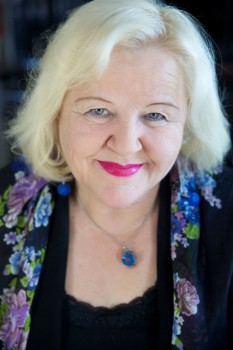
Aulikki Oksanen. Photo: Laura Malmivaara
On my wall at home are paintings given to me by the artist and poet Aulikki Oksanen. A watercolour from 1966 is a stylised depiction, a little in the manner of Modigliani, of a room with a girl by the window. In the background are a harbour and ships.
The work reminds me of the time when I got to know Aulilkki when we both moved in University Theatre circles and I visited her in the room shown in the painting. The flat was later the scene for Lapualaismorsian (‘Lapua bride’), a film which Aulikki (born 1944) took part in.
To me, with her blond, straight hair, she was like a beautiful, slender young filly, so I was not in the least surprised when her debut work included some enchanting horse symbolism. Her first book, an original, fresh collection of poems entitled Hevosen kuolema (‘Death of a horse’, 1966) gained immediate attention. More…
The joy of work
24 October 2011 | Fiction, Prose
Short prose from Sivullisia (‘Outsiders’, Like, 2011). Introduction by Teppo Kulmala
Since I’ve been unemployed, I started a blog called Outsiders. It soon came to serve as work, and I became dependent on its benefits. Although describing being an outsider helped to anaesthetise me, and verbalising all of my afternoons didn’t even take up all my time, the feedback that came in was reward enough. I wouldn’t have taken any other reimbursement anyway because of the restrictions set on recipients of government benefits. Increasingly frequently I found myself longing for more. Even a short blog comment about being an outsider felt even truer than what I with my self-employed, jobless person’s competence was able to achieve in relation to being sidelined as an unemployed person, regardless of what kind of manager I had been in my previous life. When asking for more accounts of other people’s well-being, I wanted them to use their own names. I justified this because I did not want to read lies, which often come from and lead to chatter in cafés and on the web. Apart from the pure enjoyment of being present, using one’s own name – even in wrong-headed topics or notions – makes it easier to approach the harsh laws of the working world. When one knows that by using one’s own signature one is dragging one’s family into the mire, including those who have gone before and those yet to come, one is able to blaze trails along which one can outflank the passive to activate another, equally unemployed. I did not place any further requirements on the other commenters besides first name and surname, as the rules had been drawn up by professionals in their own field. The regulator’s work also requires skill, if not a tremendous craving, for damming up another flood of text so that one’s own advantages do not have a chance to dry up. To facilitate reading for myself and others, I introduced only a couple of restrictions, which I imagined that I, too, would be able to adhere to. Only one side of a sheet of A4 was to be used – that is, one page – and what people wrote had to be true. Truth, beauty and quality ensured that everyone would begin what they had to say by writing about their current work. More stories, anecdotes, even poems piled up than the law permits me to read – much less compile – during working hours. For this book I have selected only 157 stories from the Greater Helsinki area for the sake of efficiency. The faster you can read the work, the less time it will distract you from your main job. I chose to limit things to the capital area so that the stories about well-being from individuals linked to this place would seem to form a more integral work, or document at least, about what was happening in the Big H, the centre of the nation, at the start of the millennium. I will publish the tales of work from beyond the outer ring road at some later stage, if I manage to come to an agreement with the writers concerning intellectual property rights. More…
Kullervo
31 March 1989 | Archives online, Drama, Fiction
An extract from the tragedy Kullervo (1864). Introduction by David Barrett
The plot of the Kullervo story as told in the Kalevala: Untamo defeats his brother Kalervo’s army, and Kalervo’s son Kullervo is born a slave. Untamo sells him as a young child to llmarinen whose wife, the Daughter of Pohjola, makes the boy a shepherd and bakes him a loaf with a stone inside it. Kullervo takes his revenge by sending home a flock of wild animals, instead of cattle, who tear her to pieces. He flees, and discovers that his parents and two sisters are alive on the borders of Lapland. He finds them, but one of his sisters is lost. Life in the family home is unhappy: Kullervo fails in all the tasks his father sets him. On his way home one day he finds a girl in the forest whom he abducts in his sledge and seduces. It turns out the girl is his lost sister, who drowns herself when she learns that Kullervo is her brother. Kullervo sets out to revenge himself on Untamo; he kills and destroys. When he returns home, he finds the house empty and deserted, goes into the forest and falls on his sword.
ACT II, Scene 3
Kalervo’s cottage by Kalalampi Lake. It is night-time. Kimmo, seated by a fire of woodchips, is mending nets. More…
Fairy tales updated
30 December 2008 | Authors, Reviews
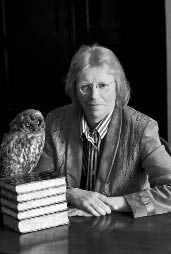
Jukka Itkonen. Photo: Irmeli Jung.
Päivi Heikkilä-Halttunen on Jukka Itkonen’s quirky fables
In Jukka Itkonen’s collection of fables for children, Sorsa norsun räätälinä (‘The mallard as tailor to the elephant’, Otava, 2008) the plots and heroes of traditional fairy tales are turned on their heads. This kind of parody drawing on old-time folktales has been introduced to Finnish readers by translations of the British author Babette Cole and her feminist-flavoured picture books. More…
What Finland read in February
28 March 2013 | In the news
Artist and painter Hannu Väisänen (born 1951) began writing an autobiographical series of novels in 2004. Born in the northern town of Oulu, he colourfully described his somewhat bleak childhood in a family of five children headed by a widowed soldier father. His fourth novel, Taivaanvartijat (‘The guardians of heaven’, Otava), is number one on the February list of best-selling Finnish fiction titles compiled by the Finnish Booksellers’ Association.
Number two is former number one, the Finlandia Prize -winning novel Is (‘Ice’, in Finnish Jää; also to be published in English, possibly later this year) by Ulla-Lena Lundberg.
The latest comic book by Pertti Jarla about the inhabitants of Fingerpori (‘Fingerborg’, Arktinen Banaani), Fingerpori 6, was number three.
In first and second place on the translated fiction list were Stephen King – (11/22/63) and J.R.R. Tolkien (The Hobbit or There and Back Again).
At the top of the non-fiction list is, for the second time, Kaiken käsikirja (‘Handbook of everything’, Ursa) by astronomer and popular writer Esko Valtaoja. In these hard times Finns seems also to be interested in economics, so number two was Talous ja utopia (‘Economics and utopia’, Docendo) by Sixten Korkman, professor and specialist in international and national economics.
Juhani Suomi: Mannerheim – viimeinen kortti? Ylipäällikkö-presidentti [Finland plays its last card – Mannerheim, Commander-in-chief and President]
30 April 2014 | Mini reviews, Reviews
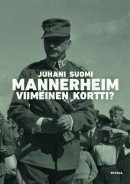 Mannerheim – viimeinen kortti? Ylipäällikkö-presidentti
[Finland plays its last card – Mannerheim, Commander-in-chief and President]
Helsinki: Siltala, 2013. 836 pp., ill.
ISBN 978-952-234-172-3
€32, hardback
In his book Professor Juhani Suomi – well-known as the biographer of President Urho Kekkonen – focuses on the life and actions of Marshal Gustaf Mannerheim (1867–1951) during the final phase of the Continuation War between Finland and the Soviet Union beginning in1943 and, in particular, during his term as Finnish President from 1944 to 1946. Mannerheim was elected President by exceptional procedure, and his difficult task was to lead Finland from war to peace, which he succeeded in doing. Suomi seeks to reply specifically to the question of whether Mannerheim lived up to the myth that was created about him, and of whether he was Finland’s last chance as the guarantor of the country’s independence during those fateful years, as he is often presented. On the basis of a number of sources, the author draws a critical portrait of an aristocrat: this was a man who was cold and vain, who at every turn thought mainly of his own posthumous reputation and who as an elderly leader was slow and fickle in his decisions – though the reader will not necessarily agree with all of Suomi’s conclusions. Well-written, occasionally a bit too detailed, his book vividly describes a dramatic period in Finland’s recent history.
Translated by David McDuff
In memoriam Paavo Haavikko 1931–2008
30 December 2008 | Authors, In the news
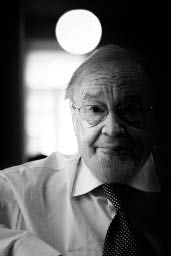
Paavo Haavikko. Photo: Kai Widell.
The poet, writer, playwright and publisher Paavo Haavikko died in Helsinki in October, at the age of 77.
Haavikko was one of Finland’s most internationally recognised writers, and his success was helped by many prominent poets’ interest in his lyric poetry. His work was translated by Anselm Hollo and Herbert Lomas (English), Manfred Peter Hein (German), Bo Carpelan (Swedish), and Gabriel Rebourcet (French), among others.
Haavikko debuted in 1951 as a lyric modernist who broke through all of modernism’s barriers. He was a master of intoxicating lyricism, and an intellectually discerning storyteller of general truths in his narrative poems. His collections Talvipalatsi (‘Winter palace’, 1959) and Puut, kaikki heidän vihreytensä (‘The trees, all their green’, 1966), in particular, have achieved the status of classics. More…
Tuula Kallioniemi: Rottaklaani [The rat clan]
24 February 2009 | Mini reviews
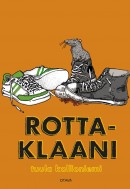 Rottaklaani
[The rat clan]
Helsinki: Otava, 2008. 192 p.
ISBN 978-951-1-23159-2
€ 16, hardback
Tuula Kallioniemi (born 1951) manages to deal with difficult issues without resorting to conventional solutions. Ykä, who is nearly 12, suffers from the normal anguish of early adolescence until the CP [cerebral palsy]-disabled Sami pushes his wheelchair into Ykä’s life. The boys decide to get the better of Antikainen who is bullying Sami, but in order to carry out their plan they need the help of quadraplegic Pete and Susanna, who has MBD [minimal brain dysfunction]. Kallioniemi’s literary prescription for the prevention of illness in young people is a simple one: we must all be friends with one other, be allowed to express wonder out loud, and remember that laughter is the best therapy. Kallioniemi’s merits are her verbal skills and her natural cultivation of situation comedy.
Studies in obsession
30 June 1981 | Archives online, Authors
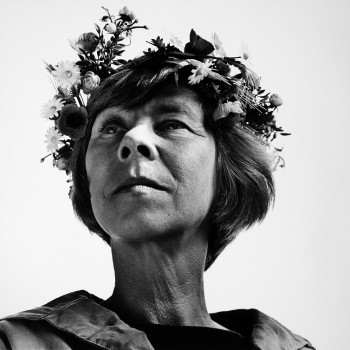
Tove Jansson. Photo: Hans Gedda
From Tove Jansson’s first short book, Småtrollen och den stora överstämningen (‘The little troll and the great flood’, 1945) to her latest volume of short stories, Dockskåpet (‘The doll’s house’, 1978 – see extracts 1 & 2), there is a great step, and few of the readers of that first children’s story could conceivably have foreseen just how far its writer was to go. Since her start in 1945 Tove Jansson’s reputation as the originator of the Moomintroll stories has become worldwide, and in one sense her own creation must have become a burden to her, not least because many of the themes which have emerged have been difficult to encompass within the Moomin framework. It is not easy for a writer who has created a reputation as a children’s author to break through what might be termed the ‘adult barrier’, but Tove Jansson has shown herself determined to do so, and with Dockskåpet she must surely have overcome any lingering doubts her readers may have had. Here is the adult writer, firmly in control of her art and delving into subjects far removed from the child mentality. More…
Ethics and the individual
31 March 1984 | Archives online, Authors, Interviews
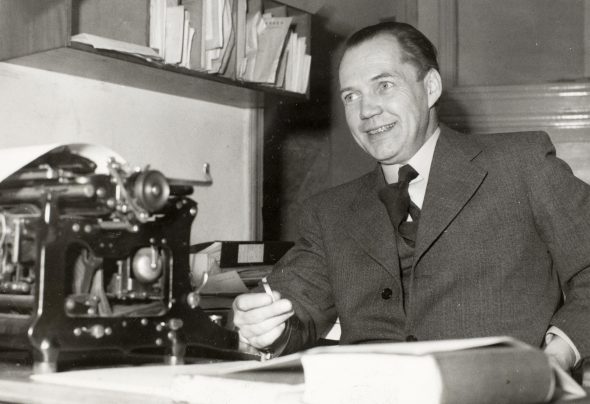
Walentin Chorell. Photo: SLS
Over one hundred stage and radio plays, twenty six novels, poetry – the extent of Walentin Chorell’s work, from the early 1940s to his death last November was huge. The Finland-Swedish writer was by profession a teacher of psychology; his writing sprang from a real need to analyze the psychological drama of human life, to study other people – and at the same time himself – through the medium of literature.
His last television play, Hyena, is to be shown in Finland this summer, and his last radio play, Utopia, is to be broadcast in the spring. Many of his radio plays have been translated into the other Nordic languages, and his works have been performed and published in more than twenty countries.
The 71-year old writer was interviewed by Glyn Jones in Helsinki two months before his death.
‘I would say that writing for radio is what gives me most satisfaction, for there no limits are placed on your imagination. There are no limits in either time or space. On the radio you can have one scene portraying your main character as a child, and in the next as an adult; you can quickly follow that main character from childhood to adulthood, and your listeners will believe in it. As for space, you can set one scene in Paris – and indicate this by making a hotel porter call out the number of a room in French – and the following one can be set in Stockholm or Helsinki, and you can do it so convincingly that your listeners will believe in it.’ More…
Fight Club
16 April 2012 | Fiction, Prose
A short story from Himokone (‘Lust machine’, WSOY, 2012). Interview by Anna-Leena Ekroos
Karoliina wondered whether her name was suitable for a famous poet.
Her first name was alright – four syllables, and a bit old-fashioned. But Järvi didn’t inspire any passion. Should she change her name before her first collection came out? Was there still time? She had four months until September.
Even if The flower of my secret was the name of some old movie, Karoliina clung to the title she’d chosen. It described the book’s multifaceted, erotically-tinged sensory world and the essential place of nature in the poems. Karoliina loved to take long walks in the woods. Sometimes she talked to the trees.
She had been meeting new people. At the writer’s evening organised by her publisher, she’d been seated next to Märta Fagerlund, in the flesh. Karoliina had read Fagerlund’s poems since her teens, and seen her charisma light up the stage on cultural television shows.
At first Karoliina couldn’t get a word out of her mouth. She just blushed and dripped gravy on her lap. But the longer the evening went on, the more ordinary Märta seemed. She was even calling her Märta, and telling her about a new friend on Facebook who said how ‘awfully funny’ Märta was. In fact, the squeaky-voiced Märta, with her enthusiasm for Greece, was a bit dry, and, after three glasses of white wine, tedious. But Karoliina never mentioned it to anyone, because she wasn’t a spiteful person. More…
True or false?
An extract from the novel Toiset kengät (‘The other shoes’, Otava, 2007). Interview by Soila Lehtonen
‘What is Little Red Riding Hood’s basket like? And what is in it? You should conjure the basket up before you this very moment! If it will not come – that is, if the basket does not immediately give rise to images in your minds – let it be. Impressions or images should appear immediately, instinctively, without effort. So: Little Red Riding Hood’s basket. Who will start?’
Our psychology teacher, Sanni Karjanen, stood in the middle of the classroom between two rows of desks. Everyone knew she was a strict Laestadian. It was strange how much energy she devoted to the external, in other words clothes. God’s slightly unsuccessful creation, a plump figure with pockmarks, was only partially concealed by the large flower prints of her dresses, her complicatedly arranged scarves and collars. Her style was florid baroque and did not seem ideally suited to someone who had foresworn charm. Her hair was combed in the contemporary style, her thin hair backcombed into an eccentric mountain on top of her head and sprayed so that it could not be toppled even by the sinful wind that often blew from Toppila to Tuira. More…
The Sleepwalker
31 March 1984 | Archives online, Drama, Fiction
We print here an extract from the radio play Somngångerskan (‘The sleepwalker’, 1978). Walentin Chorell himself said that he felt this genre to be the closest to his heart, and his radio plays are perhaps the element of his work that has contributed most to his reputation in Finland and in the rest of Europe.
As the play begins, we sense night in the old, rambling log house, with a clock ticking in the background; the sound comes closer, intensifies, and then dies away again. The clock strikes three; its works are old and complaining. Long silence.
Then the silence is broken by the loud and happy laughter of Jerine, the sleepwalker. A flock of gulls is heard calling over the beach; there is a gentle summer breeze, and the waves are lapping against the boulders on the shore.
FIRST VOICE (=the mother, frightened)
What’s wrong? What have you wakened me up for?
SECOND VOICE (=the father)
It’s Jerine. She was laughing in her sleep. More…
Mole’s hole
31 March 1992 | Archives online, Fiction, Prose
Extracts from Pikku karhun talviunet (‘The little bear’s winter dreams’, published posthumously in 1974, edited by Mirkka Rekola), prose fragments and fairy-tales. (See commentary by Soila Lehtonen)
Vauveli-Vau had grown up. She went round to Mole Hill and went into Mole’s Hole, so she could work in peace. As there are a lot of Mole’s Holes in the earth, no one had any idea where Vauveli-Vau had gone. They weren’t all that keen to know, as there’s always rather a lot to do in Mole’s Hole: pine cones and branches to be collected, trips to be made to the spring in the forest, an eye kept on Dottypot in the fire-embers, and at night you have to get up to see which bird it is that’s singing in the old rotten tree. But still more laboursome are the thick books in foreign languages and the pile of blank paper.
Quite a few days and nights had gone by before Vauveli-Vau was used to being in Mole’s Hole. During those days a lot of remarkable things occurred. A slug flourished his horns and muttered: ‘Who on earth would want to lie about in his cottage in fine weather like this?’ More…