

Search results for "tommi+musturi/2010/05/song-without-words/2009/09/what-god-said/2011/04/matti-suurpaa-parnasso-1951–2011-parnasso-1951–2011"
Poems with rounded corners
30 September 1992 | Archives online, Fiction, poetry
Poems from Talvirunoja (‘Winter poems’, Art House, 1990) and Runot! Runot (‘Poems! Poems’, WSOY, 1992)
A prayer for the trees and the rocks
Around noon I start praying
	 for the trees and the rocks
     to whom we have always been merciless.
What have we done?
    What are we doing?
In the valley of the scribbling species
Man and Woman are two animal species, sufficiently close
to allow procreation.
	They live in a cage called The Human Being,
in a place known as
		the Valley of the Scribbling Species.
    Woman is the more important animal
But Man built the cage.
Underage
30 June 1999 | Archives online, Fiction, Prose
A short story from Leiri (‘Camp’, Otava 1972). Interview by Maija Alftan
In the dark and wet the tram seemed like a stale-smelling and badly-lit waiting room at a country station, its Post Office Savings Bank advertisement set out of reach of vandalising underage hands. The conductress was two-thirds out of sight behind her desk: a small person. I glanced at the time stamped on my ticket. My only timepiece.
It was the time of day when you can see your own face in the window and through to the outside as well. I stood in the doorway, hanging onto the bar. As the tram turned into the narrow canyon of Aleksanterinkatu, the street seemed like some kind of cellar. Fantastic, how the world darkens at the end of the year. And then, when it’s at its darkest, everything goes totally white. The low-slung cars seemed to be slinking round the tram’s feet. More…
A day in the life
30 September 1996 | Archives online, Fiction, Prose
Extracts from the novel Drakarna över Helsingfors (‘Kites over Helsingfors’, Söderströms, 1996). Introduction by Jyrki Kiiskinen
It is December 1970, it is Friday afternoon and Helsingfors is shrouded in a damp, leaden-grey fog when Jacke Pettersson, trainee electrician at Mid-Nyland Vocational College, signs a receipt for his driving licence at Vallgård Police Station.
At home in the flat in Svenska Gården in Munkshöjden: the very next evening Jacke sneaks his hand down into his father’s, typesetter K-G. Pettersson’s, overcoat pocket. It is getting on for 9 o’clock and KG is sitting deeply submerged in his favourite armchair, staring concentratedly at the premiere of a new show.
Six out of forty
make it every week
sings a bright girl’s voice.
Then: the Official Supervisors and their solemn ‘Good evening’. And then: the blonde girl in her mini-dress and high boots, the glass holder with its plastic balls, the plastic balls with numbers on. More…
Blocks and locks
30 June 2008 | Archives online, Essays, On writing and not writing
For the writer, not being able to write is just one of the profession’s occupational hazards, says the author Eeva Kilpi. She recalls a particularly debilitating attack of the affliction, and offers suggestions for escaping it
I had no idea I was currently suffering from writer’s block until I was asked to describe the condition.
Now I feel – as I sit at my oId, muscle-powered, Facit typewriter – that a horror of words is the first and normal reaction every time I have to begin a piece (let alone a book). Words dart into hiding like a frightened flock of birds that has barely settled to rest. (And now I hear successful, prolific colleagues rushing to explain how easy it is to use a computer to correct mistakes and move entire paragraphs even from one chapter to another, but I am paralysed by the very thought of a flickering screen, ready and waiting, and of the fateful key by pressing which one may destroy an entire immortal manuscript, as I have heard has happened to some people.) More…
Notes for an unwritten autobiography
15 September 2011 | Fiction, Prose
Extracts from the novel William N. Päiväkirja (‘William N. Diary’, Otava, 2011). Interview by Soila Lehtonen
Paris, 15 November 1897
Constance probably bought this notebook for housekeeping purposes, but forgot it when she left, so I shall take it for my use, and I am not going to tear a single page, because the paper is of good quality and the covers are made of calico. When I write in a small hand there is plenty of room for the text, and when I write in Swedish Constance will not understand, if she chances to see the notebook. She has promised to visit once or twice a week and continue to bring food and do the cleaning (we cleared up the differences of opinion that were related to her departure), even though she has now moved and married a retired officer, having been my housekeeper for nearly 30 years. The laundry she has delegated to Madame L., who lives in this house, although that lady is intolerably nosy and talkative, and she has six smutty children. I have decided to write my autobiography, so that posterity shall receive a full and proper impression of my work. (Let Prof. Schwendener from Berlin and Dr Louis Pasteur be content with minor roles!) I shall not begin until tomorrow, for today I intend to study the specimens of South American lichens Prof. D. has sent if there is enough daylight. More…
New from the archives
13 March 2015 | This 'n' that
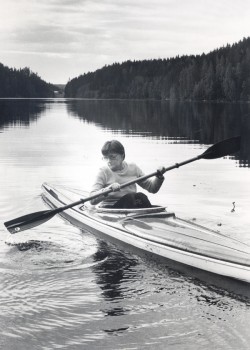
Eeva-Liisa Manner. Photo: Tammi.
Today we have a real treat – a selection of the sumptuously minimalist poetry of Eeva-Liisa Manner (1921–1995) by her near-contemporary, the British poet Herbert Lomas (1924–2011).
Born in Helsinki, Manner spent her youth in Viipuri, in what was then part of Finland; her life was, like Eeva Kilpi’s, marked by evacuation from her home and the subsequent loss of Karelia to the Soviet Union in the Second World War. Her breakthrough collection, Tämä matka (‘This journey’, 1956) marked a major arrival on the modernist poetry scene and her work has been widely translated. Always lyrically minimalist, Manner’s poetry sometimes seemed to approach the limits of language – silence:
The words come and go.
I need words less and less.
Tomorrow maybe
I’ll not need a single one,
she wrote in Niin vaihtuvat vuoden ajat (‘So change the seasons’), as early as 1964.
Lomas brought to the delicate, beautiful textures of Manner’s poetry with its themes of grief, suffering and loneliness a bluff Yorkshire, and entirely masculine, sensibility. For him, Manner had a ‘splendid sanity’ and sense of humour; hers was an oeuvre ‘that heals by listening and recovery’.
Manner’s work has more recently been translated by another English writer, Fleur Jeremiah, in a volume entitled Bright, dusky, bright (Waterloo Press, 2009). A sample of the approach taken by a woman of a different generation can be found here.
*
The digitisation of Books from Finland continues apace, with a total of 360 articles and book extracts made available online so far. Each week, we bring a newly digitised text to your attention.
Poems
31 December 1986 | Archives online, Fiction, poetry
Introduction by Kai Laitinen
Evening Mood
It’s widening:
an evening like a sigh –
languidly spreading across the land.
The tree’s unclothing
its branches of their colours, darkening.
As if something somewhere
were ringing and ringing –
a song straying like an orphan.
The words seem
something I’ve heard:
‘only a shadow –
only a shadow of a dream’
It’s slipping away. It’s dwindling.
Everything – everything – I’ve been given
I’ll give away. More…
Poems, poèmes
30 June 1987 | Archives online, Fiction, poetry
Poems from Mies joka rakasti vaimoaan liikaa (‘The man who loved his wife too much’, 1979 and Vaikka on kesä (‘Although it’s summer’, 1983). Interview by Markku Huotari
Look at this epitaph with whiskers.
Threw herself so gladly into my troubles, sometimes she seemed to be bearing, properly, my burdens.
A dog called Julia. Combining
July and Yuletide.
Often thought of putting her down, so she wouldn’t need to die.
Smash her skull or break her neck
with my own hands, to stop her mourning her premature death.
Which still seems to be delaying.
She puts her four paws gently down, one at a time. So the Lord won’t hear her still about
and whisk her away.
Two years ago, she steps on some glass, her toe sticks out, a tendon’s cut.
She looks at me. Believe it or not,
I’m grieved by little Julia’s lot: for a second
I think the blood’s dripping from my own heart. More…
Punishment and delight
31 December 1995 | Archives online, Fiction, Prose
Extracts from Pimeästä maasta (‘Out of the Land of Darkness’, Kirjayhtymä, 1995). Interview by Jukka Petäjä
‘A being far more powerful and wiser than ourselves made the mould at the beginning of time and set it up for us as a model in order that we might shape ourselves correctly,’ the teachers said. ‘The Prime Mover’s form, actions and thoughts we are unable to understand. The Prime Mover gave us the mould in order that we should not remain formless. To this extent it has made itself known to us, although we do not deserve anything from it. It did not make the mould of bog-iron, which would soon have rusted in the cellar, but of a much better material of which we know nothing, and need to know nothing. Our duty is to aspire to fill the perfect mould given to us perfectly. Most of us will never be able to do so, for we are worthless, formless, unclean messes who deserve, many times over, all the pain of fitting the mould.’
Ulthyraja Tharabereghist did not dare ask anything, but there was something she would have liked to know. How the Prime Mover had made the mould, at least, and where it had found the materials, and what the Mover had gone on to do and where it had gone when the mould was ready and in the possession of the villagers. Even illicit thoughts were said to damage one’s shape: to be visible in it, if one knew how to look, and, of course, to be felt in the pains of fitting the mould… More…
All beauty
17 November 2011 | Authors, Reviews
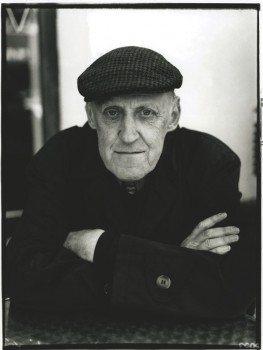
Bo Carpelan. Photo: Ulla Montan
The epigraph to Bo Carpelan’s prose work, Blad ur höstens arkiv. Tomas Skarfelts anteckningar (‘Leaves from autumn’s archive. The notes of Tomas Skarfelt’) is a quotation from Goethe: Zum Erstaunen bin ich da (‘To marvel I am here’). The world is a wonder to behold, one’s curiosity ought to be satisfied with less. It could stand as a motto for the whole of Carpelan’s literary work.
That work is now complete. Bo Carpelan died in February this year at the age of 84. He had made his debut in 1946 with the poetry collection Som en dunkel värme (‘Like an obscure warmth’).
In his prose as in his poetry, Carpelan built on a process of heightened and unconditional perception. Where others see only trees or forest, he saw a complex, branching light. His poetic ‘I’ could even watch itself perceiving, as when one autumn evening Tomas Skarfelt writes of a long-eared owl: ‘The yellow eyes looked at me attentively for a moment: a rather large, feather-clad camera.’ Carpelan often complained of having a poor memory, but it was a photographic one. More…
The forest folk’s trip to Helsinki
26 March 2015 | Children's books, Fiction
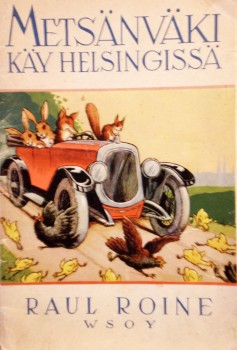 The country comes to town in this coyly modern fairy story of 1937 by the classic children’s writer Raul Roine (1907-1960). Reynard the Fox, the village taxi-driver, celebrates restoring his beat-up old Ford by taking his woodland friends – squirrels, chaffinches, bobtails… – on a day out to Helsinki. Trouble starts when a policeman tells them off for eating the plants in the Esplanade park, but the fun really begins when the hares find themselves participating in the marathon which is being run through the city streets that day…
The translation of this delectable tale is by Books from Finland’s long-time collaborator Herbert Lomas (1924-2011), who was often at his best when working on the whimsy of children’s literature.
Spring had come to the forest homeland. The wood anemones were raising their heads shyly from under the moss, large tears of joy were flowing down the spruce trees’ beards of lichen, and sky-ploughs of cranes were coming from the south. They bugled mightily on their trumpets and then landed in the Great Marsh to sample the cranberries More…
Tiger in the grass
31 March 2001 | Fiction, Prose
Extracts from the novel Maan ääreen (‘To the end of the earth’, Otava, 1999)
I left Kronstadt at the end of October in the year 1868, when I was 22 years old.
The Mozart was a three-hundred-ton barque. Even on the journey to Tvedestrand in Norway I vomited yellow bile and my toes and fingers froze. We lingered in Tvedestrand for three months while the vessel was repaired in dock. To amuse myself, I drew and wrote an accurate description of the ship. That work ended up in the sea. From the harbour captain’s library I borrowed German books which dealt with geology and topology. Their reality was different from that of the law and the interpretation of its letter and spirit. When a topologist draws a map, it has to be true. Otherwise travellers will get lost, I thought childishly, as if it were possible to draw a line between true and true. More…
The unmaking of Finland’s forests
17 March 2010 | Reviews
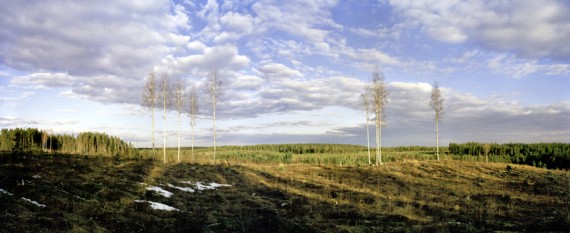
Natural landscapes? According to Metsähallitus, the government body charged with forestry, ‘the regeneration area is defined according to topography, in accordance with the landscape. Retention trees and groups of trees are always left standing in regeneration areas to enhance the landscape and to improve the survival chances of species that require old and decaying trees.’
Ritva Kovalainen & Sanni Seppo
Metsänhoidollisia toimenpiteitä
[Silvicultural operations]
Helsinki: Hiilinielu tuotanto ja Miellotar, 2009. 200 p., ill.
ISBN 978-952-99113-4-9
€ 43
Finns have a strong identity as forest people, partly because more than 95 per cent of them still speak an ancient hunter-gatherer language, Finnish, as their mother tongue. In spite of this cultural and historical background, Finland has become the world’s most eager and influential proponent of forestry models based on clear-cutting – felling all the trees in a particular area at one go and planting new trees to replace them. More…
The edge of wordlessness
1 March 2012 | Authors, Reviews

Harri Nordell. Photo: Veikko Somerpuro
The poems of Harri Nordell are a mystery to me. Each time I open one of his books, my reading begins afresh. I have analysed and translated his poems, but the texts have still not become familiar. I have not begun to comprehend them. They always speak to me as if for the first time.
I could not wish for a greater gift from a poem. These poems create a special state of being; I could call it not-knowing or marvelling. I feel I am involved in an unfolding event.
Nordell’s poems open me up, but I am unable to prise them open. I do not want to interpret cryptic expressions, or seek out more explicit meanings for them. I would not wish to write on top of these poems, to mute silence with superfluous words. More…