

Search results for "tommi+musturi/2010/05/song-without-words/2009/09/what-god-said/2011/04/matti-suurpaa-parnasso-1951–2011-parnasso-1951–2011"
The love of the Berber lion
30 December 2008 | Fiction, Prose
A short story from the novel Berberileijonan rakkaus ja muita tarinoita (‘The love of the Berber lion and other stories’, WSOY, 2008). Introduction by Janna Kantola
The lion’s name was Muthul. He was an old Berber lion from the Atlas Mountains. He had a black mane, a black tail with a bushy tip and the scars of many battles on his hide.
He had grown up as a lion cub in the royal palace at Carthage at the time when the Romans, led by Scipio the younger, destroyed the city with fire and sword. The palace was set ablaze, a bloody battle ensued in the gardens, Romans impaled on arrows lay strewn in the rose bushes, Carthaginian blood dyed the water in the fountains. Someone had let all the palace animals, wild and tame alike, out of their cages; they were running around wildly, killing each other in the grip of panic, then disappeared inexplicably. More…
Seekers and givers of meaning: what the writer said
2 October 2014 | This 'n' that
 ‘All our tales, stories, and creative endeavours are stories about ourselves. We repeat the same tale throughout our lives, from the cradle to the grave.’ CA
‘Throughout a work’s journey, the writer filters meanings from the fog of symbols and connects things to one another in new ways. Thus, the writer is both a seeker of meaning and a giver of meaning.’ OJ
‘Words are behind locks and the key is lost. No one can seek out another uncritically except in poetry and love. When this happens the doors have opened by themselves.’ EK
‘I realised that I had to have the courage to write my kind of books, not books excessively quoting postmodern French philosophers, even if that meant laying myself open to accusations of nostalgia and sentimentality.’ KW
‘If we look at the writing process as consisting of three C:s – Craft, Creativity and Chaos – each one of them is in its way indispensable, but I would definitely go for chaos, for in chaos lies vision.’ MF
‘In the historical novel the line between the real and the imagined wavers like torchlight on a wall. The merging of fantasy and reality is one of the essential features of the historical novel.’ KU
‘The writer’s block isn’t emptiness. It’s more like a din inside your head, the screams of shame and fear and self-hatred echoing against one another. What right have I to have written anything in the first place? I have nothing to say!’ PT
‘…sometimes stanzas have to / assume the torch-bearer’s role – one / often avoided like the plague. / Resilient and infrangible, the lines have to / get on with their work, like a termite queen / laying an egg every three seconds / for twenty years, / leaving a human to notice / their integrity. ’ JI
In 2007 when Books from Finland was a printed journal, we began a series entitled On writing and not writing; in it, Finnish authors ponder the complexities, pros and cons of their profession. Now our digitised archives make these writings available to our online readers: how do Claes Andersson, Olli Jalonen, Eeva Kilpi, Kjell Westö, Monika Fagerholm, Kaari Utrio, Petri Tamminen and Jouni Inkala describe the process? Pain must coexist with pleasure…
From 2009 – when Books from Finland became an online journal – more writers have made their contributions: Alexandra Salmela, Susanne Ringell, Jyrki Kiiskinen, Johanna Sinisalo, Markku Pääskynen, Ilpo Tiihonen, Kristina Carlson, Tuomas Kyrö, Sirpa Kähkönen – the next, shortly, will be Jari Järvelä.
Money, Morals and Love
31 March 1980 | Archives online, Authors
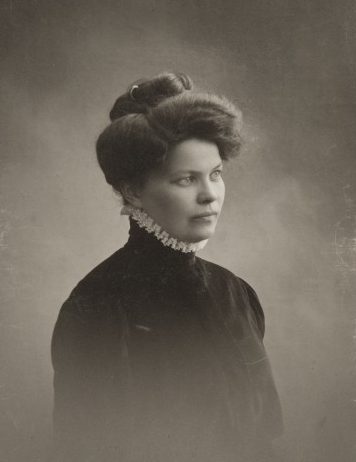
Maria Jotuni. Photo: Atelier Nyblin / CC-BY-4.0
Maria Jotuni‘s reputation as a writer rests on her daring and highly individual portrayals of women and on her gifts as a dramatist. Her works concentrate on analyses of the human condition, the contradictions, the frustrations, the fantasies. As the creative ‘observer’ she is both deeply sympathetic and ruthlessly revealing.
Maria Jotuni, whose centenary is celebrated this year, grew up in the eastern Finnish province of Savo and her early work draws richly on that background for subject matter and local colour. Her style, which over the years was honed and polished into a unique form of expression, certainly owes something to the lilting rhythms of the Savo dialect – and something to the lyricism of the Finnish Bible, with which she was familiar from her earliest years. Maria Haggrén, as she was born, was the second of six children; they lived in Kuopio, the home town of J. V. Snellman (1806–81), a man who did much to formulate the Finnish national identity, and of Minna Canth (1844–97), one of Finland’s major woman writers. The Haggréns were not wealthy, but they believed strongly in the pursuit of learning and knowledge. The home also provided a fruitful contact with rural life with opportunities to listen to the chatter and tales of the farm boys and servant girls. More…
The return of Orpheus
31 December 1992 | Archives online, Fiction, poetry
from Hid (‘Coming here’, Söderströms, 1992). A Valley in the Midst of Violence, a selection of poems by Gösta Ågren translated by David McDuff, was published by Bloodaxe Books of Newcastle-upon-Tyne in 1992. Introduction by David McDuff
No poet can endure
being dead, a sojourn without
meaning and method. He needs
order and rhythm. His poems
are really laws. He
always turns back
from the underworld, which resembles
the everyday.
The darkness hides the screams
around him, when
the way begins. The sun is
only black heraldry, only
a cavern in the sky
of stone, and he sees
it, without being blinded. More…
Mother-loves
31 March 1994 | Archives online, Fiction, Prose
Extracts from the novel Ihon aika (‘The time of the skin’, WSOY, 1993). Introduction by Suvi Ahola
In the hospital they stare at us, enquiringly, as if we are abandoning her. They look in turn at our mother’s half-conscious, ulcerous body, at the nurse who, curling her lip, cuts mother’s knickers, housecoat and apron off her, at us, the exhausted ones, who are now only at the beginning of our real work. They fill in their forms and ask their official questions; they do not know how anguished and relieved we shall be in a moment when we may leave our mother to them, that ironically smiling, wounded woman who is still, with her last strength, attempting to kick the nurse who is pouring warm water on her bloody feet.
I gaze at mother’s battered body with something like greed; I feel the same kind of curiosity toward this shocking sight as when I was four and we were in the bathroom together. I was shy, I tried to spy on mother’s fleshy body, her luxuriantly curving skin, through the mirror, but I was always left with the feeling that I had seen too little, I had been able to understand only a small part of what my eyes had registered. More…
Sanna Tahvanainen & Sari Airola: Silva och teservicen som fick fötter [Silva and the tea set that took to its feet]
13 January 2012 | Mini reviews, Reviews
 Silva och teservicen som fick fötter
[Silva and the tea set that took to its feet]
Kuvitus [Ill. by]: Sari Airola
Helsingfors: Schildts, 2011. 32 p.
ISBN 78-951-50-2053-6
€ 21.20, hardback
Silva ja teeastiasto joka sai jalat alleen
Suomennos [Translation from Swedish into Finnish]: Jyrki Kiiskinen
Helsinki: Schildts, 2011. 32 p.
ISBN 978-951-50-2054-3
€ 21.20, hardback
Sari Airola’s ability to depict different emotions makes her one of the most interesting Finnish illustrators of children’s books. Airola has long lived in Hong Kong and one can often sense an oriental spirit in her work. In this book, she makes use of Asian textile printing plates to enliven the surfaces of the images. The subject of this debut children’s book by Tahvanainen (born 1975), who is also a poet and novelist, evokes empathy with family situations that deviate from the norm. Silva lives in a big house with her mother, an isolated control freak and migraine sufferer. When her mother suffers an episode, Silva is unable to establish any contact with her and feels insecure. Although the text is allegorical, the book’s message, which concerns a parent’s caring responsibilities and a child’s need to be loved, remains accessible to children. Once the migraine attack is over, the mother goes out to look for Silva; mother and daughter are reconciled when Silva, at last, puts her fears into words.
Translated by Fleur Jeremiah and Emily Jeremiah
We are the champions
25 March 2011 | Prose
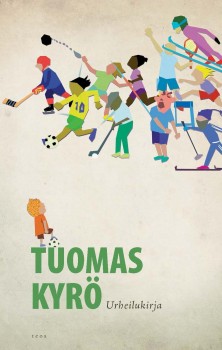 Heroes are still in demand, in sports at least. In his new book author Tuomas Kyrö examines the glorious past and the slightly less glorious present of Finnish sports – as well as the meaning of sports in the contemporary world where it is ‘indispensable for the preservation of nation states’. And he poses a knotty question: what is the difference, in the end, between sports and arts? Are they merely two forms of entertainment?
Extracts from Urheilukirja (‘The book about sports’, WSOY, 2011; see also Mielensäpahoittaja [‘Taking offence’])
The whole idea of Finland has been sold to us based on Hannes Kolehmainen ‘running Finland onto the world map’. [c. 1912–1922; four Olympic gold medals]. Our existence has been defined by how we are known abroad. Sport, [the Nobel Prize -winning author] F. E. Sillanpää, forestry, [Ms Universe] Armi Kuusela, [another runner] Lasse Viren, Nokia, [rock bands] HIM and Lordi, Martti Ahtisaari.
The purpose of sport at the grass-roots level has been to tend to the health of the nation and at a higher level to take our boys out into the world to beat all the other countries’ boys. We may not know how to talk, but our running endurance is all the better for it. However, the most important message was directed inwards, at our self image: we are the best even though we’re poor; we can endure more than the rest. Finnish success during the interwar period projected an image of a healthy, tenacious and competitive nation; political division meant division into good and bad, the right-minded and traitors to the fatherland. More…
To sleep, to die
30 September 2004 | Fiction, Prose
Extracts from the novel Unelmakuolema (‘Dreamdeath’, Teos, 2004)
Dreamdeath
Who would not like to cheat the grim reaper? Ways are known, of course, both scientific and non-scientific, but all of them are uncertain and temporary. Except for the simplest: to get there first oneself.
The refinement of this idea was Dreamdeath’s business idea. ‘Dreamdeath – because you deserve it!’ went Dreamdeath’s slogan.
The Dreamdeath home offered those who wished it the means to the most pleasant, even luxurious realisation of an autonomic death in an atmosphere of moral approval, against a suitable fee. At Dreamdeath the client himself decided when and in what conditions he would leave his mortal clay. More…
The ring
31 December 1998 | Archives online, Fiction, Prose
A short story from Irti (‘Away’, Gummerus 1998). Introduction by Milla Autio
When the car turns into the drive I know that this time it has happened. That this time it has not been for nothing that I have felt cold fear creep inside my stomach. And for a moment, as Vangelis gets out of the car and looks at me and Irini sighs deeply and grabs me as if for support, I feel nothing.
The landscape is the same, the trees and the burnt grass and the intoxicating scents of late summer. And the sounds, too, are the same; the merry cries of children farther off and the clatter of dishes from the kitchen. Later, of course, my landscape will shudder and quake from its place, fly on its way like disturbed papers. That was something you shouted at me about; other such incidents I do not remember, but when a gust of air from the door caught your papers you went mad. That moment is inscribed in my memory, caught there like the words on the pages of a book. More…
Between covers
31 December 1990 | Archives online, Children's books, Fiction
Extracts from Lastenkirja (‘Children’s book’, WSOY, 1990, illustrated by the Estonian animator and graphic artist Priit Pärn)
CHILDREN’S BOOK IS BORN
Children are wafting around the world: they come spilling out of the chimneys and clattering out of the pipes. They worm around cramped places in the nether regions, rise up through stiff roots into the treetops and muss up the clouds. Children just happen anywhere and bring the Adults along with them. More…
Poetry and Patriotism
31 December 1985 | Archives online, Authors, Essays
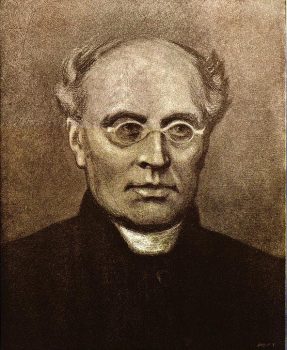
J.L. Runeberg. Painting by Albert Edelfelt. 1893.
Much revered, but little read today, Johan Ludvig Runeberg (1804-1877) is famed for his patriotism and glorification of war in a just cause. Yet Finland’s national poet did not write in Finnish, and never heard a shot fired in anger. It is, perhaps, time for a reappraisal.
What did he himself think about becoming a national poet?
Enjoyed it, probably? Who wouldn’t!
Did he write what he wanted and let
the people find their own interpretation?
Or did he write what he believed
the people expected
of a national poet?
Lars Huldén, 1978
It would not be inappropriate to begin a collection of thoughts about Finland’s ‘national poet,’ Johan Ludvig Runeberg, with a biblical text, Second Samuel, 1:25: ‘How are the mighty fallen!’ Runeberg does not own the position he once did, either in the world at large or in Scandinavia; even in his home land his exceptional grandeur has been reduced or, horribile dictu, smiled at. More…
Elina Brotherus & Riikka Ala-harja
The passing of time
2 March 2015 | Extracts, Fiction, Prose
In 1999 the Musée Nicéphore Niépce invited the young Finnish photographer Elina Brotherus to Chalon-sur-Saône in Burgundy, France, as a visiting artist.
After initially qualifying as an analytical chemist, Brotherus was then at the beginning of her career as a photographer. Everything lay before her, and she charted her French experience in a series of characteristically melancholy, subjective images.
Twelve years on, she revisited the same places, photographing them, and herself, again. The images in the resulting book, 12 ans après / 12 vuotta myöhemmin / 12 years later (Sémiosquare, 2015) are accompanied by a short story by the writer Riikka Ala-Harja, who moved to France a little later than Brotherus.
In the event, neither woman’s life took root in France. The book represents a personal coming-to-terms with the evaporation of youthful dreams, a mourning for lost time and broken relationships, a level and unselfpitying gaze at the passage of time: ‘Life has not been what I hoped for. Soon it will be time to accept it and mourn for the dreams that will never come true. Mourn for the lost time, my young self, who no longer exists.’
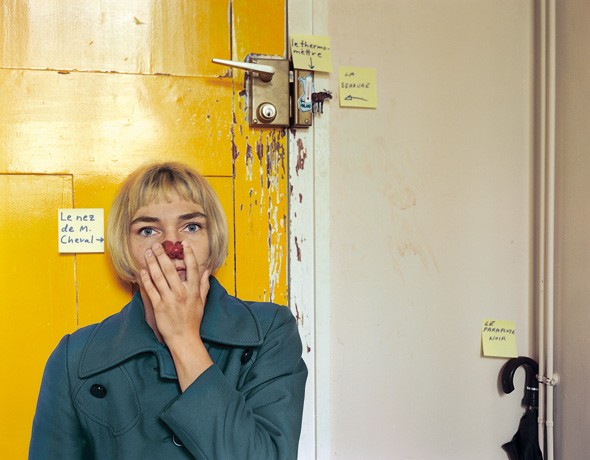
1999 Mr Cheval’s nose
At your service
19 March 2014 | Extracts, Non-fiction
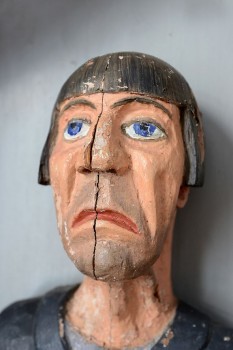
Melancholy man: detail of the almsman in Pomarkku, carved by Artturi Kaseva in the 1920s. Photo: Aki Paavola
Old men carved of wood have stood outside churches since the 17th century, begging for money to be given to the poor and the sick of the parish. These almsmen, or men-at-alms, mostly represented a disabled soldier; the tradition is not known elsewhere. Some 40 of the still surviving almsmen (there is one almswoman) were assembled for an exhibition in Kerimäki – in the world’s largest Christian wooden church – in summer 2013. The surviving specimens were hunted down and photographed by Aki Paavola for the book Vaivaisukkojen paluu (‘The return of the almsmen’). Otso Kantokorpi asks in the title of his introduction: are men-at-alms pioneers of ITE (from the words itse tehty elämä, ‘self-made life’; the English-language term is ‘outsider art’) or a disappearing folk tradition?
Many a church or belfry wall, particularly in Ostrobothnia, has been decorated – and is often still decorated – with a wooden human figure. Often they stand beneath a decorative canopy, sometimes accompanied by an encouraging phrase: He that hath pity upon the poor lendeth unto the LORD. They have been called men-at-alms or boys-at-alms. More…
Another darkness
30 September 1994 | Archives online, Fiction, poetry
Poems from Kali (Schildts, 1993)
‘Kali is the Liberator. Kali gives protection to those who know her. Kali is the Terrific One, the Destroyer of Time. As the Dark Shakti of Shiva, Kali is Space, Air, Fire, Water and Earth. Kali performs all the physical needs of Shiva. She is the Possessor of the Sixty-four Arts and increases the Joy of the Lord of Creation. Kali is the Pure Transcendental Shakti. Kali is the Night of Darkness.’
Kalika Purana
*
you show me a distant world
where all the beautiful is mine
you show yourself to me, naked, and whisper:
not the poppy
that murders the heroin addict,
not love
not my dark sister,
that will be the death of your love More…