

Search results for "tommi+musturi/2010/05/song-without-words/2009/09/what-god-said/2011/04/matti-suurpaa-parnasso-1951–2011-parnasso-1951–2011"
Adieu, Paris!
31 December 1994 | Archives online, Fiction, Prose
One day an Indian physicist discovers that Paris has disappeared – or, in the words of the French government, has been relocated: ‘it now exists not merely in one place, but in many, perhaps not precisely here or there, but to some extent everywhere’. Extracts from the novel Kadonnut Pariisi (‘Paris lost’, Otava, 1994)
The news of the disappearance of Paris was, at first, an item in the remotest corners of the foreign news pages of the newspapers and in the light feature at the end of the television news – those absurd little stories: an elephant’s escape from the zoo, the mother of four who beat the world record for toothbrush-swallowing or the suicide of a news reporter in the middle of a television broadcast.
Professor Ansari, an Indian physicist, had developed a method for the extremely accurate measurement of the mass of the Earth. His conclusion was that the Earth weighed too little. And, by an extraordinary coincidence, the missing mass was approximately the same as the estimated mass of Paris. The physicist was foolish enough to make his result public and to utter the fateful words: ‘Well, of course the simplest explanation would be that Paris is missing. That it doesn’t exist any more.’ A news item on the subject in the ‘Crazy World’ column concluded with the remark: ‘Professor Ansari is continuing the development of his theory in the government mental asylum in Delhi.’ More…
The Tollander Prize to Ulla-Lena Lundberg
17 February 2011 | In the news
One of the biggest literary prizes in Finland is the Tollander Prize, awarded annually on 5 February, the birthday of he national poet J.L. Runeberg, by Svenska litteratursällskapet i Finland (the Society of Swedish Literature in Finland). The prize is worth €35,000.
The recipient of the 2011 Tollander Prize is Ulla-Lena Lundberg, a versatile writer of novels, short stories, poems and travel essays. ‘She moves freely in different landscapes, times and cultures, finding universality in locality, whether on the island of Kökar in Åland, in Africa or in Siberia’, said the jury.
Written between 1989 and 1995, Lundberg’s fictional trilogy of Leo, Stora världen (‘The big world’) and Allt man kan önska sig (‘Everything one can wish for’), focused on the seafaring history and evolution of shipping in the Finnish Åland islands. Her autobiographical work Sibirien (Siberia’, 1993) has been published in German, Danish and Dutch.
Read the extracts from her latest book, Jägarens leende (‘Smile of the hunter’, 2010), on rock art, reviewed on our pages by Pia Ingström.
Taken by surprise
In her fifth collection of poems, Pauliina Haasjoki explores night flights, water, islands, sandy beaches where time is found stratified in stones and fossils. Interview by Teemu Manninen
Poems from Aallonmurtaja (‘Breakwater’, Otava, 2011)
Night flight
Man cannot hide in the night, his desire will betray him.
Man turns toward the lights, light sparkles as though it were close at hand
even if it is far away.
Lights, which offer themselves like jewels to the one who sits in the plane above them, are already
                                                                                                                                 in their viewers’
eyes even if they have only just begun to stream from their source. A city-jewel swaying
in the black night air.
A solitary light on the surface of an island. Seen close up it is a soft-lit lamp
which casts light only on the table and the faces around it,
but from above, at a distance of kilometres, it is an immediate spot, a straight line that
                                                                                                                                aims at the viewer
and pierces her. A fierce light-beam.
New worlds
30 September 1998 | Authors, Interviews
Photo: Ulla Montan
The heroine of Monika Fagerholm’s novel Diva is a teenage girl. But this is a Lolita with a difference; for this is an intelligent Lolita, with a voice of her own. Silja Hiidenheimo interviews her creator
In Monika Fagerholm’s best-selling book Underbara kvinnor vid vatten (1994, English translation:Wonderful Women by the Water), the sun shines and the women really are wonderful. If there is a certain melancholy about the story, it is born more of longing and the unrealised dream of freedom. And although all those of us who were born in the 1960s thought Monika had stolen precisely our childhood memories of summer, that she had leafed through our photograph albums, the work is, in the melancholy lightness of its narrative, an exception in Finnish realism. While the book forces its readers to empathise so completely that one cannot imagine Monika has invented anything in the whole story, but merely, like a camera, has registered everything just as it happened, an ironic laugh is heard in the book: realism is just as banal as life itself. If one were to summarise the plot of either, one would not be able to repeat it without blushing. More…
After thirty years
31 March 1987 | Archives online, Fiction, Prose
This, the very first Finnish science fiction story, is an extract from Viktor Pettersson’s (1849-1919) Efter trettio år (‘After thirty years’), published in 1886. Introduction by Matti Apunen
On 31 August 1916 father and daughter went up on the ‘deck’ of the air balloon Atlantic. Atlantic was just one of the comfortably furnished air vehicles that plied the regular route between the New and Old Worlds. Pleasure trips between these continents were now made, preferably, by air balloon rather than by ship, because the journey took half the time – a mere three days; and this despite the fact that the standards of comfort in ships were now excellent, since they were made of cardboard and furnished with electric motors. In addition, air balloon travellers avoided sea-sickness and the associated unpleasantnesses. Of course, they did suffer from ‘airsickness’, but the symptoms of this disease made themselves felt in a much more bearable form. For they actually made the sufferer happy, enthusiastic and friendly, so that he wanted to embrace the Lord and the whole world. Dried-up and creaky old bachelors became as lovable and sympathetic as confessors who have made their vow of celibacy; spiteful and pompous wives and spice-selling madames smelling of wormwood became in a second as devoted and sweet-natured as a mademoiselle in a shop selling drinking water. It was like being under the influence of some wonderful aphrodisiac. More…
The unicorn
30 September 1997 | Archives online, Fiction, Prose
A short story from Koira nimeltä Onni ja muita onnettomuuksia (’A dog called Lucky and other misfortunes’, Tammi, 1997)
Hilma was rattling her bars when Pirjo stepped into the ward. Once again, she was the only one awake. The three other old people were asleep, wheezing heavily through their toothless mouths, making the air thick with their breathing. Clutching the bars of her bed, Hilma clambered up to a sitting position and leaned her sparse hair against the side.
‘How are you doing with the medicine?’ Pirjo asked.
‘A mouse took it,’ Hilma said, fixing her with her eyes.
‘And you’re not at all sleepy,’ Pirjo sighed. More…
Power or weakness?
30 September 1986 | Archives online, Drama, Fiction
An extract from the play Hypnoosi (‘Hypnosis’, 1986). Introduction by Soila Lehtonen
As you all know, this company has been my life’s work and it stands for everything I’ve had to renounce. You know that for years I have not received a penny for my personal expenses, that I am on the firm’s lowest wage level, zero.
I haven’t even had a free cup of coffee; if, because I have been working hard or I wanted to improve my concentration, I have felt like a cup of coffee, I have always gone to the canteen during my coffee break and challenged one of the boys to a bout of arm wrestling under the agreement that the loser buys the coffees, and the bloke has paid. The money never came out of the firm’s running expenses, investments, trusts or funds. More…
Troubled by joy?
30 September 1998 | Fiction, poetry
Poems from Boxtrot (WSOY, 1998)
Nine lives
So far nine lives only, and
all mine, like my head in my hands.
My first was curled up at the foot of a fir tree
in the autumn forest just at day-dawn
in nighttime's raindrops.
The resin's still in my fingernails.
My second was the scent of split wood by the shed,
and the circular-saw blade's horrific disc.
The gruel, track shoes too large, and President Kekkonen,
ink spreading across my notebook, and
the clank of the railway under my dreams.
Mayday's red flags, the neighbour's daughter
naked, and dead pigeons lying on the gravel.
My third life was the discovery of anger, blind rage
turning and turning me in its leather bag,
wearing the edges of my day down. Sitting at our schooldesks
being forced towards a goal that can't be named.
Seeing how they start drinking, drinking
into their eyes that black impotent rebellion.
I'm on the point of drowning, someone's traversing
the Atlantic in a reed boat. And if I did die,
it wouldn't matter who sneered. The stars in the sky
                     are watching us in horror.
Higher goals
31 December 1987 | Archives online, Fiction, Prose
An extract from the novel Tammerkosken sillalla (‘On Tammerkoski bridge’, 1982). Introduction by Panu Rajala
I had thought there were a lot of books in the libraries in Oulu. But both those libraries were totally overshadowed when, having climbed up to the top of the Messukylä Workers’ House, I began to cast my eyes along the bookshelves in the attic. A tallish and refined-looking librarian responded when I exclaimed aloud.
‘Just under seven thousand volumes altogether. Some of them are out on loan. We’d like to have a lot more books, but getting the money to buy them is like getting water from a stone.’
‘But you’ve already got an incredible amount compared to what we have in the rural library at home… In Taivalkoski during the war all we had was two cupboardsful.’
‘You didn’t have a lot of choice there,’ agreed the librarian. More…
Green thoughts
Extracts from the novel Kuperat ja koverat (‘Convex and concave’, Otava, 2010)
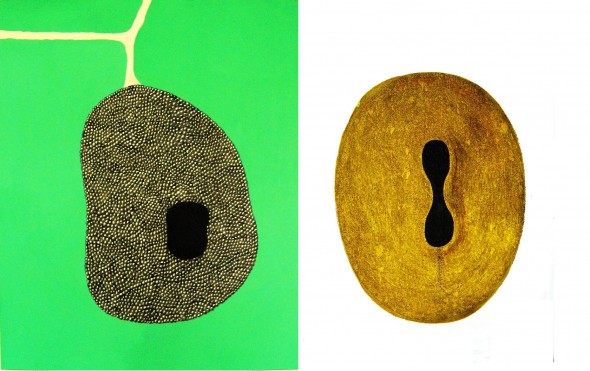
Hannu Väisänen: ‘Green and yellow in March’ (work in progress, oil on canvas, 130x193cm, 2010)
I decided to go to the Museum of Fine Arts.
After paying for my entrance ticket, I climbed the wide staircase to the first floor. There all I saw were dull paintings, the same heroic seed-sowers and floor-sanders as everywhere else. Why were so many art museums nothing more than collections of frames? Always national heroes making their horses dance, mud-coloured grumblers and overblown historical scenes. There was not a single museum in which a grandfather would not be sitting on a wobbly stool peering over his broken spectacles, interrogating a young man about to set off on his travels, cheeks burning with enthusiasm, behind them the entire village, complete with ear trumpets and balls of wool. The painting’s eternal title would be ‘Interrogation’ and it would be covered with shiny varnish, so that in the end all you would be able to see would be your own face.
I climbed up to the next floor. All I really felt was a pressing need to run away. No Flemish conversation piece acquired in the Habsburg era was able to erase a growing anxiety related to love. More…
Solitude growing
30 June 1995 | Archives online, Fiction, Prose
Extract from Häiriö maisemassa (‘A disturbance in the landscape’, Otava, 1994). In this, her first novel, Raija Siekkinen – well-known for the fragile prose fof her short stories – continues her dissection of the soul with an account of the experience of a womanwho finds that many lives are being lived through her own
She was pregnant. After all these years, the woman finally found she was pregnant: it was as if the man had made a last attack to retain his hold on a country he had once conquered.
She let the days go by, the days of autumn, which night by night edged more shadow across the damp lawn. She looked at the man from a distance, not seeing him; her mind rehearsed what she knew about him. The man had two children from a previous marriage. The woman had not wanted the children to come here, and neither did their mother; that was, indeed, the only subject on which they agreed. The man went to visit his children; they never spoke about what happened on those occasions. More…
Opera of the everyday
5 November 2010 | Reviews
Saila Susiluoto. Photo: Pekka Holmström
A plaza in Seville suddenly turns into a modern shopping mall in the new collection of poetry by Saila Susiluoto (born 1971). In Carmen (Otava, 2010) Susiluoto combines the elements of Georges Bizet’s eponymous 1875 opera – popular folk tradition and intense emotions.
The Carmen of these poems is a gypsy, a stranger, a femme fatale, a fiery augury of death. These terse poems combine a narrative continuum, a love story, the triangle drama of the opera, and Susiluoto’s own, distinctive visually flowing style, which is both fresh and familiar.
Her debut collection Siivekkäät ja Hännäkkäät (‘The Winged and the Tailed’, 2001) seems to exist within the frame of a narrative painting or a film. In this suburban story of human relations, she is both an individual growing in passions and her lover’s deserter. More…
Keeping up with the Joneskis
17 April 2009 | Extracts, Non-fiction
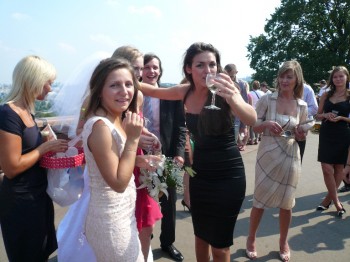
Toasting the bride: cheerful wedding parties drive up to the Sparrow Hills in Moscow in summer
Moscow-based journalist Anna-Lena Laurén finds the new Russia a promised land of materialism – a place where appearances are everything, and how you pay for maintaining them is a matter of strictly secondary interest
‘I want to go to the nightclub by boat! Come on, let’s hire one,’ Ilya says, heading towards the shore where a boat for at least twenty people is moored. There are six of us.
After two minutes of negotiation, he takes up his position alongside the gangway. He welcomes us onboard with a chivalrous gesture. We step onto the boat and are gently taken off down the Moyka canal in the white night of St Petersburg in June. The sky is pale pink and dark blue-lilac, the air damp and cold, but the captain hands out rugs to keep us warm. The ornamented bridges and pastel-coloured façades of St Petersburg glide past in a faint glow, it’s just light enough to make out the colours, powdery pink, vanilla yellow, pale blue. More…