

Search results for "tommi+musturi/2010/05/song-without-words/2009/09/what-god-said/2011/04/matti-suurpaa-parnasso-1951–2011-parnasso-1951–2011"
The summer of 1965
30 June 1995 | Archives online, Fiction, Prose
From Underbara kvinnor vid vatten (‘Wonderful Women by the Sea’, Söderströms, 1994; Finnish translation lhanat naiset rannalla, Otava, 1995). Introduction by Michel Ekman
The summer of 1965; this summer people go waterskiing. They go waterskiing behind the Lindberghs’ shining mahogany sportsboat, and from midsummer onwards they go water-skiing behind Gabbe’s outboard motorboat, an Evinrude bought second-hand from Robin Lindbergh. Now Bella and Rosa are skiing: Tupsu Lindbergh’s face is covered in freckles if you look at her close to, and it’s not particularly becoming, her fair hair is super-peroxided and she is as thin as a skeleton and everyone knows that it’s because she is so thin and ugly and not because she has a cold that she says she can’t take part in any watersports. There is something nervous about Tupsu Lindbergh. At Bella’s party at the beginning of the summer Tupsu Lindbergh sits on the white villa’s veranda, on the white villa’s lawn on a camping chair, on the white villa’s beach while Bella and Rosa go waterskiing and talk about Tupperware. Not Tupperware all the time, but Tupperware is the collective description. More…
Asking for more
14 April 2010 | Fiction, poetry
The heroines in Vilja-Tuulia Huotarinen’s new collection, Iloisen lehmän runot (‘Happy cow poems’, 2009), are timeless creatures, mythical and archaic, and yet our contemporaries, living their lives alongside us (see Ruminations)
Let the cows out on Monday
and they’ll enter the forest, wander far
aim for the waterfalls, the hole in the rock and down the precipice.
The dead come back along our the road to our yard:
Rebecca, Isolde, Rosamunda.
Allison, Eulalia, Euphrosyne.
Not as ghosts but as old friends.
Whom will they, the wingless ones, protect here?
A lean lass, a lean lass. More…
Emotional transgressions
31 December 1985 | Archives online, Fiction, Prose
Three extracts from the novel Harjunpää ja rakkauden lait (‘Harjunpaa and the laws of love’). Introduction by Risto Hannula
It was a few minutes to two, and Harjunpää was still awake, lying so close to Elisa that he could feel her warmth. He kept his eyes open, staring into the night through the crack between curtains. Once again the boiler of the central heating plant started up, and the smoke began to rise like a stiff column in the cold. Another fifteen minutes had passed, and morning was a quarter of an hour closer. He squeezed his eyes shut and tried to concentrate on Elisa’s breathing and the sleepy snuffling of the girls, but his thoughts still wouldn’t leave him in peace. Inexplicably, he felt there was something wrong, that the darkness exuded some kind of threat, that he’d left something undone or had made some kind of mistake.
He swung his feet onto the floor and got up as quietly as he could. But all his care was wasted, he should have known that.
‘What’s the matter?’ Elisa asked sleepily.
‘I just can’t get to sleep.’
‘Again … ‘
‘I can’t help it. I wonder if there’s a bottle of brew left.’
‘Sure. But listen …’
Pipsa turned over in her crib, rattling the sides, groped around a bit and began to suck her pacifier so you could hear the quiet sucking noises.
‘Yeah?’
‘Maybe you could see a doctor. You could ask for some mild … ‘ More…
A roof with a view
27 August 2009 | Fiction, Prose
Extracts from the novel Mistä on mustat tytöt tehty? (‘What are black girls made of?’, Tammi, 2009) Introduction by Tuomas Juntunen
I’m a chimney sweep’s daughter, born October 1962 as a gift, a light to a darkened world. I’ve had lots of mothers, but none of them ever stuck around for good. One of them gave birth to me, so she’s Mother, not mother. Her name is Dewdrop, because water has spilled over the only photograph of My Mother and now her face has dissolved into a single translucent droplet; her nose, cheeks and chin are now a fat, shiny blob that looks like it’s about to fall out of the bottom of the picture. More…
Helsinki Book Fair: 28–31 October
22 October 2010 | In the news
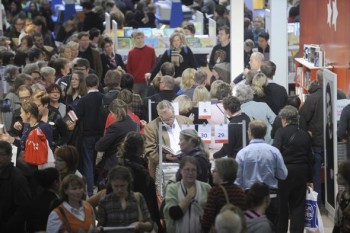
Looking for books: Helsinki Book Fair (Photo:The Finnish Fair Corporation, 2009)
The tenth Helsinki Book Fair takes place in Helsinki’s Exhibition & Convention Centre over the last weekend of October. More than 1,000 writers, artists, scientists, politicians and specialists will participate in the programme. There are more than fifty authors from 17 countries, among them the British historian Antony Beevor, the Estonian writer Jaan Kaplinski and the Indian writer Kishwar Desai.
The theme country this year is France, and among the French guests will be the novelists Andreï Makine and Nicolas Fargues, the fantasy writer Pierre Pével and the poets Sophie Loizeau, Hélène Sanguinetti and Gabriel Mwènè Okoundji, originally from Congo.
The translator Anne Colin du Terrail will talk to the writers Leena Lehtolainen and Johanna Sinisalo whose work she has translated into French.
Comics and graphic novels as well as poetry are also in the focus at this year’s Book Fair: approximately 70 Finnish and foreign poets feature in readings, interviews and nonstop performances.
In 2009 a record-breaking number of visitors – almost 77,000 – attended the Book Fair. It seems the autumnal Fair is a handy chance to many to buy Christmas presents, among other things; at least last year three out of four said they had come to buy books (and not just spot celebrities, for example).
This time, in addition to books, the visitors to the Exhibition & Convention Centre will be able to attend two other Fairs, entitled Wine, Food and Good Living and Music Fair as well.
So many words
25 April 2012 | Articles, Non-fiction
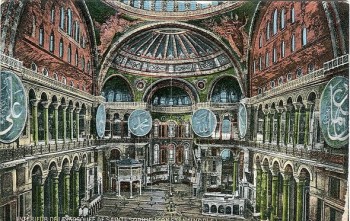
Hagia Sofia, Istanbul: from basilica to cathedral to mosque to museum. Postcard, c. 1914. Photo: Wikipedia/Xenophon
Sacred spaces, repositories of free speech, places of healing? Teemu Manninen awaits the day when libraries become virtual, enabling anybody to visit them, without having to travel across land and sea
The Bodleian Library in Oxford, the Vatican Library, the Bibliotheque Nationale in Paris, New York Public Library, the British Museum Reading Room, the Real Gabinete Portugues De Leitura in Rio De Janeiro, the Library of Congress and the National Library of Finland.
What do all of these have in common, except the obvious fact that they are all famous libraries? To put it another way: why are these famous libraries so famous?
It is not because they have books in them, although that has become one of the main tasks of the library system in the modern world. But a library is not simply an archive. If we in the West are a culture of the book – a culture of the freedom of information and expression – then a library is the architectural incarnation of our way of life: a church built for reading. More…
The net
30 June 2000 | Archives online, Fiction, poetry
Poems from Verkko (‘The net’, WSOY, 1999). Introduction by Peter Mickwitz
The descent
Down the stairs, out through the gate into the street
and you wonder
what the cobblestones had in mind
with the waves that beat
and the rock that was humbled
smooth in the course of millennia.
Streetcars would rumble
toward them with ancient god force.
Now the stones lie there quietly like
fish blown ashore
petrified by the sun.
Their memory is short. Steel is mute.
The rails remember Kallio, remember Töölö.
Words are thinner than they used to be;
they’ve been walked over too many times.
The city. more glabrous, no longer stretches
algae-covered tentacles to the gates of Babylon.
Like an animal with a premonition, the city pulls its soft parts
inside a calcareous shell, does its work there in secret.
Much has disappeared: no more twitching tectonic plates
brought on by words, no electric storms in the bowels.
Coffee is the measure of violence: no more tobacco
in whose smoke one could heal loneliness and the world.
As before, you look through glass, just a thin glass,
at the sidewalk and trees facing the restaurant. A man
is pushing a baby carriage. The glass reflects your face very briefly.
Part of you is out there, part stumbles about again in some Yoldia
a mute stone and a worn hope in his pocket. still,
that the world’s mute stones would break down into song, give
voice, crumble a couple of notes here, and a key.
Vermeer: the kitchen maid
A great painting does not require a great subject,
kings in pantyhose, the Peace of Westphalia.
The kitchen maid pours milk in a bowl, and soon
the canvas brims with self-radiant liquid
in which the morning and chunks of bread float.
The trap is primed. No rat to be seen.
Bits of something white roll on the floor. Smelling salts?
Under the milky film of the wall there are things
going on that the maid has no inkling of
a cockroach makes its way through the sawdust,
enzymes dismantle compounds into smaller pieces.
Farther away, a star collapses
and begins to radiate darkness.
Its message – a quantum of black light –
reaches Helsinki only today,
a city surrounded by ramparts of snow.
These, among other things, influence
my being what I am.
I wrap myself in darkness and wait
for the next whim, a tiny,
decisive mistake.
That’s why
The half-drowned
apartment building drifts.
Between the stuccoed ribs
disease blooms, sprouts tendrils.
punctures pulmonar alveoli. articular capsules.
Every night I could melt into the tub
until the water darkens to a hepatic dream.
One must protect oneself against the outside air.
The light draws boundaries that are too clear.
One must protect oneself against the brightness of skin.
That is why I travel deeper into your chest,
crave the tar from your lungs and the tracheae
into which I blow, a fanfare, when we are
heat and hunger,
grow vertically up from the ground toward
the fainted sun,
pull up rails, roots, traffic signs,
rusty legends,
rear up to the height of our withers, slop sweat and oil.
Aerial view
These wondrous mobiles
with which we can conquer distances.
Only the view always is the same heavenly
snow drift, nothing but condensing steam.
Icarus must have cooled his wings here,
the wax whose precise consistency is a mystery to us.
The higher he rose
the worse he froze
until the wax became too cold and melted.
By scientific means machines have been built
in which a human being can rise and fly to another
planetary phenomena in his belly
such as the direction of blood’s circulation. Loneliness
has rarely been a castle in whose cellar
philosophy was tinkered with or music distilled.
The horses were harnessed for death, the rest into museums,
cast in plastic.
The polar sea folds into a pocket
as a map that tells you where you should already
be, and how.
Translated by Anselm Hollo
The lake
30 June 1988 | Archives online, Fiction, Prose
Järvi (‘The lake’), a short story, 1915. Introductions by Kai Laitinen and Pekka Tarkka
I travel the world, not out of any desire for adventure, but because that is the way things have happened. The best of my wanderings are in obscure, tucked-away regions, where life is humdrum and pitched in a low key. There I have no need to stave off nostalgia for the past by leading a hectic life: my days go by in stolid succession from season to season, I am an ordinary unimportant individual among all the rest. For long stretches of time my life does not strike me as being either dull or bright; I derive a certain satisfaction from its very emptiness. It is as though I were, by degrees and to the best of my ability, paying off a kind of debt. More…
Bitter moments, luscious moments
31 March 2004 | Archives online, Fiction, poetry
Poems from Fänrik Ståls sägner (Tales of Ensign Stål, 1848–1860) and Dikter II (‘Poems II’. 1833), translated by Judy Moffett. Introductions by Pertti Lassila and Risto Ahti
Sven Duva
Sven Duva’s sire a sergeant was, had served his country long,
Saw action back in ‘88, and then was far from young.
Now poor and gray, he farmed his croft and got his living in,
And had about him children nine, and last of these came Sven.
Now if the old man did, himself have wits enough to share
With such a large and lively swarm – to this I cannot swear;
But plainly no attempt was made to stint the elder ones,
For scarce a crumb remained to give this lastborn of his sons. More…
The honey of the bee
30 June 2005 | Archives online, Fiction, Prose
A short story from the collection Mitä sähkö on (‘What electricity is’ WSOY, 2004). Introduction by Jarmo Papinniemi
Five days before I was born my grandfather reached sixty-six. He’d always been old. The first image I have of him gleams like a knife on sunny spring-time snow: he was pulling me on my sledge over hard frost under a bright glaring-blue sky. In the Winter War a squadron of bombers had flown through the same blue sky on their way to Vaasa; the boys leapt into the ditches for cover, as if the enemy planes could be bothered to waste their bombs on a couple of kids. Be bothered? Wrong: kids were always the most important targets.
Now it’s summer, August, and I’m sitting on the grassy, mossy face of the earth, which is slowly warming in a sun that’s accumulated a leaden shadiness. I’m sitting on my grandfather’s land. It’s the time when the drying machines buzz. Even with eyes shut, you can sense the corn dust glittering in the sun. Even with eyes shut, you can take in the smell of the barn’s old wood, the sticky fragrance of the blackcurrants barrelled on its floor, the tins of coffee and the china dishes on the shelves, and the empty grain bins; there’s the cupboard Kalle made, with its board sides and veneered door, and the dust-covered trunk that was going to accompany my grandfather to another continent. The ticket was already hooked, but Grandfather’s world remained here for good. When Easter comes we’ll gather the useless junk out into the yard and burn it; Grandfather’s travel chest will rise skywards. Grandfather stands in the barn entrance, leaning on the doorpost. He’s dead. Over all lies a heavy overbearing sun. Beyond the field the river’s flowing silently in its deep channel. At night time its dark and warm. More…
Living inside language
23 February 2010 | Essays, Non-fiction
Jyrki Kiiskinen sets out on a journey through seven collections of poetry that appeared in 2009. Exploring history, verbal imagery and the limits of language, these poems speak – ironically or in earnest – about landscapes, love and metamorphoses
The landscape of words is in constant motion, like a runner speeding through a sweep of countryside or an eye scaling the hills of Andalucia.
The proportions of the panorama start to shift so that sharp-edged leaves suddenly form small lakeside scenes; a harbour dissolves into a sheet of white paper or another era entirely. Holes and different layers of events begin to appear in the poems. Within each image, another image is already taking shape; sensory experiences develop into concepts, and the text progresses in a series of metamorphoses. More…
The everyday flow
30 June 2006 | Authors, Reviews

Johanna Venho. Photo: Heini Lehväslaiho
Johanna Venho on her own poems
While writing Yhtä juhlaa (‘It’s all a celebration’), my third collection, I was pretty aware of it as a whole. But, generally speaking, the process of writing poetry can’t be fully conscious, or in your control: you can steer it a little, but quite a lot has to be let go. My title shows there’s an irony. It points to the duality of everyday life – and of life in general: both involve celebration and the opposite of celebration.
I’ve played with rhyme – something quite new to me – and reading these poems aloud does, I’ve noticed, work. I’ve recently been having a go at writing song lyrics, too. Something else new is that the collection grows the arc of a story line, and story-telling brings along a fairytale element. More…
Caravans of winds
30 June 1988 | Archives online, Fiction, poetry
Poems from three collections. Introduction by Kaija Valkonen
The river of death froze
It froze, the river of death,
	froze too the boat of death in the nights of the Winter War,
			in the Winter War's nights.
The men shed blood,
				shed blood ,
		and it froze, the river of death.
In the nights of the Winter War, it froze, the river of death.
Day of mourning
For one day I’ve the right to mourn,
for one day I’ll shut the windows of the sky,
I’ll dismiss the blue,
I’ll raise a black sun to mark my mourning.
For one day I’ll wilt the flowers,
for one day I’ll silence the birds. More…
Poems
31 March 1980 | Archives online, Fiction, poetry
Poems from Kallista on ja halvalla menee (‘It comes dear and it’s going cheap’,1975) and Reviirilaulu (‘Territorial song’, 1978). Introduction by Pentti Saaritsa
1
A seagull shadow flitters across the gulf of the courtyard
over the gone-sour yellow wall
ogreish and swift as an execution by hanging,
that’s how I’m dangling
from this moment in this city
my ankle in the strangling noose
in the night under the jangling stars while over the roofs
a sheetmetal moon’s rising
and blurred dreams are yawning in a thousand windows,
down below me the city
and in my breast my heart, it’s socking
like a knuckleduster.
2
The simplest noise,
the noise of a glass
when you put the glass down
on a wooden table, the sound of wood
on glass
                     is like
a flash of  happiness
on a melancholy face.