

Search results for "tommi+musturi/2010/05/song-without-words/2009/09/what-god-said/2011/04/matti-suurpaa-parnasso-1951–2011-parnasso-1951–2011"
Cruising
30 September 1993 | Archives online, Fiction, Prose
An extract from the novel Vieras (‘The stranger’, Otava 1992). Introduction by Pekka Tarkka
I lay there for a moment, motionless, eyes closed.
The bunk was damp. It felt damp around my thighs; I slid down lower – and there, it was really wet.
My sleeping bag was obviously soaked, and that meant that the mattress was soaked, too. Oh, rats. I couldn’t imagine having wet myself. Or – worse – had the boat sprung a leak, the water already rising up to the floorboards? I bounded to my feet: the rugs were dry. So was the cabin floor. I raised the boards, peered down: two fingers of water in the forward bilge, as usual. So, where the –? In the course of yesterday’s rough sailing, some water had seeped in below the windowframe. No more than a cupful, but it had trickled down inside the panel and then onto the mattress. I tried the other side of the bunk. It was dry. Well, I would just have to pick up the mattress and set it on its side. More…
Matti Yrjänä Joensuu: Harjunpää ja rautahuone [Harjunpää and the iron room]
19 November 2010 | Mini reviews, Reviews
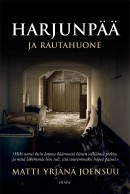 Harjunpää ja rautahuone
[Harjunpää and the iron room]
Helsinki: Otava, 2010. 302 p.
ISBN 978-951-1-24742-5
€ 26, hardback
This book’s shocking opening scene, a cot death, is not followed by anything that lightens the tone. Finland’s best-selling crime writer, Matti Yrjänä Joensuu (born 1948) – whose work has been translated into nearly 20 languages – focuses here on a criminal investigation conducted by Inspector Timo Harjunpää into the murderer of several wealthy women. The victims are linked via their purchases of sex; the detective’s attention soon falls on Orvo, a masseur who also turns tricks as a gigolo. Nearly every scene is shot through with themes of lovelessness, exploitation and the connection between malice and sex. Harjunpää is an empathetic, slightly rumpled cop who has an ambitious yet somewhat downbeat attitude to his job. Joensuu’s Harjunpää ja pahan pappi (Priest of Evil) was published in English in 2006. Joensuu himself is a retired police officer; his particular strength as an author is his extraordinarily precise, realistic portrayal of police work. But it’s not just about who did what; why they did it is equally important. One reason for Joensuu’s popularity is his extremely well-developed understanding of human nature. He observes and analyses, but never judges.
Matti Klinge: Suomalainen ja eurooppalainen menneisyys [The Finnish and European past]
8 April 2011 | Mini reviews, Reviews
 Suomalainen ja eurooppalainen menneisyys. Historiankirjoitus ja historiankulttuuri keisariaikana
[The Finnish and European past. Historiography and history culture in the Imperial era]
Helsinki: Suomalaisen Kirjallisuuden Seura, 2010. 360 p., ill.
ISBN 978-952-222-208-4
€ 34, hardback
The term ‘Imperial era’ in Finnish history refers to Finland’s period as a Grand Duchy of Russia, 1809–1917. This work is a study of the shaping of Finland’s national culture of history. ‘History culture’ refers to the ways in which ideas about the past are generated, utilised and modified. The brief essays in this book look at the way the past, the events and people involved in historiography are treated in academic research – including those who did not hold high-level academic posts and were therefore absent from previous works. Matti Klinge, an emeritus professor of history, maintains that Finnish historiography has been characterised by an emphasis on nationalism and national development and has focused chiefly on historical writing about Finland. Historians have often been viewed as following in their predecessors’ footsteps, without demonstrating influences acquired from contemporary foreign research. The author emphasises the multilingual intellectual world of the Imperial era; at that time in Finland, people were able to read more foreign languages than nowadays.
Translated by Ruth Urbom
Rainer Knapas: Kunskapens rike. Helsingfors universitetsbibliotek – Nationalbiblioteket 1640–2010 [In the kingdom of knowledge. Helsinki University Library – National Library of Finland 1640–2010]
9 August 2012 | Mini reviews, Reviews
 Kunskapens rike. Helsingfors universitetsbibliotek – Nationalbiblioteket 1640–2010
Helsingfors: Svenska litteratursällskapet i Finland, 2012. 462 p., ill.
ISBN 978-951-583-244-3
€54, hardback
Tiedon valtakunnassa. Helsingin yliopiston kirjasto – Kansalliskirjasto 1640–2010
[In the kingdom of knowledge. Helsinki University Library – National Library of Finland 1640–2010]
Suomennos [Finnish translation by]: Liisa Suvikumpu
Helsinki: Finnish Literature Society, 2012. 461 p., ill.
ISBN 978-952-222-272-5
€54, hardback
The National Library of Finland was founded in 1640 as the library of Turku Academy. In 1827 it was destroyed by fire: only 828 books were preserved. In 1809 Finland was annexed from Sweden by Russia, and the collection was moved to the new capital of Helsinki, where it formed the basis of the University Library. The neoclassical main building designed by Carl Ludwig Engel is regarded as one of Europe’s most beautiful libraries and was completed in 1845, with an extension added in 1906. Its collections include the Finnish National Bibliography, an internationally respected Slavonic Library, the private Monrepos collection from 18th-century Russia, and the valuable library of maps compiled by the arctic explorer Adolf Erik Nordenskiöld. Renamed in 2006 as Kansalliskirjasto – the National Library of Finland – this institution, which is open to general public, now contains a collection of over three million volumes as well as a host of online services. This beautifully illustrated book by historian and writer Rainer Knapas provides an interesting exposition of the library’s history, the building of its collections and building projects, and also a lively portrait of its talented – and sometimes eccentric – librarians.
Translated by David McDuff
Funny peculiar
9 December 2011 | Articles, Comics, Non-fiction
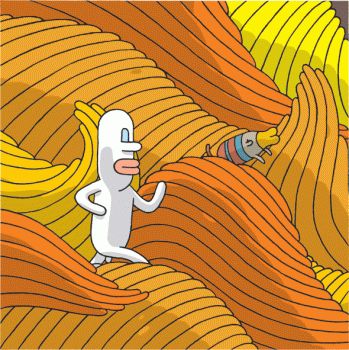
Samuel, the creation of Tommi Musturi (featured in Books from Finland on 7 May, 2010, entitled ‘Song without words’)
Comics? The Finnish word for them, sarjakuva, means, literally, ‘serial picture’, and lacks any connotation with the ‘comic’. The genre, which now also encompasses works called graphic novels, has been the subject of celebrations this year in Finland, where it has reached its hundredth birthday. Heikki Jokinen takes a look at this modern art form
Comics are an art form that combines image and word and functions according to its own grammatical rules. It has two mother tongues: word and image. Both of them carry the story in their own way. Images and sequences of images have been used since ancient times to tell stories, and stories, for their part, are the common language of humanity. The long dark nights of the stone age were no doubt enlivened by storytellers.
One of the pioneers of comics was the Swiss artist Rodolphe Töpffer. As early as 1837, he explained how his books, combinations of images and words, should be read: ‘This little booklet is complex by nature. It is made up of a series of my own line drawings, each accompanied by a couple of lines of text. Without text, the meaning of the drawings would remain obscure; without drawings, the text would remain without content. The whole gives birth to a sort of novel – but one which is in fact no more reminiscent of a novel than of any other work.’ More…
Snowbirds
2 November 2011 | Extracts, Non-fiction
The short winter days of the northerly latitudes are made brighter by snow cover, which almost doubles the amount of available light. Reflection from the snow is an aid for photographers working outdoors in winter conditions. A new book, entitled Linnut lumen valossa (‘Birds in the light of snow’), presents the best shots by four professionals, Arto Juvonen, Tomi Muukkonen, Jari Peltomäki and Markus Varesvuo, who specialise in patiently stalking the feathered survivors in the cold
The photographs and texts are from the book Linnut lumen valossa (‘Birds in the light of snow’, edited by Arno Rautavaara. Design and layout by Jukka Aalto/Armadillo Graphics. Tammi, 2011)
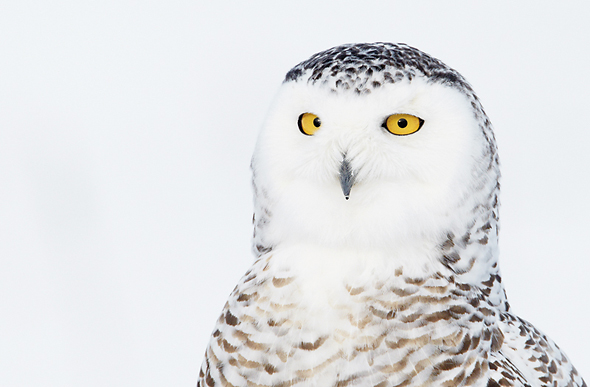
Snowy owl. Photo: Markus Varesvuo, 2010
Jarkko Laine Prize 2011
1 June 2011 | In the news
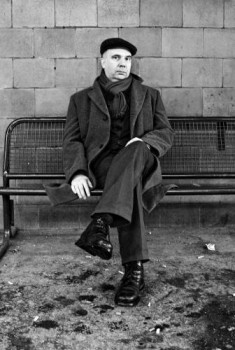
Juha Kulmala. Photo: Lotta Djupsund
The Jarkko Laine Literary Prize (see our news from 6 May), worth €10,000, was awarded to Juha Kulmala (born 1962) on 19 May for his collection of poems entitled Emme ole dodo (‘We are not dodo’, Savukeidas, 2009).
The prize is awarded to a ‘challenging new literary work’ published during the previous two years. Shortlisted were also two novels, Kristina Carlson’s Herra Darwinin puutarhuri (‘Mr Darwin’s gardener’, Otava, 2009) and Erik Wahlström’s Flugtämjaren (‘Fly tamer’, Finnish translation Kärpäsenkesyttäjä, Schildts, 2010).
Jarkko Laine (1947–2006) was a poet, writer, playwright, translator, long-time editor of the literary journal Parnasso and chair of the Finnish Writers’s Union.
Matti Klinge: Kadonnutta aikaa löytämässä. Muistelmia 1936–1960 [Finding lost time. Memoirs 1936–1960]
10 January 2013 | Mini reviews, Reviews
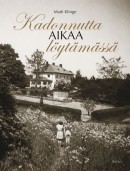 Kadonnutta aikaa löytämässä. Muistelmia 1936–1960
[Finding lost time. Memoirs 1936–1960]
Helsinki: Siltala, 2012. 557 p., ill.
ISBN 978-952-234-136-5
€31.95, hardback
Professor (Emeritus) Matti Klinge (born 1936) is a prolific historian who has specialised in the history of culture and ideas as well as in the debate on contemporary culture; he has also published 12 volumes of his diaries. In this fascinating volume of memoirs, inspired by writer Marcel Proust, he gives a detailed account of his childhood, schooldays and military service as well as his years of active study, shedding light on the cultural and social life of his time, from the point of view of Helsinki’s educated bourgeoisie, and draws telling character sketches of his contemporaries. The cultural heritage is reflected in the world of Klinge’s values and in his language. This handsomely produced book contains plenty of illustrative material ranging from entrance tickets and works of art to the jacket pictures of books important to the author and photographs. The volume lacks an index of personal names, which will hopefully be added to the final part of the work.
Translated by David McDuff
In the detail?
11 December 2009 | Essays, Non-fiction
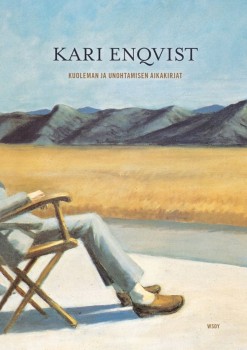 Extracts from Kuoleman ja unohtamisen aikakirjat (‘Chronicles of death and oblivion’, WSOY, 2009)
What’s the meaning of life? There are those who seek it in religion, while for others that is the last place to look. The scientist Kari Enqvist ponders why some people, including himself, seem physiologically immune to the lure of faith. Perhaps, he suggests, we should look for significance not in the big picture, but in the marvel of the fleeting moment
As a young boy I must have held religious beliefs. However, I cannot pinpoint exactly when they disappeared. At some point I eventually stopped saying my evening prayers, but I am unable to remember why or when this happened. ‘I was born in a time when the majority of young people had lost faith in God, for the same reason their elders had had it – without knowing why,’ writes the Portuguese poet Fernando Pessoa in The Book of Disquiet. More…
See the big picture?
9 November 2012 | Extracts, Non-fiction
Details from the cover, graphic design: Työnalle / Taru Staudinger
In his new book Miksi Suomi on Suomi (‘Why Finland is Finland’, Teos, 2012) writer Tommi Uschanov asks whether there is really anything that makes Finland different from other countries. He discovers that the features that nations themselves think distinguish them from other nations are often the same ones that the other nations consider typical of themselves…. In Finland’s case, though, there does seem to be something that genuinely sets it apart: language. In these extracts Uschanov takes a look at the way Finns express themselves verbally – or don’t
Is there actually anything Finnish about Finland?
My own thoughts on this matter have been significantly influenced by the Norwegian social scientist Anders Johansen and his article ‘Soul for Sale’ (1994). In it, he examines the attempts associated with the Lillehammer Winter Olympics to create an ‘image of Norway’ fit for international consumption. Johansen concluded at the time, almost twenty years ago, that there really isn’t anything particularly Norwegian about contemporary Norwegian culture.
There are certainly many things that are characteristic of Norway, but the same things are as characteristic of prosperous contemporary western countries in general. ‘According to Johansen, ‘Norwegianness’ often connotes things that are marks not of Norwegianness but of modernity. ‘Typically Norwegian’ cultural elements originate outside Norway, from many different places. The kind of Norwegian culture which is not to be found anywhere else is confined to folk music, traditional foods and national costumes. And for ordinary Norwegians they are deadly boring, without any living link to everyday life. More…
In Darwin’s garden
3 September 2009 | Authors, Interviews
Interview with Kristina Carlson, author of Herra Darwinin puutarhuri(‘Mr Darwin’s gardener’, 2009)
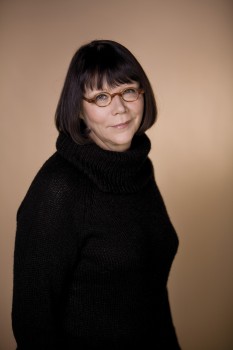
Kristina Carlson. Photo: Tommi Tuomi
Time: late 1870s. November. Place: the village of Downe, Kent, England. Villagers gather in the church on a rainy Sunday. Thomas Davies stays at home with his two children.
After the death of his wife, Thomas has been unable to get over his grief and anxiety. The villagers don’t approve of Thomas’s way of living – he isn’t sociable, keeps to himself, doesn’t go to church, and reads too many books. His employer is Charles Darwin: a famous – or notorious – man who writes too many books. ‘Mr Darwin lives here, and atheism is a worse threat than in the neighbouring villages,’ says Stuart Wilkes, voicing the views of the villagers.
Thomas is the central character in Kristina Carlson’s new novel, Herra Darwinin puutarhuri (‘Mr Darwin’s gardener’, Otava, 2009). Ten years ago her previous novel, Maan ääreen (‘To the end of the earth’), set in 19th-century Siberia, won the Finlandia Prize for Fiction.
As 2009 is the second centenary of Charles Darwin, the author of On the Origin of Species (published in 1859), the first question that comes to mind is whether this is coincidental or not… More…
Matti Salminen: Yrjö Kallisen elämä ja totuus [The life and truth of Yrjö Kallinen]
15 September 2011 | Mini reviews, Reviews
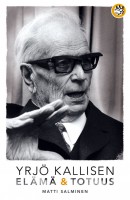 Yrjö Kallisen elämä ja totuus
[The life and truth of Yrjö Kallinen]
Helsinki: Like Kustannus, 2011. 271 p., ill.
ISBN 978-952-01-0612-6
€ 27, hardback
Counsellor of Education Yrjö Kallinen (1886–1976) was a Social Democrat politician, a passionate speaker and a pacifist who served for one parliamentary term as an MP and for two years as a cabinet minister. Kallinen was a working-class man who independently acquired a broad general education. His life and thought contain many paradoxes and contradictions. In the Civil War (1918) he received four death sentences, though he tried to act as a peace-broker between the Whites and the Reds. Kallinen avoided the death penalty but suffered a long prison sentence. After the Second World War he became Minister of Defence, though in spite of holding the post he did not abandon his pacifism. Kallinen was also strongly influenced by oriental religions and theosophy, and he is known as an early advocate of vegetarianism. The most important sources for this biography are Yrjö Kallinen’s own writings, many of which have never been published before, and his recently discovered correspondence. The summaries of Kallinen’s interviews for foreign newspapers open up interesting perspectives on recent Finnish political history.
Translated by David McDuff
Matti Rämö: Polkupyörällä Intiassa. Lehmiä, jumalia ja maantiepölyä [Cycling in India. Cows, gods, and road dust]
30 July 2010 | Mini reviews, Reviews
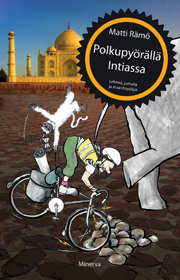 Polkupyörällä Intiassa. Lehmiä, jumalia ja maantiepölyä
[Cycling in India. Cows, gods, and road dust]
Helsinki: Minerva Kustannus Oy, 2010. 301 p., ill.
ISBN 978-952-492-335-4
€ 27.90, hardback
The author decides to take a pinch of the ashes of his dead mother to India’s Varanasi, the city of pilgrims on the banks of the Ganges, and at the same time visit his daughter at an international high school on the country’s west coast. Rämö takes his bicycle on the plane to Delhi and in the course of a month cycles more than 2,600 kilometres, from Delhi to Mumbai. The cyclist is challenged by the heat and humidity, the chaotic traffic, the awkward sections of road and the endless thirst for knowledge on the part of curious bystanders – but his observations are deeper than those of the average travel author, as he worked in India in third world research during the 1980s and 1990s. In the summer of 2007 he completed a four months’ cycle tour of the Sahara, travelling some 9,600 kilometres, and published a book about his experiences (Rengasrikkoja Saharassa, ‘Punctures in the Sahara’, Minerva, 2008). In spite of the shorter length of the Indian journey, the author thinks it possessed a higher difficulty factor.
Rock or baroque?
30 April 2014 | Extracts, Non-fiction
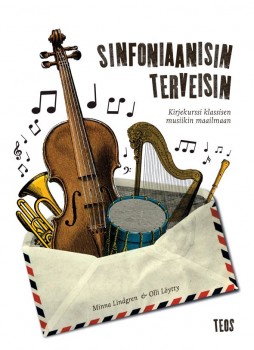 What if your old favourites lose their flavour? Could there be a way of broadening one’s views? Scholar Olli Löytty began thinking that there might be more to music than 1980s rock, so he turned to the music writer Minna Lindgren who was delighted by the chance of introducing him the enormous garden of classical music. In their correspondence they discussed – and argued about – the creativity of orchestra musicians, the significance of rhythm and whether the emotional approach to music might not be the only one. Their letters, from 2009 to 2013, an entertaining musical conversation, became a book. Extracts from Sinfoniaanisin terveisin. Kirjekurssi klassisen musiikin maailmaan (‘With symphonical greetings. A correspondence course in classical music’)
Olli, 19 March, 2009
Dear expert,
I never imagined that the day would come when I would say that rock had begun to sound rather boring. There are seldom, any more, the moments when some piece sweeps you away and makes you want to listen to more of the same. I derive my greatest enjoyment from the favourites of my youth, and that is, I think, rather alarming, as I consider people to be naturally curious beings whom new experiences, extending their range of experiences and sensations, brings nothing but good.
Singing along, with practised wistfulness, to Eppu Normaali’s ‘Murheellisten laulujen maa’ (‘The land of sad songs’) alone in the car doesn’t provide much in the way of inspiration. It really is time to find something new to listen to! My situation is already so desperate that I am prepared to seek musical stimulation from as distant a world as classical music. I know more about the African roots of rock than about the birth of western music, the music that is known as classical. But it looks and sounds like such an unapproachable culture that I badly need help on my voyage of exploration. Where should I start, when I don’t really know anything? More…
In memoriam Herbert Lomas 1924–2011
23 September 2011 | In the news
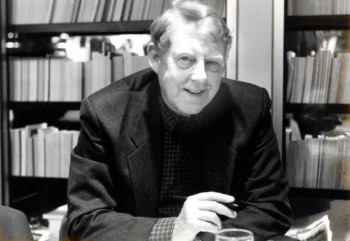
Herbert Lomas. Photo: Soila Lehtonen
Herbert Lomas, English poet, literary critic and translator of Finnish literature, died on 9 September, aged 87.
Born in the Yorkshire village of Todmorden, Bertie lived for the past thirty years in the small town of Aldeburgh by the North Sea in Suffolk. (Read an interview with him in Books from Finland, November 2009.)
After serving two years in India during the war, Bertie taught English first in Greece, then in Finland, where he settled for 13 years. His translations – as well as many by his American-born wife Mary Lomas (died 1986) – were published from as early as 1976 in Books from Finland.
Bertie’s first collection of poetry (of a total of ten) appeared in 1969. His Letters in the Dark (1986) was an Observer book of the year, and he was the recipient of several literary prizes. His collected poems, A Casual Knack of Living, appeared in 2009.
In England Bertie won the Poetry Society’s 1991 biennial translation award for one of his anthologies, Contemporary Finnish Poetry. The Finnish government recognised his work in making Finnish literature better known when it made him a Knight First Class of Order of the White Rose of Finland in 1987.
To Books from Finland, he made an invaluable contribution over almost 35 years – an incredibly long time in the existence of a small literary magazine. The number of Finnish authors and poets whose work he made available in English is countless: classics, young writers, novelists, poets, dramatists.
Bertie’s speciality was ‘difficult’ poets, whose challenge lay in their use of end-rhymes, special vocabulary, rhythm or metre. He loved music, so the sounds and tones of words, their musicality, were among the things that fascinated him. Kirsi Kunnas’ hilarious, limerick-inspired children’s rhymes were among his best translations – although actually nothing in them would make the reader think that the originals might not have been written in English. A sample: There once was a crane / whose life was led / as a uniped. / It dangled its head / and from time to time said:/ It would be a pain / if I looked like a crane. (From Tiitiäisen satupuu, ‘Tittytumpkin’s fairy tree’, 1956, published in Books from Finland 1/1979.)
Bertie also translated work by Eeva-Liisa Manner, Paavo Haavikko, Mirkka Rekola, Pentti Holappa, Ilpo Tiihonen, Aaro Hellaakoski and Juhani Aho among many, many others; for example, the prolific writer Arto Paasilinna’s best-known novel, Jäniksen vuosi / The Year of the Hare, appeared in his translation in 1995. Johanna Sinisalo’s unusually (in the Finnish context) non-realist troll novel Ennen päivänlaskua ei voi / Not Before Sundown, subsequently translated into many other languages, appeared in 2003. His last translation for Books from Finland was of new poems by Vilja-Tuulia Huotarinen in 2009.
It was always fun to talk with Bertie about translations, language(s), writers, books, and life in general. He himself said he was a schoolboy at heart – which is easy to believe. He was funny, witty, inventive, impulsive, sometimes impatient – and thoroughly trustworthy: he just knew how to find the precise word, tone of voice, figure of speech. He had perfect poetic pitch. As dedicated and incredibly versatile translators are really hard to find anywhere, we all realise our good fortune – both for Finnish literature and for ourselves – to have worked, and enjoyed with such enjoyment, with Bertie.
Poet Aaro Hellaakoski (1893–1956) was not a self-avowed follower of Zen, but his last poems, in particular, show surprisingly close contacts with the philosophy. ‘Secrets of existence are revealed once one ceases seeking them’, the literary scholar Tero Tähtinen wrote in an essay published alongside Bertie’s new Hellaakoski translations in (the printed) Books from Finland (2/2007). Bertie was fond of Hellaakoski, whose existential verses fascinated him; among his 2007 translations is The new song (from Vartiossa, ‘On guard’, 1941):
The new song |
Uusi laulu |
| No compulsion, not a sting. | Ei mitään pakota, ei polta. |
| My body doesn’t seem to be. | On ruumis niinkuin ei oisikaan. |
| As if a nightbird started to sing | Kuin alkais kaukovainioilta |
| its far shy carol from some tree – | yölintu arka lauluaan |
| as if from its dim chrysalis | kuin hyönteistoukka heräämässä |
| a little grub awoke to bliss – | ois kotelossaan himmeässä |
| or someone struck from off his shoulder | kuin hartioiltaan joku loisi |
| a miserable old bugaboo – | pois köyhän muodon entisen |
| and a weird flying creature | ja outo lentäväinen oisi |
| stretched a fragile wing and flew. | ja nostais siiven kevyen. |
| Ah limitless bright light: | Oi kimmellystä ilman pielen. |
| the gift of lyrical flight! | Oi rikkautta laulun kielen. |