

Search results for "tommi+musturi/2010/05/song-without-words/2009/09/what-god-said/2011/04/matti-suurpaa-parnasso-1951–2011-parnasso-1951–2011"
Contemplating the cosmos
30 September 2006 | Fiction, poetry
Poems from Valkoiseksi maalattu musta laatikko (‘A black box painted white’, WSOY, 2006). Introduction by Pertti Lassila
Good morning, murmuring universe,
dim tortuous thingamybob
with your moving and unmoving parts,
which every day need
new instructions for use
even though the previous ones
were not all that clear, because the article itself
is perpetually modifying its rules of behaviour.
There are threats that our details are being checked,
exhortations to be good, to wait,
wait and believe,
to stay outside at night
in abstract space
till the next numerical series. More…
Mirdja
31 March 1984 | Archives online, Fiction, Prose
An extract from the novel Mirdja (1908). Introduction by Marja-Liisa Nevala
Now they were in the city – their minds more alive than usual with wilfulness and daring.
For – quite unable to jettison their shared life – they had at least to get on top it… Had to … Every single person has to battle …
And Mirdja’s head was full of efficacious rules for balance, countless cool and wise thoughts – to meet all conflicts.
Lucidly and coldly she had clarified her present position for herself. She was married. Right. No particular joy in that. But no need for any particular disaster in it either. And if she had thrown herself into dependence through this banal arrangement, the sort that everyone has a little of in this life, she had only herself to blame. She had to be able to live by rising above the trivialities of existence. Besides, she had always known that in the final count it was immaterial whom one was married to. A marriage always had its own profile, its dreary distinguishing marks, but one was not compelled to absorb these dreary sides into one’s own being. How did they do it in France? Every year thousands of marriages occur, without an atom of personal liking entering into the game, and extremely seldom are the marriages unhappy. Why so? Mutual politesse: a little of the art of social intercourse, and the whole problem is solved. In the morning a tiny friendly greeting at the breakfast table: ‘Bonjour ma chère,’ – ‘Bonjour, mon ami’; a courteous kiss on the hand, a pretty smile in response, and everything’s as it should be. Because those people know how to go about it. Marriage – one of society’s many empty regimentations! Only stupid people tried, within narrow limits like these, to find fullness of content or idealize. Stupid, Mirdja had been. Comically destructive in that heavy northern solemnity of hers – refusing to acknowledge any form without content, yet fearful of endowing content with any form except the conventional and time-tested. She had lived with a common-or-garden person’s longing for fullness, and then allowed, exactly like that sort of person, her disappointment and bitterness to flood over all her nearest and dearest. She had lived in indiscretion. She had been paltry and rotten and considered herself a slave … More…
Sunweave
30 June 1998 | Archives online, Fiction, poetry
Poems From Aurinkopunos (‘Sunweave’, WSOY, 1997). Introduction by Jyrki Kiiskinen
Evening in Manhattan
the mechanism clicks
in the past I suppose it was called
falling in love but now we’re expected to merely
note that the cogs of chance have revolved into a propitious position
chemicals catch fire for exciting actions
under the street old fire moves under the sewers
maybe an alligator
they are calm creatures but we of course aren’t
we bounce off of each other into each other
flee from earth’s death the rising motion
the forest grows into skyscrapers petrifies
into the rings of suns More…
Romantic and political
30 June 2004 | Authors, Reviews

Photo: Heini Lehväslaiho
If I had to describe Tomi Kontio’s new book of poems, Vaaksan päässä taivaasta (‘A span away from heaven’, Teos, 2004, page 93) in ten words or less, I would say that it is a succession of deep breaths taken between catastrophes great or small.
Since I have a few more words at my disposal here, I’ll also say that it meets every expectation set up by his previous three volumes of poetry: sonorous language, an essentially Romantic but not egocentric worldview, and extraordinary skill in combining straightforward narrative with spectacularly effortless runs of metaphors, as in these lines from the poem ‘Pietà’: More…
No one can tell
31 March 1999 | Fiction, poetry
Poems from Ahava (WSOY, 1998)
And life went on, went on as a kind of weird fugue,
               a forked path that drops across your eyes,
                    rejecting simple questions.
Which summer was that,
               I ask in December,
in a high room, with a tiled stove, a bricked up
          nostalgic sentence about the warmth of other times,
               a crossing where all the world's words
                         discover the the comparative degree of silence,
                                        the one with meaning.
Should I peep across a couple of cloudy stanzas to get a better view,
     but again my eye conjures up a medieval constricted soul.
All that's left is a thirst of all the senses, a frigid study of sentences,
                              of bones.
Experiments with reality
30 September 1985 | Archives online, Authors
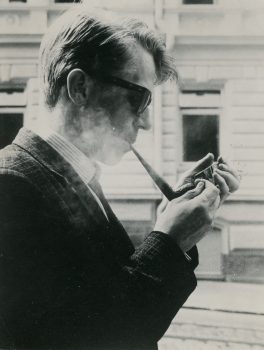
Väinö Kirstinä. Photo: SKS Archives
Väino Kirstinä (born 1936) regards himself as a member of the ‘second generation’ of Finnish modernists. His first collection of poems, Lakeus (‘The plain’) was published in 1961, followed two years later by Hitaat auringot (‘Slow suns’) and, the same year, by the work that gained him public recognition, Puhetta (‘Talk’). In 1979 Kirstinä commented on the aims of Puhetta: ‘the work … aimed to break the mould of Finnish modernism in some senses – hermetics, for example. I tried to bring everyday language into poetry – trams and fridges alongside the familiar symbols of mountains, lakes, beaches and birds. My poetry opened up, it developed into a kind of unclean lyricism.’
His interest in words as one of the constituents of poetry is characteristic of Kirstinä’s work, as is his search for the sources of modern poetry, such as the work of Baudelaire, which he has translated into Finnish, and the later tradition of surrealism and dada, which is clearly influential in his extensive collections Luonnollinen tanssi (‘Naturaldance’, 1965) and Pitkän tähtäyksen LSD-suunnitelma (‘Long-term LSD plan’, 1967). More…
The Mermaid Café
30 June 2000 | Archives online, poetry
From Cafe Sjöjungfrun (‘The Mermaid Cafe’, Söderströms, 1999). Introduction by Peter Mickwitz
Caesura
Yesterday we had the first evening of autumn
even though it is still July. The cool
moist darkness lights that seemed
softer, the Esplanade’s octagonal cone
lit up red, yellow and green above
the underground tunnel from restaurant
to hotel. In the row of lime trees
worn garlands began to show, more
than a third of their light bulbs gone, broken
lines of burning dots gently
swaying. Farther away
sun-bleached awnings, some oily
neon, it, too, segmented,
and people moving
at a calmer pace, already anonymous,
close to unreal reflected in glass panes,
entryways, street lamps shaped like big hooks.
Traffic noise becomes more explicit
as if in an echo chamber or does it
grow more dense as if we walked about
with yellowing wads of cotton in our ears
or a window or a door was closed
and voices a moment ago
distinct, or at least partly,
are transformed into a numb buzz,
all that remains of the message
are ups and downs, a caesura when the conversation, at regular intervals,
reaches a rhythmic point of rest.
Burgundian rain
30 September 1992 | Archives online, Fiction, poetry
from Burgundiska sviten (‘Burgundian suite’, Schildts, 1966). Introduction by Tuva Korsström
and if we could reach our Burgundian boundaries
you close to mine and I closer to yours than mine
and there see far beyond all boundaries
and there see jar beyond all shores
and there see far beyond all seas
and the ice blocks which this winter’s day
are brought heaving from below and the numbed cliffs
and ice-shattered shores vanish
and before us lies our open
quite open and naked sea More…
Head in a cloud
27 May 2011 | Articles, Non-fiction
Thinking, reading, writing, buying… Teemu Manninen explores the new freedoms, literal and poetic, offered by cloud computing, where what you can do is no longer limited by what you happen to have on your computer
High in the sky: cumulus clouds. Photo: Michael Jastremski, Wikimedia
I’m sitting in a rocking chair on the porch of a cottage by a lake. My fingers tap and slide on the surface of a black glass panel, a kind of instrument used in the composing of literature. Each tap equals a letter, a series of taps equals a word, a symphony of taps becomes a paragraph, a paragraph an essay.
The glass panel remembers these letters and words and the writings they become, and knows them by their names, but it could also record anything I see or hear. I could even talk to it and it would understand my commands, as if some nether spirit were captured inside, a magic genie slaved to do my bidding. More…
The unpassing of time
30 June 2001 | Authors, Reviews

Photo: Marjaana Saarenpää
The poems of Anne Hänninen (born 1958) recall the paintings of Henri Rousseau, in which animals and plants, each in their turn, burst out, appear into existential space and freeze to gaze at the viewer. Hänninen achieves this effect by avoiding words, action words, motion. The poems often embody an expression, vision or performance of release, but Hänninen is able to make even the ineluctable passage of time seem oddly static: ‘the pearl-buds of the rowans once gone – / lilies of the valley. And from under the hepaticas violets, / and forget-me-nots from the wood anemones.’ More…
From A to Z
31 March 2001 | Authors, Reviews
 Susanne Ringell’s new work is the shortest of the books published in 2000. It easily disappears on the bookshelf if one doesn’t carefully remember where one put it. Only 62 pages. Yet it constructs a whole civilisation and a humanity.
Av blygsel blev Adele fet (‘It was embarrasment that made Adele fat’) is an ABC for grown-ups. At each letter we meet a person. At ‘A’ we encounter Adele, who grows as fat as she is shy. She carries 78 kilos of shyness inside her, and she eats until her body is the same weight. At ‘W’ we meet Walter, who runs away from the zone therapist’s clinic to the restaurant. He is in no doubt as to what does body and soul good: a rare beef steak, in spite of his wife’s pleas in favour of the beneficial therapy. And at ‘E’ and ‘F’ we meet Egil and Folke: two shy men waiting for a train – and for a long period of waiting to end.
Susanne Ringell gives her readers an entire alphabet; she restores to us the foundation for our structuring of language and the world around us. But a language without people would be dead. So each letter is a person; each letter is coloured by a human fate that seldom figures largely in the history books, but on which Susanne Ringell confers dignity. The people we encounter in the book are lonely. That is certainly nothing new in literature – but Ringell has an unusual gift of being able to create dignity around the most bizarre creatures. More…
Pekka Tarkka on Antti Tuuri
30 June 1981 | Archives online, Authors
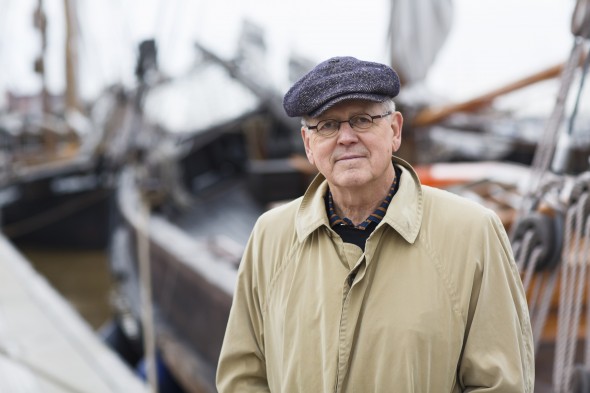
Antti Tuuri. Photo: Jouni Harala
A character in one of Antti Tuuri’s short stories, a German engineer, remarks: “It has always seemed to me that the Finnish language doesn’t contain individual words – it is just an effusion from a state of mind.” The quotation is taken out of context but it serves as a good description of the slow and sentimental or atmospheric tradition of prose style developed by a number of Finnish writers. This is a category which does not include Antti Tuuri (born 1944). His prose is crisp, clear and concrete in the Indo-European manner. It is not in the least ‘an effusion from a state of mind.’ He uses ‘individual words’ precisely, concrete observations, descriptions of specific phenomena; it is not rare to find numerals in his text.
Tuuri’s style undoubtedly owes something to his training and background. He qualified as an engineer and has worked in a number of posts requiring a high level of technical skill and business ability: he was technical supervisor in a newsprint works and in a wallpaper factory, he has sold Finnish printing equipment abroad and has trained engineers in his field. When Tuuri became Chairman of the Union of Finnish Writers in 1980 he brought to the Union’s administration the modern and professional management techniques that are characteristic of his approach. More…
Writers’ talk
13 May 2011 | In the news
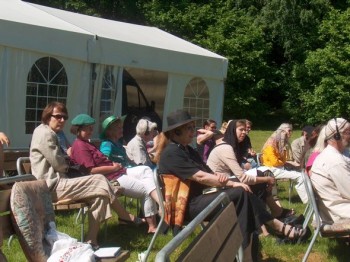
Under the midday sun: participants of the Writers' Reunion in 2005
Next month sees a new International Writers’ Reunion at Messilä Manor in the city of Lahti in central Finland. The first such meeting was organised in 1963.
Since then, more than a thousand writers, translators, journalists, critics and other book people, Finnish and foreign, have met for a few days every other year just before Midsummer to discuss various topics.
And the nights are light, and long, and the talking goes on.
This time the theme is ‘The writer beyond words’: how will the writer meet the limits of language and narration? (More on the topic in our article Beyond words.) The meeting takes place between 19 and 21 June.
So far about twenty writers, from Canada, Czech Republic, Denmark, Estonia, France, Germany, Great Britain, Ireland, Lithuania, Norway, Russia, Slovenia, Sweden and Udmurtia, are expected to arrive, as are some 20 Finnish participants. All debates and poetry evenings are open to the general public free of charge.
Writing and power
15 October 2009 | This 'n' that
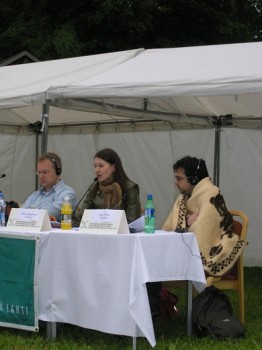
Speaking in the cold: the Chairperson of the Lahti Writers' Union, Jarmo Papinniemi (left), and the Bosnian writer Igor Štiks (right) listen to Riina Katajavuori's presentation
The theme of the biannual International Writers’ Reunion (LIWRE) which took place in Lahti, southern Finland, in June for the 24th time, was ‘In other words’.
The theme inspired the participants (54 in total, foreign and Finnish) to talk, among other things, about the power of the written word in strictly controlled regimes, about fiction that retells human history, about the difference between the language of men and women, about languages that have been considered – by those who rule, naturally – ‘better’ than other languages. Eleven presentations are available in English.
Speaking about the birth of her latest collection of poems, Kerttu ja Hannu (‘Gretel and Hansel’, 2007), the Finnish writer Riina Katajavuori described in her presentation the need to use other words. In her case they were those of poetry, in retelling a tale; here are some extracts (scroll down!). More…