

Search results for "tommi+musturi/2010/05/song-without-words/2009/09/what-god-said/2011/04/matti-suurpaa-parnasso-1951–2011-parnasso-1951–2011"
One and twenty
30 September 2007 | Archives online, Fiction, poetry
(Extracts from the epic poem Kaksikymmentä ja yksi, Otava, 1974)
[Canto I]
Twenty-one and a sail, days and nights.
              Nights, they sleep. Days, they row, days and days up the Nevá,
they row, stop at night, pull the vessel with ten pairs of oars
              across the bare water,
from the Nevá to the Roiling Waves, from the Roiling Waves
              up to Novgorod, from Novgorod to the headwaters,
                        and from there across the isthmus,
over round logs, running the last log up to the prow, they pull,
they row, they descend, they pull, they sail toward Pohja,
               the Southland.
Twenty-one and a sail, days and nights,
              nights, they sleep, they row, day and night, up the Nevá.
The rower turns into arms, the arms turn into palms,
              the palms turn into oars, the oars turn into the river, the river runs.
Night changes to day, day changes to autumn, autumn to wind,
              the wind turns into a sail,
as one single bird ten pairs of oars pairs of wings fly upriver,
              across the isthmus, all night without stopping
they pull, they float the vessel, they keep going
              toward the Southland.
And South is the name of a slave.
 …
They stand in the Southland's yard.
              Bent, Bent, Nightbird, Big Toe, Crow's Son, Cuckoo's Son,
Väinö's Son, Dead Man’s Son, Whitefish, Black Dick
              Man’s Wood, Broom, Lover Boy, Pumpkin,
Water Cloak, Fishless, Stocking Foot, Fist, Mast and Fishery.
              Bent and Bent are twins, their father is also a Bent,
                      Bent the Guardian of the Spears.
More…
The bad and the ugly in the writing of Pentti Haanpää
31 December 1984 | Archives online, Authors
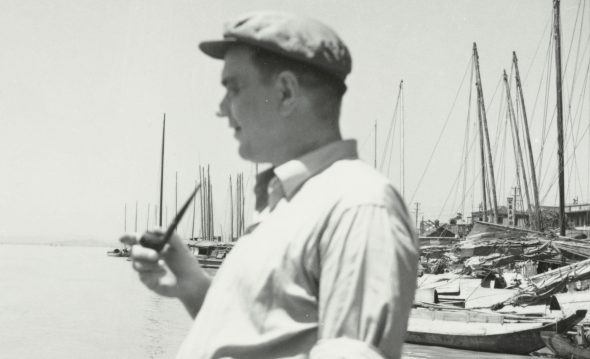
Pentti Haanpää. Photo: SKS Archives
Pentti Haanpää (1905-1955), author of ten novels and three hundred short stories, wrote about lumberjacks, woodsmen, crofters and smallholders; his individual style has established him as one of the most popular short story writers in Finnish literature.
The first full biography of Haanpää, by Vesa Karonen, Haanpään elämä (‘Haanpää’s life’), is to be published in January 1985 by Finnish Literature Society.
Haanpää’s strength as a writer is in his short stories. He is a man’s writer who writes about a man’s world: logging and other heavy manual work, hiking, war hunting, fishing, sport. His language, too: is masculine: rugged, sometimes rough, dense, laconic. Haanpää’s scale of emotions is wide and varied, but there is a bass note that is often sounded in his work. It is one of the characteristics that gives Haanpää’s work its particular stamp: his preoccupation with the bad and the ugly. More…
The house of the rising sun
30 June 1998 | Archives online, Fiction, poetry
Poems from Nousevan auringon talo (The house of the rising sun’, Tammi, 1997). Introduction by Jyrki Kiiskinen
Closeness. License to kill. And to go on living
         becomes impossible.
 When you see a waterfowl’s eyes, if you see them
         in the dark, that is the right distance.

Now the fire power of our forces consists of infantry arms.
         You are hard ammo exercises, controlled
 regression, kiss of a porcupine, flower
                   from the great gardener's garden, who
                          shall be killed nevertheless.
         The one who in every piss-stained jail cell tries
                   to inch his own death forward a little.
*  More...
An intimation of Paradise
31 December 1984 | Archives online, Fiction, poetry
Poems from Paratiisiaavistus (‘An intimation of Paradise’, 1983). Introduction by Pertti Lassila
Satu Salminiitty (born 1959) has published only one collection of poetry since her first appeared in 1981, but with these two volumes she has achieved considerable success. She writes with a fine rhetoric using language and rhythm that are far removed from those of spoken Finnish. Religious pathos has a prominent place in her work, and her poems often derive from praise, prayer or even magic incantations; Salminiitty is a creator of vision who trusts to her metaphysical intuition, a quality not generally discernible among today’s Finnish poets. Equally rare is her lively faith in the goodness and beauty of people and of the world. A conscious rejoinder to materialism, pessimism and fear of the future can be read in her poems. More…
L’Amour à la Moulin Rouge
Extracts from the novella Yksin (‘Alone’, 1890). Introduction by Jyrki Nummi
After dining at the Duval on the Left Bank I take the same route back and drop in at the Café Régence to flick through the Finnish papers they have there.
I find my familiar café almost empty. The waiters are hanging about idly, and the billiard tables are quiet under their covers. The habitués are of course at home with their families. Anyone who has a friend or acquaintance is sharing their company this Christmas Eve. Only a few elderly gentlemen are seated there, reading papers and smoking pipes. Perhaps they’re foreigners, perhaps people for whom the café is their only home, as for me.
A little way off at the other end of the same table is a somewhat younger man. He was there when I came in. He’s finished his coffee and appears to be waiting. He’s restless and keeps consulting his watch. An agreed time has obviously passed. He calms himself and lights a cigarette. A moment later I can see a woman through the glass door. She’s hurrying across the street in front of a moving bus and running straight here. Now the man notices her too, and he cheers up and signals to the waiter for the bill. The woman slips through the door and goes straight across to him. They altercate for a moment, come to an understanding and depart hand in hand. More…
The price of a free lunch
31 December 1994 | Archives online, Fiction, Interviews
Eeva Joenpelto’s new novel, Tuomari Müller, hieno mies (‘Judge Müller, a fine man’), is the story of a good woman with a bad conscience, and of the small-town, big-business corruption of Finland in the 1980s. (Interview of EJ: 1994)
… the front door of the office building flew open. Men swept out and down the street, as fast-moving, garrulous and laughing as if it had been decided by vote in a council meeting. The entire width of the street was filled with the scent of vigorous, masculine deodorants: thyme, tarragon, gunpowder.
At the end of the 1980s, successful men smelt of gunpowder even in the Finnish boondocks: then, after all, money was on the move, whatever the business – bank management, whirlpool baths or local politics. This last seemed to move significantly closer to business life when the fast-moving and garrulous politicians organised a few benefits for themselves from the flowing stream of money, and no one saw fit to object. Yet. More…
Green gold, black gold
31 March 2001 | Archives online, Fiction, poetry
Poems from Jakutian aurinko (‘The Yakutian sun’; Tammi, 2000). Introduction by Kari Sallamaa
So this, then, is Tomsk,
a town, tumbling into snow.
Even its lanes rise up into the sky.
No longer fragrant the pine,
the juniper, not even the gardens.
Can’t trust the skirts,
above the rooftops,
stripes are beaten out of the carpet,
yellow and turquoise for the horizon,
under the rooftops, fingernails
rip the wallpaper,
those white frost fingernails.
So, this is Tomsk,
in its streets the Volgas zip by.
And when I get a ride, the back seat fills up in no time.
Breath steams, nylon rips. The ladies
apply lipstick, unconcerned. More…
The dance of the living
30 June 1994 | Archives online, Fiction, poetry
From Dikter från havets botten (‘Poems from the bottom of the sea’, Söderström & Co, 1993)
Who was he that lived my life and now
is some Other? Who was the little boy
asking questions? Who the teenager asking
who the little boy was? The yellowing photo
remains, and the hand holding the photo. The photograph,
the hand, the image of the boy, the hand’s image. More…
Thrills ‘n’ spills
3 October 2011 | In the news
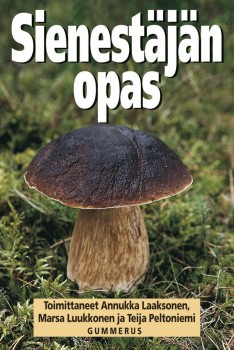 Thrillers occupied half the top ten spaces on August’s list of best-selling fiction titles in Finland, compiled by the Finnish Booksellers’ Association. Top place was taken by Leena Lehtolainen’s latest crime thriller, Oikeuden jalopeura (‘The lion of justice’, Tammi).
At number two was Kaari Utrio’s new historical novel, Oppinut neiti (‘Learned Miss’, Amanita), followed by Kari Hotakainen’s Jumalan sana (‘God’s word’, Siltala).
The non-fiction list reflected Finns’ passion for mushrooming. Since August, rain and warmth have worked wonders for friends of fungi: zillions of ceps, boletuses, chanterelles as well as poisonous specimens are abundant everywhere, so you’d better know which are safe to put into your pan. The top 20 list includes four guidebooks/cookbooks for those who love roaming in the forests and fields in pursuit of mycotic delicacies. The list was topped by Sienestäjän opas (‘Mushroom hunter’s guide’, Gummerus), which even beat the Finnish version of Harry Potter Film Wizardy.
All the grace
21 February 2013 | Fiction, poetry
Poems from Huhtikuu (‘April’, 1932), Sateen jälkeen (‘After the rain’, 1935), Hunnutettu (‘Veiled’, 1936), Kaukainen maa (‘Distant land’, posthumous, 1937; all published by WSOY). Introduction by Vesa Haapala
ON THE SHORE
The wonderful pale clouds
cross the sky like wings.
Quiet and enchanting
the open water sings.
The sand has grown weary
of the waves’ caressing play.
Now come in perfect quiet,
now come here, right away…