

Search results for "tommi+musturi/2010/05/song-without-words/2009/09/what-god-said/2011/04/matti-suurpaa-parnasso-1951–2011-parnasso-1951–2011"
Aqua Regia
30 June 2000 | Archives online, Fiction, poetry
Poems from Kuningasvesi (‘Aqua Regia’, WSOY, 1999). Introduction by Peter Mickwitz
Aqua Regia
Aqua regia, aqua regia,
thus dissolve into you
tallow candles and wing-wax,
and in the distilled sun's bowl
gold's will is broken.
Equal in you are ergot
and lightning-rod platinum,
 no difference between feather and lead,
if you perish to become what you love
you are the dawn's own.
Medieval landscape
He is a man who takes the measure
of words as if each one of them
were an angel. Rarely do they
agree peaceably to dance
with gravity.
You can see him sowing
his hymns under the wrong balconies,
and that is when even one
stammering syllable feels
like lightning striking your hip.
Sufficient ransom, if you remember
the name oft he one you long for.
His own the man curses
like a fleur de lys, burnt
seal on a shoulder.
Diogenes
You citizen of the world and the barrel
troublemaker in the town square

Whose heart is a mustard seed
and whose memory-is quicklime

Who fraternizes with stray dogs
and hates coins more than fleas

Tell us what they taste like
raw cuttlefish and lupine

What it feels like to search lantern in hand
 for the sun buried in shame

Tell us how great is the freedom
 envied even by Alexander

How small an empire compared
to a slave's brash request:

'Sell me to that man.
 He needs a master.'
Translated by Anselm Hollo
From Bosnia with love
31 March 2002 | Authors, Reviews

Photo: Pertti Nisonen
Daniel Katz’s new novel Laituri matkalla mereen (‘A jetty to the sea’, WSOY, 2001), tells the story of the impossible romance between the Bosnian wife of a blind Finnish colonel and a history teacher. Introduction by Tuva Korsström
At some point 250 years ago, a Swedish monarch decided to grant town status to some villages in the estuary of Kuhnusjoki (‘Sluggish river’) on the south-west coast of Finland.
There the little town lies today and is, with its environs, the setting for Daniel Katz’s novel Laituri matkalla mereen (‘A jetty to the sea’). It’s the late 1990s, early autumn, and this year the autumn gales come early. The history teacher Henry Loimu goes down to the bank of the river to repair his jetty in the gusts of wind. More…
Funny stuff
1 April 2009 | In the news
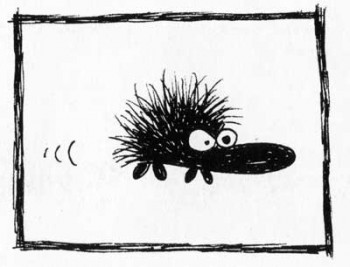
Milla Paloniemi's swearing hedgehog
For the first time, comic books rule the latest bestsellers list of Finnish fiction.
A cartoon series called Fingerpori by Pertti Jarla evidently tickles the Finnish funny bone, as three of his collections occupy the second, sixth and eighth places on the February top ten list, compiled by the Booksellers’ Association of Finland. More…
On Bo Carpelan
30 September 1977 | Archives online, Authors
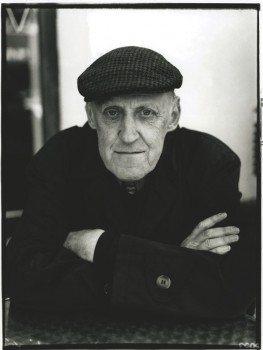
Bo Carpelan. Photo: Ulla Montan
For a small country Finland is richly endowed with poets. Of particular interest, in view of the smallness of the Finland-Swedish population (about 7% of the total), is the number of poets who speak and write Swedish as their first language and consistently produce work of outstanding quality. International recognition of the work of one of these poets came earlier this year with the award of the Nordic Council Literary Prize to Bo Carpelan.
Carpelan’s first volume of verse, Som en dunkel värme (‘Like a dark warmth’) appeared in 1946. Since then he has brought out a further ten volumes of poetry and six prose works (all published by Schildt, Helsinki). It would be difficult, and probably premature, to attempt any detailed analysis of the fusion of influences and inspiration that have come together in Carpelan’s poetry. It is clear, however, that his early work has points of contact with the Finland-Swedish modernism of the 1920s and that he followed with particular interest the 40-talists, a group of Swedish poets active in the 1940s: the influence of their heavy, profuse imagery can be discerned in his early collections.
Critics identify two main periods in Carpelan’s poetry. The first of these is represented by his first volume and by Du mörka överlevande (‘You dark survivor’, 1947), Variationer (‘Variations’, 1950), Minus sju (‘Minus seven’, 1952) and Objekt för ord (‘Objects for words’, 1956). The second period begins with the collection Landskapets förvandlingar (‘The changing landscape’, 1957) and was followed by Den svala dagen (‘The cool day’, 1961), 73 dikter (’73 poems’, 1966), Gården (The courtyard’, 1969), Källan (‘The spring’, 1973) and most recently by I de mörka rummen, i de ljusa (‘In the dark rooms, in the bright ones’, 1976). In all his poetry Carpelan sees life as a mystery, but his approach to this mystery changes and develops. In his earlier works his language is deft, yet at the same time private and intimate, later it becomes sharp and simple. More…
New from the archives
19 February 2015 | This 'n' that
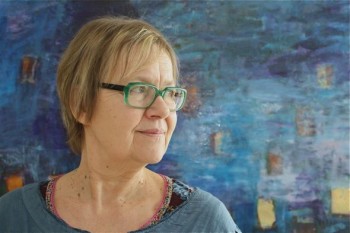
Tua Forsström. Photo: Mao Lindholm
Some weeks the digitisation project turns up material we’ve all but forgotten about; other times it’s like greeting an old friend. The poet Tua Forsström’s voice belongs in the second category: quintessentially feminine, wise, simultaneously vulnerable and strong, she is a quiet, watchful observer of everyday life, fixing the chimerical, the evanescent not with, it seems, but between, the words of her poems. This extensive selection of poems is introduced by her friend and fellow poet, Claes Andersson.
Born in Porvoo in 1947, Forsström publishes rarely. She won the Nordic Council Literary Prize in 1998 with Efter att ha tillbringat en natt bland häster (‘After having spent a night with horses’, 1997). Her breakthrough into the English-speaking world came in 1987 with her sixth collection, Snow Leopard (Snöleopard), which was translated into the English by David McDuff and published by Bloodaxe Books. We’ve featured her work regularly, including her most recent collection, En kväll i oktober rodde jag ut på sjön (‘One evening in October I rode out on the lake’, Söderströms, 2012), with an introduction by Michel Ekström.
*
The digitisation of Books from Finland continues apace, with a total of 358 articles and book extracts made available online so far. Each week, we bring a newly digitised text to your attention.
Writing letters
30 December 2001 | Fiction, Prose
From Meddelande. Noveller i urval 1971–1997 (‘Messages. Selected short stories 1971–1997’, Schildts, 1997)
I’ll make it to Maritim, got hold of Gustafsson, van coming at 8, have redirected mail to summer address, bye kiss Tooti
Take last things out of fridge
Hi my name is Olavi. You write well but last time you didn’t make a happy ending. Why do you do this?
We look forward to your valued reply soonest concerning Moomin motifs on toilet paper in pastel shades
Don’t say too much if they ring, don’t promise yet. Bye Tooti
Hi! We’re three girls in a mad rush with our essays about you could you help us by saying in just a few words how you started writing and why and what life means to you and then a message to young people you know the kind of thing. Thanks in advance More…
Gospel truths?
31 March 1999 | Authors, Reviews

Photo: Irmeli Jung
Lauri Otonkoski (born 1959) has the reputation of being a poet who passes attentively by and always has room for doubt.
He assumes a chatty tone, full of an irony often at his own expense, though his schooling as a music critic has given him a fine ear and the art of producing structures comparable to music.
Otonkoski has published six collections, two of them prizewinning. In 1996 he received the Nuoren taiteen Suomi-palkinto (‘The Finnish Award for Young Artists’), and in 1997 the Finnish Radio Poetry Prize, ‘Dancing Bear’. More…
This is a map
30 June 1992 | Archives online, Fiction, poetry
from Tasanko 967 (‘Plain 967’, Kirjayhtymä, 1991). Introduction by Jukka Petäjä
	and he woke
			 to the babble of a hungry baby
 		and his palate, his mouth
				was dry
	and waking he recalled images of
		bodies battered
			in the violent overthrow
				of Vilnius TV Station
			and he dozed off
				into the sound of suckling
Love me tender… in Latin
12 April 2013 | This 'n' that
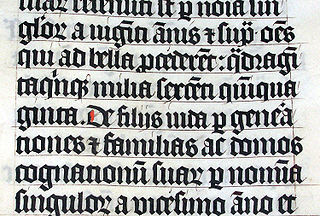
Latin Bible, 1407. Malmesbury Abbey, Wiltshire, UK. Photo: Arpingstone, Wikipedia
Nuntii Latini, conspectus rerum internationalium hebdomadalis, est programma Radiophoniae Finnicae Generalis in terrarum orbe unicum.
Nuntii Latini is a five-minute radio programme broadcast every Friday by the Finnish Broadcasting Company, YLE. It is the only regular news programme in Latin in the world, and has been on the air since 1989. (Not even Vatican Radio broadcasts news.)
Professor Tuomo Pekkanen from Jyväskylä University and Reijo Pitkäranta are the founding fathers of the programme, and they are helped by some other friends of Latin.
In a report on 8 April The New York Times wrote that even Elvis Presley has inspired the friends of the dead language: Jukka Ammondt, a Finnish university lecturer in English and German, began singing Elvis songs in Latin a couple of decades ago, and occasionally still does. Love Me Tender: Tenere Me Ama.
John Tagliabue describes in his article how Leah Whittington, an English professor at Harvard, ‘catches the news bulletins on her iPod while strolling to classes.’ Whittington says: ‘I’m often struck when I’m listening how well structured they are, how idiomatic, how precise the vocabulary is.’
The editors don’t invent new words, they look for new expressions using existing Latin vocabulary. A golf course, for example, is campus pilamallei.
The human factor
14 March 2013 | Non-fiction, Tales of a journalist

Illustration: Joonas väänänen
Columnist Jyrki Lehtola zooms in on the worst factor in the diminishing quality journalism: us. Our voice is now dominant in the media, and it isn’t a particularly pleasant one.
Have you heard the rumours about the crisis in the media yet? Or their search for a new revenue logic that consists of repeating the words ‘Internet’ and ‘money’? I’m sure you have, even though the media itself claims to be getting along fairly well and can always find some perspective on its dropping circulation numbers that tells everyone they’re doing just fine. (For example, their numbers are better than in 1898 when the paper didn’t exist. Yes, we rule!)
But that isn’t the only problem. The other problem exists in us, the readers, listeners and viewers. Social media, discussion boards, and the media itself have given us a voice, and, er, well, it isn’t the kind of voice anyone wants to hear.
It turned out we have an ugly voice, and we want all the wrong things. More…
Coming in from the cold
13 December 2012 | This 'n' that
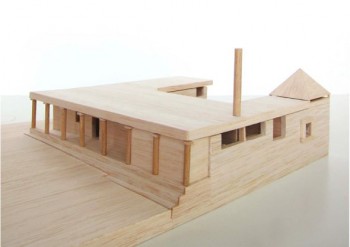
Kulttuurisauna in Helsinki: design by Tuomas Toivonen and Nene Tsuboi
Kulttuurisauna, ‘The culture sauna’, will soon be opened in Helsinki as a part of the World Design Capital 2012 programme. The idea was developed into a project by architect Tuomas Toivonen and designer Nene Tsuboi, a Finnish-Japanese couple who will also run the sauna.
‘When we started considering the idea of building a public sauna in Helsinki, I realised that my dream job is to run a public sauna – offering people a place for cleansing, bathing and sharing quiet togetherness. We have been working in the field of design and architecture for 10 years now, and felt that we can use all of our skills in this project, developing a new public sauna in Helsinki; as a building, as a service and as an environment. By doing this, we want to contribute to the city, participating in making Helsinki more interesting and enjoyable’, says Tsuboi. More…
Inventing reality
30 June 2001 | Authors
 Changes of self and perspective – and even of gender – fascinate the chameleon-like writer, dramatist and actress Pirkko Saisio. Set in Helsinki in the 1950s and 1960s, her autobiographical novel Pienin yhteinen jaettava (‘Lowest common multiple’, 1998) was on the shortlist for the Finlandia Prize. ‘We look into the mirror,’ she says in this introduction to her writing, ‘to wonder at the fact that we have the ability to divide in two, into she who looks and she who is looked at’.
Extracts from Miten kirjani ovat syntyneet (‘How my books have been born’, edited by Ritva Haavikko, WSOY, 2000)
On the top shelf of the bookshelf in my childhood home were about thirty volumes of the collected works of Vladimir Ilyich Lenin. On the bottom shelf were the same number of the collected Stalin. Between them were A Young Woman’s Cookbook and Dale Carnegie’s How to Win Friends and Influence People, which my father had had to study in order to graduate from correspondence school as a commercial technician. More…