

Search results for "tommi+musturi/2010/05/song-without-words/2009/09/what-god-said/2011/04/matti-suurpaa-parnasso-1951–2011-parnasso-1951–2011"
Need to go?
23 June 2010 | This 'n' that
 No traveller can avoid toilets, as the internet service about.com (run by the company that owns the New York Times) points out on its Scandinavia travel website.
Thus, it may be reassuring to know that ‘the days of outhouses are numbered’, and in Finland there are no squat toilets, according to the experiences of the editor, Terri Mapes. (The concept of ‘Finlandic restrooms’, however, is a new one to us – as is, for that matter, the adjective ‘Finlandic’.)
However, under the title ‘Bad Things About Toilets in Finland’ you’ll be informed about the possibility of outhouses without running water, should you choose the option of wandering into the wildernesses. And as toilets at airports or train stations may occasionally smell bad, it is advisable to use the bathroom at your hotel, unless your needs are urgent of course. More…
Landscapes of the minds
31 March 2001 | Authors, Interviews
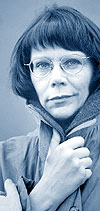
Kristina Carlson’s novel Maan ääreen (‘To the end of the earth’, 1999) tells the story of a young man who seeks to escape himself by travelling to the most distant corner of 19th-century Russia. Interview by Hildi Hawkins and Soila Lehtonen
BfF We’d like to begin by asking you about the setting of your novel. Most people think of 19th-century Siberia as the place to which the undesirables of the Russian empire were deported – one imagines it full of petty criminals, violent brigands and political dissidents. It comes as quite a surprise to find your Nahodka peopled by civilised Europeans busily engaged in building their futures, with impressive houses, women in pretty lace dresses, social occasions with champagne, orchestras and whist drives. Could you say something about what led you to choose this setting for your novel, and the real historical circumstances on which it’s based?
KC From my own point of view, Maan ääreen is not so much a historical novel as a novel set in a historical context. The difference, I believe, lies in the fact that the latter attempts – in a sense like scholarship – to cast light on the past from a new perspective. In my book, Siberia is above all the mental landscape of the main character, although it is also of course a real and existing place. More…
Beautiful books
15 May 2014 | Letter from the Editors, Non-fiction
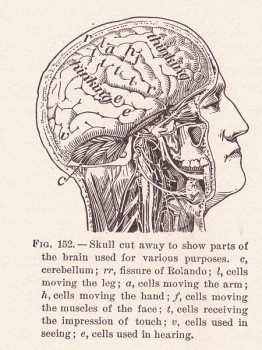
Brains at work. (Alvin Davison, ‘The Human Body and Health’, 1908) Wikimedia
A precise translation of the word non-fiction doesn’t exist in the Finnish language. Fiction is kaunokirjallisuus (a word invented by two diligent scholars, D.E.D. Europaeus and A. Varelius in mid-19th century for their Swedish-Finnish dictionary) – and a pretty word it is: kauno- is derived from the word kaunis, beautiful, beauteous. Non-fiction translates as tietokirjallisuus: literally, ‘literature of knowledge’.
Recently the status of Finnish non-fiction has been discussed in various media. Authors of non-fiction, as well as a number of readers, have been worried about diminishing sales, a decline in interest among both the general public and publishers, a lack of professional publishers’ editors. In a small-language area producing and profitable publishing ‘literature of knowledge’ is financially hard. More…
Night city
30 June 1998 | Authors

Stephen Kuusisto
The German poet Novalis wrote: ‘Daylight has got limits and hours, but the hegemony of Night penetrates through space and through time.’ In effect he says that the night is always with us, even when the sun is out. The lines always bring me back to Helsinki, the city where night permeates every wall and cobblestone.
I first came to Helsinki as a three-year-old boy, wrapped up in a heavy wool coat. My father, an American Finn, had been invited to the University of Helsinki as a Fulbright scholar. While my father taught courses in political science I practiced and perfected a child’s insomnia and remained energetically awake during hours of the day and night. I lived in a perpetual state of shadow-sleep and never closed my eyes. As a result my emerging brain absorbed Helsinki the way a night-blooming flower takes in the moon. More…
Poems
30 June 1998 | Fiction, poetry
Sometimes
Sometimes the river that gave birth to me
Whispers in my ear. And while the harsh hand
Of day keeps at me, my river
Sounds like birds walking on the leaves,
And the waters speak to me in Finnish:
Ikävä on olla kartanolla –
I am alone and waiting in the yard…. More…
Soulscapes
30 June 1987 | Archives online, Authors, Reviews
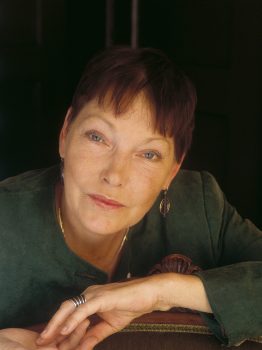
Raija Siekkinen. Photo: Irmeli Jung
When the first collection of short stories by Raija Siekkinen (born 1953), entitled Talven tulo (‘The coming of winter’, 1978) appeared, the critics were unanimous on one point: here was a mature writer with an original, individual voice. For her second collection, Tuomitut (‘The condemned’, 1982), Raija Siekkinen received the coveted Kalevi Jäntti Prize. Since then she has remained faithful to the short story. And since the publication of her fourth collection, Pieni valhe (‘A small lie’), the reader has been able to trace a development in which she has polished and tightened her narrative and brought to it more and more poetic and symbolic elements.
The main character in Raija Siekkinen’s short stories is generally a woman, not old but not very young either, often alone, sometimes broken by illness. Death is a recurring theme with Siekkinen; illness withers her women, her men die sometimes by their own hand. Siekkinen writes seldom about children; when she does so, it is from a child’s point of view. This perspective results in a critique of the narrow and restricted world view of adults. But always sensitively, never pointing the finger. More…
The forest, everything
31 March 1998 | Authors, Interviews
Lassi Nummi
Lassi Nummi (1928–2012) considered himself a prose-writer who has strayed into poetry. In a career spanning almost half a century and 25 collections of poetry, his preoccupations, and his central metaphors, remained constant: landscape, trees, bushes, blades of grass. Interview (1997) by Tarja Roinila
Now I can see how
        distinct
each twig is on the bush, each grassblade
       with, all around, the void
(1986)
My first encounter with the poet Lassi Nummi came with Maisema (‘Landscape’), a novella which appeared in the same year as his first collection of poetry. The experience was startling. The text delineates the building timbers of his subsequent poetry: trees, bushes, blades of grass. Maisema is a dazzlingly modern work, a complete realisation of something Virginia Woolf wrote in the same year, 1925: ‘Let us record the atoms as they fall upon the mind in the order in which they fall, let us trace the pattern, however disconnected and incoherent in appearance, which each sight or incident scores upon the consciousness.’ More…
A sensitive pessimist
30 December 2000 | Authors, Reviews

Photo: Irmeli Jung
When we arrive in Oaxaca, we find a Sapotek culture pulsing with quiet wisdom, a people who, even in their appalling poverty, have preserved their joy in life, mezcal bars which threaten to overturn our blameless work schedules, and the house rented by the Finnish Writers’ Union, where the rooms we are shown to as are empty and unfurnished as the solitary confinement cells in the central jail.
But Pentti Saaritsa has the language skill and, more essentially, the art of relating to people as though he has been lifelong friends with the whole of humanity. During the first week, we explore the squares, markets and furniture stores of Oaxaca. Ritsa haggles with astonishing perseverance, with the result that, in the second week, we are the proud owners of two genuine Mexican desks, stools and standard lamps. But the typewriter takes up an entire chapter in Pentti Saaritsa’s autobiography. Untiringly, he finally reaches the price he wants. And so we settle in a town turned upside down by the Zapatista movement: ‘The Mexican typewriter has / its own handwriting: with letters that bounce / off the lines it continues / the story of my life….’ More…