

Search results for "tommi+musturi/2010/05/song-without-words/2009/09/what-god-said/2011/04/matti-suurpaa-parnasso-1951–2011-parnasso-1951–2011"
Jarmo Papinniemi in memoriam 1968–2012
9 October 2012 | In the news
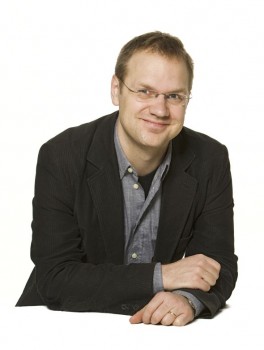
Jarmo Papinniemi
The editor, literary critic and writer Jarmo Papinniemi has died of a sudden illness in Helsinki.
Two days later, the latest edition of Parnasso was published: Papinniemi became editor-in-chief of this august 60-year-old literary magazine in 2005. During his period as editor, the magazine’s readership increased, quite an achievement in the difficult world of periodicals.
Jarmo Papinniemi worked as a literary critic and as a news and arts reporter for Finnish Broadcasting Company from 1998 to 2005. He wrote and directed television documentaries, and was the author of numerous books on literature and music, including Aloittamisen taito (‘The art of beginning’, 2010, with Kaisa Neimala) and Sävelten siivillä (‘On the wings of music’, 2011), a study of the work of the composer Ilkka Kuusisto.
Jarmo was also a member of the Editorial Board of Books from Finland from 2002. He was a quick, industrious and knowledgeable reader and writer whose opinions were well grounded and expressed, and he was interested in an unusually wide range of culture. Cheerful, humorous, a connoisseur of music, Jarmo was a colleague with whom conversations were always enjoyable and thought-provoking; he will be greatly missed by all of us who worked with him.
Close encounters
31 March 1999 | Fiction, Prose
Viimeinen syli (‘The last embrace’, Otava, 1998)
The hospital looked as if a child had been given a big pile of building blocks and told to make a house, a big house. And then, when the building was ready, more bricks had been brought, and the child had been forced to pile them up over a wider and wider area, to spread rows of blocks across the adults’ routes and over the edge of the carpet until at last it had grown bored and left the last blocks higgledy-piggledy next to its creation.
Around the hospital ran a road from which the whole mess was revealed. Wing after wing, corridors and windows from which no one really ever looked out. The hospital was full of window views that did not belong to anyone, which did not open up from anyone’s office or day-room, but varied meaninglessly like a motorway landscape from the window of an accelerating car. Viivi had been born there, on the sixth floor of the old part of the hospital. As Mikael waited in the tiled fathers’ room next to the room where the Caeserean section was being carried out for his child to be brought to him, the view out had been breathtaking. More…
High above the years
23 September 2011 | Fiction, poetry
In Gösta Ågren’s poetry austere aphorisms alternate with concrete observations of life in a small village that was and again is his home, and with portraits of people he has met on his journey in the world. Introduction by David McDuff
Poems from the collection I det stora hela (’On the whole’, Söderströms, 2011)
Father’s hands
(1945)
Father’s hands were like stiff
gloves; a furious
kettle had bewitched them
in his childhood. We ride
from the church’s tall letter
along the river’s long sentence
to the parenthesis of the bridal house,
and the thunder of three hundred hooves
fills the space beneath the clouds.
I saw father driving through
his life with those numbly
gripped reins, and later,
right now, I think of the
life-long body in which a man
comes, is wounded, and goes. More…
Jacob’s Dream
30 September 1986 | Archives online, Fiction, Prose
An extract from Hänen olivat linnut (‘Hers were the birds’, 1967). Introduction by Pirkko Alhoniemi
‘It was Jacob’s Dream, Alma.’
How could she put it so Alma wouldn’t get hurt. Alma had ruined the surface of the painting. The pastor’s widow stood nervously in front of the window and tried to say what she’d had on her mind for several days but couldn’t quite come out with. When Alma went out of the house, the pastor’s widow would wander through the rooms and check on things. And the painting wasn’t the only object in danger, but also the birds. Their feathers were ruffled because Alma kept wiping them with a wet rag. How could she put it.
‘Alma.’
Alma turned to look at her.
‘It’s called Jacob’s Dream.’ More…
Teemu Kupiainen & Stefan Bremer
Music on the go
3 March 2010 | Extracts, Non-fiction
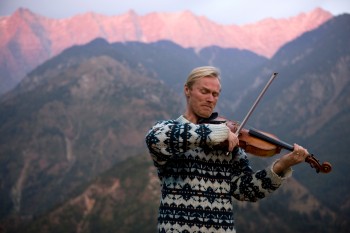
A little night music: Teemu Kupiainen playing in Baddi, India, as the sun sets. Photo: Stefan Bremer (2009)
It was viola player Teemu Kupiainen‘s desire to play Bach on the streets that took him to Dharamsala, Paris, Chengdu, Tetouan and Lourdes. Bach makes him feel he is in the right place at the right time – and playing Bach can be appreciated equally by educated westerners, goatherds, monkeys and street children, he claims. In these extracts from his book Viulun-soittaja kadulla (‘Fiddler on the route’, Teos, 2010; photographs by Stefan Bremer) he describes his trip to northern India in 2004.
In 2002 I was awarded a state artist’s grant lasting two years. My plan was to perform Bach’s music on the streets in a variety of different cultural settings. My grant awoke amusement in musical circles around the world: ‘So, you really do have the Ministry of Silly Walks in Finland?’ a lot of people asked me, in reference to Monty Python. More…
Words of feeling
31 March 2002 | Fiction, poetry
Poems from Vain tahallaan voi rakastaa (‘You can only love deliberately’, WSOY, 2001)
The musicians of Bremen (Self-portrait as a five animals)
People say man’s above all the other beasts.
I decided to prove that – and first turned poet
and then painfully became a flying horse, celebrating its freedom
on great shivering brawn. They captured me and put me to pulling
loads, and, seeing I endured everything docilely, they said,
He’s like the Giant Atlas, or Hanuman, the upholder of the world.
And they whipped me and sat on my back and finally
buried me alive. I became a pig and gorged my bellyful and my senses full
and it horrified people, who said: He’s a disease, an epidemic, Death itself.
And they cut my ears and blinded me and sliced my belly in two.
And I turned into a dog and learned everything I was taught and they said,
He’s completely without a will, like the angels, like an ascetic, and a prophet.
And they drove me out to wander the streets and the wildernesses. And in the desert
I turned into a tiger and people shouted in terror
What on earth
has God done – look, he’s Satan himself. And they shot me
from an elephant’s back. And I died into a cock and people woke up and shouted,
The healer of the world! And whenever I sing, because I only sing untold-to,
People wring my neck. More…
Finlandia Prize for Non-Fiction 2010
19 November 2010 | In the news
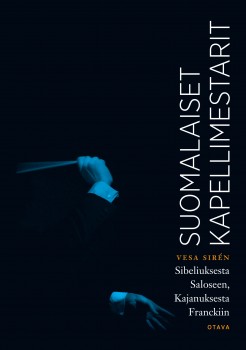 A massive tome running to 1,000 pages by Vesa Sirén, journalist and music critic of the Helsingin Sanomat newspaper, features Finnish conductors from the 1880s to the present day. On 18 November it became the recipient of the 2010 Finlandia Prize for Non-Fiction by the Finnish Book Foundation, worth €30,000.
The choice, from six shortlisted works, was made by economist Sinikka Salo. Suomalaiset kapellimestarit: Sibeliuksesta Saloseen, Kajanuksesta Franckiin (‘Finnish conductors: from Sibelius to Salonen, from Kajanus to Franck’) is published by Otava.
The other five works on the shortlist were Itämeren tulevaisuus (‘The future of the Baltic Sea’, Gaudeamus) by Saara Bäck, Markku Ollikainen, Erik Bonsdorff, Annukka Eriksson, Eeva-Liisa Hallanaro, Sakari Kuikka, Markku Viitasalo and Mari Walls; the Finnish Marshal C.G. Mannerheim’s early 20th-century travel diaries, Dagbok förd under min resa i Centralasien och Kina 1906–07–08 (‘Diary from my journey to Central Asia and China 1906–07–08’, Svenska litteratursällskapet i Finland & Atlantis), edited by Harry Halén; Vihan ja rakkauden liekit. Kohtalona 1930-luvun Suomi (‘Flames of hatred and love. 1930s Finland as a destiny’, Otava) by Sirpa Kähkönen; Suomalaiset kalaherkut (‘Finnish fish delicacies’, Otava) by Tatu Lehtovaara (photographs by Jukka Heiskanen) and Puukon historia (‘A history of the Finnish puukko knife’, Apali) by Anssi Ruusuvuori.
Beyond words
15 December 2010 | This 'n' that

Meeting place of the Lahti International Writers' Reunion: Messilä Manor
‘Whereof one cannot speak, thereof one must remain silent.’
This famous quotation from the Austrian philosopher Ludwig Wittgenstein has been adapted by the organisers of the Lahti International Writers’ Reunion (LIWRE): the theme of the 2011 Reunion, which takes place in June, will be ‘The writer beyond words’.
‘Whereof one cannot speak, thereof one must write.’ How will the writer meet the limits of language and narration?
‘There are things that will not let themselves be named, things that language can not reach. Our senses give us information that is not tied to language – how can it be translated into writing? And how is the writer going to describe horrors beyond understanding or ecstasy that escapes words? How can one put into words hidden memories, dreams and fantasies that lie suppressed in one’s mind? Does the writer fill holes in reality or make holes in something we only think is reality?
‘Besides literature, there are other forms of interpreting the world; can the writer step into their realms to find new ways of saying things? The surrounding social sphere may put its own limits to writing. What kind of language can a writer use in a world of censorship and stolen words? How does the writer relate to taboos, those dimensions of sexuality, death or holiness that the surrounding world would not want to see described at all? Is it the duty of literature to go everywhere and reveal everything, or is the writer a guardian of silence who does not reveal but protects secrets and everything that lies beyond language?’
The first Writers’ Reunion took place in Lahti at Mukkula Manor in 1963; since then, more than a thousand writers, translators, critics and other book people, both Finnish and foreign, have come to Mukkula to discuss various topics.
In 2009 the theme was ‘In other words’, which inspired the participants to talk about the power of the written word in strictly controlled regimes, about fiction that retells human history and about the differences between the language of men and women, among other things. See our report from the 2009 Reunion; eleven presentations are available in English, too.
Digging for gold
30 June 1989 | Archives online, Fiction, Prose
Antti Tuuri has found his theme in the life of Finnish émigré communities and their experience in what used to be called ‘the New World’. Uusi Jerusalem (‘The New Jerusalem’, 1988), is about the Finns who migrated to Canada during the Depression, only to find that their utopian dreams had no basis in reality. In the following extract the narrator finds himself and his fellow mineworkers in the middle of the forest at night, on the way by foot to the Kirkland Lake gold mines, where they are going to be strikebreakers. The novel, an ironical tale of life in a new land, follows on from Pohjanmaa (‘Ostrobothnia’, 1982), Talvisota (‘The Winter War’, 1984), Ameriikan raitti (‘The American road’, 1986).
The train pulled up at Swastika station, many a mile from Kirkland Lake, and Hamina said we’d have to press on by foot from the station to the town.
Swastika, he said, meant the crooked cross, but he didn’t know whether there were any of those German Adolf-fanciers around, who were so keen on the sign. He was certain, in fact, the town had got its name long before anyone in Germany had heard of Adolf or his swastika.
We asked why we had to walk from here to the town. Hamina said we’d got to walk because even in Canada vehicles didn’t drive through the backwoods; moreover, it wasn’t a good idea to walk along the Kirkland Lake road: we might meet up with the kind of guys who’d make our arrival at Kirkland Lake seem very unwelcome. More…
Veikko Huovinen (1927–2009) in memoriam
23 October 2009 | Authors, In the news
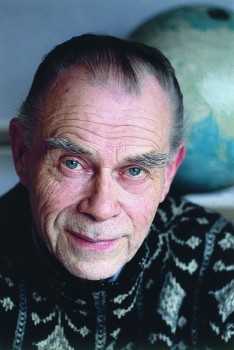
Veikko Huovinen (1927–2009). – Photo: Irmeli Jung /WSOY
Author Veikko Huovinen died on 4 October at his home in Sotkamo, in northern Finland, at the age of 82.
Huovinen was a graduate of the forest research programme at Helsinki University and worked for a period as a forest ranger. In the 1950s he began working as a full-time writer after his first novel, Havukka-ahon ajattelija (‘The thinker of Havukka-aho’, 1952), achieved great success.
Havukka-ahon ajattelija is the story of a stubbornly ruminative backwoods philosopher who ponders natural phenomena and the great political turning points that he hears about on the radio. The novel has been translated into six languages.
The soil that Huovinen’s works spring from is his northern community surrounded by deep forest, and his characters are modelled on its inhabitants: a self-sufficient business owner, a vagrant rascal, an ill-tempered hermit. They withdraw into the shelter of their homes, where the arctic winds and the evil of the world can’t reach them. Such humoresques might bring to mind Mark Twain or the early works of Nikolai Gogol. More…
Icy prospects
8 October 2010 | This 'n' that
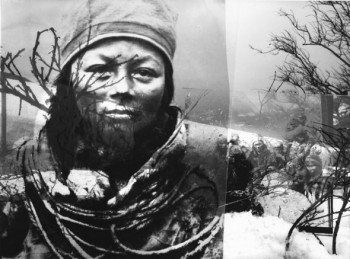
Jorma Puranen: Juovlajohka, Norway, 1997
Photographer Jorma Puranen (born 1951) has long been concerned with nature and the representation of northern landscapes, particularly Lapland, as well as light and its reflection.
One of his most famous projects is Imaginary Homecoming. In the 1990s, on a visit in the Musée de l’Homme in Paris, he found some old archive boxes full of glass negatives. They were ethnographical images of the Sámi, taken by G. Roche, employed by the French Count Bonaparte on an expedition to Lapland in 1884.
Puranen took them back to the wildernesses of Lapland and photographed them once more in their native surroundings, where they became a photographic installation in the tundra. He published them in his book Kuvitteellinen kotiinpaluu / Imaginary Homecoming (Pohjoinen, 1999).
Puranen’s 2006 series Icy Prospects explores landscape: the large pictures are made by painting wood with black gloss paint, reflecting the landscape on the wood and photographing the reflection.
Snow, ice, water, sky and trees are portrayed the way that brings Impressionism to mind, as Liz Wells writes in her introduction in the book entitled Icy Prospects, published by Hatje Cantz (Germany, 2009).
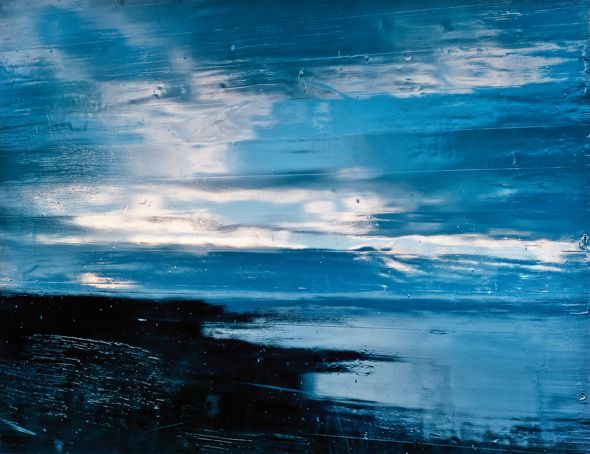
Jorma Puranen: Icy Prospects (series, 2006)
A new exhibition of Jorma Puranen’s work from 1992 to 2010, at EMMA, the Espoo Museum of Modern Art, opened on 29 September; it runs until 9 January 2011. Partly retrospective, it features Puranen’s techniques of chromogenic colour and black and white photography, showcasing his highly original style.
Age before beauty?
5 April 2012 | This 'n' that
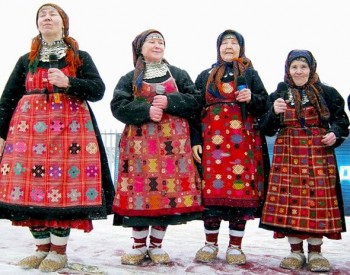
Buranovskiye Babushki: Udmurt originality. Photo: Wikipedia/Larisa Gorbunowa, 2011
We can’t be the only ones to have a secret fondness for the Eurovision Song Contest– however cheesy the offerings, however rigged or outright political the voting, however bored or drunken the presenters (or maybe that’s only in the UK). Camp, innocent, calculating, so ugly it’s beautiful (or vice versa). In fact, we suspect that’s why we like it so much.
In the 57th Contest, to be held in Azerbaijan in May, Russia is to be represented by the song ‘Party for everybody’ by a group of eight old ladies, the Buranovskiye Babushki, from the republic of Udmurtia, deep in the heartland of the Russian Federation, some 1400 kilometres from Moscow. More…
For your eyes only
11 May 2015 | This 'n' that
Photo: Steven Guzzardi / CC BY-ND 2.0
Imagine this: you’re a true bibiophile, with a passion for foreign literature (not too hard a challenge, surely, for readers of Books from Finland,…). You adore the work of a particular writer but have come to the end of their work in translation. You know there’s a lot more, but it just isn’t available in any language you can read. What do you do?
That was the problem that confronted Cristina Bettancourt. A big fan of the work of Antti Tuuri, she had devoured all his work that was available in translation: ‘It has everything,’ she says, ‘Depth, style, humanity and humour.’
Through Tuuri’s publisher, Otava, she laid her hands on a list of all the Tuuri titles that had been translated. It was a long list – his work has been translated into more than 24 languages. She read everything she could. And when she had finished, the thought occurred to her: why not commission a translation of her very own? More…
Compelled to write
30 June 2000 | Authors, Interviews

Photo: Marica Rosengård
Kjell Westö (born 1961) is one of a generation of younger, urban Swedish-language writers who are at home in both Swedish and Finnish. An extract from his novel Vådan av att vara Skrake (‘The perils of being Skrake’, Söderströms, 2000), which traces the fortunes of the Helsinki family of Skrake from the 1910s to the present day. Here, Westö is interviewed by his alter ego, the discontented poet Anders Hed, editor of the cultural journal Bokassa (now sadly extinct)
Anders Hed: So, to get us going: do you write any poetry at all nowadays?
Kjell Westö: No. The last poem I wrote comes at the end of the title story in Fallet Bruus (‘The Bruus case’). And that book came out in 1992.
It’s a poem about human face and the search for ‘the Thou’, isn’t it?
Exactly. More…