

Search results for "tommi+musturi/2010/05/song-without-words/2009/09/what-god-said"
A portrait of Elmer Diktonius
30 June 1982 | Archives online, Authors
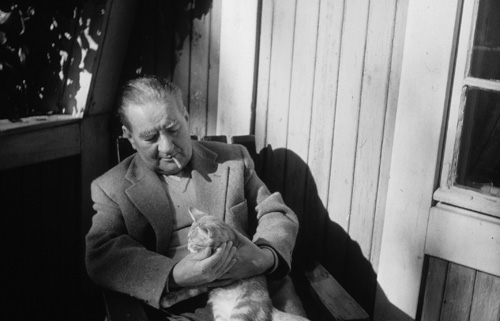
Elmer Diktonius at his home in Kauniainen (Grankulla). Photo: Wikimedia Commons / Public domain
Elmer Diktonius, one of the leading Finland-Swedish modernists of the 1920s, was a revolutionary poet, prose-writer and critic who also tried his hand at composing. Professor George Schoolfield, whose article on Diktonius appears below, appends his own translations of several of the lyrics: a filler selection is going to be published in the United States, Recently Professor Schoolfield has been working on a biography of Diktonius which he hopes to publish soon.
The literary fate of the Finland-Swedish modernist Elmer Diktonius (1896-1961) has not been an altogether happy one. Saluted early and late in his career as Finland’s Strindberg and as a possible rival to Mayakovsky in the contest for the greatest lyricist of the revolution, Diktonius would seem, surely, to deserve a place on the world’s literary stage. Yet the attention he has received outside the north has been mostly unwitting: the writers of program notes quote his description of the Silbelius Fourth, ‘the bark-bread symphony’ without knowing its source, the collected concert-reviews of Opus 12: Musik (1933). Surveys that might have introduced him to a larger public are silent. The chubby Pelican Guide to the European Literature of Modernism ignores him; the Penguin Book of Socialist Verse omits him from its 134 specimens of the lyric left; and Ulrich Weisstein’s volume of Expressionism as an International Literary Phenomenon does not have him in its chapter on ‘Expressionism in Scandinavia’, although he would qualify – as the Swedish scholar Bill Romefors has proved – as the major northern heir of German expressionism. More…
The joy of work
24 October 2011 | Fiction, Prose
Short prose from Sivullisia (‘Outsiders’, Like, 2011). Introduction by Teppo Kulmala
Since I’ve been unemployed, I started a blog called Outsiders. It soon came to serve as work, and I became dependent on its benefits. Although describing being an outsider helped to anaesthetise me, and verbalising all of my afternoons didn’t even take up all my time, the feedback that came in was reward enough. I wouldn’t have taken any other reimbursement anyway because of the restrictions set on recipients of government benefits. Increasingly frequently I found myself longing for more. Even a short blog comment about being an outsider felt even truer than what I with my self-employed, jobless person’s competence was able to achieve in relation to being sidelined as an unemployed person, regardless of what kind of manager I had been in my previous life. When asking for more accounts of other people’s well-being, I wanted them to use their own names. I justified this because I did not want to read lies, which often come from and lead to chatter in cafés and on the web. Apart from the pure enjoyment of being present, using one’s own name – even in wrong-headed topics or notions – makes it easier to approach the harsh laws of the working world. When one knows that by using one’s own signature one is dragging one’s family into the mire, including those who have gone before and those yet to come, one is able to blaze trails along which one can outflank the passive to activate another, equally unemployed. I did not place any further requirements on the other commenters besides first name and surname, as the rules had been drawn up by professionals in their own field. The regulator’s work also requires skill, if not a tremendous craving, for damming up another flood of text so that one’s own advantages do not have a chance to dry up. To facilitate reading for myself and others, I introduced only a couple of restrictions, which I imagined that I, too, would be able to adhere to. Only one side of a sheet of A4 was to be used – that is, one page – and what people wrote had to be true. Truth, beauty and quality ensured that everyone would begin what they had to say by writing about their current work. More stories, anecdotes, even poems piled up than the law permits me to read – much less compile – during working hours. For this book I have selected only 157 stories from the Greater Helsinki area for the sake of efficiency. The faster you can read the work, the less time it will distract you from your main job. I chose to limit things to the capital area so that the stories about well-being from individuals linked to this place would seem to form a more integral work, or document at least, about what was happening in the Big H, the centre of the nation, at the start of the millennium. I will publish the tales of work from beyond the outer ring road at some later stage, if I manage to come to an agreement with the writers concerning intellectual property rights. More…
Little and large
5 November 2010 | This 'n' that
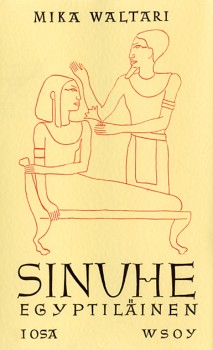
A Finnish tale set in Egypt: Mika Waltari's post-war novel has been translated into 30 languages, English in 1949
a about after again against all also always an and another any are around as at away back be because been before being between both but by came can children come could course day did didn’t do does don’t down each end er even every fact far few find first for from get go going good got great had has have he her here him his home house how i i’m if in into is it its it’s just kind know last left life like little long look looked made make man many may me mean me might more most mr much must my never new no not nothing now of off oh old on once one only or other our out over own part people perhaps place put quite rather really right said same say says see she should so some something sort still such take than that that’s the their them there these they thing things think this those though thought three through time to too two under up us used very want was way we well went were what when where which while who why will with without work world would year years yes you your
Doesn’t this just run like a poem? An extract from somebody’s stream of conscience? ‘…again against all also always… quite rather really right said’? Actually it’s a list of the 200 most used words of the English language in alphabetical order.
This remarkable list is among the references* in a new doctoral thesis from the Department of Modern Languages at the University of Helsinki, Englanniksiko maailmanmaineeseen? Suomalaisen proosakaunokirjallisuuden kääntäminen englanniksi Isossa-Britanniassa vuosina 1945–2003 (‘To world fame in English? The translating of Finnish prose fiction into English in Great Britain between 1945 and 2003’). More…
What the critic said
9 July 2010 | Letter from the Editors

Illustration by Joan Barrás
‘Pay no attention to what the critics say. A statue has never been erected in honour of a critic,’ said the Finnish composer Jean Sibelius.
No, probably not; but people still read what the critics write – and, sometimes, also what they wrote fifty or a hundred years ago.
An annual list of professions most highly valued by the public in Finland is always headed by surgeons. Shepherds generally feature at the bottom of the list. But critics fare none too well, either – a couple of years ago they were ranked between butchers and gravediggers. Which, of course, can be interpreted, in metaphorical terms, either as hilarious or tragicomical. More…
AZ661748
19 September 2013 | Fiction, Prose
A short story from Novelli palaa! Matkanovelleja (‘The short story returns! Travel stories’, edited by Katja Kettu and Aki Salmela; WSOY, 2013)
Mum didn’t want to travel abroad. Mum wanted to tend her rose garden and her pea beds, which sloped down the hill towards the lake. In mum’s opinion, the view from the porch was the best view in the world.
Dad wanted to travel. He never got very far, because Mum wouldn’t go. Dad got as far as the neighbouring forest. In Mum’s opinion, there was no better long-haul destination than the lake at the bottom of the slope and the grove around the house, which was full of blueberries and raspberries and, in the spring, morel mushrooms.
In Dad’s opinion, the forest was full of mosquitoes and flies and ants and mites.
On the lake, the loons dived and called on late summer evenings, Mum thought it was the best sound in the world. Beautiful and harrowing, at the same time. The lamentations of the loon demonstrated that a living creature can be so completely happy that its cry is full of grief. Her children’s crying and whingeing and desire to go to the Linnanmäki funfair in Helsinki were, to Mum, a sign that they are ecstatically happy at home.
Little loons, Mum said to us. More…
Nautilus
30 September 1996 | Archives online, Fiction, poetry
Poems from Erotus (WSOY, 1995). Introduction by Lauri Otonkoski
As the future First Mate dreams, embryonic sails in his eyes
and runs, a rat, from one ship to the next in the harbor, so I saw my image in the imago
pushing out of its chrysalis under my father’s hand that held the lens.
His other hand rested on my shoulder like a wing,
‘Resurrection!’ he cried out, and I felt my heart tumble.
And there it was: Parnassius Apollo or Parnassius Mnemosyne mnemosyne
on the glass slide, straightening its flying gear,
and a moment later, a narcotized, trembling piece of jewelry.
I handed my father a shiny pin, and he pushed it skillfully
through the body. Daylight adhered to the collection.
For the duration of the blink of an eye, all butterfly wings breathed. More…
Last resorts
31 March 1999 | Authors, Interviews

Photo: Irmeli Jung
The novelist Pirjo Hassinen’s subjects are men, women and death. Particularly, in her novel Viimeinen syli (‘The last embrance’, Otava, 1998), death. Interview by Leena Härkönen
The blizzard to end all blizzards is tearing Finland apart. The railway system is in a mess, and the heating system in our building has stopped working. There is no way I can leave Helsinki for Jyväskylä, the town in central Finland, 300 kilometres away, where Pirjo Hassinen lives. I am obliged to interview her on the telephone, although she says she loathes talking on the phone, and I too would prefer to meet her face to face.
The day I ring Hassinen, Lapland achieves a record low of -51 Celsius. Even on the south coast the mercury sinks well below -20°C, and a freezing wind makes the frost almost unbearable. The entire country is as white and cold as – death. It is an easy comparison, for it is death that is the theme of Pirjo Hassinen’s latest novel. The main character of Viimeinen syli is an undertaker, transporting bodies. There is a lot of death in the book: two suicides plus an accidental one. According to Hassinen, her subject matter is the conclusion of a logical development.
‘I deal with whatever concerns me most at a given moment and whatever I feel I can say something about.’ More…
Intelligent living
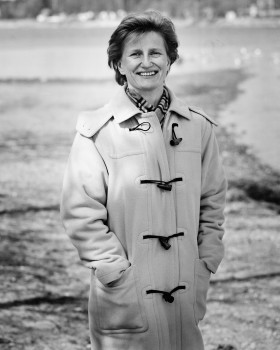
Minna Lindgren. Photo: Ville Palonen.
In Ehtoolehdon tuho [‘The decline of Twilight Grove’, Teos, 2015), the final novel in a trilogy about life in an assisted living home, employing human staff has become too expensive and the old folk are part of a pilot project in which they are cared for by electronic devices, monitors, cameras, ‘smartwalls’ and cleaning robots: ‘there was intelligence everywhere, masses of it, just a hiccup and something terribly intelligent would happen.’
The aged lady residents don’t like their new life, but they’re resilient; they’re not about to let the new technology defeat them…
Minna Lindgren’s mordantly satirical, often hilariously funny writing has earned her a wide readership. Translations of the trilogy are soon to appear in English, German and French.

An excerpt from Ehtoolehdon tuho [‘The decline of Twilight Grove’, Teos, 2015). Review by Soila Lehtonen
‘You’re 97 today! Your wakeup call service today congratulates!’
As if she wouldn’t have remembered. Ninety-seven was almost a hundred. She and Irma had decided that they would refuse to turn one hundred. It would only make trouble. One lady, in the bottom apartment of the A staircase, had received an invitation to the health centre on her birthday. Apparently all five-year-olds were called in for monitoring of their motor and psychological development, and when this lady turned 105, the computer system thought she was a toddler. The computer didn’t recognise numbers over one hundred. Siiri thought the lady should have kept the appointment; she would have done, for the tests were fun. You had to draw a triangle and walk along a straight line. Not that easy for someone of 105. But the lady didn’t go, she just made a terrible fuss about it and complained to everyone, until she died before her complaints reached the right official. More…
Three prose poems
30 September 1986 | Archives online, Fiction, poetry, Prose
Prose poems from Runot ja proosarunot (‘Poems and prose poems’,1966) and Maan ja veden välillä (‘Between land and water’, 1955 ). Introduction by Pirkko Alhoniemi
Underground
I went underground, I was looking for my brother’s grave, and I saw him lying under a transparent slab of marble. His face was like gold, death had passed from it, and I knew I no longer mourned him. I came above ground. At the edge of the graveyard there was a round tower made of stone and I was high up in the top of the tower. There stood my brother in dark trousers, white shirt, looking exactly the same, in the same position as in the dim photograph someone, I don’t remember who, took of him when he was about to go fishing, hands in his pockets, head held high, he was looking up at something, not at me. And I asked him: ‘Did it hurt when the bullet went through your head, when the exploding bullet went through your head in the battle of Karhumäki, and you were still alive at the first aid station and you said something they told us about in a letter.’ He answered, ‘Yes, it did hurt.’ ‘What’s your life like now, tell me.’ I said. He raised a hand and pointed to the sky. The sky was blue, and white clouds were scudding across it. More…
A good day
30 June 2001 | Archives online, Fiction, poetry
From Juomarin päiväkirjat (’A drunkard’s journals’, edited by Pekka Tarkka, Otava, 1999). Introduction by Claes Andersson
Iceland, Summer 1968
I don’t know how to describe what I see,
           the lava’s colors; the afternoon green of the grass,
      and I can’t tell if that white is buildings or snow.
The mountains are fortresses of the gods, and if
      people’s construction projects irritate them
          too much, they let the ground shake, volcanos
erupt and tum everything upside down, assign new sites
      to houses and different routes for cars.
      The gods’ noses itch when their breath
          is caught in pipelines and
      channeled into radiators and greenhouses.
Sheep tear the grass but horses
                                             browse in a civilized manner.
Jónas does not believe in the gods, but he
                             is afraid of them, the gods are not pleased
      with the Americans, who do not know
          anything about the gods or history yet come here
                 and start interfering with the land
                                                            as if it were theirs.
*** More…
Government prize for translation 2012
14 September 2012 | In the news
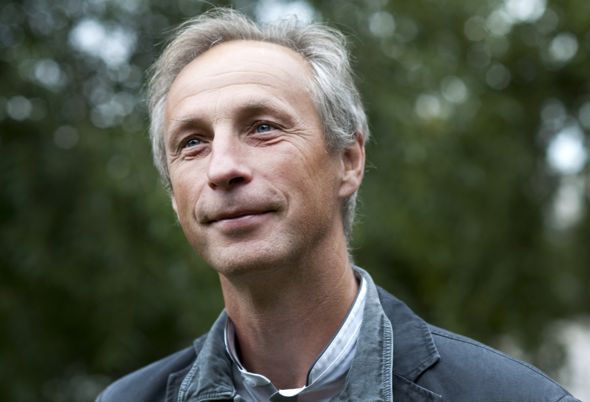
Vladimír Piskoř. Photo: Charlotta Boucht
The Finnish Government Prize for the Translation of Finnish Literature of 2012 – worth €15,000 – was awarded to the Czech translator Vladimír Piskoř.
Piskoř (born 1960), graduated from the Charles University of Prague in 1984, majoring in Finnish. Since the early 1990s he has translated almost 30 titles, most by contemporary authors, including Kristina Carlson, Kari Hotakainen, Leena Krohn, Rosa Liksom, Asko Sahlberg, Juha Seppälä, Petri Tamminen and Maria Peura.
‘I personally am fond of the novels by Kari Hotakainen: I sometimes play with the idea of becoming a writer myself, and I find his style and themes particularly interesting. Kristina Carlson’s latest novel Herra Darwinin puutarhuri (‘Mr Darwin’s gardener’, 2010) is a truly inspiring work both as a reader and a translator,’ he says.
Piskoř is currently working on Kari Hotakainen’s novel Jumalan sana (‘The word of God’) and Leena Lander’s historical novel Käsky (‘Command’). In 2006 he was awarded the Czech translators’ special prize for the novel Höyhen (‘Feather’) by Asko Sahlberg.
Vladimír Piskoř received his award in Helsinki on 10 September from State Secretary Jarmo Lindén; he thanked Piskoř for the work he has done for the last twenty years, particularly in the field of contemporary Finnish fiction.
The prize has been awarded – now for the 38th time – by the Ministry of Education and Culture since 1975 on the basis of a recommendation by FILI – Finnish Literature Exchange.
Kari Kuula: Paholaisen biografia [The biography of the Devil]
13 May 2011 | Mini reviews, Reviews
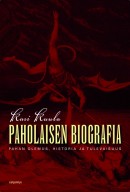 Paholaisen biografia. Pahan olemus, historia ja tulevaisuus
[The biography of the Devil. The essence of evil, history and future]
Helsinki, Kirjapaja, 2010. 381 p.
ISBN 978-951-607-837-6
€ 38, hardback
This book is a chronological study of the Devil, seen through the history of ideas and cultural history. As the Devil is mainly a concept in Christian theology, the most profound studies of his essence have been carried out by experts of this field. The book also studies the Devil’s ‘disciples’, demons, and beliefs related to them. The main theme of the work consists of the history of diabology and demonology, from the Old Testament to contemporary theology. Another central theme is the theological dilemma of why God allows evil and suffering. In the cultural history section the author concentrates on the practical implications of belief in the Devil in different ages as well as parallel phenomena such as possession and belief in witchcraft. Folk tales about the Devil and descriptions of his putative looks as well as some classic works of fiction featuring the Devil are discussed. Kari Kuula is doctor of theology and priest who has published several non-fiction books on the Bible and Christianity.
Panu Rajala: Lasinkirkas, hullunrohkea [Glass-clear, daredevil]
20 May 2010 | Mini reviews, Reviews
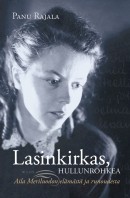 Lasinkirkas, hullunrohkea. Aila Meriluodon elämästä ja runoudesta
[Glass-clear, daredevil]
Helsinki: WSOY, 2010. 417 p., ill.
ISBN 978-951-0-35488-9
€39, hardback
Aila Meriluoto (born 1924) is a poet, author and translator whose first collection of poems, entitled Lasimaalaus (‘Stained glass’), sold more than 25,000 copies in 1946. She became a celebrity of her time, as her young, fresh voice expressed post-symbolist visions and, after the long, cruel years of the war, spoke defiantly about the death of God. Hailed as a youthful prodigy, she was favoured by the dominant poet and professor of literature, V.A. Koskenniemi. Meriluoto has published ten collections of poems, as well as novels, children’s books, diaries, memoirs, and a book about her first husband, the poet and author Lauri Viita (1916–1965). She has translated works by Rainer Maria Rilke, Harry Martinson and Astrid Lindgren. This biography tends to concentrate on the writer’s personal history rather than on her works. The author and scholar Panu Rajala and Meriluoto became acquainted in the 1970s, and he calls his biography ‘a subjective testimonial’. Rajala has written plays, novels and film scripts as well as biographies, among them one of the classic author Mika Waltari (1908–1979).
Nature’s not my thing
A short story from Hommes (Tammi, 2006)
Lying unemployed on my sofa I hear a lot of stuff on the radio almost every day you hear some children’s choir chanting the same songs over and over about our country’s blue lakes the sky and all our trees and their white trunks. They’ve all finally worked their way into my subconscious. After hearing enough of these songs my subconscious rears its head and commands my idle body: go to the forest. In a situation like that it’s hard to put up a fight or struggle against something you can’t see or hear or smell that all of a sudden pops into your head.
The great debate was over so quickly that hardly anyone managed to get a word in I think to myself as I lie in bed at night just before falling asleep. More…