

Search results for "tommi+musturi/2010/05/song-without-words/2009/09/what-god-said"
The snake
31 March 1998 | Fiction, Prose
In this horror story by the Finland-Swedish author Kjell Lindblad (born 1951), a man believes he is wandering among art installations in an apartment block – but the reality he is experiencing turns out to be much more sinister. From the collection of short stories Oktober-mars (‘October-March’, Schildts, 1997)
I only noticed the poster on the notice board in the vegetarian restaurant because it was so obviously different from the rest of the colourful items there, with their large headlines offering everything from Atlantic meditation to Zen ping-pong, together with promises of a new and fulfilled life in harmony with the soul and the cosmos. Poster is perhaps an overstatement it was a white sheet of paper with an egg-shaped oval in the middle. Inside the oval there was a horizontal row of seven numbers. For some reason, perhaps because the row of numbers was the only information on the piece of paper, it stuck in my memory and when I got home I had a compulsive desire to find out if it was a phone number. So I dialled the number and a tape-recorded voice that could have belonged to a man but equally well to a woman, said:
‘We bid you welcome. Please don’t write down the address just memorise it….’ More…
Things
31 March 1997 | Archives online, Fiction, Prose
A short sory from Kaunis nimi (‘A lovely name’, Otava, 1996). Raija Siekkinen’s limpid prose is at its best when she explores the complex feelings that lie behind the events of everyday life. Here objects are indicators of emotions, memory and loss, and what is most important is left unsaid
And where was the pen, the fountain pen, black, chubby; the one which pumped the ink straight up from the bottle?
There were three gold-coloured bands on the cap of the pen, and its nib, too, was golden, It had been given to her in a case lined with black velvet, and there was a groove for the pen, and a depression for the ink-bottle; and the bottle was narrow -necked, with curving sides, and the ink in it was not bright blue, but dark, so that words written in it looked old, written a long time ago; one forgot that one had written them oneself, one read them like the words of a stranger.
She remembered the pen, and began slowly to wake up. More…
Out of the body
13 January 2011 | Reviews
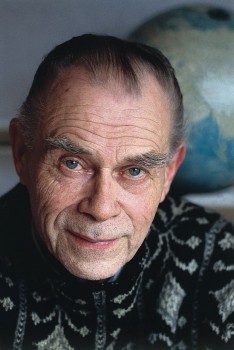
Veikko Huovinen. Photo: Irmeli Jung
‘Where will you be spending your eternity?’ ‘A spot of transmigration’, a short story by Veikko Huovinen (1927–2009), immediately confronts its main character, a man named Leevi Sytky, with this ultimate question.
Behind it is the sense of sin and fear of damnation typical of the religious life of northern Finland. Anyone who has made it as far as this final short story of Huovinen’s 1973 collection, Rasvamaksa (‘Fatty liver’) will, however, not make the mistake of taking the question too seriously; something diverting is clearly once again on offer.
Soon Leevi Sytky takes his leave of life in slightly sinful circumstances, but in the hereafter it turns out that these are not looked upon with disapproval. More…
Noah’s progeny
30 October 2009 | Fiction, Prose
Graphic design: M-L Muukka
Extracts from the novel Puupää (‘Blockhead’, Teos, 2009)
In these ‘shavings’ hewn from the block in constructing the storyline of his new novel, Juha Hurme offers us four unique glimpses into the Finnish psyche
The rune singer of Nokia
Three years ago I purchased a used mobile phone when its predecessor took an overdose of sea water and went mute on a rowing trip in a broken-down loaner of a fibreglass boat in a gale-force nor’wester. This three-year-old phone has been a thoroughly satisfactory implement and indispensable contact link. The power button got stuck a year ago, but the gadget is still fully operational with the aid of a match stick or something similar. It is my belief and hope that it will continue to fulfil the role of telephone for seven more years, because I prefer not to own, let alone purchase, anything that withstands fewer than ten years of use. More…
An end and a beginning
31 March 1982 | Archives online, Fiction, Prose
An extract from Det har aldrig hänt (‘It never happened’, 1977). Translated and introduced by W. Glyn Jones
There they are!
Over the ice they ride. The hoofs in rhythmical movement kick up the snow. The trail points north west. The sound of the hoofs is absorbed in the blue twilight of a March evening. The two horsemen push on, close together, passing one tiny island after another. Their eyes are fixed on a trail which has lain before them throughout the day. They are hunting like wolves. Yes, like wolves they are.
Or are they?
The twilight gives way to darkness and the black of night. The riders lean low over their horses in an attempt to follow the trail, but at last one of them raises his hand. The hunt is called off. The horses snort and toss their heads so their manes dance. Clouds of steam rise from them, enveloping the men as they dismount and lead their horses to an islet where the dark and deserted profile of a fisherman’s cabin can be glimpsed. Heaven knows who the hut belongs to, but it is a good thing that it is there with its walls and a roof, a shelter against the night. More…
Landscape
30 June 2006 | Archives online, Fiction, Prose
(Landskap, 1919). Introduction by Juha Virkkunen
12 March
To begin with, there’s a great white field. The field is criss-crossed with low slender fences and little patches of yellow-green stubble peering up through the snow, and hare-tracks slanting away towards the stubble. But we won’t notice the fences and the stubble and the hare tracks. Because we’re going to take a wider, more sort of decorative view.
So we see the great white field. And where the field ends a dark green screen has been drawn. The screen has been cut short rather amusingly in the middle, so one can see yet another white held. This belongs to another village. And this other village itself has crept up timidly to the forest-clad hill and lies close to it, so we don’t notice this other village. Because we want to take a wider view of things. More…
Verse and freedom
16 January 2014 | Articles, Non-fiction
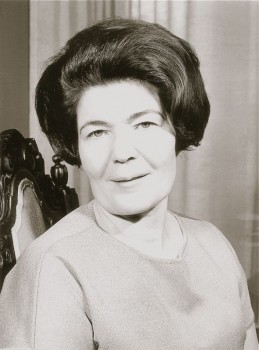
Aale Tynni (1913–1997). Photo: WSOY
Finnish poetic modernism, which with its freedom of rhythm came to dominate the literary mainstream of the 1950s, posed a particular challenge to the poets of the classical metrical and romantic poetic tradition. Aale Tynni (1913–1997) is not a poet of any one school or form, but rhythm is the deepest foundation of her poems, whether expressed in metre, free verse or the speech rhythms that characterise some of her poems of the 1950s and 60s, as well as those of her final years.
An Ingrian Finn, Tynni left Ingermanland near Petersburg for Finland as a refugee after the First World War, in 1919. The war and the period of uncertainty that followed it are present in her poems as an allegory, sometimes appearing as a dance of death or a carnival. At other times they emerge in the myth of Phaethon, who with his sun chariot is in danger of throwing Mother Earth off her axis, or as a game of chess in which God and the angel Gabriel play with the planets and moons as pieces. The poet makes use of mythic and cosmic references to widen her scope and to portray Man in the stages of history and the present age. More…
Piranesi
30 August 2013 | Fiction, Prose
An extract from the novel För många länder sedan (‘Many lands ago’ Schildts & Söderströms, 2013; Finnish edition: Monta maata sitten; Otava, 2013). Introduction by Pia Ingström
‘I assume your father wanted you to become a doctor?’ asked Igor at the beginning of our life together. My parents did indeed want me to become a doctor. Not a pathologist, but a general practitioner. I became an art historian instead. There was a time when my area of research aroused curiosity in Igor.
‘Why Piranesi?’ he wondered.
‘As a child I devoured classic novels about pale, emaciated families living in a cellar,’ I explained jokingly. ‘I became interested in catacombs and vaults. That’s why I wanted to study the history of drawing.’
I’ve always had a fascination for underground spaces. I’m drawn to them like a homing missile. This interest of mine must have genetic roots. My mother was born in a bomb shelter during the first German air raid over Leningrad. More…
Speaking about the heart
30 June 1991 | Archives online, Articles
New Finnish poetry, translated and introduced by Herbert Lomas
The ‘modernist’ revolution in Finnish poetry is now 40 years old, and the art must be ripe for changes.
Of course, the modernism of post-war Finnish poetry was not – except in Haavikko and to some extent in Saarikoski – extremely modernist. The poets were more interested in their content than their experiments. They were perhaps closer to ancient Chinese poets and early Pound than to Eliot in their elided brief juxtapositions and meditations on nature, society and moment-to-moment transience. The poets picked up a few liberties that unshackled them from metrical and rhyming formalities uncongenial to Finnish stress, syntax and phonemics; and they took off to speak about the heart. That is the strength of this poetry, and its originality, since all originality consists in being oneself – which includes one’s national self, and ultimately other people’s selves. And every generation still has to make a new start, admittedly in new circumstances, with the experience of its forefathers from birth to death. More…
Letters from Klara
31 March 1992 | Archives online, Fiction, Prose
A short story from Brev från Klara (‘Letters from Klara’, Söderström & Co, 1991)
Dear Matilda,
you are hurt because I forgot your ancient birthday: that is unreasonable of you. To put it bluntly, you have expected my particular devotion all these years merely because I am three years younger. But let me now at last tell you that the passage of the years An Sich is no feather in one’s hat.
You pray for Higher Guidance – excellent. But until you receive it, it might perhaps be as well to discuss certain bad habits which are, as a matter of fact, not foreign to me, either. More…
1968
30 March 2005 | Fiction, Prose
A short story from Lugna favoriter (‘Quiet favourites’, Söderströms, 2004)
We were in the space age, the age that came and went, the age of space and great dreams, when space was what we talked about and space was what the papers wrote about, and about Vietnam and protests and revolution, in articles precocious and prematurely old children spelled their way through, children living in the mixed forests of the North which had recently been transformed into gleaming suburbs where ink-caps, puffballs and parasol mushrooms still grow in the backyards of high-rise tower blocks. It says in the paper that we humans will soon have to move away, leave the Earth because our planet has become overcrowded and almost uninhabitable, and space and the eternity of space are waiting for us and we have engineers of the highest class who will soon solve such small problems as still remain. It’s not a question of forests of mixed trees or ink-caps or parasol mushrooms or other earthly things, it’s a question of it being too late now, that we must go further, first to the moon and then to Mars and Andromeda and further still, and here are some of the key words and phrases: space programme, space race, Apollo, Vostok, Tereshkova and Glenn. For humanity has dreams, dark mixed visions and a nagging and not easily extinguished sense of life’s inscrutability and greatness, but down here all goes on as before, we kill each other, we kill our fellow men in jungles and marshes, we kill them amid rugged mountains and in snow-clad forests, we poison them and blow them to pieces, we kill them in dark backstreets and in ramshackle wooden hovels and in mighty marble palaces where the bath-taps glitter with gold. Only a chosen few are able to escape, and to do this they have to set off upwards into a coolness, and seek out a darkness and solitude where there will be no anxiety or feelings of guilt. But before they can get there they must face opposition of a magnitude that can only be overcome by a fierce rush of power, and before the rocket can start it sits and breathes out smoke and gases and fire for a good thirty seconds before lifting off slowly and reluctantly as if unwilling to leave its home planet, as if it hasn’t the slightest desire to go, but when it gets under way it travels at incomprehensible speeds over unimaginable distances, it’s only 108 years since Lenoir invented the internal combustion engine and we are already up in space where it’s silent and cool and peaceful, just a little anxiety in case some instrument fails, in case some double safeguard shows itself insufficient, otherwise nothing, just weightlessness and silence, just the oceans and deserts and mountain-chains on the surface of our blue globe. Though let’s be fair: the Chinese, who haven’t been up in space, claim that the Great Wall of China must be visible from up there, but on the other hand they have nothing to say about the visibility of new-built suburbs in the miserable little capitals of small underpopulated countries with frosty climates. More…
Notes for an unwritten autobiography
15 September 2011 | Fiction, Prose
Extracts from the novel William N. Päiväkirja (‘William N. Diary’, Otava, 2011). Interview by Soila Lehtonen
Paris, 15 November 1897
Constance probably bought this notebook for housekeeping purposes, but forgot it when she left, so I shall take it for my use, and I am not going to tear a single page, because the paper is of good quality and the covers are made of calico. When I write in a small hand there is plenty of room for the text, and when I write in Swedish Constance will not understand, if she chances to see the notebook. She has promised to visit once or twice a week and continue to bring food and do the cleaning (we cleared up the differences of opinion that were related to her departure), even though she has now moved and married a retired officer, having been my housekeeper for nearly 30 years. The laundry she has delegated to Madame L., who lives in this house, although that lady is intolerably nosy and talkative, and she has six smutty children. I have decided to write my autobiography, so that posterity shall receive a full and proper impression of my work. (Let Prof. Schwendener from Berlin and Dr Louis Pasteur be content with minor roles!) I shall not begin until tomorrow, for today I intend to study the specimens of South American lichens Prof. D. has sent if there is enough daylight. More…
The lady who could fly
30 June 1989 | Archives online, Fiction, Prose
A short story from Kenkää suurempi jalka (‘The foot bigger than the shoe’, 1992)
A day came when she felt she could fly. You used technological gear and gadgets for flying, or meteorological shifts in the air masses: rising currents gave you a weightless ecstasy with the lightest of equipment. But that wasn’t it.
To begin with it was one of those typical flying dreams, which gradually extended into the waking state: she could feel it coming in her sinews, her nervous system, her cortex. She was acquainted with Freud and Jung and the other dream-interpreters of today. Characters in the myths and fairytales flew; cruel princesses flew on the wings of the storm; Gogol’s overcoats, Chagall’s lovers, cows and cats flew; and vampires – those last leather-winged flutterings of the prehistoric archaeopterix in the mud of the gene pool. More…