

Search results for "tommi+musturi/2010/05/song-without-words/2009/09/what-god-said"
New from the archives
13 March 2015 | This 'n' that
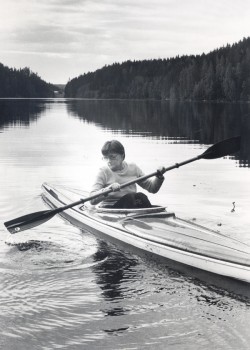
Eeva-Liisa Manner. Photo: Tammi.
Today we have a real treat – a selection of the sumptuously minimalist poetry of Eeva-Liisa Manner (1921–1995) by her near-contemporary, the British poet Herbert Lomas (1924–2011).
Born in Helsinki, Manner spent her youth in Viipuri, in what was then part of Finland; her life was, like Eeva Kilpi’s, marked by evacuation from her home and the subsequent loss of Karelia to the Soviet Union in the Second World War. Her breakthrough collection, Tämä matka (‘This journey’, 1956) marked a major arrival on the modernist poetry scene and her work has been widely translated. Always lyrically minimalist, Manner’s poetry sometimes seemed to approach the limits of language – silence:
The words come and go.
I need words less and less.
Tomorrow maybe
I’ll not need a single one,
she wrote in Niin vaihtuvat vuoden ajat (‘So change the seasons’), as early as 1964.
Lomas brought to the delicate, beautiful textures of Manner’s poetry with its themes of grief, suffering and loneliness a bluff Yorkshire, and entirely masculine, sensibility. For him, Manner had a ‘splendid sanity’ and sense of humour; hers was an oeuvre ‘that heals by listening and recovery’.
Manner’s work has more recently been translated by another English writer, Fleur Jeremiah, in a volume entitled Bright, dusky, bright (Waterloo Press, 2009). A sample of the approach taken by a woman of a different generation can be found here.
*
The digitisation of Books from Finland continues apace, with a total of 360 articles and book extracts made available online so far. Each week, we bring a newly digitised text to your attention.
Fair game
23 October 2009 | This 'n' that
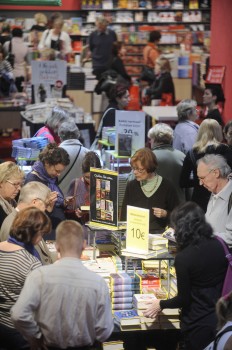
Words for sale: Helsinki Book Fair, 2009. - Photo: Suomen Messut / Kimmo Brandt
The Helsinki Book Fair opened yesterday (22 October), with the theme ‘What’s really happening’, at the Helsinki Exhibition and Convention Centre. Over four days there will be more than a thousand performers (mostly writers and their interviewers) and nearly 300 exhibitors. Last year’s Fair attracted 68,000 visitors.
The words of the theme are borrowed from a 1960s collection of poems (Mitä tapahtuu todella) by Pentti Saarikoski (1937–1983). According to the press release, the theme ‘sums up what literature is about’; moreover, ‘fiction and non-fiction reflect this very day, reinterpreting the past and present glimpses of what is to come’.
What’s really happening, it seems to us, is that inventing catchy titles for commercial purposes is an enterprise that should be undertaken with caution, as it may produce unintentional connotations for the delectation of those in the know… Mitä tapahtuu todella – its title borrowed in turn from none other than the Russian revolutionary Vladimir Ilyich Lenin – was a politically utopian collection in which Saarikoski expressed his belief in dialectical materialism and communism, contrasting American avant-garde art with the Marxist-Leninist utopia in which the writer wished to live.
In recognition of bicentennial 1809, the year in which Finland ceased to be part of the kingdom of Sweden and became an autonomous Grand Duchy of Russia, Sweden is under focus at the Book Fair, and is represented by 27 exhibitors and more than 30 performers. Writers from eight countries in all will visit the Fair, Russia taking part for the first time. Among the visitors are the writers Andrei Astvatsaturov and Herman Sadullajev and the translators Lyudmila Braude ja Anna Sidorova, who were awarded this year’s Finnish Government Prize for Translation.
The Fair is organised by The Finnish Fair Corporation in conjunction with the Finnish Book Publishers Association and the Organisation of the Booksellers Association of Finland.
Forest and fell
8 May 2013 | Reviews
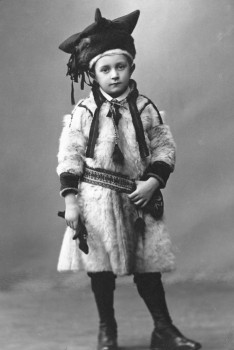
From North to South: young Heikki Soriola on his way to represent Utsjoki in Helsinki, in 1912. Photo from Saamelaiset suomalaiset
Veli-Pekka Lehtola
Saamelaiset suomalaiset: Kohtaamisia 1896–1953
[Sámi, Finns: encounters 1896–1953]
Helsinki: Suomalaisen Kirjallisuuden Seura, 2012. 528 p., ill.
ISBN 978-952-222-331-9
€53, hardback
Leena Valkeapää
Luonnossa: Vuoropuhelua Nils-Aslak Valkeapään tuotannon kanssa
[In nature, a dialogue with the works of Nils-Aslak Valkeapää]
Helsinki: Maahenki, 2011. 288 p., ill.
ISBN 978-952-5870-54-1
€40, hardback
The study of the Sámi people, like that of other indigenous peoples, has become considerably more diverse and deeper over recent decades. Where non-Sámi scholars, officials and clergymen once examined the Sámi according to the needs and values of the holders of power, contemporary scholarship starts out from dialogue, from an attempt to understand the interactions between different groups. More…
Hiking through a poetic universe
30 March 2006 | Authors, Reviews

Lars Huldén. Photo: Charlotta Boucht
The gods decreed that Lars Huldén was born on the same date as Finland’s national poet Johan Ludvig Runeberg (1804–1877), who wrote the words of the Finnish national anthem – and who has turned into a dead classic. Lars Huldén will never be thought of as a member of the dead poets’ society.
A collected volume entitled Utförlig beskrivning av en bärplockares väg (‘A thorough description of a berry-picker’s path’, Schildts [Finnish translation, by Pentti Saaritsa: Erään marjamatkan seikkaperäinen kuvaus, WSOY]) containing work from the whole of Huldén’s literary career – from his first book all the way to new poems written in 2005 – has been published in honour of his 80th birthday in February 2006. He has published thirty-six collections of poetry in Swedish, and it is a generous, intelligent and (self-)ironic textual universe that unfolds through the volume’s 500 pages. More…
Kidult culture
4 April 2012 | Non-fiction, Tales of a journalist

Illustration: Joonas Väänänen
Life is hard, and then you grow up. Except that you don’t really, at least if you keep watching television. Jyrki Lehtola takes a look at entertainment for the Peter Pan generation – which, he argues, is pretty much all of us
When did we start making television for children? I mean, in theory for adults (believe me, advertises, believe me: for adults!) but in practice for children?
Theoretically television is a wonderful, flexible medium less dependent on big money than the film business. Why did we let it slip out of our hands as a form of expression?
Why did we start making adult programmes for children and children’s programmes for adults? In other words, why do we make exactly the same TV programmes for everyone? More…
A small lie
30 June 1987 | Archives online, Fiction, Prose
A short story from Pieni valhe (‘A small lie’). Introduction by Marianne Bargum
The white cat had started to hate her.
Only half a year ago, Marja remembered, it had been playing with the hems of her robe, while she had passed the morning reading and drinking coffee. Right now it was staring relentlessly at her from the bookcase where it was ensconced: out of reach, she thought. Its stare was green and mean. At night it attacked her ankles; it lurked in the crevices of the apartment and when it heard her approaching steps it leapt past her, screaming, and crossed the room to the curtains or the table. The curtains fell, books crashed to the floor, the cat stared with its eyes opened wide, the pupils like narrow slits. She would lock the cat into the other room for the night, hear it mew and feel the door with its paws; she fell asleep only after the cat had calmed down. When she approached it during the day, stroked it and called its name, it looked at her, motionless, as if it had seen and known everything, and then she withdrew her hand, backed off, started behaving as if there wasn’t even a cat in the apartment. More…
We Finns
15 January 2010 | Columns, Tales of a journalist
Illustration: Joonas Väänänen
Is it so bad to criticise a Finn, if you’re a Finn? Columnist Jyrki Lehtola takes another look at what you think about us Finns out there
Recently, the word ’Finland’ has been repeated in Finland, and generalisations made about what we Finns are like.
Last year saw the seventieth anniversary of the Winter War, and we congratulated ourselves on what a fine fighting nation we are.
A government branding work group tells us at regular intervals how creative a nation we are.
From time to time someone remembers to mention the sauna, while someone else is a little more critical and says we are also an envious nation. More…
Between three cultures
5 February 2010 | Authors, Reviews
Zinaida Lindén. Photo: Johan Lindén
A new collection of short stories by the Leningrad-born author Zinaida Lindén explores the ambiguities of life between three cultures: her native Russia, her adopted Finland, and Japan, where she has also lived. In this introduction to Lindén’s short story Shards from the empire, Janna Kantola appreciates Lindén’s capricious, recalcitrant prose, and the positive, generous spirit that lies behind her work
Seen from a distance, Finns and Russians seem very like one another.
Zinaida Lindén has written her books from a cultural no-man’s-land in which she may have been forced to ponder the central questions of national identity. After studying Swedish in her native Russia, Lindén (born 1963) settled in Finland with her Finland-Swedish husband, and has written all of her works in Swedish. A recurring theme is that of encounters with the foreign, the other. More…
All beauty
17 November 2011 | Authors, Reviews
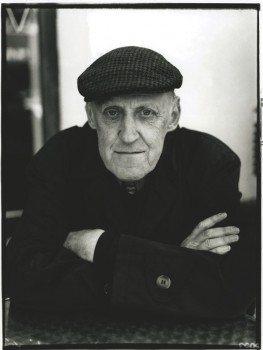
Bo Carpelan. Photo: Ulla Montan
The epigraph to Bo Carpelan’s prose work, Blad ur höstens arkiv. Tomas Skarfelts anteckningar (‘Leaves from autumn’s archive. The notes of Tomas Skarfelt’) is a quotation from Goethe: Zum Erstaunen bin ich da (‘To marvel I am here’). The world is a wonder to behold, one’s curiosity ought to be satisfied with less. It could stand as a motto for the whole of Carpelan’s literary work.
That work is now complete. Bo Carpelan died in February this year at the age of 84. He had made his debut in 1946 with the poetry collection Som en dunkel värme (‘Like an obscure warmth’).
In his prose as in his poetry, Carpelan built on a process of heightened and unconditional perception. Where others see only trees or forest, he saw a complex, branching light. His poetic ‘I’ could even watch itself perceiving, as when one autumn evening Tomas Skarfelt writes of a long-eared owl: ‘The yellow eyes looked at me attentively for a moment: a rather large, feather-clad camera.’ Carpelan often complained of having a poor memory, but it was a photographic one. More…
The forest folk’s trip to Helsinki
26 March 2015 | Children's books, Fiction
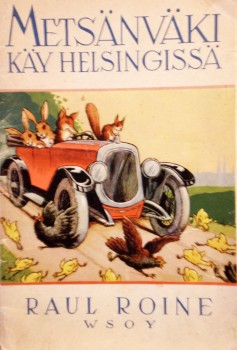 The country comes to town in this coyly modern fairy story of 1937 by the classic children’s writer Raul Roine (1907-1960). Reynard the Fox, the village taxi-driver, celebrates restoring his beat-up old Ford by taking his woodland friends – squirrels, chaffinches, bobtails… – on a day out to Helsinki. Trouble starts when a policeman tells them off for eating the plants in the Esplanade park, but the fun really begins when the hares find themselves participating in the marathon which is being run through the city streets that day…
The translation of this delectable tale is by Books from Finland’s long-time collaborator Herbert Lomas (1924-2011), who was often at his best when working on the whimsy of children’s literature.
Spring had come to the forest homeland. The wood anemones were raising their heads shyly from under the moss, large tears of joy were flowing down the spruce trees’ beards of lichen, and sky-ploughs of cranes were coming from the south. They bugled mightily on their trumpets and then landed in the Great Marsh to sample the cranberries More…
A respectable tragedy
30 June 1988 | Archives online, Fiction, Prose
An extract from the novel Säädyllinen murhenäytelmä (‘A respectable tragedy’, 1941). Introduction by Kaija Valkonen. The central theme of the novel is love: young, old, passionate, innocent, proper, improper. The main characters are a middle-aged couple, the doctor and his wife Elisabet, his sister Naimi and the love of her youth, Artur. Hämäläinen’s fine irony, careful and thoughtful psychology and colourful language have made the novel a bestseller. Naimi, an aesthete and an uncompromising character, has left her husband Artur twenty years ago because of his infidelity. But slowly she begins to forgive: this tragic but compassionately told love story, not without tragicomedy and humour, ends in reconciliation
Embalmed passion
In that new Helsinki of the ‘thirties, which had opened like a garden flower, gaily coloured, sunlit, practical and impractical, in love with every novelty of the moment, which it thought astonishing, lived Naimi Saarinen, back from her exile, where she had been driven by wounded passion twenty years before. More…
Temporarily out of order
Extracts from the novel Hullu (‘The lunatic’, Teos, 2012). Introduction by Soila Lehtonen
I found myself standing in front of the noticeboard. The rules were on a sheet of paper:
Ward 15 5-C
MEAL TIMES:
Breakfast 8:00 AM
Lunch 11:45 AM
Dinner 4:30 PM
Evening Snack 7:30 PM
COFFEE:
After lunch
We recommend leaving money, valuables, and bankbooks for storage in the ward valuables locker. We take no responsibility for items not left in the locker! Money may be retrieved 1–3 times per day. Use of mobile phones on the ward by arrangement.
VISITING HOURS:
M–F 2–7 PM
Sa–Su 12–7 PM
PERSONAL CLOTHING:
Use of one’s own clothing by individual arrangement. Clothing care individual. Washer and dryer available for use in the evenings after 6 PM.
OUTDOOR RECREATION:
Arranged individually according to health condition. Outdoor pass does not include the right to leave the area.
VACATIONS:
Vacations arranged during morning report, according to health condition.
NOTA BENE!
Smoking is only allowed on the smoking balcony! Smoking prohibited from 11 PM to 6 AM.
Pastor Karvonen available by appointment.
These were impossibly difficult rules. I read them through three times and simply did not understand. ‘Clothing care individual.’ ‘Outdoor pass does not include the right to leave the area.’
What did these sentences mean? With whom did you schedule the pastor and how? And why? More…
What the snail thought
30 September 2005 | Fiction, Prose
Poems from Tapahtui Tiitiäisen maassa
(‘It happened in Tumpkin land’, WSOY, 2004)
Illustrations by Christel Rönns

Meritähti
Eli merenpohjassa Meritähti
tuhat tonnia vettä yllä.
      - Minä jaksan kyllä,
      sanoi Meritähti.
      - On terävät sakarat,
      ja litteät pakarat
ja paineenkestävät kakarat!
Tweet! Oink! Ow!
14 June 2012 | This 'n' that
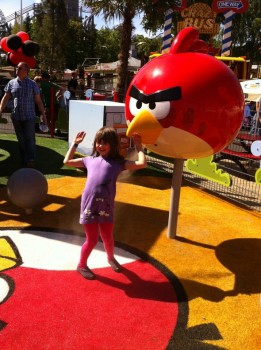
Fan fun: Angry Birds theme park, Tampere. Photo: Hildi Hawkins
For anyone who’s not a fan, it can be hard to see what has made the Finnish-born game Angry Birds the number one paid smartphone app in the world.
Catapulting wingless birds at pigs seems an unlikely route to hours of focused fun; but then, the same could seem true, prima facie, of moving a set of unrelated figures around a chequerboard according to some rather arbitrary rules. There are similarities, though – as 10-year-old Sophia said, ‘Angry Birds is a lot like chess – only more fun.’
So, when the most junior members of the Books from Finland editorial team – Max (3), Tia (6) and the above-mentioned Sophia (see their previous review here) – discovered that the world’s first officially sanctioned Angry Birds theme park was opening during their visit to Finland, it was obvious they had to be there for the occasion.
Friday 8 June was a fabulously sunny day for a trip to Tampere, Finland’s second city, and its famous Särkänniemi fun fair, on a spectacular location between two lakes. Angry Birds Land was packed with the nursery- and primary-aged children it’s intended for. More…