

Search results for "tommi+musturi/2010/05/song-without-words/2009/09/what-god-said"
Round and round
2 December 2011 | Essays, Non-fiction
In this essay, Olli Löytty imagines himself in a revolving door that is able to spin his old family home and its inhabitants backwards in time – as far as prehistory. In addition to his own family’s past, Löytty zooms back into the history of the world’s great changes, for a moment playing the part of a cosmic god examining our globe
An essay from Kulttuurin sekakäyttäjät (‘Culture-users’, Teos, 2011)
If a film camera had stood outside my home from the time when it was built, I would rewind the movie it made from the end to the beginning. The story would begin with my children, one autumn morning in 2011, walking backwards home from school. The speed of the rewind would be so fast that they would quickly grow smaller; I, too, would get thinner and start smoking. I would curiously seek out the point where my wife and I are seen together for the last time, stepping out of the front door, back first, and setting out on our own paths, to live our own separate young lives.
At that time my grandmother still lives in the house with her two daughters and their husbands, and lodgers upstairs. The next time I would slow the rewind would be the point where, at the age of 18, finally move out of the house. The freeze-frame reveals a strange figure: almost like me, but not quite. In the face of the lanky youth I seek my own children’s features.
When I let the film continue its backwards story, I seek glimpses of myself as a child. Even though we lived in distant Savo [in eastern Finland], we went to see my grandmother in the city of Tampere relatively often. We called her our Pispala grandmother, although her house was located to the west of the suburb limit, in Hyhky. I follow the arrival of my grown-up cousins, their transformation into children, the juvenation of my grandmother and her daughters, the changing lodgers. At some point the film becomes black-and-white. More…
Dreams so strong
31 March 1996 | Archives online, Fiction, poetry
Poems from Regnets uråldriga sätt att regna (‘The rain’s primordial way of raining’, Schildts, 1993)
the necessity of low tide
the necessity of still, mud-grey days
where the bird’s egg and your memory hide in the sand of the shy
the weak light
made of molten wind
and our faces deep inside the shadow.
we sleep: we dream a dream of sprouting shoots,
of the red heads of the newborn children
that palpitate beneath the ice –
We are the champions
25 March 2011 | Prose
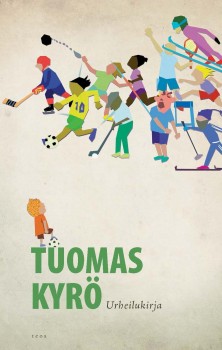 Heroes are still in demand, in sports at least. In his new book author Tuomas Kyrö examines the glorious past and the slightly less glorious present of Finnish sports – as well as the meaning of sports in the contemporary world where it is ‘indispensable for the preservation of nation states’. And he poses a knotty question: what is the difference, in the end, between sports and arts? Are they merely two forms of entertainment?
Extracts from Urheilukirja (‘The book about sports’, WSOY, 2011; see also Mielensäpahoittaja [‘Taking offence’])
The whole idea of Finland has been sold to us based on Hannes Kolehmainen ‘running Finland onto the world map’. [c. 1912–1922; four Olympic gold medals]. Our existence has been defined by how we are known abroad. Sport, [the Nobel Prize -winning author] F. E. Sillanpää, forestry, [Ms Universe] Armi Kuusela, [another runner] Lasse Viren, Nokia, [rock bands] HIM and Lordi, Martti Ahtisaari.
The purpose of sport at the grass-roots level has been to tend to the health of the nation and at a higher level to take our boys out into the world to beat all the other countries’ boys. We may not know how to talk, but our running endurance is all the better for it. However, the most important message was directed inwards, at our self image: we are the best even though we’re poor; we can endure more than the rest. Finnish success during the interwar period projected an image of a healthy, tenacious and competitive nation; political division meant division into good and bad, the right-minded and traitors to the fatherland. More…
An officer and a gentleman
31 December 2004 | Archives online, Authors, Reviews
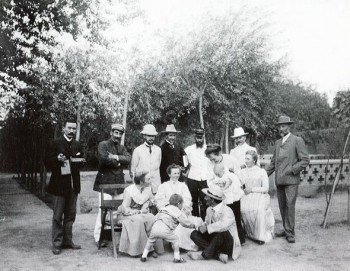
A moment in the Chinese garden: from left, Eric Macartney. Kashgar, China, 1906. Photo: C.G.E. Mannerheim
A photograph from 1906 prompted Markus Nummi to write a 500-page novel about the people of the caravan route in China. One of his characters, the Finnish photographer and spy-explorer Carl Gustaf Mannerheim, in reality later became Finland’s sixth president. Where does fiction end and history begin? Anna-Leena Nissilä investigates
The city of Kashgar in Chinese Turkestan in the year 1906: a group of French explorers and a crowd of Swedish missionaries from the local province, along with other members of the European community and their children, have gathered together in an orchard to take a picture. Midilimanglar, keep still, says the photographer, Baron Carl Gustaf Mannerheim, and presses the shutter release. The admonition is without effect; the picture turns out restless. Little Eric can’t hold still; a baby girl is grabbing at a man’s hat; the adults are looking past the camera. For some reason the host of the event, an Englishman named Macartney, is standing a pace away from the rest of the group.
Almost a century later, the author Markus Nummi (born 1959) runs across Mannerheim’s snapshot and becomes inspired. He tells how the expansive and thematically wide-ranging historical novel Kiinalainen puutarha (‘The Chinese garden’, Otava, 2004) began to form around the photograph:
‘The photograph is the starting point for everything, the intersection and blink of an eye in which all of my story’s central characters are close to another. I was fascinated by the picture’s bustle: people looking every which way, all the fumbling about. And when you look at the picture more closely, you start to see different kinds of connections; when you look at where these people were coming from and where they went in their lives, you can start to imagine what is hidden behind the picture. I started to contemplate what the photographer saw at the moment the picture was taken, maybe angels?’ More…
In this room, or elsewhere
31 March 1994 | Archives online, Fiction, poetry
‘Some people play bridge; some people shoot pool; we read and write poems’, says Jouni Inkala (born 1966) of his generation of poets. These poems from his prize-winning first collection of poems, Tässä sen reuna (‘Here is its edge’, WSOY, 1992)
Behind the window, wet snowflakes rise and descend,
cold white insects.
In the summer, their brothers swirled in the sun’s low,
silent volleys,
as I sped on my bicycle through the dark gullet of spruce-rows some always filtered into my eyes, my mouth.
They were cool, even then.
Now I sacrifice toenails, relinquish some of my own warmth to the back of an armchair.
As a dark, painful spot in God’s brain,
which is unknown
as long as it isn’t troubled into truth,
pain made visible, known. More…
Perfect thing
31 December 2000 | Archives online, Fiction, Prose
Extracts from the novel Ennen päivänlaskua ei voi (‘Not before sundown’, Tammi, 2000). Interview and introduction by Soila Lehtonen
A youngster is asleep on the asphalt in the backyard, near the dustbins. In the dark I can only make out a black shape among the shadows.
I creep closer and reach out my hand. The figure clearly hears me coming, weakly raises its head from the crouching position for a moment, opens its eyes, and I can finally make out what it is.
It’s the most beautiful thing I’ve ever seen.
I know straight away that I want it. More…
A sense of order
30 June 1987 | Archives online, Authors, Reviews
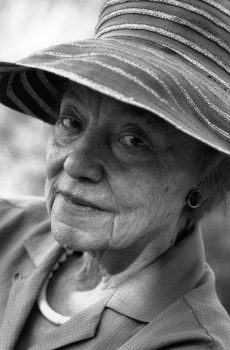
Solveig von Schoultz. Photo: Charlotta Boucht
That Solveig von Schoultz occupies the position of ‘grand old lady’ of Finland-Swedish poetry is beyond question; yet it is an epithet that fits her badly. It all too easily suggests the image of a stern and queenly poetess, an Edith Sitwell, Marianne Moore or Gabriela Mistral. The poetesses of Scandinavia are, by and large, less solemn – more gentle and down-to-earth, even when they grow older and wiser and ascend some of Parnassus’s more elevated thrones.
Solveig von Schoultz has, of course, had a long journey to the top. She has behind her twelve collections of poetry, at least fifteen volumes of prose, and an even greater number of plays for radio, television and theatre, spanning a good fifty years’ acitivity as a writer.
In this long artistic career there is both continuity and development. It might be said that the continuity is represented by the fact that from the very beginning she has preferred to describe women – their daily lives, their loves, thoughts, impulses, relationships. But since so much in the world of women and in women’s thinking has changed during the decades since her literary debut in the 1930s, both her themes and her outlook have necessarily altered, too. Among other things, she has had many of her early, then only half-developed ideas taken up by a later generation, and has thereby had them given back to her renewed. As a feminist she has always been one of the least militant, and for a short time some of her younger co-sisters were uncertain about the strength of her commitment to the Cause. More…
The Canada goose
31 December 2008 | Archives online, Fiction, Prose
A short story from Tapaus Sidoroff (‘The Sidoroff case’, WSOY, 2008). Introduction by Kristina Carlson
It was no use even trying the old cart track branching from the main road. I turned off the engine and glanced into the back seat. My aunt lifted the brim of her hat, her bright eyes peering at me questioningly.
‘We can’t get any farther by car. The road’s nothing but rough brush. What do you think, Aunt Alli, can you walk the rest of the way?’
My aunt shook her head and didn’t even bother to answer. She opened the car door and clambered out. A swarm of black flies wafted into the air from the brush at the bottom of the ditch.
‘For heaven’s sakes, there’s sure enough of these flies.’
She fanned at the air with her hat, straightened the hem of her dress and trudged across the ditch, without looking back, through the thicket of willows. In spite of her hip trouble, the old woman made her way in such a hurry that I had my work cut out keeping up with her. More…
Big-city blues
30 September 2005 | Fiction, Prose
Extracts from the novel Beige. Eroottinen kesä Helsingissä (‘Beige. An erotic summer in Helsinki’, Sammakko, 2005). Introduction by Tuva Korsström
Helsinki starts – where? Where a country girl will wear white corduroy pants if she’s eight and her pen pal tells her to. Where you’re allowed to jump in at the public swimming pool, and water splashes in your face no matter what you do, and it’s a long way to the bottom, you can’t touch. Unreal. That’s what Helsinki was like. Buildings that you recognized from pictures. A city where pictures were the starting point of your life, not experience. You step into the picture and begin your life. The step takes a long time. An entire youth. The first few days go well. You’re a tourist. The crowd of anonymous, noisy people is relaxed, you feel uninhibited. Nobody pays any attention to you. Then you start to want to feel. To talk. To say hi to somebody. The waiting begins, and there’s nothing you can do to speed it up. You have to live in the city. Ten years and you’re in, maybe, a little. Be there. Stay. You’ll circulate around the triangle formed by Sokos, Stockmann, and Forum department stores. They’re familiar from pictures, you’re wary of the others. The streetcar home. Home and downtown. The city. The lanes. Conduits. Lights. Trams. Taxis. Buses. The first negro. The first stop at a traffic light. The yellow stone building. The colorful cottages at the foot of the bridge. More…
Mikko Rimminen: Nenäpäivä [Nose day]
29 October 2010 | Mini reviews, Reviews
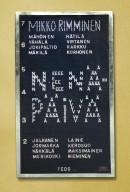 Nenäpäivä
[Nose day]
Helsinki: Teos, 2010. 339 p.
ISBN 978-951-327-1
€ 25.90, hardback
Female protagonists as sympathetic as this are rare in contemporary literature; in this third novel by Mikko Rimminen (born 1975), Irma is a solitary, slightly awkward outsider who gets badly tangled up in a muddle of her own making. She poses as a door-to-door market researcher – in order to meet people. Rimminen employs a more complex plot than in his previous novels (his 2004 debut work, Pussikaljaromaani, ‘A six-pack novel’, about idle young men, has been translated into five languages). The author is an acknowledged master of the slow narration: he is skilled at describing the sound of silence and giving a page-long description of the behaviour of a mobile phone in someone’s hand. All that passes unsaid and unseen between people is cleverly and hilariously put into words. Rimminen’s Finnish is highly original – he keeps creating new verbs and compounds – and his characters who stand on the margins hankering after ordinary life gain the reader’s genuine sympathy.
Cool, not ice-cool
17 October 2013 | This 'n' that
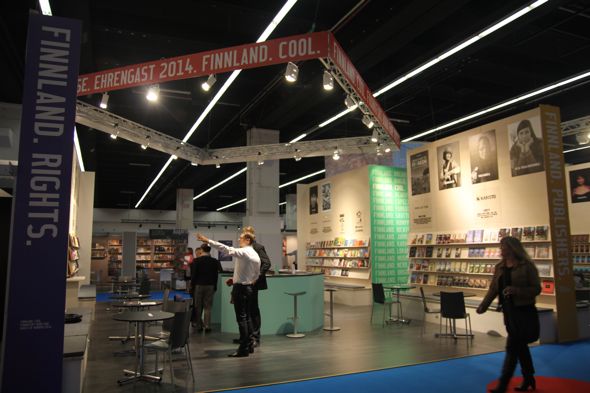
Getting ready: book fair scenery, 2013. Photo: FILI
The Finnish book world is preparing for the big event of ‘F14’: Finland will appear as Guest of Honour at the Frankfurt Book Fair in October next year.
The slogan for this enterprise is Finnland. Cool.
The coordinating organ is FILI, the Finnish Literature Exchange, a part of the Finnish Literature Society. Co-operating with FILI are three ministries, literary organisations and publishers, the Finnish Embassy and Finnland-Institut in Berlin and the Goethe-Institut in Helsinki.
Last week a large proportion of the FILI staff – who now need to keep their cool for the next busy year – went to Frankfurt, and on 10 October (aptly, the memorial day of the national author Aleksis Kivi and also Finnish Literature Day) the press conference was opened by the Finnish Minister of Culture and Sport, Paavo Arhinmäki. On 13 October the 2013 Guest of Honour, Brazil, passed the baton to Finland. (More photographs here.)
The world’s largest book fair, Frankfurt, attracts some 300,000 visitors each year. Accessible to both professionals and the general public, the fair is also the biggest cultural event in Germany.
The Guest of Honour countries receive a vast amount of attention in the media, and the number of new translations from the respective languages into German, as well as other languages, will increase.
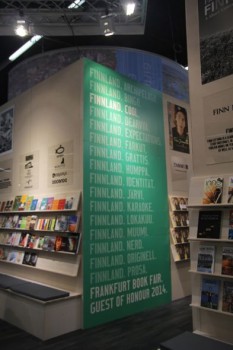
Finnland: arktik. Blondi. Cool. Demokratia. Einsam. Formula 1. Girji. Heimat. Ihminen. Joy…. Photo: FILI
The total Finnish budget for the years 2010–2015 is approximately four million euros, half of it money from the government. And the mission? Here are some warm words from the cool FILI agenda:
‘Why are Finns reading so much? Why are Finns so good at reading? Because we love it. Because reading plays such an important role in everyday life.
‘And because it is so important in Finland that everybody has access to reading – regardless of whether you are male or female, where you live, where you work, what your education or talent is. Fun, everyday life and for everyone – these are the main themes of the satellite programme for the Guest of Honour at the Frankfurt Book Fair 2014.’
Helsinki Book Fair 2011
2 November 2011 | In the news
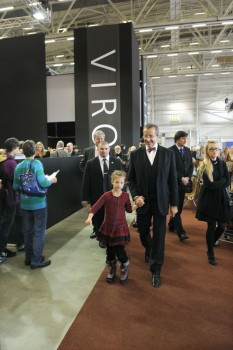
President Toomas Hendrik Ilves at the Book Fair: Viro is Estonia in Finnish. Photo: Kimmo Brandt/The Finnish Fair Corporation
The Helsinki Book Fair, held from 27 to 30 October, attracted more visitors than ever before: 81,000 people came to browse and buy books at the stands of nearly 300 exhibitors and to meet more than a thousand writers and performers at almost 700 events.
The Music Fair, the Wine, Food and Good Living event and the sales exhibition of contemporary art, ArtForum, held at the same time at Helsinki’s Exhibition and Convention Centre, expanded the selection of events and – a significant synergetic advantage, of course – shopping facilities. Twenty-eight per cent of the visitors thought this Book Fair was better than the previous one held in 2010.
According to a poll conducted among three hundred visitors, 21 per cent had read an electronic book while only 6 per cent had an e-book reader of their own. Twenty-five per cent did not believe that e-books will exceed the popularity of printed books, and only three per cent believed that e-books would win the competition.
Estonia was the theme country this time. President Toomas Hendrik Ilves of the Republic of Estonia noted in his speech at the opening ceremony: ‘As we know well from the fate of many of our kindred Finno-Ugric languages, not writing could truly mean a slow national demise. So publish or perish has special meaning here. Without a literary culture, we would simply not exist and we have known this for many generations, since the Finnish and Estonian national epics Kalevala and Kalevipoeg. – During the last decade, more original literature and translations have been published in Estonia than ever before. And we need only access the Internet to glimpse the volume of text that is not printed – it is even larger than the printed corpus. We live in an era of flood, not drought, and thus it is no wonder that as a discerning people, we do not want to keep our ideas and wisdom to ourselves but try to share and distribute them more widely. The idea is not to try to conquer the world but simply, with our own words, to be a full participant in global literary culture, and in the intellectual history and future of humankind.’
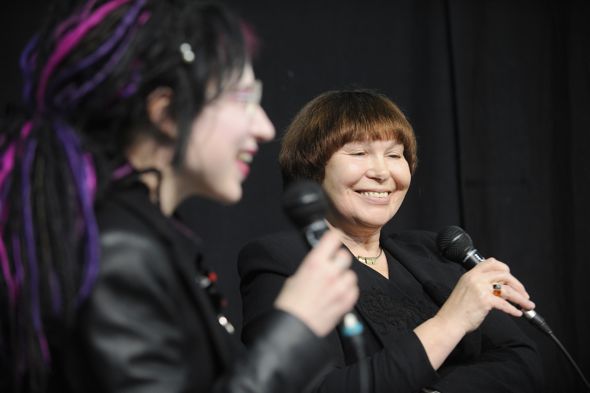
Finland meets Estonia: authors Sofi Oksanen and Viivi Luik in discussion. Photo: Kimmo Brandt/The Finnish Fair Corporation
Bright lights, small city
26 August 2010 | Articles, Non-fiction
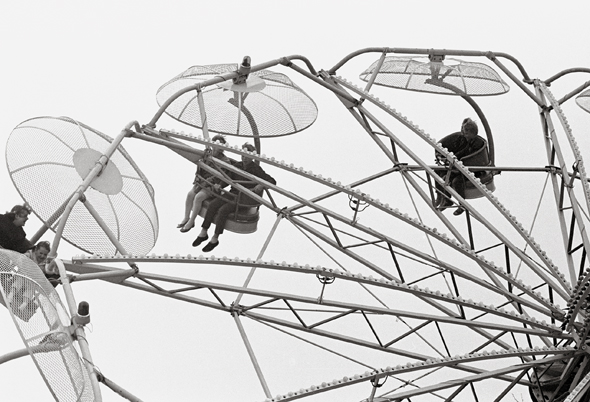
Helsinki people on the big wheel: Linnanmäki amusement park, 1968
Helsinki people on the big wheel: Linnanmäki amusement park, 1968
Photographs and excerpts from Helsinki 1968 by Claire Aho and Kjell Westö (text in Finnish, Swedish and English; WSOY, 2010)
A year that rocked the world: 1968. The Vietnam War, the Chinese cultural revolution, the invasion of Czechoslovakia, hunger in Biafra. Helsinki that year: a quiet little city, in a quiet little country. But Finland’s baby-boomers, born after the war, were now coming of age, resulting in the beginnings of a change of generation in politics; and the students of Helsinki University joined the global student unrest of this ‘crazy year’. Photographer Claire Aho takes a series of photographs of her home town, participating in an exhibition in Kiel, Germany. Forty-two years later her photos are published in Helsinki 1968, together with reflections by Kjell Westö, whose novels are deeply rooted in his native city. Here are words and images of Helsinki that mirror the past – and the present
Both the city and its people carry their past with them, find it hard to let go, and don’t really want to. Many of us are reluctant to embrace the new. Hence there is often something ambivalent, something enigmatic in the frozen moment of the photograph…. More…