

Search results for "tommi+musturi/2010/05/song-without-words/2009/09/what-god-said"
Peter von Bagh: Sodankylä ikuisesti [Sodankylä forever]
11 June 2010 | Mini reviews, Reviews
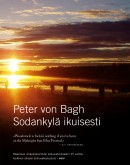 Sodankylä ikuisesti
[Sodankylä forever]
Helsinki: WSOY, 2010. 308 p., ill.
ISBN 978-951-0-36290-7
€ 52, hardback
The Midnight Sun Film Festival is the world’s northernmost film festival. Held in Sodankylä, Lapland, it is now 25 years old. This scrapbook includes the text of speeches given by filmmakers as well as a wealth of material about the films shown over the years. Much of this material is based on the morning discussion panels which the festival’s director, film historian and author Peter von Bagh, has chaired with his guests. More than one hundred film directors, from Samuel Fuller to Wim Wenders, talk about the background and influences in their work. Von Bagh has constructed dialogues between directors who did not actually attend the same sessions; he calls these conversations – sometimes between the living and the dead – ‘heavenly dialogues’. The Festival was founded by Finnish film directors Aki and Mika Kaurismäki and Anssi Mänttäri in collaboration with the municipality of Sodankylä. The light summer nights and laid-back atmosphere at the festival delight the speakers and audience members every year. In the words of the American filmmaker D.A. Pennebaker, ‘Woodstock is fuckin’ nothing if you’ve been at the Midnight Sun Film Festival.’
The pearl
30 December 1999 | Fiction, Prose
A short story from Tutkimusmatkailija ja muita tarinoita (‘The explorer and other stories’, Loki-kirjat, 1999)
My name is Jan Stabulas. I am one of the quietest and inconspicuous workers in our department store, this giant ant-heap swarming with people. No one really pays any attention to me, although I am on show all the time. My job is quite simple: to stand in the menswear department, dressed in fashionable clothes. Now that doesn’t take much, I have heard it said. Well, try it yourself. Try standing for ten hours, without moving, in an awkward, even an unnatural, position, wishing that the air conditioning would work when it was hot, or that it would be switched off when you can feel the draught cutting you to the marrow. Think how the customers stare at you as they pass by, like an object which they cannot buy, and consider your words once more. More…
Scenes from a life
30 September 2004 | Archives online, Fiction, Prose
Extracts from Muistelmat (‘Memoirs’, Otava, 2004). Introduction by Soila Lehtonen
1973, Mietoinen
The shot put circle
Great Grandma knew a lot. She could look over to the neighbor’s yard two kilometers away and told us she could see a broom there leaning against the door. I was practicing the shot-put with the boys by the gable end of the barn. The shot flew three meters. Great Grandma walked past: ‘So what are you boys up to?’ I stared at the ground and said: ‘We don’t know yet.’
1980, Turku
The people in the neighboring car
Reeds rustled against the sides of the boat. The car stood in the sun. We drove into town. At the end of the trip, traffic slowed. I sat in the back seat and got a good view of the people in the car next to us. When we started moving again, I knew I would never see them again. After thirty seconds, they were there, right next to us. More…
The Comb
30 September 1981 | Archives online, Fiction, Prose
A short story from Tilanteita (‘Situations’, 1962). Introduction by Vesa Karonen
The young man’s comb dropped behind the radiator under the window. The young man crouched down to look and felt with his fingers in between the pipes and along the floor. No trace of the comb.
Lose something on a train and it eludes you. A train ticket I left once – just placed it long enough on the window ledge for it, too, to fall behind the radiator. Couldn’t find it. The conductor came along, said “Any new fares! Tickets please.” I just sat still, totally unconcerned, until he’d gone. I’m sure there are little details which give the game away to conductors, they know who’s just got on.
New passengers are always somehow fresher, more alert. In winter, I hear, they look at the passengers’ feet. If there’s snow round the edges of the shoes, no need to hesitate. A lot of people are done for by looking straight in their eyes. Offenders always look straight back and then in the middle try to look somewhere else entirely. I was careful not to look steadily into the conductor’s eyes. It was easy when I concentrated on the way the long ventilator cords swung back and forth from the ceiling. They all swung in the same direction but some cords were a bit behind the others. Perhaps it was because the cords were all slightly different in weight and length. Now I remember – it’s not the weight that counts, just as it’s not weight that affects the way a pendulum swings. When the conductor had gone I began to look for my ticket again. I went on looking for it all the way to Tampere. The young man, too, would obviously go on looking for his comb until he got where he was going, without finding it. More…
The train
31 March 1995 | Archives online, Fiction, Prose
Extracts from the novel Koe (‘The experiment’; WSOY, 1994). Interview by Tuva Korrström
In the morning a wild rose tapped beseechingly at the window, the wind sighed in the shaft of the chimney, the entire house creaked, pregnant with so great a longing that they had to awaken.
And as soon as they began to speak to each other, the house settled.
‘I should like to see the train,’ Sari said.
‘Why?’
‘Because that is the reason why I am here.’
‘I didn’t plan it like that,’ Kari said. More…
The legacy of a self-made man
29 October 2010 | This 'n' that
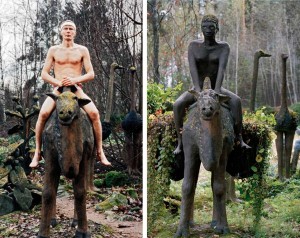
On camelback: in the exotic part of Veijo Rönkkönen’s concrete cosmos there are animals and palm trees, side by side with the living plants of the northerly latitudes. - Photo, left: Veijo Rönkkönen; photo, right: Veli Granö
Some of our readers may remember a story entitled ‘Self-made man’, published in Books from Finland in April 2009: Veijo Rönkkönen, who lived his entire life on a small, isolated farm in eastern Finland, built a garden inhabited by five hundred human and animal figures made of concrete.
Rönkkönen worked in a nearby pulp factory for 41 years. He lived in a small house in the middle of the garden, surrounded by his sculptures, which he had started making in the early 1960s.
Photographer and writer Veli Granö introduced the life and works of this self-made artist in his book Veijo Rönkkösen todellinen elämä / The real life of Veijo Rönkkönen (text in Finnish and English, Maahenki, 2007).
Contemporary folk art in Finland goes by the acronym ITE, from the words itse tehty elämä, ‘self-made life’. The French called it art brut; the English-language term is ‘outsider art’. The artists are ‘unschooled visionaries’ who make their art independent on any societal requirements or definitions.
The sculpture park became the most notable tourist attraction in Parikkala, visited by as many as 26,000 visitors every summer. Rönkkönen, however, refused to turn it into business. He never talked to visitors voluntarily either, but the park was open and free to all. He was awarded a state prize for artistic achievement, the Finland Prize, worth €30,000, in 2007, which he accepted.
Veijo Rönkkönen died last spring at the age of 66. The estate – Rönkkönen’s siblings, living elsewhere in Finland – offered the unique park to the county of Parikkala, which declined the offer because it’s upkeep was estimated to be too expensive.
In October businessman Reino Uusitalo bought the place for €140,000, with the intention of founding an administrative committee for the upkeep of the park. Rönkkönen’s extraordinary ‘total work of art’, will thus stay open – at least until nature – lichen, moss, creepers – claims what it considers it own. 500 sculptures: a self-made man’s open-air art
When the viewer vanishes
26 May 2015 | Essays, Non-fiction
 For the author Leena Krohn, there is no philosophy of art without moral philosophy
I lightheartedly promised to explain the foundations of my aesthetics without thinking at any great length about what is my very own that could be called aesthetics. Now I am forced to think about it. The foundations of my possible aesthetics – like those of all aesthetics – lie of course somewhere quite different from aesthetics itself. They lie in human consciousnesses and language, with all the associated indefiniteness.
It is my belief that we do not live in reality, but in metareality. The first virtual world, the simulated Pretend-land is inherent in us.
It is the human consciousness, spun by our own brains, which is shared by everyone belonging to this species. Thus it can be called a shared dream, as indeed I have done. More…
The painter who wrote
6 October 2014 | Non-fiction, Reviews
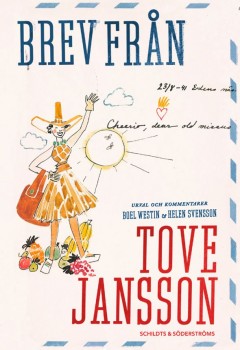 Brev från Tove Jansson
Urval och kommentarer Boel Westin & Helen Svensson
[Letters from Tove Jansson, selected and commented by Boel Westin & Helen Svensson]
Helsingfors: Schildts & Söderströms, 2014. 491 pp., ill.
ISBN 978-951-52-3408-7
€34.90
In Finnish (translated by Jaana Nikula):
Kirjeitä Tove Janssonilta
ISBN 978-951-52-3409-4
Nothing could be more mistaken than to describe Tove Jansson as ‘Moominmamma’. In her statements she was both cutting and complex – conflict-ridden and full of paradoxes. And she was nobody’s mamma.
Tove Jansson (1914–2001) became world famous (especially ‘big’ in Japan) with her Moomins – the characters of her illustrated books for children (1945–1970) – and her books for adults are a part of her work that is at least as interesting. Her training, ambition and artistic passion were, however, focused on painting.
Anyone who has read Boel Westin’s excellent biography – now available in English, Tove Jansson: Life, Art, Words – ‘knows’ all this, but to experience it through Jansson’s own letters, in an alternating process of reflection and recreation, brings the problems close to the reader in quite a different way: one that is shocking, but also deeply human. More…
Truths to tell
1 June 2011 | Authors, Interviews
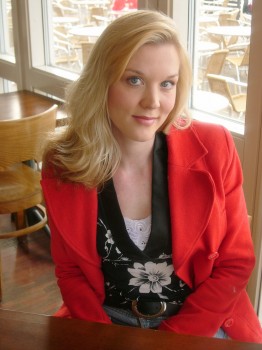
Johanna Holmström. Photo: Irmeli Jung
‘In my writing I try to give as many angles as possible, and my agenda is to show that there’s not just one truth, that there are always several ways of seeing what one perceives at first sight. So I often have more than one main narrator. I constantly aim to question accepted truths. My stories always begin with indignation about something I feel I must write about. Fiction is a way of distancing oneself. After all, books are literary, invented things. When you work on the subject of a literary text it becomes less personal.’
This is how Johanna Holmström (born 1981) describes her approach to writing. Since her first collection of short stories published in 2003 she has produced a book every two years: three short story collections and one novel. Her books have been variously described as imaginative, committed and uncomfortable. Her short story ‘Stormen’ (‘The storm’) is a precisely observed account of a day when everything changes for its young protagonist.
Just reading
18 June 2009 | Letter from the Editors
 The Books from Finland website has been live for two months, and we’re gradually settling in to our new mode of being. To say we were growing accustomed to our new environment, though, would be misleading. Since our last editorial, the Editor-in-Chief, the London Editor, the Web Editor and the Designer have actually spent physical time in the same room (yea, to cement the feeling of non-virtuality, they have even eaten pizza together). It would be fair to say that our reaction, jointly and severally, to publishing on line, could best be summarised as ‘Yay! This is great!’
The party’s not yet over
14 November 2013 | Authors, Interviews
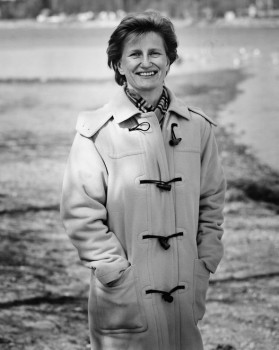
Minna Lindgren. Photo: Ville Palonen
Ordinary, boring, controlled life in an old folks’ home takes an interesting turn as crimes are committed. But daily tramrides in Helsinki, the virtues of friendship and general joie de vivre are enjoyed by 90-year-plus-old ladies who refuse to act as expected – as Bette Davis put it, old age is no place for sissies. Minna Lindgren is interviewed by Anna- Leena Ekroos
Welcome to Twilight Grove, a Helsinki home for the elderly – the bright, institutional lighting in its parlour creating an atmosphere like a dentist’s office, the odd resident dozing on the sofas, waiting for the next meal. The menu often includes mashed potatoes, easy for those with bad teeth. Residents seeking recreation are offered chair aerobics, accordion recitals, and crafts. A very ordinary assisted living centre, or is it? In Minna Lindgren’s novel, Kuolema Ehtoolehdossa (‘Death at Twilight Grove’, Teos), the everyday life of a home for the elderly is the setting for absurd and even criminal happenings, suspicious deaths and medical mix-ups.
Anna-Leena Ekroos: You’re a journalist and writer. Formerly you worked for the Finnish Broadcasting Company. In 2009 you won the Bonnier journalism prize for an article of yours about the last phases of your father’s life, and his death. Kuolema Ehtoolehdossa is your first novel. How did it come into being?
Minna Lindgren: I’ve always known I was a writer but the mere urge to write isn’t enough for a novel – you have to have a meaningful story. The more absorbed I became in the life of the old, the more important it felt to me to write this story. Writing a novel turned out to be carefree compared to working as a journalist. Many of the stories I heard would have become bad social porn in the media, dissolved into banality, but in a novel they become genuinely tragic, or tragicomic, as the case may be. More…
Kari Hotakainen: Ihmisen osa [The human lot]
9 October 2009 | Mini reviews, Reviews
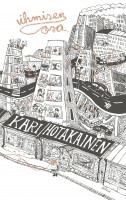 Ihmisen osa
[The human lot]
Helsinki: Siltala, 2009. 276 p.
ISBN 978-952-234-021-4
30 €, hardback
Kari Hotakainen (born 1957) is one of Finland’s most internationally successful contemporary authors, and is widely known for his children’s books, plays and television screenplays. Like many of Hotakainen’s other works, Ihmisen osa is a contemporary novel, but it is one that sees the author being angrier and more ferocious than before; this is a story that will move readers and make them laugh. Its plot gets off to a slightly ungainly start: an impatient writer wants to ‘buy someone’s life’ for the purpose of turning it into material for a novel and is prepared to pay an elderly widow €7,000 for hers. A former yarn-seller tells him all about her life as she remembers it, and the writer writes it up into his own book – the husband’s wilful silence, a serious accident suffered by one of the three children, gradually being revealed. Having got the beginning out of the way, Hotakainen then puts his foot on the gas: in his laconic style he throws light on the conditions at the edges of contemporary working life: the business of selling images, selfishness and greed, the power of words. The yarn-seller writes to one of her children: ‘Don’t rise above your station. There’s no air up there, and you’ll get dizzy.’ Hotakainen’s novel Juoksuhaudantie (‘Trench Road’) was awarded the Finlandia Prize for Fiction in 2002. It has been translated into 17 languages and was awarded the Nordic Council’s Literature Prize in 2004.
Self-made life
2 April 2011 | This 'n' that
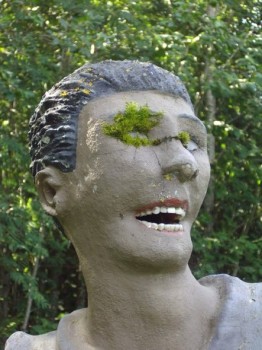
Art & nature: one of Veijo Rönkkönen's sculptures. Photo: Soila Lehtonen
You may perhaps remember an article entitled Self-made man, published on these pages in 2009: the sculptor Veijo Rönkkönen lived on a small, isolated farm in Parikkala, eastern Finland, where he spent his spare time building a garden of five hundred figures of concrete.
He lived in a cottage in the middle of his garden. Rönkkönen died a year ago, at the age of 66, and the future of his park, open and free to all, was unsolved for a while, as the Parikkala authorities were not willing to foot the bill for the upkeep the place – despite the fact that more than 25,000 people visit the park each year.
Now, the problem of the upkeep of the statue park, a ‘total work of art’, has been solved, as a businessman has bought the garden from Rönkkönen’s estate. and a number of institutions and individuals, among them friends of art and voluntary workers, have pledged keep the park open to visitors.
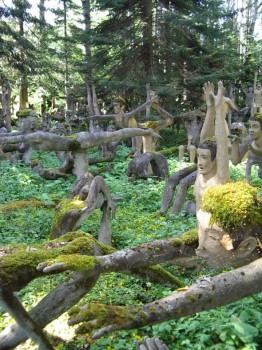
Yoga bare: Veijo Rönkkönen himself practised yoga. Photo: Soila Lehtonen
Photographer and writer Veli Granö introduced the life and works of this self-made artist in his book Veijo Rönkkösen todellinen elämä / The real life of Veijo Rönkkönen (Maahenki, 2007). Contemporary folk art goes by the acronym ITE, from the words itse tehty elämä, ‘self-made life’. The English-language term is ‘outsider art’.
The future of Rönkkönen’s cottage is undecided: it may become a park-keeper’s residence, or be used as an artist’s residence. Around it, the extraordinary legacy of this self-made artist – hundreds of statues, human and animal figures – will keep growing lichen and moss, ageing naturally.