

Search results for "tommi+musturi/2010/05/song-without-words/2009/09/what-god-said"
One more time
31 December 1999 | Archives online, Fiction, poetry
Poems from Kun elän (‘As I live’, Tammi, 1999). Introduction by Pekka Tarkka
XI
Here is a treetop
with three
thousand branches,
three thousand
names, whose
syllables no one
knows, three
thousand minds,
one murmur
traversed by a
breath, a sentence,
I’m afraid to say
anything,
a million leaves
sough, speechless,
a thousand dark
branching roots,
names in the soil,
a million words
in humus heaven
a thousand sprouts
bloom yet are lifeless,
dead heroes,
pointless tales,
three million
wrinkles. faces
obscured
by branches,
in the brain’s roots
a new person’s thought
is born and
hums through branches,
roots,
the smoke disappears
through the branches,
the smoke disappears.
XVIII
He saw faces behind the glass,
heard himself breathe.
With his fingertips, he brushed the glass surface
but it was not the same as skin.
Slowly, he arranged what he saw,
that blurry motion, but it did not work
as an architecture, the kind
a living city is perennially building.
He opened up to a gaze, froze,
lost the game altogether.
Then the scythe disappeared. He opened
a window onto the street, heard
leaves rustle as if waking up
to life, one more time.
Intermission
But I did not sing,
I chased her away,
flushed the toilet, paced
circles in the living room
like a moth that looks for
a place to land
or a solution that does not exist
to a problem that probably
does not exist either,
just a wall full of
leather-backed books
and seats among which
the moth chooses one, a
commodified insomnia
a landscape someone
invented once: palaces,
persons, tensions,
systems and maps
constructed by language insects
on top oft he void,
in the air, an imago mundi
never seen before
never before heard-of
utopias, illnesses
people prefer to endure
rather than
giving up, once they have
forgotten the war’s causes
or the cornerstone of their learning
ground up to gravel
long ago, they still love
the country they have
destroyed, for love
is stronger than
its object, and who
needs it, the group
eats reason and everything learned,
it turns us into beasts,
the congregation executes
its christ, the state
its sages, but the sleepless
animal keeps wrestling
in the mud with its inner
hero, the beast; yearns, spits,
rages and grieves, looks for
reconciliation, tries
to mediate and interpret
between invisible enemies
to whom only sleep and murmur
can lend a shape, until the image
finally shatters
into sentences, steps
into line between covers,
on the shelf: in the closed pages
simmers yet another delirium
no one has ever seen before.
Four o’clock
Don’t know why I burst out laughing
in bed, but someone instantly answered
as if by rote, as if
comprehending eternity,
laughing without malice, life
and soul of the party, cruel
as a certain hero
who was asked to hold up
the roof while they were still making
speeches in the hall, while the fool
scratched his belly, raised his cup
to the host. while a woman
raised her skirt, the whole forest laughed
and every demon claw
inscribed history. from which
the laughter freed him.
All of a sudden the clock struck four,
but I heard only my heartbeat,
the rush of systole and diastole,
tides of a muddy delta,
the sleepless whimper
of birth and death, the streams of cellular fluids,
the pulsing of stars, the animal’s paws
as it padded along the runner,
all in step; not long now until the wolfs hour,
nothing stirred on the plains, I felt
a thundercloud push down on my forehead,
and the wind died, the grass
stopped rustling, sugar coagulated, and then
lightning stopped my heart with one blow,
in one rapid motion my hand
tore off the pillow case, my body
sat up in bed, my mouth shouted,
the primal animal, evolution howled.
Upright. he stood in front of me,
in the rearview mirror the car came closer
struck me again and again from behind
with a huge iron fist, made words burst
from my mouth, the car rose into the air: a plane,
a pegasus galloping straight at the pillar,
now muteness, the windshield
cracked, flew out in one piece
to rest on the hood
in the rearview mirror the car
came closer again, I saw how I flew
into the foliage, in my mind
two separate memories:
thus memory shatters time, and so
one can look at the past as true,
barely, barely endure it: she
bent over me, said something.
At the wake, lips moved. behind
the glass stood a fair boy
whom I knew, even though
he had already grown up to be a man.
Translated by Anselm Hollo
Figuring out father
18 October 2012 | Extracts, Non-fiction
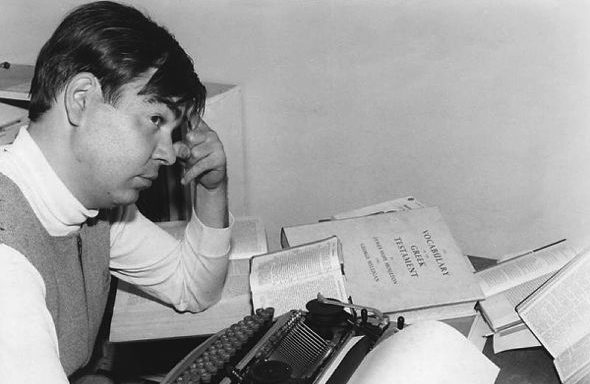
Pentti Saarikoski (1960s). Photo: Otava/Nikolai Naumoff
The poet and translator Pentti Saarikoski (1937–1983) jotted in one of his journals: ‘I have never cared for relatives.’ Thirty years after his death one of his five children set out to find out what his father was like – by reading almost all he left behind in writing; these comments by Saska Saarikoski are from his Sanojen alamainen (‘Servant of words’, Otava, 2012), an annotated selection of Pentti Saarikoski’s thoughts
Pentti Saarikoski died when I was 19. I remember complaining to my mother that I had not yet even got to know my dad. My mother answered: You’ve got plenty of time, the real Pentti is to be found in his books. She did not know how right she was, for she meant Pentti’s published books, not knowing what a mountain of texts awaited its readers in the archives of the Finnish Literature Society. Pentti had written everything down in his diaries.
I read Nuoruuden päiväkirjat (‘Youthful diaries’), published soon after Pentti’s death in 1983, as soon as they were published, but when his Prague, Drunkard’s and Convalescent’s Diaries appeared around the millennium, they went straight on to my library shelf. I was not terribly interested in the ramblings of Pentti’s alcoholic years.
It could be that my reluctance was influenced by the cool attitude I had adopted from early on in relation to my father. Other people were welcome to consider him a genius; for me, he was a father who did not telephone, write or come to see my football matches. I didn’t call him, either; for me, it was a father’s job. More…
A rare bird from Fancyland
20 August 2013 | Reviews
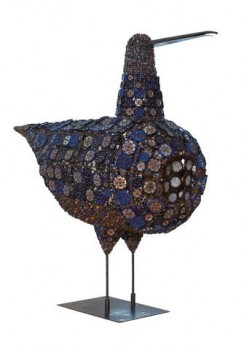
Bead-covered curlew, 1960. Height ca. 115 cm, Collection Kakkonen. Photo: Niclas Warius
Harri Kalha:
Birger Kaipiainen
Helsinki: Suomalaisen Kirjallisuuden Seura (The Finnish Literature Society), 2013. 249 p., ill.
(Summaries in Swedish and English)
ISBN 978-952-222-457-6
€46, hardback
Ceramics confectioner. Degenerate aristocrat. Ornamental criminal. These epithets can be found in Birger Kaipiainen, a new, full-length study of the ceramic artist by art historian Harri Kalha.
Throughout his artistic career Birger Kaipiainen (1915–1988) worked with forms, subjects and methods that were unfamiliar in the field of traditional ceramics, at least in mid-20th-century Finland, and made use of fantasy and ornament. As a ‘porcelain painter’ he showed little interest in the technical challenges of clay – although in his ceramic creations Kaipiainen explored three-dimensional form, montage, colour, texture and the tactile dimensions of the medium. More…
Howl came upon Mr Boo
31 December 1983 | Archives online, Children's books, Drama, Fiction
The first Mr Boo book was published in 1973. Mr Boo has also made his appearance on stage this year; his theatrical companions are the children Mike and Jenny, who are not easily frightened – Mr Boo’s courage is a different matter, as can be seen in the extract from the stage play that follows overleaf.
Hannu Mäkelä describes the birth of Mr Boo:
To be honest, Mr Boo has long been my other self. The first time I drew a character who looked like him, without naming it Boo, I was really thinking of my fifteen year-old self.
The years went by and the Mr Boo drawing was forgotten for a time. It hadn’t occurred to me to write for children; I seemed to have enough to do coping with myself. Then I met Mr Boo, whom I had not yet linked up with my old drawing. My son was about six years old and we had been invited out. There were several children present. As I recall it it was a wet Sunday afternoon. I had entrenched myself with the other grown-ups in the kitchen to drink beer. The noise of the children grew worse and worse (in other words they were enjoying themselves). At last the women could bear it no longer and demanded that I, too, get to work. Really, what right had I always to be sprawled at a table with a beer glass in my hand? None. So I rose and went into the sitting-room. I shouted at the children to form a circle around me. At that time I had a motto: ‘Mäkelä – friend to children and dogs’. The reverse was true of course. The name Mr Boo occurred to me, probably as a result of some obscure private (and possibly even erotic) pun and I begun to tell a story about him. In telling it I paused dramatically and accelerated just as primary school teachers are taught to do: that part of my training, after all, wasn’t wasted. I was astonished; the children listened in complete silence. And if my memory doesn’t fail me (or even if it does, this is the way I wish to remember it), at the end of the story the smallest of the children said, rolling his r’s awkwardly, ‘Hurrrrah’. I was hooked.
The children themselves asked me to tell the same stories again. They still enjoyed them. It wasn’t long before I began to think seriously of writing a whole book about Mr Boo. For the first time in my life I really wanted to write for children. Every day after work I wrote a new Mr Boo story. Then in the evening I read it to my son. That is how the stories grew into a book.
The child likes right to triumph; he likes the good and the moral. The child is the kind of person we adults try in vain to be. It was only through Mr Boo that I began to see children in a totally new way and above all to become seriously interested in them.
One-night stand: an interview with publisher Leevi Lehto
17 September 2010 | Interviews
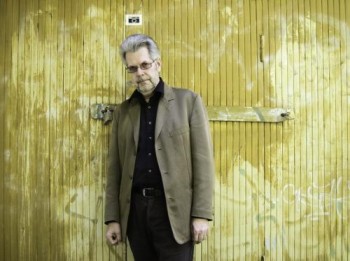
Leevi Lehto. Photo: Lotta Djupsund/Savukeidas
Founded by poet Leevi Lehto, ntamo is seen by many as the black sheep and enfant terrible of the world of Finnish publishing.
From its inception, ntamo (shortened from the word kustantamo, publishing company) has striven to subvert the familiar conservative models of publishing that audiences are used to.
Ntamo publishes books for small circulation, such as poetry and experimental prose. Its catalogue includes works both by celebrated writers, such as Kari Aronpuro, and by a whole host of authors making their literary debuts.
Lehto’s objective has been to publish as many books as possible, using a system of print on demand, and to have as little to do with the books’ content as possible. What’s more, ntamo’s publications are not marketed at all. Readers can find information on new publications by following the publisher’s blog [in Finnish only]. I met up with Lehto a while ago and we discussed ntamo’s current situation, new trends in the publishing world and the future of books and literature in general. More…
Girl-embryos
30 December 2003 | Authors, Reviews

Photo: Irmeli Jung
Stanza is, of course, Italian for ‘room’, and Saila Susiluoto’s second volume, Huoneiden kirja, is a book of rooms. The 17th-century English poet John Donne said: ‘We’ll build in sonnets pretty rooms’; Susiluoto’s poems are prose poems, not sonnets – but imaginary rooms with real feelings in them. They’re not pretty either, but beautiful, furnished with lyrical echoes, echoing with experience.
The protagonist is a girl, but there are many other personae, women, men, children: ‘Sorrow’s walked through me in the shape of people.’ The personae think there are many ways to walk through things, or towards them. They follow the signs they find on their way – from the ground floor (partly underground) of a draughty house up to the sixth floor (fifth in English), which also floats.
Behind the shining mirror twin girls are squealing, they disappeared inside the walls long ago… Inside us there are two hundred girl-embryos, the girls shout….
The girls are hand-made: fashioned by themselves – ‘like us’ – ‘out of pearls, blood, splinters of mirror’. More…
Like it, or else
23 January 2014 | Non-fiction, Tales of a journalist

Illustration: Joonas Väänänen
Hitting the ‘like’ button is not only boring but also working its way from Facebook deeper into society, says Jyrki Lehtola. Surely there must be some other way of solving the world’s problems?
At the end of the autumn the theatre critic of the Helsingin Sanomat newspaper panned Sofi Oksanen’s stage adaptation of her novel Kun kyyhkyset katosivat (‘When the doves disappeared’, 2013).
That’s life. Artists struggle with their projects, sometimes for years. Then a critic takes a glance at the result and crushes it in a matter of hours.
Then there’s a huff about unfairness, the use of power and all the things artists blow off steam about when they feel that their creations have been treated unfairly. The debate is held between injured authors and sometimes the critic, but generally few others participate, and just as well. More…
A slow passion
30 September 2007 | Fiction, Prose
A short story from the collection of short stories Hidas intohimo (‘A slow passion’, Gummerus, 2007)
I don’t want to interfere with it. If something comes of it, then something comes of it. You can’t interfere with time, or fate, or another person. Time ripens things on its own. Fate takes a longer view of things than people do. Like the prophet says, there is a time for every purpose, for my purposes and other people’s.
This garden cottage is a good place to watch everything quietly, a ringside seat for someone who doesn’t want to flail around getting smashed up. The potatoes bloom when it’s time for them to bloom, depending on the length of the summer, the weather, and the time they were planted. Their white and purple flowers are worthy of admiration– potato flowers are flowers, after all. But when the flowers are just opening, it’s not yet time to go digging around among the roots. You have to restrain yourself and wait until the tubers form. You have to wait until they’re finished blooming and the flowers are replaced by plumping green, poisonous berries – though not all potato varieties produce them. But if your fingers are really itching for them, you can poke into the dirt and grope around a little before it’s really time, feel for tubers and remove them carefully, patiently, leaving the plant undisturbed for the smaller ones to grow. If the groping turns up something, you can slip away and savour it, but you still have to wait before you can dig up the whole plant with its rootstock, its beautiful pure tubers heaved up onto the soil, as if Life were offering itself on a silver salver. Then you can have them. They’re ready. But it takes time. Many good things are destroyed by impatience. More…
A thankless task?
24 November 2011 | Letter from the Editors
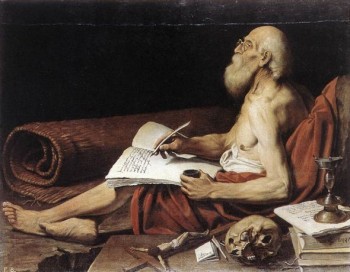
Translator at work: St Jerome, translator of the Latin Bible in the late 4th century, is the patron saint of translators and librarians. Leonello Spada's 1610s painting, Galleria Nazionale d'Arte Antica, Rome. Picture: Wikimedia
Why translate, asked the late Herbert Lomas thirty years ago in an issue of Books from Finland (1/82) – the pay’s absurd, one’s own writing suffers from lack of time, it’s very hard to please people. And public demand for translation from minor languages into English was almost non-existent.
But he also admitted that translating is generally a pleasurable experience: ‘You have the pleasure of writing without the agony of primary invention. It’s like reading, only more so. It’s like writing, only less so.’ More…
What does the neighbour think?
26 April 2013 | Essays, Non-fiction
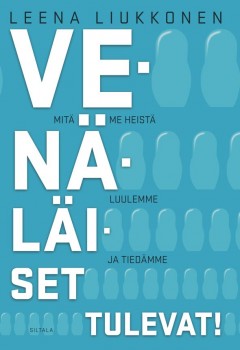 For more than 20 years journalist Leena Liukkonen has been thoroughly involved with Russian culture, commerce, language and psyche. The subtitle of her new book of essays Venäläiset tulevat! (‘The Russians are coming!’) is ‘What we think and know about them’, and refers to the fact that the Finns do not really know their eastern neighbours very well. Liukkonen writes with insight about the differences in history, mentality and world view
Extracts (under original subtitles) from Venäläiset tulevat! Mitä me heistä luulemme ja tiedämme (Siltala, 2013)
WAR, REMEMBERING AND FORGETTING
In café conversations with other visitors to Russia, we often react with exasperation to the fact that discussions in Finland only ever start with the Winter War. Sometimes we wonder why the threshold between us and our neighbour to the east is still so high. My own living contact with the past, however, makes it clear to me that everything the elderly carry round with them could not have been simply shaken off with the passage of time. Nor can the next generation just break away from it. My own experience also reminds me how distant our eastern neighbour was during peacetime. After all, a very few have made the long journey to the country next door. To many people, the old story was the only story there was about Russia. More…
Hearth, home – and writing
30 December 2007 | Archives online, Extracts, Non-fiction
Extracts from Fredrika Runeberg’s Min pennas saga, (‘The story of my pen’, ca. 1869–1877). Introduction by Merete Mazzarella
The joy and happiness I experience at being able to see into [her husband] Runeberg’s soul, at living with him in his heart and his thoughts, belong far too firmly to the mysteries of my soul that I should wish to attempt to express them in words. But of the life that existed around us I should like to try and give an impression of sorts.
We moved to Borgå in 1837. I was unfamiliar with the town and knew only a little old lady, weak with age, and found myself very lonely indeed, accustomed as I was to living with relatives and a genial circle of friends. I did, however, still have my two eldest sons at home to keep me happy and occupied. More…
If grief smoked
31 March 1989 | Archives online, Fiction, poetry
Poems from six collections of poetry. Introduction by Herbert Lomas
The City
How the houses have ascended in this city,
the abysses deepened, the water blackened,
soon to be creeping along the streets.
The railings are rusting through,
the water table’s rising,
the cellars are slopping.
Fear is rising, or being covered up
behind strangling discretion,
outbreaks of crime.
The best thing
30 September 2004 | Fiction, poetry
Poems from Valekuun reitti (‘The path of the false moon’, WSOY, 2004). Introduction by Herbert Lomas
At first light I put my hand
     in the hollow of a white willow –
once someone's cigarette box
had been left there –
     now a bird flew out
going seaward.
Touch of a wingquill on the back of my hand.
     It flew higher.
          In the evening
I felt its touch on my shoulder blade.