

Search results for "tommi+musturi/2010/05/song-without-words/2009/09/what-god-said"
Hare-raising
13 February 2015 | Reviews
In this job, it’s a heart-lifting moment when you spot a new Finnish novel diplayed in prime position on a London bookshop table – and we’ve seen Tuomas Kyrö’s The Beggar & The Hare in not just one bookshop, but many. Popular among booksellers, then – and we’re guessing, readers – the book nevertheless seems in general to have remained beneath the radar of the critics and can therefore be termed a real word-of-mouth success. Kyrö (born 1974), a writer and cartoonist, is the author of the wildly popular Mielensäpahoittaja (‘Taking umbridge’) novels, about an 80-year-old curmudgeon who grumbles about practically everything. His new book – a story about a man and his rabbit, a satire of contemporary Finland – seems to found a warm welcome in Britain. Stephen Chan dissects its charm
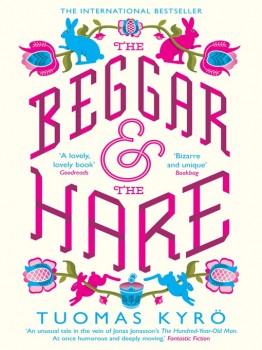 Tuomas Kyrö: The Beggar & The Hare
(translated by David McDuff. London: Short Books, 2011)
Kerjäläinen ja jänis (Helsinki: Siltala, 2011)
For someone who is not Finnish, but who has had a love affair with the country – not its beauties but its idiosyncratic masochisms; its melancholia and its perpetual silences; its concocted mythologies and histories; its one great composer, Sibelius, and its one great architect, Aalto; and the fact that Sibelius’s Finlandia, written for a country of snow and frozen lakes, should become the national anthem of the doomed state of Biafra, with thousands of doomed soldiers marching to its strains under the African sun – this book and its idiots and idiocies seemed to sum up everything about a country that can be profoundly moving, and profoundly stupid.
It’s an idiot book; its closest cousin is Voltaire’s Candide (1759). But, whereas Candide was both a comedic satire and a critique of the German philosopher and mathematician Gottfried Wilhelm Leibniz (1646-1716), The Beggar & The Hare is merely an insider’s self-satire. Someone who has not spent time in Finland would have no idea how to imagine the events of this book. Candide, too, deployed a foil for its eponymous hero, and that was Pangloss, the philosopher Leibniz himself in thin disguise. Together they traverse alien geographies and cultures, each given dimension by the other. More…
Virtual realities
30 September 1993 | Archives online, Fiction, Prose
Prose pieces from Bamalama (WSOY, 1993)
After eating his family, he went abroad. There was a heatwave in Torremolinos. The sandy beaches were empty despite the Mediterranean waves’ enticing glitter. Although it was so hot, not a trace of the sun could be seen in the sky, and no clouds either. He sat in an armchair in his modest hotel room and breathed deeply. He thought about the pretty young girls on the beaches just waiting to be casually plucked, bony adolescent bodies, opulent and luscious adult female forms, and lips beyond all powers of description. He sat there, and time passed. Soon darkness spread over the beach, and he could see nothing but velvety black nothingness stretching out to the horizon. He was overcome by a powerful sense of fear, caused by the bleak desolation of the scene, this gloomy darkness that covered and hid the millions of shades of natural colors. He accepted his feelings and let them flow into himself, because he knew that morning, sunrise, and the play of nature’s colors down there on the beach boulevards, would resuscitate within him a great dreamer, impervious to the storms of the world. More…
Out of my hands
10 November 2011 | Articles, Non-fiction
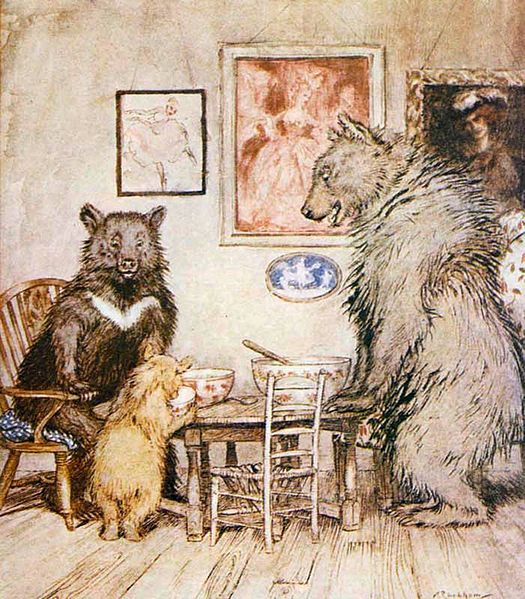
Who's been eating my porridge? From ‘English Fairy Tales’ by Flora Annie Steel (1918), illustrated by Arthur Rackham. The Project Gutenberg e-Book
In the classic fairy-tale, on finding their belongings were not as they had left them, the three bears exclaimed: ‘Who’s been eating my porridge?’ When our technology correspondent Teemu Manninen found someone else’s underlinings in the electronic text he was reading, he wondered: ‘Who’s been tampering with my ebook?’ Which led him to ponder how similar books and their virtual counterparts really are – and could his ebook really be called ‘his’?
A few months ago I was reading an ebook on my iPad when I came across an underlined passage. For a moment I felt strangely disturbed. My initial thought was that I had not made the underlining, and therefore this had to be a glitch, an error in the computer program that was the book, which meant that there was something wrong with my book. What made this thought disturbing was the realisation that the kinds of harm that can befall digital books – and the measures that one can take to prevent them – are no longer ‘in my hands’: that the book is no longer physical, but virtual. More…
Getting by
18 May 2012 | Non-fiction, Reviews
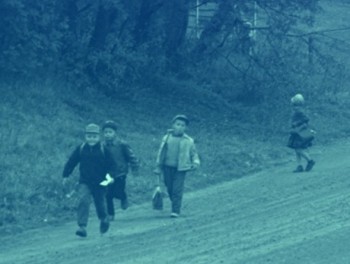
To school: children on the march – no buses or taxis in the Finnish countryside after the war. Photo: the cover of Kauaksi kotoa
Kauaksi kotoa. Muutoksen sukupolvi kertoo
[Far from home. Stories of the change generation]
Toim. [Ed. by] Anja Salokannel & Kaija Valkonen
Helsinki: Kirjapaja, 2012. 320 p.
ISBN 978-952-247-291-5
€32.90, hardback
The post-war period in Finland was a time of hope and reconstruction, of procreation and tough, grey heroism. Finland picked itself up by the bootstraps, as fathers who had been ‘driven mad in the war’, who took to drink or spat blood because they had shrapnel in their lungs, built veterans’ houses around the small towns and cleared fields in the backwoods. More than 83,000 men were killed in the wars (Winter War 1939–1940, Continuation War 1941–1944).
Mothers worked like men. The baby boomers – the demographic peak which consists of those born between the war years and 1950 (in 1946–1949 more than 100,000 babies were born each year, compared to some 60,000 in 2011) – had to be fed and clothed and educated for a better and more prosperous future.
Now the baby boomers have started to retire. Editors Anja Salokannel and Kaija Valkonen (baby boomers themselves) have compiled the book Kauaksi kotoa. Muutoksen sukupolvi kertoo (‘A long way from home. Stories of the change generation’), in which 21 men and women talk about their lives during the decades of change. More…
Writers meet again in Lahti
14 May 2009 | In the news
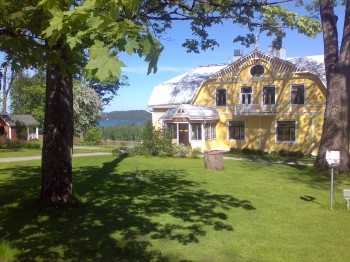
In other words: LIWRE at Messilä Manor
The Lahti International Writers’ Reunion (LIWRE; www.liwre.fi) will be held this year between 14 and 16 June.
In the politically and culturally active 1960s, marked by the confrontation between East and West, an idea was born to found an international, bi-annual rendezvous where writers from all over the world could freely engage in discussions on various themes.
Breadcrumbs and elephants
27 March 2014 | Essays, On writing and not writing
In this series, Finnish authors ponder the pros and cons of their profession. Alexandra Salmela operates in two languages, her native Slovakian and Finnish, which has become her literary language. Adventure and torture alternate as she attempts to shape reality into writing
I had started to write before I knew how. With fat wax crayons, in big stick-letters, I scratched my stories in old diaries. There were lots of pictures. From the very beginning, I wrote both poetry and prose. At 11 I didn’t finish my great sea-adventure novel, but at 12 I was already writing my memoirs. They, too, somehow remained unfinished.
Writing is… I wanted to write fun, but in the end I’m not quite sure about that. Writing is adventure and liberation and terribly hard work. Torture of the imagination and the pale copying of real events. Reading is a way to escape reality and at the same time a route to the sources of reality. By writing, you can shape reality in your own image: it’s your own character fault if the result is ugly and depressing.
If I were to write a pink world, it would be so sugary that it would make everyone sick, me and other people. More…
Beyond good and evil?
30 June 1987 | Archives online, Authors, Interviews
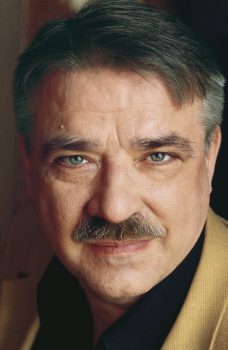
Esa Sariola. Kuva Irmeli Jung
Markku Huotari interviews Esa Sariola
A stylish restaurant in the Stock Exchange building in Helsinki. Esa Sariola and I order a businessmen’s lunch. We talk about hard-nosed success stories. About technocracy, casino economics.
About profit.
A steely-eyed businessman enters the room from the stock exchange and sees us two soft-talkers, even if we look like men, wasting time. The ruthless gambler bolts down his lunch and disappears to the upper floor again, where he is making money.
We remain.
We’re just talking.
And there’s no money accruing in our wallets.
All the same we have a grip on that investor. Esa Sariola has already laid siege to people like him in three books: Väärinkäsityksiä (‘Misconceptions’, 1983), a collection of short stories, and two novels: Rakas ystävä (‘Dear friend’, 1985) and Kuolemaani saakka (‘Until my dying day’, 1986). More…
Suddenly here, fully present
5 April 2011 | Fiction, poetry
The women in mirrors who recur in the work of Aila Meriluoto (born 1924) are poetic figures who have featured in her poetry since her first collection, published in 1946. In these new poems, from Tämä täyteys, tämä paino (‘This fullness, this weight’), she also describes women who are ‘alive to the brim’ or ‘extreme ballerinas’. Introduction by Mervi Kantokorpi
We live in strange times
my skull full of echoes.
The rose has throbbed
the heart flowered.
In the mirror a girl on her head,
from the wall steps an old woman,
all of them familiar,
none remembered.
Suddenly here.
Fully present.
Eighty-five years.
Hands wrinkled, shaky legs.
And alive to the brim.
And over. Dripping.
Surging. More…
The height of the night
15 October 2009 | Letter from the Editors
 The autumnal equinox is past; and as we tilt towards the winter solstice, here in these northerly latitudes, the darkness expands palpably from day to day, giving more space for introspection – high on the list of Finnish national pastimes – and for reading.
We want to make our website primarily a place for reading – not, in other words, for clicking, going on to the next thing. To think to the end what cannot be thought to the end elsewhere, as the Russian poet Osip Mandelstam said of his experience of staying in what was, at the turn of the 20th century, still Finnish Karelia. So you will not find our texts littered with links; for the most part, links appear at the end of a piece, not in it. More…
A personal appreciation
31 December 1982 | Archives online, Authors
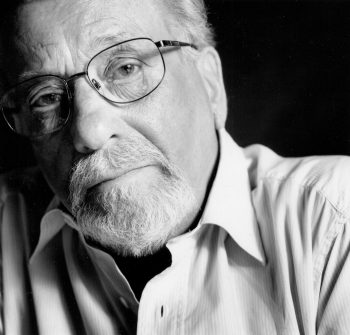
Christer Kihlman. Photo: Magnus Weckström
Almost twenty years ago, a book arrived on my table from a London publisher, a large book called Den blå modern, by someone called Christer Kihlman, of whom I had never heard. Although the book came from Stockholm, in fact it turned out to be the work of a Finland-Swedish writer, perhaps the second or third I had ever read.
The book was to me remarkable. I had never read anything quite like it before, and I have been reading adult fiction for over fifty years. Looking back now in my ancient tatty files, I see I typed three single-spaced pages of synopsis and two and a half of comment, and even translated several extracts, not something I can normally afford to do. This was partly because I was impressed with the book, partly because it was almost impossible to explain the style, or styles, in which it was written, and also it was very difficult to say succinctly just what kind of book it was. The blurb called it a ‘family chronicle’, which in a way it was, but in all other respects it was nothing like what we normally call a family chronicle, anyhow of the kind so familiar from the United States. Two sons trying to live up to their father’s image of a third son, who is dead; but in fact it seemed to me to be the story of one man’s struggle with himself and the agony of existing in a world in which pain and hatred and suffering and despair are constantly victorious over love. In the book was almost everything any thinking person struggles with in his or her mind during a whole lifetime, a search for some kind of meaning in a life that appears meaningless. More…
Picture this
9 April 2015 | Articles
It’s impossible to put Finnish graphic novels into one bottle and glue a clear label on to the outside, writes Heikki Jokinen. Finnish graphic novels are too varied in both graphics and narrative – what unites them is their individuality. Here is a selection of the Finnish graphic novels published in 2014
Graphic novels are a combination of image and word in which both carry the story. Their importance can vary very freely. Sometimes the narrative may progress through the force of words alone, sometimes through pictures. The image can be used in very different ways, and that is exactly what Finnish artists do.
In many countries graphic novels share some common style or mainstream in which artists aim to place themselves. In recent years an autobiographical approach has been popular all over the worlds in graphic novels as well as many other art forms. This may sometimes have led to a narrowing of content as the perspective concentrates on one person’s experience. Often the visual form has been felt to be less important, and clearly subservient to the text. This, in turn, has sometimes even led to deliberately clumsy graphic expression.
This is not the case in Finland: graphic diversity lies at the heart of Finnish graphic novels. Appreciation of a fluent line and competent drawing is high. The content of the work embraces everything possible between earth and sky.
Finnish graphic novels are indeed surprisingly well-known and respected internationally precisely for the diversity of their content and their visual mastery.
Life on the block
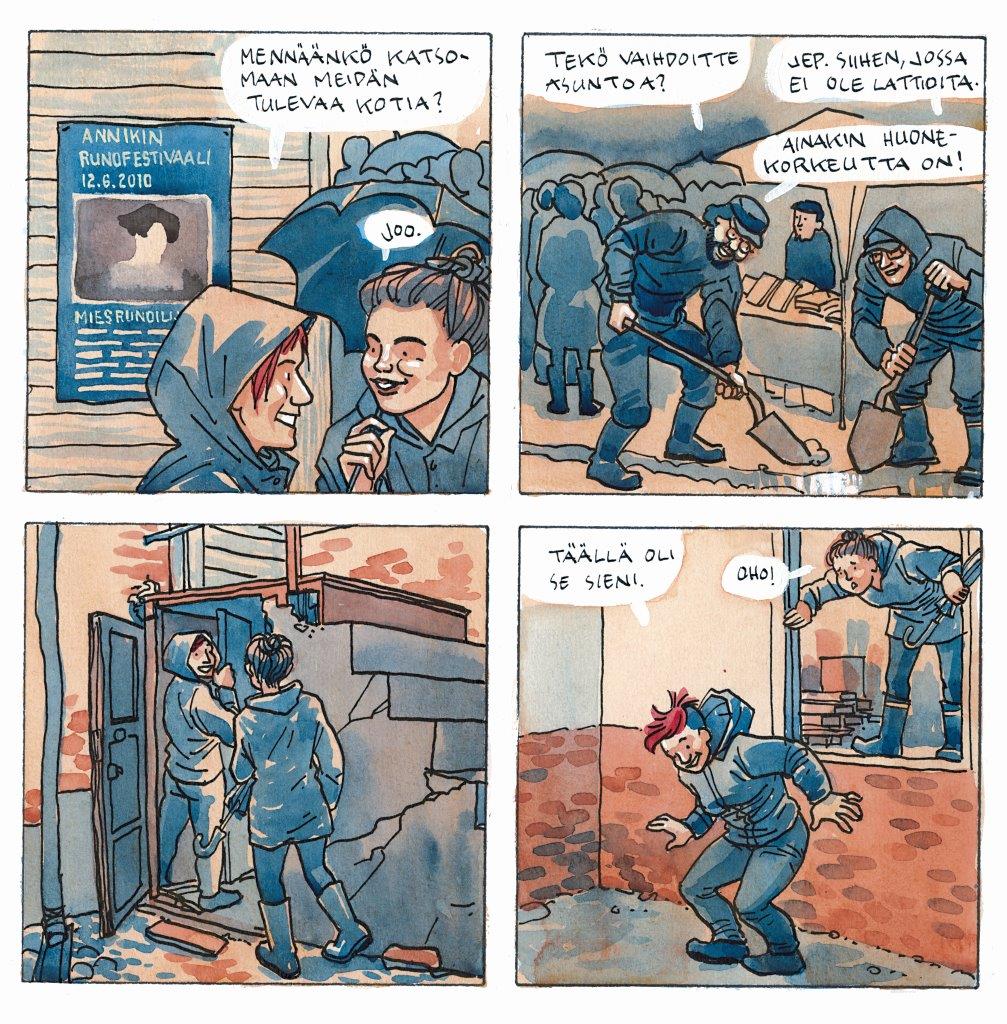
‘Shall we go and look at our new house? / Yeah. / Did you move house? / Yeah, to one without a floor. / At least you have head-space! / This is where the mould was. / Oh dear!’. Tiitu Takalo, Minä, Mikko ja Annikki (‘Me, Mikko and Annikki’, Suuri kurpitsa).