

Search results for "tommi+musturi/2010/05/song-without-words/2009/09/what-god-said"
Poetry written aloud
20 May 2011 | Reviews
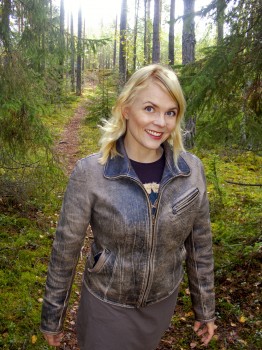
Heli Laaksonen. Photo: Otava/Irmeli Jung
In the 21st century, poetry written in various dialects has drawn new audiences to poetry readings. A common feature of, for example, Sinikka Nopola’s short prose about the family, written in the dialect of the Tampere area, and Heli Laaksonen’s poetry, which is written in the dialect of south-west Finland, is the enormous popularity of live performances by the authors. Their audiences love to hear them read in dialect, because the texts are funny, and they sound even funnier when read aloud.
Heli Laaksonen (born 1972) has, ever since her first collection, Pulu uis (‘Pigeon swimming’, 2000), been Finland’s best-selling poet. Her three collections and audio books have achieved sales figures that are astonishing in the Finnish context – tens of thousands of copies. Her fourth collection, Peippo vei (‘The chaffinch took it’, Otava, 2011), has been at the head of bookseller’s sales lists throughout March and April. More…
The trees
31 March 1998 | Archives online, Fiction, Prose
A short story from Sunnuntaina kahdelta (‘Sunday at two’, Otava, 1997)
Maisa enjoyed her trees without knowing their names, without ever counting how many of them there actually were. The trunks twisted together and then forked again, the branches wound round and stretched past each other, and the tapered leaves rustled in dark, wide fans. In the autumn, when the wind blew and the rain fell, the naked stand of trees flailed in a single damp movement, and in February the branches snapped and cracked invisibly under the snow like a promise that would be fulfilled before long.
Sometimes on summer evenings, when the boy was asleep, she listened to the birds fluttering among the shaded lower branches, to the shrews and field mice dashing between the trunks on their nocturnal journeys and the roots pushing deeper into the soil day by day. When she shut her eyes, she could see the sap pulsing under the bark, and her own arms and legs moved more lightly, her heart beat strongly, and her thoughts welled up. More…
In all honesty
18 September 2014 | Non-fiction, Tales of a journalist

Illustration: Joonas Väänänen
To puke or not to puke? Despite appearances, Jyrki Lehtola thinks there is too little truth on show on social media
I recall two brilliant articles that appeared years ago in Finland’s biggest gossip magazine.
In one of them, a vaguely famous radio host talked about his divorce and how badly he was doing since splitting from his wife. There’s nothing interesting or pioneering about this level of openness per se, but fortunately the magazine saw fit to depict the radio personality’s plight in a series of photos.
They published a photo story consisting of nine images showing him walking down the streets of Helsinki, until he suddenly recalls his divorce. More…
Ho-ho-no!
10 December 2010 | This 'n' that
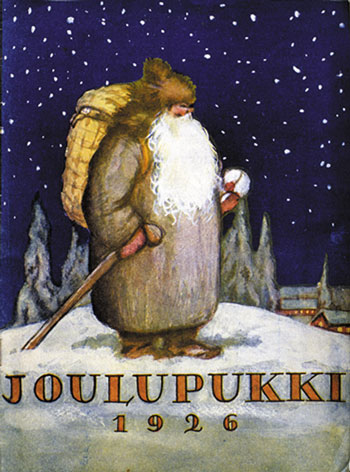
In the olden days: Father Christmas dressed in grey. A Christmas magazine illustration, 1926. Picture: Helsinki City Museum
St Nicholas, Father Christmas, Santa Claus? According to Finns, the benevolent, bearded, reindeer-driving, present-giving figure lives on Korvatunturi fell in Lapland (not at the North Pole, not anywhere else!).
In Finnish his name is Joulupukki, ‘Yule goat’ (or ‘buck’, Old English, bucca). Joulupukki developed from pagan traditions where his predecessor was a creature called Nuuttipukki, ‘Knut’s goat’, which referred to St Knut’s day, originally on 7 January.
The end of Christmas was celebrated by itinerant groups of people visiting houses playing for food and, in particular, booze. Leading them was the scary ‘Knut’s goat’ disguised in horns, a face mask and lambskins, frightening children. If he wasn’t given beer, he could steal the spigot from the beer barrel or beat people with a bunch of twigs.
This tradition was popular until the beginning of the 20th century, when the good Joulupukki replaced his old bad post-Christmas counterpart, shedding his horns and mask. However, when he came to people’s homes on Christmas Eve to bring presents, he still wore a fur coat, was heavily bearded and might still carry both twigs and gifts – so children had indeed better watch out how they behaved all year.
Naughty or nice? A new full-length Finnish film directed by Jalmari Helander entitled Rare Exports: A Christmas Tale was released internationally in early December.
In this Yuletide film the central figure of the mundane Christmas celebrations is not the red-dressed, jolly Santa we know, but ‘a sinister old codger who chews off ears and whose demon minion kidnaps innocent children. Ho ho no!’, as Jeannette Catsoulis reported in the New York Times.
‘Rare Exports is an enormously entertaining and unpredictable Yuletide romp packed with sly wit, solid scares and naked geriatrics,’ said Tom Huddleston of Time Out London.
Frank Lovece, in Film Journal International, wrote: ‘Some human and reindeer gore make this inappropriate for young children, as much as the movie’s boy-hero denouement may suggest otherwise. But for anyone who needs an inoculation of humbug to counter artificial sentiment, or who simply likes to smoke their Christmas cheer or put it in brownies, this off-kilter return to roots is a welcome gift.’
The plot involves a mysterious block of ice that has been unearthed in Lapland, sprouting a pair of horns. Children begin to disappear, reindeer are found killed. A ten-year-old boy finds out what’s happening, and he and his dad take up fighting back. ‘Wicked fun in the manner of a 21st century Grimm’s fairy-tale,’ said Chris Barsanti of filmcritic.com. ‘Exuberantly pagan images,’ wrote Jeannette Catsoulis.

Santa's place: 360° panorama from Korvatunturi, Lapland. Photo: Wikimedia/Panoramio
Well, Rare Exports was in fact filmed in Norway: Finnish fells are low and unimpressive in comparison to the higher Norwegian fells and mountains. Joulupukki’s home on Korvatunturi is particularly difficult to access, as the Russian border cuts through this formation of fells, which is also a part of a nature conservation area.
Santa’s red, fur-lined outfit is a comparatively recent invention, by the way: it became popular in the United States in an advertising campaign for Coca-Cola in 1931. By a trick of fate, though, the image was designed by one Haddon Sundblom who was of Finnish (Åland) origin.
So, what’s the truth about Joulupukki ? Could it be that an incarnation of the ancient horned shaman-like creature might still dwell in the depths of that faraway Lapland fell, and that the Coca-Cola man on whose lap your kid is sitting, listing his or her wishes, is just some commercial impostor?
Finlandia Prize for Non-Fiction 2012
5 December 2012 | In the news
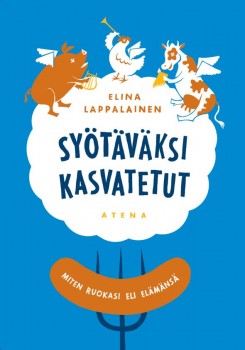 ‘It is one of the rules of quality journalism that writers aim for even-handed and impartial reporting, but at the same time challenge their respondents to account for their actions. Writers should also have the capacity for in-depth reporting and analysis,’ said Janne Virkkunen, former Editor-in-Chief of Helsingin Sanomat newspaper on 8 November, as he announced the winner of this year’s Finlandia Prize for Non-Fiction, worth €30,000.
The winner, Syötäväksi kasvatetut. Miten ruokasi eli elämänsä (‘Grown to be eaten. How your food lived its life’, Atena) by the young journalist Elina Lappalainen, is her first book.
‘The book could have fallen prey to the sensationalism of which we all probably have experience in the media, at least. This writer was able to avoid the temptation,’ Janne Virkkunen said.
The other works on the shortlist of six were as follows: Arabikevät (‘The Arab spring’, Avain), a study of spring 2011 in the Arab world by Lilly Korpiola and Hanna Nikkanen, Norsusta nautilukseen. Löytöretkiä eläinkuvituksen historiaan (‘From the elephant to the nautilus. Explorations into the illustration of animals’, John Nurminen Foundation) by Anto Leikola, Kevyt kosketus venäjän kieleen (‘A light touch to the Russian language’, Gaudeamus) by professor of Russian Arto Mustajoki, Karhun kainalossa. Suomen kylmä sota 1947–1990 (‘Under the arm of the Bear. Finland’s Cold War 1947–1990’, Otava) by Jukka Tarkka and Markkinat ja demokratia. Loppu enemmistön tyrannialle (‘Market and democracy. The end of the tyranny of the majority’, Otava) by banker Björn Wahlroos.
The dog
30 September 1992 | Archives online, Fiction, Prose
From the collection of short stories Matka Grönlannin halki (‘A journey across Greenland’, Tammi, 1992)
The water in this town tasted of shit. Unto swallowed a couple of mouthfuls, gargled the rest and spat it into the wash-basin. The taste of garlic and old booze disappeared and only a flavour of metal remained on his palate. Unto glanced at the mirror and began to fumble for a comb. The bags under his eyes were flushed.
He pulled a clean shirt from his suitcase, and suddenly remembered how Mervi smelt in bed. There was a stirring in his groin, and unconsciously Unto sniffed at his shirt-sleeve as he buttoned his cuffs. In front of the mirror, he straightened the hem of his cardigan, combed his moustache and drew a deep breath. He felt like some meat soup. More…
Sex, violence and horror, anyone?
20 September 2012 | Letter from the Editors
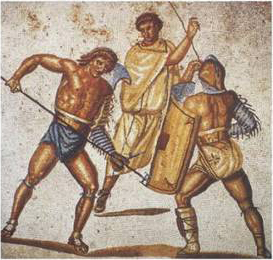
Gladiatorial entertainment: Mosaic from the Roman villa at Nennig (Germany), 2nd-3rd century AD. Picture: Wikipedia
In our last Letter, ‘Art for art’s sake’, we pondered how the efforts of making art (or design) profitable and exportable result, in public discourse, in the expectation that art (or design) should aid the development of business.
Not a lot is talked about how business can help art.
Art of course, is in essence ‘no use’, art doesn’t exist in order to increase the GDP (although nothing prevents it from doing so, of course).
The Finnish poet-author-translator Pentti Saarikoski (1937–1983) argued that art needs no apologies whatsoever: ‘What’s wrong with “Art for art’s sake”? – any more than bread for bread’s sake?
‘Art is art and bread is bread, and people need both if they are to have a balanced diet.’
Defining what is entertainment is and what is art is not always significant or necessary. The boundaries can be artificial, or superficial. But occasionally one wonders where the makers of ‘entertainment’ think it’s going. Entertainment for entertainment’s sake?
The Finnish Broadcasting Company (YLE) recently announced a new radio play series. It is, it said, a series that differs stylistically from traditional radio plays; it seeks a new and younger audience. The news item was headlined: ‘The new radio play drips with sex, violence and horror.’ In a television interview the director said that the radio dramaturge who had commissioned the series had described what the (new, younger) listeners should experience: ‘They should feel thrilled and horny all the time.’ More…
Hilda Husso
31 March 1980 | Archives online, Fiction, Prose
A short story from Kun on tunteet (‘When you have feelings’,1913). Introduction by Irmeli Niemi
A Phone call between Hotels
‘Hello – is that the Francesca?’
‘— — —’
‘I’d like to speak to Mr Aksel Lundqvist, the maître d’hotel, if it’s possible, please.’
‘— — —’
‘Oh, I see, that is Mr Lundqvist. I’m ringing from the Iris Hotel. It’s Hilda Husso here – do you remember me, Mr Lundqvist?’
‘— — —’
‘I used to be at Ekbom’s, as a cleaner, in the Brasserie, and I got pregnant – it was a boy, you may remember?’
‘— — —’
‘Hello, what was that, I can’t hear?’ More…
A dictionary of human destinies
31 March 2001 | Fiction, Prose
Short stories from Av blygsel blev Adele fet (‘It was embarrasment that made Adele fat’, Söderström & Co., 2000)
Adele
It was embarrassment that made Adele fat. It wasn’t from hunger that her fridge-fumbling fingers began to grow nimble, but from confusion. And it was never knowing what her tongue ought to say that led her to the concrete business of the fridge. Her tongue certainly knew all about tasting. It could feel her teeth chewing even if it didn’t know how to speak. It became a better and better judge of brussels sprouts and speckled sausage. The rest was just good morning and thanks, thanks and goodbye and nice day. More…
Face, book
23 June 2011 | Letter from the Editors
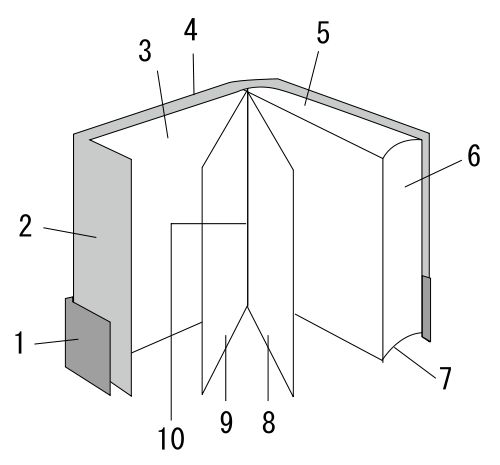
What are books made of? Picture: Wikipedia
‘The worst of all is if the writer forgets writing and starts turning out books.’
This thought is from the poet Vilja-Tuulia Huotarinen’s introductory talk at the Lahti International Writers’ Reunion (LIWRE), which took place at Messilä Manor between 19 and 22 June. ‘There’s too much talk of the stunting of the book’s lifespan and the economic life of the publishers,’ she continues. A writer ‘must not forget that he or she is responsible to the work of art, nobody else, not even the readers.’
Today, book publishers are responsible to capital and productivity, and a work of literature resembles a product with an invisible best-before marker. Is its life a couple of months, like ice cream? Books delivered to the shop in September are already old-hat in February, and are best put on sale. More…
Patsy, the artist of the lumber camps
31 December 1984 | Archives online, Fiction, Prose
A short story from Atomintutkija ja muita juttuja (1950). Introduction by Aarne Kinnunen
Deep in the wilds, where the only sound is the sad, primeval sighing of the forest, it is easy to succumb to a mood of boredom and melancholy. It may sometimes occur to you that in such a place you are wasting your life. Real life goes on elsewhere, in places with more people, more signs of human activity, more light, more gaiety…
You fell a tree, severing a string of that mighty instrument, the forest. You saw it into logs, you strip off the bark: it all seems dull and pointless. Sometimes the rain decides to go on for days: the trees have streaming colds, droplets hang from every needle-tip. You make for the shelter of a lumber camp. But the low-roofed rest-hut, deep in the forest, looks a dreary place, the well-known faces are so dull, the talk so futile. You feel you know in advance what each man is going to say. And the food, too, is just the same as usual, the same old rubbishy mush. The sight of the pot, with its blackened sides, gives no pleasure: you know all too well what is in it. And those grubby playing-cards, how disgusting! The mere sight of them is enough to make you feel defiled… More…