

Search results for "tommi+musturi/2010/05/song-without-words/2009/09/what-god-said"
The next generation
23 October 2009 | Columns, Tales of a journalist

Illustration: Joonas Väänänen
Truth will not out, and neither will humour, if things cannot be freely discussed in the media without fear of giving offence, argues Jyrki Lehtola
One September weekend I was in the city of Turku watching Finland’s first ‘comedy roast’ being taped before a live audience for a television pilot.
Roast is a tradition originating in the US. At its centre is a celebrity guest of honour, the roastee. One after another, well-known comedians take the stage and for several minutes make fun of the guest of honour, on the premise that no subject is out of bounds and the more sensitive the topic, the more arrogantly it must be raised to the fore.
The task of the guest of honour is to be able to laugh at him- or herself as well as at the comedians, and at the end to propose a counter-roast, i.e. insult the insulters. Easy targets like reality TV stars are not chosen but rather prominent figures with extensive careers to their name, people for whom the mockery contains the same mix of respect and warmth as a stag night roast. A roast is a language game in which the most important thing is that everyone, including the audience, understands and accepts the rules. More…
Skiing in Viipuri
31 March 1993 | Archives online, Fiction, Prose
An extract from Vanhempieni romaani (‘My parents’ story’, 1928–30). Introduction by Kai Laitinen
One of my earliest memories of my parents, Alexander and Elisabet, is a scene from early spring that must be located somewhere in the vicinity of Viipuri [Vyborg], in those distant times [the 1860s] when the young couple, having moved from St Petersburg, had lived for only a few years in Finland, where my father held the post of director of the topographical district.
I remember a glorious walk with my father and mother.
Alexander had his skis with him. Elisabet held us both by the hand, Kasper and me. We had come out to see Papa ski. Our other brother, Eerik, was still too small for such expeditions, and had been left at home.
Presumably Mama, too, saw downhill skiing for the first time on that occasion, and she was amazed to see how it was done, standing, with one foot on each ski.
Mama was wearing a tight half-length fur coat; on her head she had a brownish-grey fur hat whose top part was made of dark red velvet.
I remember the steep, snow-covered slope, which our cheerful mother good-humouredly helped us climb, carrying each of us in turn, from time to time setting us down in the deep snow, in which we sank up to our waists. In places the snow was so hard that we could run along it as if along the floor.
I remember that dazzling, bright slope as if it were yesterday. The snow glitters with sparkling brightness. One cannot keep one’s eyes open. The snow has a yellowish sheen, like the sun itself.
Papa is wearing a pale grey officer’s greatcoat with silver buttons; on his head is a dark military fur hat, and on his feet shining knee-boots. Now he pushes with his skisticks and sets off down the slope. His downhill speed is terrifying, even though he is standing up on his skis. On reaching the plain, he grows smaller and smaller, and, finally, is only a dot, far, far away. What a long time we had to wait before he came back to us!
Mama was greatly thrilled and amazed. But she was astonished that Papa dared stand up on his skis, when he could have sat.
To make the long wait shorter, Mother invented a game for us to play. She dug nests in the snow, and we crouched in them. She went behind a bushy juniper, hooked her fingers frighteningly in front of her face, and pretended to be a bear. We squealed and burrowed deeper into our nests. Growling, she crawled out from behind the juniper.
This was fun. We forgot Papa completely, and did not notice him until he was back on the slope. Once back at the top, he pointed his skis downhill again and shouted for Mama. He wanted her to stand on the skis behind him and hold on to the belt of his greatcoat, so that they could ski down the slope together.
Mother was full of laughter and panic. Covering her eyes with her hands, as if afraid even to contemplate such danger, she fairly squealed with terror. Papa had already put on his skis, and merely asked Mama to hurry up.
‘Ni za chto, ni za chto!’ cried Mama, waving her arms as if to protect herself. That meant that she would not for any price consent to such a reckless action. ‘No, no, no, no!’
Papa shook his head to try to make Mama ashamed of her cowardliness, saying, what will the boys think of having such a cowardly mother!
But this had no effect. She merely turned away, and a crease began to appear between Papa’s eyes, something that we boys always took note of, however far we were from him. And I think Mama would have noticed it, too, if she had not happened to be turned away.
‘Come on!’ said Papa, in a voice that made Mother glance at once toward him. And now, of course, she abandoned all her objections. She did as we would have done. Without showing any hesitation, she went bravely up to Papa, placed herself on the skis behind him and gripped the belt of his greatcoat.
And Papa said: ‘just hold on tight, and start to step with me, first with your left foot, then your right, one, two, one, two…’
Papa spoke in a decisive voice that one could not imagine anyone disobeying. And they began to move forward. We stood a little lower down and watched their descent. Papa speeded them onward, helping with both his sticks.
As they reached the slope and the skis began to slip forward under their own power, Mama’s head was hunched between her shoulders and her eyes were tightly shut. Clearly she was preparing to throw herself into the maw of the world’s greatest danger, come what may!
Excitedly, we watched the extraordinary spectacle. They sped past us at a furious speed. Papa and Mama together! Together for once, and skiing, which meant they were playing a game! We had never seen anything like it. At home they were nearly always in different places, one in the kitchen and by the beds, the other at the office and in his study, where we were not allowed to go when Papa was at home. But now they were skiing together, and even Papa could laugh, because this was a game! We were carried away with enthusiasm. Could there be anything more exciting or exhilarating! My chest swelled with joy, and I would have liked to shout and scream, for no reason, or to turn somersaults, over and over, head buried in the deepest snow.
But what was this?
Just as their speed was at its greatest and they were about to reach the plain, we saw them fall over. Their speed threw them apart. Mama spun around in the snow, with a flash of white underclothes. Papa stayed where he was, but he too had turned head over heels in the snow. And one of his skis ploughed far, far on, on to the plain.
Mama must have guessed that we were frightened, for she leaped up and started waving to us, cheerfully shouting, ‘Coo-ee!’, and began to hurry back towards us. Papa set out on one ski to fetch the other one. But even so, they arrived back at the top of the hill at the same time. Mama’s progress had been slowed by her excessive laughter. When he reached her, Papa had begun animatedly explaining something to her, and perhaps it was this that made her laugh, or perhaps the fact that the snow was so soft that she often sank into it up to her waist. At times she was so helpless with laughter that, on foot in the deep snow, she was forced to lean against the frozen snow-crust. This exasperated Papa, but that only made Mama find their fall even funnier.
When they reached the top of the hill, Mama could no longer make out, through her laughter, what Papa was trying to say to her. Then Papa turned to us, and we realised that he was not really angry at all. He only wanted to absolve himself from blame for the fall. He wanted to make it clear that Mama had been pulling him backward with all her strength. The faster they went, the more Mama had tried to slow them down, until in the end she pulled both of them over. We understood this explanation perfectly well, and both of us, with manly solidarity, took Papa’s side.
He started to demand that Mama should climb up on the skis again.
And, strange to say, Mama seemed quite happy to do so, as if she, too, thought it was fun.
But nothing came of it. Apparently one or other of her sons had, after all, been so frightened by the recent somersault that, as Mama climbed on to the skis once more, he burst into tears. And, to cheer him up, Mama began to amuse him. Began to pretend to scold and threaten Papa, and push him off his skis with one of the sticks. Papa, too, was inspired to make believe. As Mama poked him, he pretended to fall over in the snow. Then it was his turn to attack Mama. And now Mama seemed to fall over. But Mama got her own back, breaking off a branch of juniper and approaching Papa menacingly. Now Papa pretended to take flight. He skied off down the slope at speed, but made a sudden turn halfway and climbed up again. What an excellent skier he was!
This make-believe fight amused us so much that we almost split our sides with laughter. The funniest thing was to see Papa being frightened of Mama! Could there be anything more ridiculous: Papa running away from – Mama! Again I wanted to shout for joy and turn a somersault in the snow.
But most hilarious of all was to see them romping together in so unruly a fashion, pushing each other into the snow and wrestling each other off balance.
No other memory from those times has remained as bright and clear to the last detail as this apparently insignificant scene. And yet it casts light on the blackest darkness of succeeding years, a completely solitary memory, as if it had gathered all light to itself, and extinguished all other sources with its brilliance.
Why should one particular memory outshine all others and become the most important experience of childhood? With the best will in the world, I cannot understand why it alone, and no other, engraved itself on my memory. In order to explain something in the future?
I cannot think other than that the memory has survived because of the unforgettable feeling of joy that was awakened in us by my parents drawing companionably closer in their unruly games.
Other parents too, if they knew how such a sight would delight their children, might play together more often.
Translated by Hildi Hawkins
Too beautiful
2 July 2009 | Extracts, Non-fiction
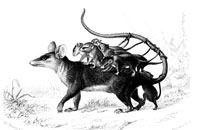
Illustration: The Universal Dictionary of Natural History (Paris, 1849)
Extracts from the collection of essays Kutistuva turska ja muita evoluution ihmeitä (‘The shrinking cod and other evolutionary marvels’) by Hanna Kokko & Katja Bargum
Who cannot but stand in awe of the genius of various parasites’ nervous system manipulations or of how beautifully the orchid ensures its pollination? The astonishingly precise adaptations of organisms are the starting point for the idea of Intelligent Design. According to Intelligent Design, such adaptations are too perfect to be products of evolution – rather, they reveal the actions of an intelligent designer. It’s a fascinating idea, write Hanna Kokko and Katja Bargum – but is it science? More…
National treasures
7 April 2011 | This 'n' that
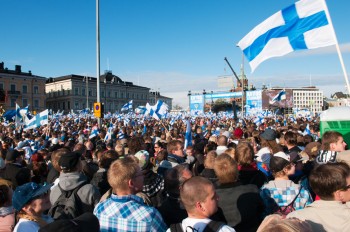
The name of the game: ice hockey. Photo: Jaakko Oksa
In Japan, artists or craftsmen of the highest quality may be honoured with the title ‘Living National Treasure’. In Finland, it seems only ice hockey players are eligible for that title, if you ask the man on the street, as ice hockey seems to be Finland’s ‘national’ sport.
(For example another ice team sport, synchronised skating, doesn’t compete in the same national treasure series, despite the fact that the Finnish team won the gold – again – in the World Championships in April. [Finland has won gold six times, Sweden five.] No national flag-waving resulted. But of course they are just women, who don’t win sports wars against other nations.)
On Sunday, 15 May, a dream came true at last, as Finland won the gold medal at the Ice Hockey World Tournament. And what’s more, it was Sweden – neighbour and old colonial overlord – they beat (6–1).
As the victorious team, escorted by a Hornet fighter from the Finnish air force, returned from Bratislava to Helsinki on Monday night, some 100,000 people crowded the capital’s Market Square to celebrate. The team and a selection of pop musicians climbed up on a stage to start the party – and President Tarja Halonen also popped in, from her presidential palace by the Square, to congratulate.
When’s the last time when 100,000 Finns gathered anywhere? Perhaps in 1995, when Finland first won the same title? See the series of photographs on the Internet pages of the Swedish paper Aftonbladet, particularly a shot of Helsinki harbour taken with a fish-eye lens.
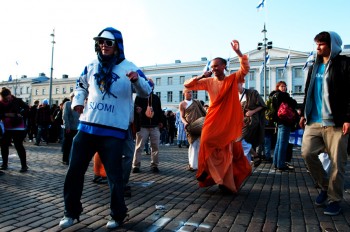
All together now! Photo: Jaakko Oksa
Sweden has been a much more successful hockey country than Finland, but it’s clearly tough to be a good loser. As the rivalry – in sports in particular – between Sweden and Finland is traditionally a larger-than-life issue, the Swedish newspapers and their readers displayed a highly amusing spectrum of opinions. ‘Kul att dom får fira något. Dom bor ju trots allt i Finland’ (‘Great that they have something to celebrate. After all, they live in Finland’), said one reader sourly.
And celebrate they did. One of the coaches stumbled and fell on his face on the red carpet on landing in Helsinki, and before you could say oops, he ended up on the YouTube accompanied by extracts from the final match television coverage by the celebrity sports commentator Antero Mertaranta.
Sportsmen and -women are supposed to be positive role models for young people, but as some of the team members clearly seemed to enjoy something stronger than sports drinks on the Market Square, they have been reproached for this behaviour by many people – spoilsports?
The coach of the Finnish national team, Jukka Jalonen, said in an interview that he could not condemn the use of alcohol in celebrating a ‘rare achievement’ like this, as ‘children and young people surely understand that adults may sometimes get drunk. Many of them have seen their parents sloshed.’
Well, if we assume it’s OK to be drunk in front of your children, it is no wonder that younger and younger children start drinking – which, however, is not considered OK, not by anyone. Can someone explain this?
In memoriam Anselm Hollo 1934–2013
1 February 2013 | In the news
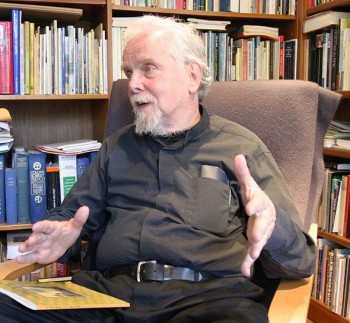
Anselm Hollo. Photo: Gloria Graham; taken during the video taping of Add-Verse, 2005. (Wikipedia)
Poet and translator Anselm Hollo died in Boulder, Colorado, on 29 January, at the age of 78. His father, Professor J.A. Hollo, translated literature from 14 languages. Anselm, born in Helsinki in 1934, worked with languages all his life, translating from Finnish, English, German, Swedish and French.
In the 1950s he lived in Germany and Austria, and then moved to England to work for the BBC. He published his first collection of poems, Sateiden välillä (‘Between rains ’), in Finnish in 1956. He once said that as a poet he ‘makes things in and out of language’.
In the late 1960s Anselm moved to the United States, where he was to write more than 30 books in English. He was a Professor of Writing and Poetics at Naropa University in Boulder, where he lived with his second wife, the visual artist Jane Dalrymple-Hollo. His own poetry is influenced by the 1950s and 1960s Beat Generation, among whom he had several personal friends; he translated Allen Ginsberg and Robert Creeley into Finnish – as well as the two books of poetry by John Lennon.
His last work remains Guests of Space (Coffee House Press, 2007). Notes on the Possibilities and Attractions of Existence: New and Selected Poems 1965–2000 received the San Francisco Poetry Center’s Book Award for 2001. His collection Corvus (2002) was also published in Finland, translated by Kai Nieminen. Among the many literary prizes he received was the Finnish Government Prize for the Translation of Finnish Literature in 1996.
Among his best-known translations of Finnish poetry are poems by Pentti Saarikoski (1937–1983) and Paavo Haavikko (1931–2008), whose work he also translated into German. For many years he served as a member of the literary advisory board of Books from Finland, and translated new work by, for example, Lassi Nummi, Jarkko Laine, Rosa Liksom, Leena Krohn and Riina Katajavuori.
During Anselm and Jane’s visits to Finland it was always enjoyable to talk about literature, art, new books and translation over a glass of wine. Anselm rarely, if ever, said no to requests to translate something: he remained sincerely interested in his native language and the ways it was used for creating fiction. We miss a jovial friend and an exceptionally skilful man of letters.

i.m. Hannes Hollo, 1959–1999
by Anselm Hollo
(Hannes Hollo was his son from the first marriage with poet Josephine Clare)
Fought the hungry ghosts here on Earth
‘What is man?’ asked the King
Alcuin’s reply: ‘A guest of space.’ And time yes time:
The past lies before us, the future comes up from behind
Walking on Primrose Hill or Isle of Wight beaches
Iowa City streets scrambling up snow-covered deer track
To Doc Holliday’s grave in Glenwood Springs
His helmet now shall make a hive for bees
He fought the hungry ghosts here on Earth
Strong & resourceful on his best days,
Patient kind and presente
Returning those with him to here & now
But just as we settle in with our Pepsi and popcorn
THE END rolls up too soon always too soon
(Anselm reads the poem here)
Aphorisms
31 December 1986 | Archives online, Fiction, Prose
Aphorisms from Pahojen henkien historia (‘A history of evil spirits’, 1986). Markku Envall’s essay on aphorism
Do not set out in the wrong mood, at the wrong moment, for the wrong place.
Learn to distinguish these from one another, for it is an impossible task.
Do not admit to changes in yourself, say rather that your associates vary.
And that your relationships are changeable. But do not say this of yourself.
Not knowing a person should not be regarded as sufficient reason for not making his acquaintance. More…
The Blinking Doll
30 June 1988 | Archives online, Fiction, Prose
A short story from Metsästys joulun alla (‘The hunt before Christmas’, 1982). Introduction by Erkka Lehtola
There was a strong bond between Juutinen and Multikka: both their lives, from their beginnings, had been fragmented and scattered, lacking any solid, reliable points of support. Even their marriages had come and gone; they had left no residue worth remembering. As in the old parable, their lives resembled the trail a skier leaves in fresh snow in a blizzard: behind him, it disappears in a few moments without a trace, and ahead and on either side there is only pristine density and no one or nothing one might follow. More…
A brush with death
30 September 2000 | Archives online, Fiction, Prose
From the collection of short prose Hyväkuntoisena taivaaseen (‘Getting to heaven in good shape’, Tammi, 1999)
I had agreed to meet Death at the Assembly Rooms in the centre of Helsinki. Seldom has an interview made me feel so nervous beforehand. Luckily, this gave me a good reason to cancel an appointment with my dentist. (Although of course I know that in the end I shall have to go there myself.)
It is customary to regard Death as a man who is not affected by the whims of fashion. Thus it is surprising to hear that Death is particularly concerned about his public image. ‘In public, I am considered stern and unbending. Unchanging and therefore uncontrollable,’ Death thunders. ‘This is not at all accurate. Fortunately, people understand me better when I am at work. More…
And the winner is…?
27 March 2012 | This 'n' that
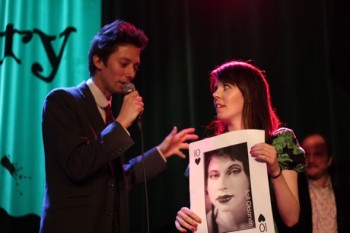
Playing your cards right: Todd Zuniga talks to Riikka Pulkkinen on 20 March in Helsinki. Photo: courtesy/T. Zuniga
The writer Johanna Sinisalo’s words lash the stage like the tail of Pessi the troll in her best-known novel. The novelist Riikka Pulkkinen bursts into deconstructive dance. The singer Anni Mattila translates the poet Teemu Manninen’s explosive poetic frolics into rhythmic dictations and the Finlandia Prize-winning author Rosa Liksom’s conductor’s glittering moustaches see the audience off on a train journey to Moscow.
On a March evening, a Literary Death Match has begun in the Korjaamo Culture Factory in Helsinki’s old tramsheds. The creation of the American author and journalist Todd Zuniga, the Literary Death Match combines an evening of readings with stand-up comedy as well as the judging familiar from reality TV shows.
‘It all started with me eating sushi with two of my friends and talking about some of the readings we’d been to. We all loved literature and loved to listen to writers reading from their own work. But the audience was always the same circle of people. We wanted to expand it beyond literary circles,’ Zuniga explains. More…
Music of the heart
30 December 2003 | Authors

Photo: Irmeli Jung
The short stories of Raija Siekkinen (1953–2004) – she very rarely wrote long fiction – are almost always about women. Something has happened, or is about to happen, vague, unspecified. The change is all-engulfing, and often to do with men. Memories are summoned, or stirred, in the effort to face the future.
‘Throughout the day, memories re-entered her mind, densely, as if in a high fever, drifting from one image to the next, aimless, directionless,’ runs the narrative in the title story from her collection Kuinka rakkaus syntyy (‘How love begins’ 1991), ‘and somewhere behind the clear realisation that moments are long, endlessly expanding, and life is short.’ Resolution, if any is offered, often lies beyond the end of the story, beyond the printed page, in the mind and heart of the reader. More…