

Search results for "tommi+musturi/2010/05/song-without-words/2009/09/what-god-said"
Johan Bargum’s analyses
30 June 1982 | Archives online, Authors
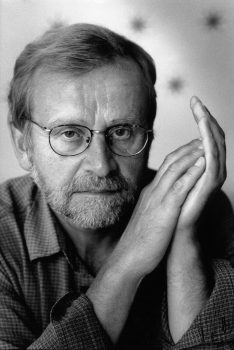
Johan Bargum. Photo: Irmeli Jung
Few Finland-Swedish authors can make a living by their writing. A readership of little more than 300,000 cannot support a large number of writers, and only the most successful books sell more than a thousand copies. Writers have thus no choice but to seek other markets, notably in Sweden or among the Finnish-speaking population.
Both alternatives present problems, but popular writers like Henrik Tikkanen and Christer Kihlman are tending more and more to publish simultaneously in all three markets. Since the publication of his novel Den privata detektiven (‘The private detective’) in 1980, which even became the Book of the Month in Sweden, Johan Bargum has joined this group. Enthusiastic reviewers have since speculated on the possibility of translations into other European languages.
Born in 1943, Bargum grew up in Helsinki and, like so many other writers with their roots in the Finnish capital, he comes from an upper-class family. Politically he belongs to the left, while artistically he has benefited from family tradition: both his grandmother, Margit von Willebrand-Hollmerus, and his mother, Viveca Hollmerus, are well-known authors. Writing as a family tradition is actually quite a common phenomenon in Finland-Swedish literature.
A social conscience
Thanks to his skill as a dramatist as well as a prose-writer, Johan Bargum has been able to live by his pen for the past ten years. Early in the 1970s he had a success with Som snort (‘A cinch’), Bygga bastu (‘Building a sauna’) and Virke och verkan (‘Material and the making’), all specially written for Lilla Teatern, the Swedish-language theatre in Helsinki. In this trilogy he was concerned with the difficulties encountered by small businessman in their struggle against large monopolies. His text is characterized by a strong ironic humour. More…
Poems
31 March 1983 | Archives online, Fiction, poetry
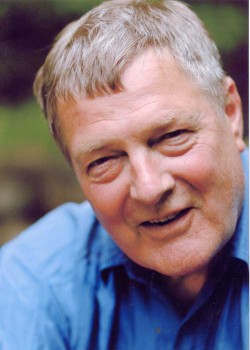
Claes Andersson. Photo: Johan Bargum.
Claes Andersson (born 1937) became, during the 1960s, one of the few authors to free themselves from the modernist tradition so firmly established in Finland-Swedish writing in the 1920s to create poetry of a more distinctly personal kind. Claes Andersson’s poems are coloured by his training as a psychiatrist; he uses technical language in which scientific terms are exploited as an expressive device. His work also sometimes contains black humour and an ironical element calculated to shock the reader; they reflect the contrast between the dream of beauty and love and the grim reality of evil . To date, Andersson has published eleven collections of poems and a considerable number of plays for the stage, cabaret and radio. He has also written three novels, the latest of which – entitled En människa som börjar likna sin själ (‘The person who began to resemble his soul’) – is to appear in the autumn of 1983. For an introduction to Claes Andersson’s work, see Thomas Warburton’s article in Books from Finland 3/1979. Claes Andersson’s poems have recently appeared in translation in Poetry East, Seneca Review, Scandinavian Review and Grand Street.
Loneliness
My love, the moments I spend
in your cunt I forget my
migraine aching joints drinking problem grand mal paralysis
hallucinations pain between the shoulderblades short-
ness of breath hiccoughs dandruff dry skin vertigo bedwetting
impaired hearing chafed lips pustules liver
spots leg sores bleeding gums flatulence
sciatica crying fits thoughts of suicide swol-
len ankles pathological thirst Angst baldness double
vision facial twinges difficulty concentrating
cross eyes burning in the urethra running ears ring
ing ears cramps throat pain itching allergies
strange subcutaneous lumps cold hands nail-
biting hoarseness obesity jealousy vomiting
constipation sleeplessness noctural crying fits
failing memory pus in each nasal sinus and gout.
From Rumskamrater (‘Roommates’), 1974)
Hip hip hurray!
13 June 2014 | This 'n' that
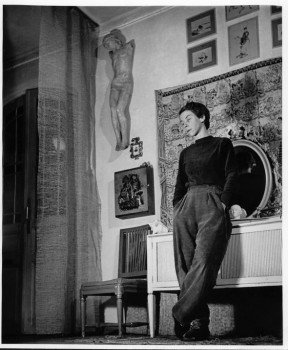
Tove Jansson, 1956. Photo: @Moomin Characters™
The English author of bestselling children’s fantasy books Philip Pullman – of His Dark Materials fame – declares himself a devoted fan of Tove Jansson, the Finnish Moomin-creator and artist, whose stories and novels have been translated into 44 languages.
Pullman has been a fan since the age of eight – now, reassessing Jansson’s work, he notes ‘the perfection of the drawings’. Jansson illustrated her Moomin books, in black-and-white mostly.
Pullman reviews two books in Books for Keeps, the British online children’s book magazine: the newly translated biography of Tove Jansson (1914–2001) by the Swedish scholar Boel Westin (Tove Jansson: Life, Art, Words, Sort of Books, 2014) and Tove Jansson’s memoir from her childhood, Sculptor’s Daughter. ‘Jansson responded to the world with a freshness and originality that have hardly ever been matched in the field of children’s books,’ he writes.
The artist, painter, writer Tove Jansson was born on 9 August – almost a hundred years ago. A major centenary exhibition of her work at the Finnish National Gallery Ateneum is open until 7 September.
Pullman concludes: ‘she could convey all the excitement of wonder as well as the reassurance of comfort and familial love – and [–] evoke a mood of apprehension, loss and mystery. She should have had the Nobel Prize.’
Three cheers – we at Books from Finland agree!
Juhani Niemi on Väinö Linna
31 December 1980 | Archives online, Authors
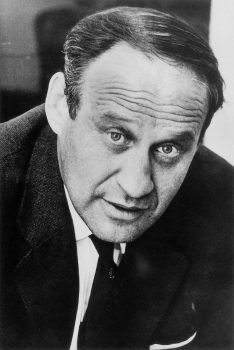
Väinö Linna. Photo: WSOY
Väinö Linna fits squarely into one of the dominant patterns of twentieth century literary development in Scandinavia. Like many writers of the period, Linna came from a working class background and struggled to free himself from that environment through self-education. He had no special interest in politics but his natural leanings were moderately left-wing. He isn’t a ‘political’ writer as such, and it would be simplistic to apply labels to his views. His central interests, which directly affect his style, are a concentration on firstly, acute social observation and, secondly, social analysis. Through novels in this genre – and Linna is without doubt a master – the reader finds a world and all its influences, from the personal to the historical and economic dissected, the casings laid back, the true juxtapositions revealed.
The process can be powerful and effective and Linna’s major works Tuntematon Sotilas (‘The Unknown Soldier’, 1954, English translation 1957) and the trilogy Täällä Pohjantähden alla (‘Here beneath the North Star’, 1960-62) have struck deep into the Finnish national consciousness radically influencing the way events in recent Finnish history have been viewed by a wide audience of readers. Both works have been enormously popular: the characters have so accurately caught the Finnish personality that they have become part of the nation’s mythology. More…
Our fellow creatures
30 June 2004 | Authors, Reviews

Photo: Tiina Itkonen
Hannele Huovi is a compelling story-teller (see page 98) but, again and again, she makes us realise what a strange place our world is – how easily we can slip out of it into dream or psychosis, or cross some concealed frontier into a parallel universe.
Hers is a readable form of surrealism – the art of defamiliarising familiar things by putting them in anomalous environments. The results are absorbing for children but fascinating and entertaining for adults too, an essential of good children’s literature. Because it can be serious without being solemn and can expand consciousness, the genre has engaged very great wits from Jonathan Swift to Lewis Carroll. Eeva-Liisa Manner’s stories (see Books from Finland 1/2004) are another obvious point of contact, but Huovi is brilliantly inventive and completely original. More…
Nature girl: on the poetry of Sirkka Turkka
21 January 2010 | Authors, Reviews
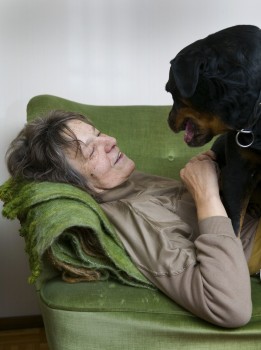
Sirkka Turkka with a friend. Photo: Pertti Nisonen
Sirkka Turkka writes precise, lucid sentences, as if composing a treatise. But her poems often relate utterly loopy things; the work is playful, frisky. It is not based on explication or hidden themes. When it refers to abstract matters, it always couples them with concrete reality, with natural or everyday occurrences. ‘Trees have the snowy faces of ancestors, and on the road where dogs walk in their wind-blasted trousers, silence eats itself like silk.’
The poems contain numerous allusions to literature and culture, including popular culture. The tone can be parodic in these instances, but not critical; rather, a new point of departure is established, as when Turkka writes about Hamlet in her 1970s collection, Yö aukeaa kuin vilja (‘The night opens like corn’). ‘On long, silent winter days, when his father immersed himself in additional studies or demonstrations of learning, Hamlet would shut himself up in his room in order to rewrite history. He colonised countries and swapped their locations. At one stage he even thought of making the sun rise in the West and America encounter Columbus, but he restrained himself.’ More…
Jukka Laajarinne & Timo Mänttäri: Isä vaihtaa vapaalle [Dad takes time off]
9 January 2014 | Mini reviews, Reviews
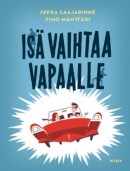 Isä vaihtaa vapaalle
[Dad takes time off]
Kuvitus [Ill. by]: Timo Mänttäri
Helsinki: WSOY, 2013. 31 pp., ill.
ISBN 978-951-0-39780-0
€26.90, hardback
Isä vaihtaa vapaalle is a picture book infused with wry humour which lends itself to both realistic and fanciful readings. In the story, a girl’s father is a secret agent. He’d like to reduce his working hours to spend more time with his daughter, but his employer has other ideas. This book provides an amusing reflection of its time: parents’ job titles often do not mean much to children, so their strange roles and the heavy briefcases parents lug home start to take on a life of their own in children’s minds. The story is free from clichés about gender roles and will entertain boys and girls alike. Timo Mänttäri, making his debut as a children’s book illustrator here, depicts fast-paced, dangerous situations and amusing details. The comic book-style narrative and large, double-page illustrations create suspense in this zippy story. The words and pictures are seamlessly integrated, and the not-overlong text is balanced by the exceptionally strong, expressive visuals.
Translated by Ruth Urbom
Self-made man
1 April 2009 | Extracts, Non-fiction
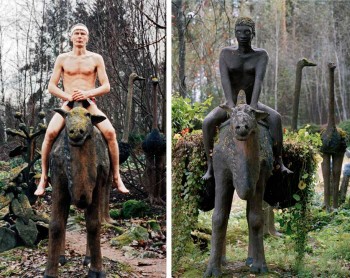
On camelback: in the exotic part of Veijo Rönkkönen’s concrete cosmos there are animals and palm trees, side by side with the living plants of the northerly latitudes. - Photo, left: Veijo Rönkkönen; right: Veli Granö.
Extracts and photographs from Veijo Rönkkösen todellinen elämä / The real life of Veijo Rönkkönen (Maahenki, 2007. Translation: Kirsti Nurmela-Knox)
Veijo Rönkkönen (born 1944) has lived all his life on an isolated, small farm in eastern Finland, Parikkala, less than a kilometre from the Russian border, where he has quietly built a garden inhabited by nearly five hundred human figures made of concrete. Entrance is free.
What have brains got to do with it?
17 October 2013 | Columns, Tales of a journalist
Illustration: Joonas Väänänen
Pondering his changing profession once again, columnist and media critic Jyrki Lehtola feels compelled to present a brief history of the media
Not long ago a certain media company invited me to participate in a panel on brainprints.
I didn’t know what they were talking about, so I agreed. At most I thought it was about the engram left in our collective psyche that yes, we used to have this sort of print media thing that told us what the world was like.
And then we didn’t – look at this picture of print media on my iPad, kids, isn’t it cute?
That wasn’t what it was about at all. Brainprint means all the ways the media can influence us as consumers. In other words, this is one more conversation the media has with itself to convince itself that it has a role to play.
There we sat around a long table once again talking about whether the media is a mirror or a window when maybe we should have been talking about the pile of glass on the ground and whether someone shouldn’t clean it up before someone hurts themselves. More…
Alone here
31 March 1989 | Archives online, Fiction, poetry
Gösta Ågren has published a couple of dozen volumes of poetry; Jär (the title is a dialect word meaning ‘here’) won the Finlandia Prize in 1989. Ågren’s earlier poems have been epic, tinged with Marxism, in the style of Whitman and Neruda. Gradually his has become more strongly linguistically concentrated, developed towards a more conventionally lyrical style questioning the problem of existence. He himself has expressed the matter in one of the paradoxical statements he particularly enjoys: ‘don’t worry / it will never work out.’ Introduction by Erkka Lehtola
Here
Here she came, through the motion
less Sunday of old age.
In headscarf and long skirt
she came, a tall bird
of clothes. She wondered in
the sunlight on the shed-hill
what she should do
so she could die. I must
write about this. For it happens
everywhere, and there are no
questions to answer. But questioning
is already insight. Only
those questions that are never asked
need answers. I remember
that her hands were no longer
part of her. Idle
they lay in her lap. She saw
with her eyes only darkness
and light. It was silent. I
thought: the silence is creeping
through her body. Soon
it will reach her heart. Soon
I will be alone
here. More…
On Sirkka Turkka
30 June 1982 | Archives online, Authors
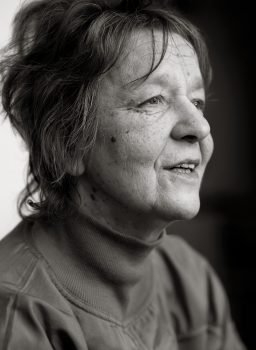
Sirkka Turkka. Photo: Pertti Nisonen
1.
I met Sirkka Turkka towards the end of the sixties; she was a friend of a girl-friend of mine.
We called her Hemuli. Not that she bore any resemblance to the Hemulen of the Moomin books, but she did view the world with the same charitable curiosity as some of Tove Jansson’s immortal characters.
In the evenings Hemuli would speak with wit and wisdom, as the sky darkened, then paled towards dawn. Her words were spontaneous: she talked of nature, of the city, always with a gentle understanding, a compelling magic which dissolved ideas into music, full of a sad beauty, echoes of loneliness, painful and happy memories. She looked life straight in the eye, without illusions.
What I’m saying, Sirkka Turkka was a master of the spoken word. She was a story-teller, a ballad-singer, a reciter of epic tales, creating literature of a kind no longer recognized as literature. More…
Hiding the soul
30 September 2002 | Authors

Photo Irmeli Jung
The world makes people anxious, is the thesis of the writer Petri Tamminen in his new book, Piiloutujan maa (‘The land of the hider’). Well, if this is true, what do you do then? Rage and fight – or go into hiding?
The people in Tamminen’s world choose a hiding place. Fortunately, the world is full of them, and they are not only places, but also states of mind and modes of behaviour.
The writer and freelance reporter Petri Tamminen (born 1966) made his debut with a volume of short prose entitled Elämiä (‘Lives’, see Books from Finland 3/1994), in which people’s life stories are presented in about 200 words; entire decadesflash by in a sentence, or lives are summed up in a single event, often an apparently insignificant one. The comic and the tragic lie side by side, and are often not reached by language, but what the author does not choose to say. Next came the short story book Miehen ikävä (‘Male blues’, 1997) and the novel Väärä asenne (‘The wrong attitude’, 2000), which described the nightmares of a new father, plagued with a horror of bacteria. More…