

Search results for "tommi+musturi/2010/2009/10/writing-and-power/page/www.booksfromfinland.fi/2012/04/fight-club"
Really existing?
30 March 2007 | Fiction, Prose
Extracts from the novel Mehiläispaviljonki. Kertomus parvista (‘The Bee Pavilion. A story about swarms’, Teos, 2006)
There are few old buildings in this town. Most are demolished to make way for new ones long before they reach the end of their first century.
Nevertheless, one brick building in our part of town, built at the beginning of the last century, was spared demolition for a long time. The two-storey building functioned as a Support Centre for the Psychically Ill and later on, for a couple of winters, as a shelter for alcoholics. The board fence that had surrounded the building for decades was taken down long before the building itself, but the maples on the sidewalk cast their shadows on its windows to the very end. When the lilacs and dogwoods in the back garden were in bloom, their heavy racemes shed purple and white on the sand. More…
Lucky strikes
12 August 2010 | This 'n' that
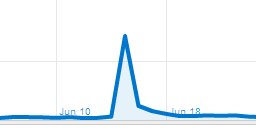
Stumbled upon: readers find Tommi Musturi's comic strip (June 10–June 18)
When Books from Finland was a printed journal, it was relatively easy to define its readership – now it is different: we are a part of the internet’s ecosystem, its surging and multifarious mass of knowledge.
Those who visit our pages may have the most diverse motives for wanting to read our articles – and they may travel surprising itineraries before arriving on Books from Finland’s pages, as we found out recently: StumbleUpon is still a fairly little-known service in Finland. Thus it took a while before we realised why so many of the comments about our piece on Tommi Musturi’s wordless comic strip, on colour and friendship, began with the words ‘I stumbled upon’… More…
Serial fun, or comics celebrated
24 January 2011 | In the news
The art of comics celebrates its first centenary in Finland this year. The first Finnish picture story was a book called Professori Itikaisen tutkimusretki (‘Professor Itikainen’s expedition’, WSOY), by Ilmari Vainio, published in 1911; see our post on the Books from Finland website.
By the way, comics in Finnish is sarjakuva, ‘serial picture’, covering the modern usage of ‘comics’ – including serious, graphically impressive stuff such as the newish genre of the graphic novel.
The annual Helsinki Comics Festival, organised by Finnish Comics Society (founded 1971), is the biggest event in the field in northern Europe; this year’s festival will take place in September. In 2011 comics exhibitions will take place at the Finnish Design Museum, the Finnish Post Museum and the National Library of Finland.
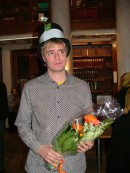
Tommi Musturi. Photo: the Finnish Comics Society
The Society awarded its Puupää prize 2011 to Tommi Musturi (born 1975) – take a look at an extract from his Walking with Samuel which we ran on the Books from Finland website in May 2010.
Among Musturi’s publications are ten anthologies entitled Glömp; he has also worked for Kuti magazine and Huuda Huuda publisher. The jury remarked, in particular, on their appreciation of Musturi’s highly original, often wordless, stories and their graphic brilliance.

The prize: Puupää's hat
The prize is not money but a honorary hat, and is named after a classic Finnish cartoon character, Pekka Puupää (‘Pete Blockhead’), created by Ola Fogelberg and his daughter Toto. The Puupää comic books were published between 1925 and 1975, and some of the stories were made into film.
Fight Club
16 April 2012 | Fiction, Prose
A short story from Himokone (‘Lust machine’, WSOY, 2012). Interview by Anna-Leena Ekroos
Karoliina wondered whether her name was suitable for a famous poet.
Her first name was alright – four syllables, and a bit old-fashioned. But Järvi didn’t inspire any passion. Should she change her name before her first collection came out? Was there still time? She had four months until September.
Even if The flower of my secret was the name of some old movie, Karoliina clung to the title she’d chosen. It described the book’s multifaceted, erotically-tinged sensory world and the essential place of nature in the poems. Karoliina loved to take long walks in the woods. Sometimes she talked to the trees.
She had been meeting new people. At the writer’s evening organised by her publisher, she’d been seated next to Märta Fagerlund, in the flesh. Karoliina had read Fagerlund’s poems since her teens, and seen her charisma light up the stage on cultural television shows.
At first Karoliina couldn’t get a word out of her mouth. She just blushed and dripped gravy on her lap. But the longer the evening went on, the more ordinary Märta seemed. She was even calling her Märta, and telling her about a new friend on Facebook who said how ‘awfully funny’ Märta was. In fact, the squeaky-voiced Märta, with her enthusiasm for Greece, was a bit dry, and, after three glasses of white wine, tedious. But Karoliina never mentioned it to anyone, because she wasn’t a spiteful person. More…
At the Fluctuating Reality Club
30 March 2007 | Authors, Reviews

Leena Krohn. Photo: Mikael Böök / Teos
For Leena Krohn, compromise doesn’t seem to be an option. Although the novel Mehiläispaviljonki (‘The bee pavilion. A story about swarms’, Teos, 2006) is her 26th book, her uncompromising approach doesn’t show the slightest sign of relaxing.
Once again, Krohn (born 1947) spreads before the reader an array of fragments of reported realities, which crisscross the boundaries of imagination and challenge the whole traditional conception of the world.
Since the short-story collection Donna Quijote ja muita kaupunkilaisia (1983; English translation: Dona Quixote and Other Citizens, 1995), Krohn has moved more towards the role of thinker and polemicist than ordinary storyteller. In her work in the 1980s and 1990s, she developed a unique, highly personal hybrid literary form, which combines the elements of fiction and essay. Krohn’s attention has focussed on human consciousness, ecology and moral and social questions. Her work has been translated into 12 languages; she received the Finlandia Prize for Literature for her work Matemaattisia olioita tai jaettuja unia (‘Mathematical beings or shared dreams’, 1992). More…
Song without words
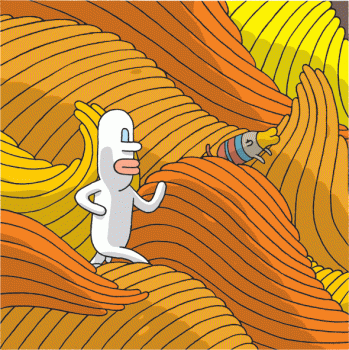
The episode we feature here is from Samuelin matkassa (‘Walking with Samuel’, Huuda Huuda, 2009; the book has been also published in Germany, Belgium, Sweden and Portugal)
Our lives are now more surrounded with images – moving or still, narratives or icons, emblems and symbols – than ever before – but do we know how to interpret them? How well can we read pictures?
Try this: Samuel is a cartoon character, created by Tommi Musturi, who wanders through time and a fantastically colourful universe of his own. His story is told in pictures, not words – and the details speak volumes. It tells, as you will find if you ‘read’ it carefully, about friendship between man and… another creature. More…
Markku Kuisma & al.: Hulluja päiviä, huikeita vuosia. Stockmann 1862–2012 [Crazy days, amazing years. Stockmann 1862–2012]
29 March 2012 | Mini reviews, Reviews
 Markku Kuisma & Anna Finnilä & Teemu Keskisarja & Minna Sarantola–Weiss
Hulluja päiviä, huikeita vuosia. Stockmann 1862–2012
[Crazy days, amazing years. Stockmann 1862–2012]
Helsinki: Siltala, 2012. 532 p., ill.
ISBN 978-952-234-086-3
€37.90, hardback
Also available in English- and Swedish-language editions:
Crazy days, amazing years. Stockmann 1862–2012
Galna dagar, svindlande tider. Stockmann 1862–2012
The largest department store in the Nordic countries, whose current building was completed in 1930 to a design by the architect Sigurd Frosterus, is celebrating its 150th birthday. The Akateeminen Kirjakauppa (Academic Bookstore), owned by Stockmann, is the biggest bookshop in the Nordic countries. The shop founded by the German-born H.F.G. Stockmann has grown into an international business, trading in 14 countries (including Russia, where it has stores in St Petersburg and Moscow). Now quoted on the Finnish stock exchange, Stockmann, owned by a conglomerate of families and foundations, has survived recessions, financial crises and wars. In the 19th century Stockmann was considered an expensive shop for gentlefolk, but as a result of growing competition it has been forced to focus strongly on a diverse concept of service. For decades one of the capital’s best-known meeting places has been ‘under the clock’, outside the main entrance of the department store. The book’s writers are historians from various fields. The generously illustrated work offers new information about the history of trade and the city.
Rainer Knapas: Kunskapens rike. Helsingfors universitetsbibliotek – Nationalbiblioteket 1640–2010 [In the kingdom of knowledge. Helsinki University Library – National Library of Finland 1640–2010]
9 August 2012 | Mini reviews, Reviews
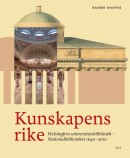 Kunskapens rike. Helsingfors universitetsbibliotek – Nationalbiblioteket 1640–2010
Helsingfors: Svenska litteratursällskapet i Finland, 2012. 462 p., ill.
ISBN 978-951-583-244-3
€54, hardback
Tiedon valtakunnassa. Helsingin yliopiston kirjasto – Kansalliskirjasto 1640–2010
[In the kingdom of knowledge. Helsinki University Library – National Library of Finland 1640–2010]
Suomennos [Finnish translation by]: Liisa Suvikumpu
Helsinki: Finnish Literature Society, 2012. 461 p., ill.
ISBN 978-952-222-272-5
€54, hardback
The National Library of Finland was founded in 1640 as the library of Turku Academy. In 1827 it was destroyed by fire: only 828 books were preserved. In 1809 Finland was annexed from Sweden by Russia, and the collection was moved to the new capital of Helsinki, where it formed the basis of the University Library. The neoclassical main building designed by Carl Ludwig Engel is regarded as one of Europe’s most beautiful libraries and was completed in 1845, with an extension added in 1906. Its collections include the Finnish National Bibliography, an internationally respected Slavonic Library, the private Monrepos collection from 18th-century Russia, and the valuable library of maps compiled by the arctic explorer Adolf Erik Nordenskiöld. Renamed in 2006 as Kansalliskirjasto – the National Library of Finland – this institution, which is open to general public, now contains a collection of over three million volumes as well as a host of online services. This beautifully illustrated book by historian and writer Rainer Knapas provides an interesting exposition of the library’s history, the building of its collections and building projects, and also a lively portrait of its talented – and sometimes eccentric – librarians.
Translated by David McDuff
Finlands svenska litteratur 1900–2012 [Finland’s Swedish literature 1900–2012]
6 November 2014 | Mini reviews, Reviews
 Finlands svenska litteratur 1900–2012
[Finland’s Swedish literature 1900–2012]
Red. [Edited by] Michel Ekman
Helsingfors: Svenska litteratursällskapet i Finland / Stockholm: Atlantis, 2014. 376 pp., ill.
ISBN 978-951-583-272-6
€35.90, paperback
This history of Finland-Swedish literature is an updated version of the second volume of Finlands svenska litteraturhistoria (eds. Johan Wrede and Clas Zilliacus, 1999–2000), and it concentrates on the period from 1900 to 2012, with much new critical material relating to the years after 1975. Some 20 contributors under the editorship of Michel Ekman provide a diverse and inclusive overview of a literature that embraces poetry, prose fiction, children’s writing, essays and drama. The book traces the story of Finland-Swedish literature from the ‘fresh start’ of the turn of the 19th century, through the experiments of modernists like the poets Edith Södergran and Elmer Diktonius, to the work of present-day novelists like Monika Fagerholm and Kjell Westö. However, the emphasis throughout is on general lines of development rather than on individual authors’ careers. The authors discuss the relationship between the work of Finland’s Swedish-language writers and their Finnish-language counterparts in a perspective that not only views the minority literature as a part of the Finnish whole, but also considers it as a bridge between the literatures of Sweden and Finland – the subject of a concluding essay by Clas Zilliacus. The material is presented in essays subdivided in a readable way that combines factual information with critical and historical analysis.
Markku Kuisma & Teemu Keskisarja: Erehtymättömät. Tarina suuresta pankkisodasta ja liikepankeista Suomen kohtaloissa 1862–2012 [The infallible ones. The story of the great bank war and Finland’s commercial banks, 1862–2012]
13 December 2012 | Mini reviews, Reviews
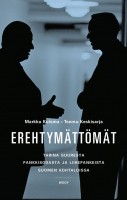 Erehtymättömät. Tarina suuresta pankkisodasta ja liikepankeista Suomen kohtaloissa 1862–2012
[The infallible ones. The story of the great bank war and Finland’s commercial banks, 1862–2012]
Helsinki, WSOY, 2012. 496 p., ill.
ISBN 978-951-0-39228-7
€ 38.80, hardback
Historians Markku Kuisma and Teemu Keskisarja’s lively book tells the story of Finland’s commercial banks, from the establishment of the first one in 1862. A recurrent theme in the book is the competition between the two largest. With their relations to and allies in the business world the banks have had an important social and political influence in the country. The commercial banking institutions have had more prominence than others, and the directors have often been strong personalities. Most of the emphasis in the book is placed on the final decades of the 20th century. In the 1980s the financial markets were deregulated, and the boom of the ‘crazy years’ of the bank war was accelerated by share trading and cornering. In 1995 the recession caused by the banking crisis led to the merger of the two largest commercial banks. A few years later this new institution merged with a Swedish one, and the large new bank Nordea subsequently expanded to neighbouring countries. The age of large national commercial banks in Finland was over.
Translated by David McDuff
Books from Finland to take archive form
22 May 2015 | In the news
The following is a press release from the Finnish Literature Society.
The Finnish Literature Society is to cease publication of the online journal Books from Finland with effect 1 July 2015 and will focus on making material which has been gathered over almost 50 years more widely available to readers.
Books from Finland, which presents Finnish literature in English, has appeared since 1967. Until 2008 the journal appeared four times a year in a paper version, and subsequently as a web publication. Over the decades Books from Finland has featured thousands of Finnish books, different literary genres and contemporary writers as well as classics. Its significance as a showcase for our literature has been important.
The major task of recent years has been the digitisation of past issues of the journal to form an electronic archive. The archive will continue to serve all interested readers at www.booksfromfinland.fi; it is freely available and may be found on the FILI website (www.finlit.fi/fili).
Much is written in English and other languages about Finnish literature: reviews, interviews and features appear in even the biggest international publications. The need for the presentation of our literature has changed. Among the ways in which FILI continues to develop its remit is to focus communications on international professionals in the book field, on publishers and on agents.
The reasons for ceasing publication of Books from Finland are also economic. Government aid to the Finnish literature information centre FILI, which has functioned as the journal’s home, has been cut by ten per cent.
Books from Finland was published by Helsinki University Library from 1967 to 2002, when the Finnish Literature Society took on the role of publisher. FILI has been the body within the Finnish Literature Society that has been responsible for the journal’s administration, and it is from FILI’s budget that the journal’s expeses have been paid.
Enquiries: Tuomas M.S. Lehtonen, Secretary General of the Finnish Literature Society, telephone +358 40 560 9879.
The ladies’ dining club
30 September 1994 | Archives online, Fiction, Prose
From the novel Luonnollinen ravinto (‘A natural diet’, WSOY, 1994). Interview by Tuva Korsström
My dear, wise and ever-faithful secretary, colleague, friend and right hand, you who, without counting the hours, have been my helpmeet in many awkward situations, and not only in work matters but in others, all sorts of matters that belong to my private life and particularly those, you have remembered things that I have found hard to remember, like the birthday of my wife or some important colleague, and at Christmas you have always remembered me with some small gift, always different and always carefully chosen, of which I hardly need say how much it has warmed my heart, when I haven’t been able to do better than a single miserable hyacinth. And you have always reminded me of engagements I haven’t been able to keep track of: dentists, barbers, garages, less important and more important receptions, lunches and dinners, but what is most important, and why l am most grateful to you, is that in your generosity and open-mindedness – your eternal femininity – you have understood that a person in my position may sometimes find himself in situations whose consequences he cannot always control, and that he begins to be bothered by all sorts of people, although they should understand from the smallest hint that their company is not required, and you have sensitively but firmly turned them away, sometimes telling a little lie, and you have never, ever taken a moral stand or judged my actions, but have averted your eyes, having made the decision to accept that your boss is anything but perfect. For that reason I wish to express my gratitude to you; but not, however, unreservedly. Our seamless collaboration, my ever-lovable secretary, has meant that something belonging to me has begun to belong to you, that you have become part of me just as I have become part of my wife, even before she touches me with her fork. So I have no doubt that you, too, could appear at the dinner that is soon to be arranged. Bon appetit! More…
Aleksi Mainio: Terroristien pesä. Suomi ja taistelu Venäjästä 1918-1939. [Terrorist lair. Finland and the fight for Russia 1918-1939.]
29 June 2015 | Mini reviews, Reviews
 Aleksi Mainio
Terroristien pesä. Suomi ja taistelu Venäjästä 1918-1939. [Terrorist lair. Finland and the fight for Russia 1918-1939.]
Helsinki: Siltala, 2015. 380pp., ill.
ISBN 987-952-234-288-1
€34.95, hardback
After the October Revolution in Russia in 1917 and the rise of the Bosheviks to power, thousands of their opponents fled the country. The historian Aleksi Mainio’s book describes how many of the emigrants, who represented not only monarchists but many other ideologies, attempted to act against Soviet Russia through espionage and even terrorism from Finland and partly with funding from western powers. Their fighting organisations sent intelligence officers and bomb squads across the eastern border, often admittedly with poor results as the organisations had often been infiltrated by Soviet-sympathising double agents. The Tartu peace treaty between Finland and Russia, subsequently the Soviet Union, was signed in 1920. Nevertheless, many officials of the security police and the military were prepared to approve the emigrants’ attempts to weaken Soviet Russia. Some counter-revolutionaries also acted as assistants to the Finnish or, for example, British intelligence services. On the other hand, Finnish officials put a stop where necessary to illegal activities by emigrants. Mainio’s book, which is based on his doctoral thesis, paints a fascinating picture of espionage activity in Finland between the wars, although the sheer volume of detail and characters pose a challenge to forming an overview of the situation.
Rock or baroque?
30 April 2014 | Extracts, Non-fiction
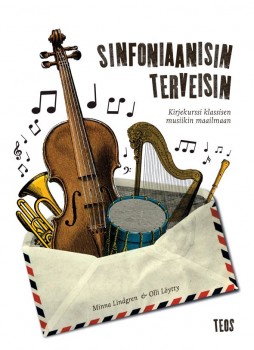 What if your old favourites lose their flavour? Could there be a way of broadening one’s views? Scholar Olli Löytty began thinking that there might be more to music than 1980s rock, so he turned to the music writer Minna Lindgren who was delighted by the chance of introducing him the enormous garden of classical music. In their correspondence they discussed – and argued about – the creativity of orchestra musicians, the significance of rhythm and whether the emotional approach to music might not be the only one. Their letters, from 2009 to 2013, an entertaining musical conversation, became a book. Extracts from Sinfoniaanisin terveisin. Kirjekurssi klassisen musiikin maailmaan (‘With symphonical greetings. A correspondence course in classical music’)
Olli, 19 March, 2009
Dear expert,
I never imagined that the day would come when I would say that rock had begun to sound rather boring. There are seldom, any more, the moments when some piece sweeps you away and makes you want to listen to more of the same. I derive my greatest enjoyment from the favourites of my youth, and that is, I think, rather alarming, as I consider people to be naturally curious beings whom new experiences, extending their range of experiences and sensations, brings nothing but good.
Singing along, with practised wistfulness, to Eppu Normaali’s ‘Murheellisten laulujen maa’ (‘The land of sad songs’) alone in the car doesn’t provide much in the way of inspiration. It really is time to find something new to listen to! My situation is already so desperate that I am prepared to seek musical stimulation from as distant a world as classical music. I know more about the African roots of rock than about the birth of western music, the music that is known as classical. But it looks and sounds like such an unapproachable culture that I badly need help on my voyage of exploration. Where should I start, when I don’t really know anything? More…
Time to go
29 June 2015 | Greetings
[kml_flashembed publishmethod=”static” fversion=”8.0.0″ movie=”https://booksfromfinland.fi/wp-content/uploads/2015/06/Books_Kesabanneri_2015.swf” width=”590″ height=”240″ targetclass=”flashmovie”]  [/kml_flashembed]
Animation: Joonas Väänänen
We’ve often thought of editing Books from Finland as being a bit like throwing a party.
It’s our job to find a place to hold it, send out the invitations and provide the food and drink.
It’s your job to show up and enjoy.

Books from Finland is a party that’s been running since 1967 – for nearly fifty years.
In that time, we’ve served up almost 10,000 printed pages and 1,500 posts, a wide-ranging menu of the best Finnish fiction, non-fiction, plays and drama, accompanied by essays, articles, interviews and reviews.
We’ve had a ball, and to judge by the letters and emails we’ve received from many of you, you’ve had a good time too.
But now it’s time to go: the landlord, to stretch the metaphor, has called in the lease on our party venue. Faced with funding cuts in the budget of FILI – the Finnish Literature Exchange, which has since 2003 been Books from Finland’s home – the Finnish Literature Society has decided to cease publication of Books from Finland with effect 1 July 2015. Our archive will remain online at this address, and the digitisation project will continue. We won’t be adding any new material, though; this is, literally, the last post.
The party may be over, the lights and music turned off – but what about the partygoers?
They are doing what partygoers always do: they – we – are moving on.
Readers and writers, photographers and illustrators, everyone who’s helped, supported and enjoyed Books from Finland, thank you!
So long. See you around.
Hildi Hawkins & Leena Lahti