

Search results for "Riikka/2010/10/mikko-rimminen-nenapaiva-nose-day"
We are the champions
25 March 2011 | Prose
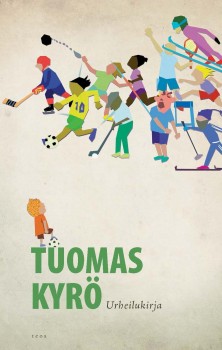 Heroes are still in demand, in sports at least. In his new book author Tuomas Kyrö examines the glorious past and the slightly less glorious present of Finnish sports – as well as the meaning of sports in the contemporary world where it is ‘indispensable for the preservation of nation states’. And he poses a knotty question: what is the difference, in the end, between sports and arts? Are they merely two forms of entertainment?
Extracts from Urheilukirja (‘The book about sports’, WSOY, 2011; see also Mielensäpahoittaja [‘Taking offence’])
The whole idea of Finland has been sold to us based on Hannes Kolehmainen ‘running Finland onto the world map’. [c. 1912–1922; four Olympic gold medals]. Our existence has been defined by how we are known abroad. Sport, [the Nobel Prize -winning author] F. E. Sillanpää, forestry, [Ms Universe] Armi Kuusela, [another runner] Lasse Viren, Nokia, [rock bands] HIM and Lordi, Martti Ahtisaari.
The purpose of sport at the grass-roots level has been to tend to the health of the nation and at a higher level to take our boys out into the world to beat all the other countries’ boys. We may not know how to talk, but our running endurance is all the better for it. However, the most important message was directed inwards, at our self image: we are the best even though we’re poor; we can endure more than the rest. Finnish success during the interwar period projected an image of a healthy, tenacious and competitive nation; political division meant division into good and bad, the right-minded and traitors to the fatherland. More…
Really existing?
30 March 2007 | Fiction, Prose
Extracts from the novel Mehiläispaviljonki. Kertomus parvista (‘The Bee Pavilion. A story about swarms’, Teos, 2006)
There are few old buildings in this town. Most are demolished to make way for new ones long before they reach the end of their first century.
Nevertheless, one brick building in our part of town, built at the beginning of the last century, was spared demolition for a long time. The two-storey building functioned as a Support Centre for the Psychically Ill and later on, for a couple of winters, as a shelter for alcoholics. The board fence that had surrounded the building for decades was taken down long before the building itself, but the maples on the sidewalk cast their shadows on its windows to the very end. When the lilacs and dogwoods in the back garden were in bloom, their heavy racemes shed purple and white on the sand. More…
Conversations with a horse
31 December 2004 | Archives online, Fiction, Prose
Extracts from the novel Kiinalainen puutarha (‘The Chinese garden’, Otava, 2004). Introduction by Anna-Leena Nissilä
Colonel Mannerheim.
Near Kök Rabat, on the caravan route between Kashgar and Yarkand.
October 1906
It is growing dark. Let the others go on ahead. Let us wait here awhile. Perhaps the pain will go over. We’ll get through.
Steady, Philip.
You always obey. And listen. Your ears proudly, handsomely pricked.
Steady, I said, there in the garden. No reaction. Everyone was moving. Pure comedy. And something else.
An illusion, two girls. Then gone.
How to explain.
Before that. I had a conversation with Macartney, the British chargé d’affaires…
Pain…. It burns, now it burns again. Let us wait now, Philip. Steady, steady now. More…
In defence of small people
15 November 2012 | Non-fiction, Reviews
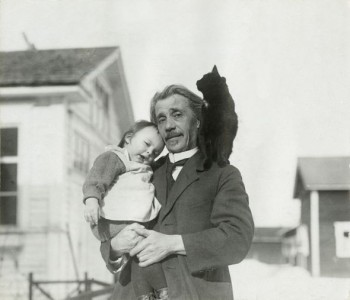
Teuvo Pakkala with grandson Teuvo-Pentti and Mirri the cat. Photo: F. Suomela / Otava, 1922
The best-known work of author Teuvo Pakkala (1862–1925) is Tukkijoella (‘On the log river’, 1899), Finland’s most-performed play. The song-studded comedy set in motion a phase of ‘logger romanticism’ in Finnish literature which later spread to film as well. Like the cowboy of the old west, the wandering lumberjack became the prototype for the Finnish masculine adventurer.
The entertaining musical play was a blockbuster. Pakkala’s works of more literary significance, however, encountered more difficulty. His short story collections on the lives of children – Lapsia (‘Children’, 1895) and Pikku ihmisiä (‘Little people’, 1913) – were greeted with flattering acclaim, but marked the author as hopelessly ‘effeminate’, as the critics put it. The stories were read as a kind of child-rearing guide, or even as tales for children. It wasn’t until much later, in the second half of the 20th century, that these psychological studies of children were re-examined as early gems of the short story form by a contemporary of Freud. More…
Metamorphoses
30 June 1992 | Archives online, Fiction, Prose
Extracts from the novel Tummien perhosten koti (‘Home of the dark butterflies’, Kirjayhtymä, 1991). Introduction by Soila Lehtonen
The girl is on the rock every evening.
By the side of the sheltered bay, she knits or reads a book. Sometimes she simply lies, motionless, under a large towel, her closed face towards the sun as it sinks into the sea.
She has undone her thick plait. Sometimes her hair lies against the reddish boulder like a fan. As if it had been placed there deliberately.
She does not notice the boy, who can move soundlessly. More…
How Real is a Dead Person?
30 September 1979 | Archives online, Fiction, Prose
An Extract from the Novel Sirkus (‘Circus’). Introduction by Pekka Tarkka
Once again I seem to be moving towards a deeper understanding of these people who figure in my recollections, most of whom, by now – by this particular Friday I am now experiencing – are already dead. And this, in its turn, sets me wondering about the degree of reality, if any, that they can claim to possess. How real is a dead person? Is he, perhaps, totally unreal? In memories, of course, he is real to the extent that the memories themselves are real. But objectively, independently of memory? But here a sadness comes over me, many-headed, hard to take hold of.
And in any case I think it is time I came to a clearer understanding of the economic circus founded by my grandfather Feodisius. Uncle Ribodisius has also already made the front pages of the newspapers, and the Bilbao has published an interview.
But I have left a picture unfinished. Father’s cardboard boxes! The separation from Dianita – and from the children! And I have broken off in the middle of these curious memoirs of mine. Thinking of which, I find myself grinding to a halt again, stuck with Yellow-Handed Fred and Haius and Desmer, Lesmer and Sesmer – until I realize that instead of coming to a clearer understanding of my grandfather’s economic circus, I am on Lesmer’s estate, one evening in late May – a couple of months ago – listening to the trilling of an unusually talented song-thrush. Perched on the top of a tall spruce, he goes through the repertoire of all the other birds he has ever heard, both native and foreign – creating, however, new combinations of his own; not content with mere mimicry, he rattles, croons, wails, whistles, whirrs, twitters, flutes, sighs, chirrups and shouts his way through a complete set of variations on themes provided by the rest of the bird world: like some rather advanced medieval chronicler who, no longer content to record faithfully (if perhaps chaotically, as Auerbach points out) what he saw, heard, thought and smelt, had begun to create personal shapes and entities – thus preparing the way for the greatest miracle in the history of world literature, the advent of the perceptive reader. More…
Poems
30 December 1998 | Fiction, poetry
From Gården (‘The courtyard’, 1969)
The brown tablecloth hung over the edge.
I sat below there unseen in the odour of cabbage and warmth.
The sky hung on rusty hooks, the women of the courtyard shrank.
They were the only flowers the summer had.
They carried pails to the back yard where there was no sun.
Father read the newspaper, in the middle drawer of the writing table were
bills, promissory notes, pawn tickets, the rent book, everything in order. More…
A musical advent calendar
9 December 2011 | This 'n' that
The Finnish Broadcasting Company has delved into its vast archives, and its website, YLE Areena, is throughout December featuring a series of musical numbers, many with reference to Christmas, sung or played Finnish singers and musicians. These inserts are being broadcast on each day, from 1 to 24 December, and they can be listened to via the Internet (although be warned, the information is given in Finnish only).
Among the Finnish composers are, among others, Oskar Merikanto (1868–1924), Erkki Melartin (1875–1937), Toivo Kuula (1883–1918) and Jean Sibelius. The sopranos Irma Urrila and Helena Juntunen are presented, singing Mozart and Gounoud respectively.
For example: on 6 December, the Finland’s Independence Day, one of the three inserts is a piano piece, entitled Pankakoski, by composer Heino Kaski (who died a day earlier than Sibelius, in September 1957), played by Juhani Lagerspetz (1995). The other two are Andante Festivo (1922), a work originally composed for a string quartet, by Jean Sibelius, played by the Radio Symphony Orchestra (1995) and a song from the 1970s opera Punainen viiva (‘The red line’) by Aulis Sallinen, sung by Matti Salminen (1984).
Fifteen more days to go…
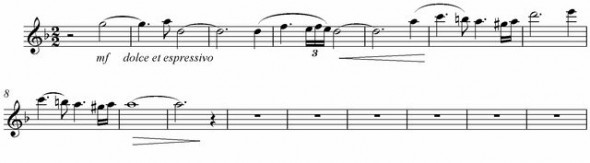
Dolce et espressivo: Violin concerto by Sibelius, 1st movement (1905). Photo: Wikimedia
Scenes from a life
30 September 2004 | Archives online, Fiction, Prose
Extracts from Muistelmat (‘Memoirs’, Otava, 2004). Introduction by Soila Lehtonen
1973, Mietoinen
The shot put circle
Great Grandma knew a lot. She could look over to the neighbor’s yard two kilometers away and told us she could see a broom there leaning against the door. I was practicing the shot-put with the boys by the gable end of the barn. The shot flew three meters. Great Grandma walked past: ‘So what are you boys up to?’ I stared at the ground and said: ‘We don’t know yet.’
1980, Turku
The people in the neighboring car
Reeds rustled against the sides of the boat. The car stood in the sun. We drove into town. At the end of the trip, traffic slowed. I sat in the back seat and got a good view of the people in the car next to us. When we started moving again, I knew I would never see them again. After thirty seconds, they were there, right next to us. More…
Fruits of reading
30 December 1998 | Authors, Interviews

Photo: Promedia
This is an edited version of an interview published in Leva skrivande. Finlandssvenska författare samtalar (‘Living by writing. Finland-Swedish writers in conversation’), edited by Monika Fagerholm (Söderströms, 1998)
Bo Carpelan is one of the most translated of Finnish writers; his novel Axel (1986) attracted international attention when it was published in English translation. Here, in our occasional series of interviews with writers, he is in conversation with fellow poet Mårten Westö
Mårten Westö: The American writer Paul Auster has said: ‘A young person who wants to be an artist or a writer is above all influenced by art. But a young writer has nothing to say. One has a love of literature, but one can only imitate other writers to begin with. It takes a long time before one finds one’s own way.’ What do you think of that statement?
Bo Carpelan: Of course there’s a lot in what he says. At the same time I am convinced that one must have at least the shadow of one’s own voice from the very outset, otherwise what one writes turns out to be merely plagiarism. But to start with one does probably tend to work in close association with tradition. That was also true of me, but in my own view I didn’t continue – as has often been asserted – in the wake of Finland-Swedish modernism. It is of course quite possible that later on I returned to it, but the basis of my activity was probably the American New Criticism: the large anthologies on criticism and poetry that I read in the 1950s. Those influences have left their clearest traces in the very comprehensive bibliography of my academic work on the Finland-Swedish poet Gunnar Björling. In the last chapter of the dissertation I also tried to draw my own guidelines as to what I mean by poetry: that it is concrete and synthetic. More…
The situation in Narva
31 December 1993 | Archives online, Fiction, Prose
A short story from Pakosarja (‘Exhaust manifold’, WSOY, 1993)
We went into the building where Voroshilov said the waitress had disappeared. Inside was a big room lined with wooden benches. A tin-clad stove radiated heat. Someone had shut the dampers too early, probably out of meanness; it had that kind of smoky smell.
A corridor led from the room, with a few doors off it. We peered inside, but there was no one to be seen. There was nobody in the entire building. We left.
We walked across the railway yard in what I thought was the direction of the train. We heard the sound of the engine long before we could see anything through the snowstorm. At regular intervals the engine’s pressure valve let off steam. Voroshilov went for a leak. He leaned against the engine’s big back wheel and watered the lever, which had been left in the down position. The liquid ran down the engine’s rounded flank. The snowflakes melted as they fell on to the black casing of the water-tank. More…
Pig-Sweet
30 September 1998 | Fiction, Prose
An extract from the novel Diva. En uppväxts egna alfabet med Docklaboratorium (en bonusberättelse ur framtiden) (‘Diva. An alphabet of your own for growing up with Doll Laboratory [a bonus story from the future]’, Söderströms, 1998)
I am Diva and everything I say is true. Close your eyes, dream about the most beautiful thing of all. Open your eyes again. See me. Girl-woman. Diva-Lucia. Thirteen, nearly fourteen. Baby Wonder. The one they thought did not exist.
Squelch
(an eternal day, love is born)
Daniel and I. In the autumn we go out to a cottage in the forest. We go walking for a whole extra day. We walk and walk, and it is an autumn day which is implacable. The lingonberries glow in the sun as if on a garish work of art by an impressionist seeing the world for a moment in a sickly way, sweat running inside boots, and squelch squelch on dry crackling ground, so it feels as if the whole forest would be shattered under your boot-clad feet. Great black boots, certainly two sizes too large so as to allow for a proper squelch. Or to allow something. A dry dry autumn, Daniel admits metres ahead of me. And that the elk-flies can’t have had time to get here from across the eastern border beyond which, as far as I know, they exist; it will take years before they manage to get here, Daniel explains. I squelch on, however much those creepy-crawlies are undeniably creeping over my body under my hot tracksuit, in my hair and scalp. Daniel knows about the forest and nature. Daniel knows about everything. And he laughs again because of those flies, and later, he laughs at night, for they don’t stop crawling then either, in the sleeping-bag which in a special way attaches me to Daniel because the zip has stuck and has to be nibbled apart by my teeth, for by then Daniel is asleep, and I have to get out and spew, for I have eaten the wrong things in the wrong order, as so often, all at once, I mean. So Daniel does not believe me. We walk on. More…