

Search results for "Riikka/2010/10/mikko-rimminen-nenapaiva-nose-day"
Eye to eye
30 September 1993 | Archives online, Fiction, poetry
A selection of previously untranslated poems by the Finland-Swedish modernist poet Gunnar Björling (1887–1960), introduced by Birger Thölix
Like silent sounds sail passes after sail.
But the night’s globe stands
and just as open stands the wide sea
and all the days expire in morning brightening.
Like a thing not expired
a life-warm scent throbs
through my limbs
and my hand is filled with tablets to read
and new hearts burn.
1933 More…
Delina
30 September 1999 | Archives online, Fiction, Prose
A short story from Löytöretkeilijä ja muita eksyneitä (‘The explorer and other lost people’, Tammi, 1999). Introduction by Soila Lehtonen
The stranger met Delina at a development organisation’s work camp, but Delina was not a volunteer. Delina lived in the country permanently.
The stranger did not spend very much time in Delina’s company. His evenings were spent with fellow-volunteers in the village cafe, where Delina’s parents did not allow her to go. During the day, both of them worked in their separate ways: Delina at home and the stranger in the work camp’s fields.
The stranger did, however, get to know the girl well enough to hear that she was in love with a soldier called Zmiri from the nearest garrison. This soldier was arrested once when he and his comrades drunkenly molested volunteers – but Delina knew nothing of the case. More…
Down to business
31 March 2006 | Archives online, Fiction, Prose
An extract from the novel Ystävät kaukana (‘Friends far away’, Gummerus, 2oo5)
The half-day secretary Oksana Pelkonen was already bustling about the office as I squeezed my Mercedes onto the side of Viherniemenkatu Street. I had kept my office next to the Hakaniemi Market even though newer places had been pressed on me. There were new messages taped to the doors and windows, anyway. They explained, in what I thought was a quiet way, that the so VK Corporation’s office was here and that Kärppä Construction, VK East Trade, VK Consulting and Hakaniemi Eastern Aid also belonged to the Group. The slogan was at the bottom: ‘Two centuries’ experience trading with the East’. Would have been just as true to put ‘two millennia’, but the customer might have started to wonder.
‘Good morning, Vityuha, good morning!’ Oksana greeted me doubly. ‘I just put the tea onto steep for you. And look, on top of the pile of mail, three letters to Viktor Kärppä. That’s how I knew you were coming.’ More…
Poems
31 March 1998 | Fiction, poetry
Agnosis IV
Set your altar up in the evening,
in the morning clear it away:
the wandering goes on. Don't persuade yourself
       of anything, or anyone else:
fearful forces are epidemic,
no place is sacred
for long.
       Again and again
       the sacred
starts.
       If you happen to be there
don't refuse to see.

a light wind
       stirring a treetop:
a shoal of fish
       in blue abyss
Journey to the first palm tree
16 October 2014 | Fiction, Prose
Teemu is a fat, desperate middle-aged man who’s had it with life – he drives his old Lada to Spain, where he intends to commit suicide by letting himself be trampled to death by bulls in the Pamplona bullrun. (However, there is a chance of this tragedy being cancelled, thanks to a tenacious hitch-hiker, female.) An extract from the novel Särkyvää (‘Fragile’, Tammi, 2014)
When I was seventeen, I yearned to leave behind the small town where I grew up. I heard the owl hooting in the forest: go to Europe.
I heard the dirt-track gravel crunching beneath my shoes: run, lad, run.
The birch in the yard rustled and whispered: if you spend one more summer hanging around the garden of your childhood, you’ll stay here forever.
A frog in the ditch gave a stern croak: look at your father; if you don’t escape you’ll end up an old codger just like him.
Even the smoke twirling up from the sauna chimney spoke to me in billows: I’ll show you the right direction, head south, and don’t stop until you see the first camel. More…
Books and roses
23 April 2013 | In the news
 The tradition of the international Day of the Book and the Rose derives from 1920s Barcelona, where the tradition was for men to give women roses while women gave men books.
23 April is the day – and it is (possibly) also Shakespeare’s birthday. In 1995 UNESCO proclaimed it is the World Book and Copyright Day.
(Actually, we’ve always thought the idea of what is exchanged is rather silly. As women, we would much rather be given a a book than a withering cut flower. On the other hand though, a rose is a safe bet….)
Last year, the Finnish booksellers decided to celebrate the occasion by publishing a new novel which was given for free to all customers who made a purchase worth €10. This was the only way to get hold of a copy; the print run was 3,000 copies. The author was Tuomas Kyrö, the novel, Miniä (‘Daughter-in-law’).
This year the print run is more than tenfold, and the author is Jari Tervo. His novel Jarrusukka (‘Slipper sock’) tells the story of a teacher, working in an immigrant neighbourhood, who finds out it’s not possible to lease a baby in a short term.
All my loving
15 February 2013 | This 'n' that
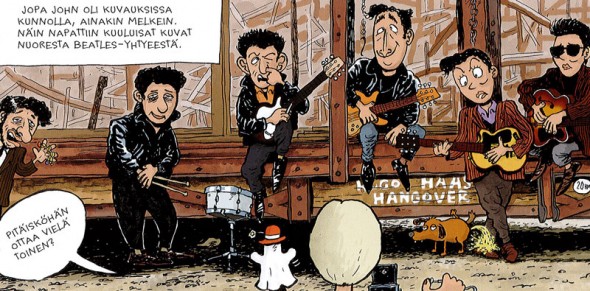
(Early days in Hamburg) Even John behaved himself in the photo sessions, at least almost. This is how the famous photos of the young Beatles were taken.
–Should I take one more? (Astrid the photographer)
One day in the antediluvian times of dawning Beatlemania, a schoolboy in a Finnish small town found himself smitten head over heels by the new pop songs by (probably) the most famous band in the world ever (so far). Like some two billion other teenagers, he learnt by heart every single song the Beatles recorded. Yeah!
The schoolboy grew up and became the illustrator and writer Mauri Kunnas (born 1950), whose storybooks, mostly for children, have now been translated into 30 languages.
But his interest in the Fab Four never left him, and last year he published his illustrated history of John, Paul, George and Ringo, from the day they were born to the day when Please, Please Me / Ask Me Why became number one in the British Top 20 in 1962. As the book is partly written in his native local dialect, its title is Piitles. Tarina erään rockbändin alkutaipaleesta (‘Beatles. The story of the first stage of a rock band’, Otava, 2012).
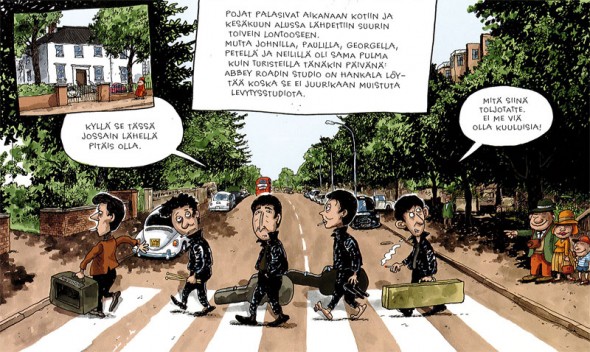
At last the boys came home from Germany, and in June 1962 they left for London with high hopes. But John, Paul, George, Pete and Neil had the same problems that tourists experience even today: The Abbey Road studio is hard to find because it doesn’t look like a recording studio. – It ought to be around here somewhere. – What are you staring at, we’re not famous yet!
In this 77-page graphic story the Beatles grow from babies into celebrities. The large number of hilarious visual details keeps the reader vigilant: for example, in their early days on Hamburg’s Reeperbahn John, Paul, George and Pete (Best) stay in lodgings behind a cinema that are less than hygienic, so on closer examination the lads turn out to be wearing underpants with yellow spots.

–To Eppy! –To my boys!
Julia Lennon, Klaus Voormann, Astrid Kirchherr, Stuart Sutcliffe, Cynthia, Brian Epstein, George Martin: the faces in the gallery of characters are instantly recognisable. Piitles illustrates how Beatlemania was born, and it is truly the work of a faithful fan.
An infinite number of days
31 March 1997 | Archives online, Fiction, poetry
Poems from Molnsommar (‘Cloud summer’, Schildts, 1996). Introduction by Tuva Korsström
Old man
He almost merely slept
and while he slept
his life was accomplished.
Pieces slid out
were examined and fitted together
and while he slept
he was made ready. More…
One night stand
31 March 1987 | Archives online, Fiction, Prose
Stories from Yhden yön pysäkki (‘One night stand’, 1985) and Unohdettu vartti (‘The forgotten quarter’, 1986). Introduction by Pekka Tarkka
At the beginning of November it really started to freeze. A month earlier than usual. There was little snow to speak of, but the ground froze hard as bone.
Tamed by hunger, reindeer clustered along the roadsides and on the village outskirts. Many of them ended their misery by flinging themselves under the timber-lorries in the evening dark. Bony and bloody carcasses littered the ditches and field-edges.
Then the snowstorms came. It snowed without stop for nearly two weeks. At times the whole landscape was reduced to a white line. Snowdrifts mounted round the houses and up the snow fences. The reindeer carcasses lay about under the snowbanks, waiting for spring. More…
The storm
From the collection of short stories Tvåsamhet (‘Two alone’, Söderströms, 2005). Introduction by Tiia Strandén
A storm blows up during the night. As he lies in bed, not yet asleep, just lingering on the brink of falling, in that soft yet sensitive state where sounds seem to grow and get bigger, he can hear the clattering, hissing sound of the wind coming up out there and sweeping up everything not fastened down, capable of being put in motion. It scrapes against the roof and window, loosens leaves and pine needles which scud across the ground, and it whistles and whines round the chimney and the windows, and it even beats against the shed door, which Dad must have forgotten to shut properly before he came in. Before he stamped the mud off his boots in the front hall. Before he had a chance to pull the front door shut firmly as well, because Joakim can hear how he brings the storm into the hall with him, and it sweeps through the kitchen faster than he ever could have imagined. Joakim shuts his eyes tighter, even though he is no longer really awake, and he hears the powerful gust flap past Dad, who is still standing with his hand on the door handle, and then Mum starts shouting because the wind is slamming into the furniture and making dishes crash to the floor and making pots and pans do the same. When Dad starts shouting as well, Joakim lets go of the last little bit of wakefulness and lets himself sink down into the cradle of dreams to be carried along until the morning. It is the sun that wakes him, or maybe the sound of the telephone, because he wakes up just as it rings, but in any case it has stopped blowing, and the branches of the big lilac bush outside the window are completely still. More…
Updated, alive
8 May 2014 | Non-fiction, Reviews
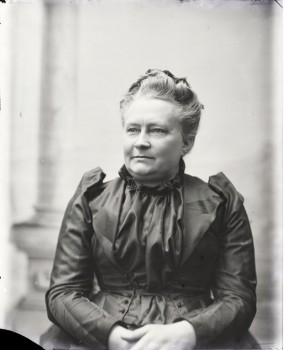
Minna at 50. The Finnish flag is flown on her birthday: 19 March has been named the Day of Equality. Canth also flies on the tail of one of the aircrafts of the Nordic airline Norwegian: the fleet carries portraits of ‘heroes’ and ‘heroines’ of four Nordic countries (the other Finn is the 19th-century poet J.L. Runeberg). Original photo: Viktor Barsokevich / Kuopio Museum of Cultural History
Herkkä, hellä, hehkuvainen – Minna Canth
[Sensitive, gentle, radiant – Minna Canth]
Helsinki: Otava, 2014. 429 pp., ill.
ISBN 978-951-1-23656-6
€40.20, hardback
There are two sure methods of preserving the freshness of the works of a classical author in a reading culture that is increasingly losing its vigour.
The first is to give a high profile to new interpretations of them, either in the form of scholarly lectures or of artistic re-workings, such as dramatisations, librettos or film scripts. Another unbeatable way to keep them alive as a subject of discussion is an updated biography, through which the author is seen with new eyes.
Minna Canth (1844–1897) is now celebrating her 170th anniversary, and she is fortunate in both respects. Having begun her literary career in the late nineteenth century, she still continues to be Finland’s most significant female writer.
Her influence on the role of women in society and, in particular, her promotion of girls’ education, is the cornerstone of Finland’s social equality. In the twenty-first century Canth’s plays are still receiving new interpretations, and they have also been made into operas and musicals. (Read her short story, ‘The nursemaid’, here.) More…
Can’t say it’s not spring
18 April 2013 | Fiction, Prose
Short prose from Mahdottomuuksien rajoissa. Matkakirja (‘In the realm of impossibility. A travel book’, Teos, 2013). Texts by Katri Tapola, illustrations by Virpi Talvitie. Interview by Anna-Leena Ekroos
The first try
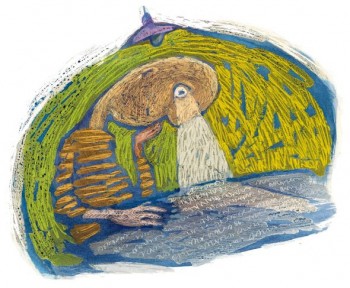
A reader doesn’t have to understand anything on the first try. You can always put a book aside and see if the second read will help. If the second, third, fourth, or even fifth read doesn’t help, that’s still all right. What is this constant compulsion to understand everything? There’s nothing wrong with not understanding – on the contrary, it is precisely the state of baffled befuddlement that hides the hope of light within it. I can’t understand any of this! I’m having fun! the reader happily exclaims, and goes on with his life, eyes overflowing with light. More…
Green gold, black gold
31 March 2001 | Archives online, Fiction, poetry
Poems from Jakutian aurinko (‘The Yakutian sun’; Tammi, 2000). Introduction by Kari Sallamaa
So this, then, is Tomsk,
a town, tumbling into snow.
Even its lanes rise up into the sky.
No longer fragrant the pine,
the juniper, not even the gardens.
Can’t trust the skirts,
above the rooftops,
stripes are beaten out of the carpet,
yellow and turquoise for the horizon,
under the rooftops, fingernails
rip the wallpaper,
those white frost fingernails.
So, this is Tomsk,
in its streets the Volgas zip by.
And when I get a ride, the back seat fills up in no time.
Breath steams, nylon rips. The ladies
apply lipstick, unconcerned. More…