

Search results for "Riikka/2010/10/mikko-rimminen-nenapaiva-nose-day"
A taste of life
30 March 2004 | Authors, Reviews
 The origins of the world, personal histories and Finnish history intertwine in a language bringing new meanings to familiar words and placing newer words in their older contexts. In her new collection of poetry, her fourth, Olen tyttö, ihanaa! (‘I’m a girl, wonderful!’, Tammi, 2003), Merja Virolainen (born 1962) combines reality and make-believe, life lived and that yet to come, in an outstanding fusion of themes and images.
Virolainen is a master of words. Last year she published and edited a substantial body of long-awaited translations of poetry from two continents. The Finnish-German poetry anthology Toisen sanoin / Mit den Worten des Anderen (‘In someone else’s words’, Like, 2003) demonstrates how meanings and reading between the lines can open up across two languages. The volume Hän jota ei ole (‘The one who doesn’t exist’, Nihil Interit, 2003), focusing on contemporary English-language poetry from India, is a fine testament to the immense undertaking of its two editors, Virolainen and Markus Jääskeläinen. The anthology is the most extensive collection of post-colonial poetry ever published in Finland. More…
Prose prizes
7 May 2010 | In the news
This year’s Finnish Government Prizes for Literature and Translation have been awarded to, respectively, the writer and journalist (and former Editor-in-Chief of Books from Finland) Kristina Carlson (born 1949) and the translator Tarja Roinila (born 1964). The prizes, which are given on the recommendation of the Finnish National Council for Literature and are worth €15,000 each, were awarded at a ceremony in Helsinki on 4 May by the Minister of Culture and Sports, Stefan Wallin.
Carlson’s second novel, Herra Darwinin puutarhuri (‘Mr Darwin’s gardener’, Otava), published last autumn, is a taut, deep and rich story narrated by many voices, contrasting science and faith, solitude and community. ‘It is not often that a single work renews the novel form,’ remarked the jury. (We featured an interview with Carlson, as well as an extract from the novel here on the Books from Finland website last September.)
The translator Tarja Roinila has specialised in prose and poetry written in Spanish, French and German; her latest translations, of the linguistically complex novels of the Austrian author Thomas Bernhard, are extremely musical, the jury remarked.
On 4 May, which was celebrated in Finland as the Day of the Book and the Rose (this custom, which originally took place on St George’s Day, April 23, was born in Barcelona: originally men gave women roses, and received books in return), Kristina Carlson received the Kiitos kirjasta (‘Thanks for the book’) medal, awarded jointly by the Booksellers’ Association, the bookshop sales asistants’ association Libro and the Finnish Library Association.
At the sand pit
30 September 1985 | Archives online, Fiction, Prose

Antti Tuuri. Photo: Jouni Harala
‘After nearly 40 years of observing the Ostrobothnians, I am convinced that they have certain characteristics which explain the historical events that took place there and which also shed light on the region today. I do not know how these characteristics develop, but it appears that heredity, economic factors and even the landscape form the nature of people. Everywhere people who live in the plains are different from those who dwell in the mountains, and from those who fish the archipelagos,’ writes the author Antti Tuuri, himself an Ostrobothnian.
Antti Tuuri’s Pohjanmaa (‘Ostrobothnia’, 1982), which last January was awarded the Nordic Prize for Literature, has now been translated into each language of the Nordic countries. Tuuri’s novel describes the events of one summer day in Ostrobothnia, on the west coast of Finland, where a farming family, the Hakalas, has gathered for the reading of the will of a grandfather who emigrated to the United States in the 1920s.
The inheritance itself is insignificant, but it has brought together the four grandsons, with their wives and children. The story is narrated from the point of view of one of the brothers. The women of the family remain inside while the men take out an automatic pistol which has been kept hidden away since one of them smuggled it home from the Continuation War. The men go off to a sand pit to do some shooting and to drink some illegal home brew. There they meet their former schoolteacher, who joins in with their drinking and shooting. Some surprising events take place as the day’s action unfolds, and Tuuri’s narrator views them in an unsentimental way, describing them matter-of-factly and at times with ironic humour. The men recall the violent history of Ostrobothnia, the years of the Civil War and the right-wing Lapua movement of the 1930s.
The Nordic Prize jury commented that the novel ‘portrays the breaking up of the old society, and conflicts between generations as well as between men and women.’ Tuuri has constructed his novel on conflicts, and the result is a highly dramatic narrative.

An extract from Pohjanmaa (‘Ostrobothnia’)
A Finnish hound dog came out of the woods just beyond the sandpit, stopped at the edge of the pit and started to bark at us. The boys quickly began putting the weapon together. Veikko yelled that you were allowed to shoot a dog running loose in the woods out of hunting season. He kept asking me for cartridges; he’d shoot the dog right away, before it could tear to pieces the young game birds that couldn’t fly yet. I told him to shut up. Seppo finished putting the automatic pistol together and gave it to me. I ran to the car, put the gun down on the floor in front of the back seat and tossed a blanket over it.
When I got back, I saw the teacher coming out of the woods over by the pit. He snapped a leash on the dog and started towards us through the pine grove. The boys sat down around the campfire and began taking swigs of home brew from their cups. More…
True or false?
An extract from the novel Toiset kengät (‘The other shoes’, Otava, 2007). Interview by Soila Lehtonen
‘What is Little Red Riding Hood’s basket like? And what is in it? You should conjure the basket up before you this very moment! If it will not come – that is, if the basket does not immediately give rise to images in your minds – let it be. Impressions or images should appear immediately, instinctively, without effort. So: Little Red Riding Hood’s basket. Who will start?’
Our psychology teacher, Sanni Karjanen, stood in the middle of the classroom between two rows of desks. Everyone knew she was a strict Laestadian. It was strange how much energy she devoted to the external, in other words clothes. God’s slightly unsuccessful creation, a plump figure with pockmarks, was only partially concealed by the large flower prints of her dresses, her complicatedly arranged scarves and collars. Her style was florid baroque and did not seem ideally suited to someone who had foresworn charm. Her hair was combed in the contemporary style, her thin hair backcombed into an eccentric mountain on top of her head and sprayed so that it could not be toppled even by the sinful wind that often blew from Toppila to Tuira. More…
On Pentti Saarikoski
31 December 1977 | Archives online, Authors
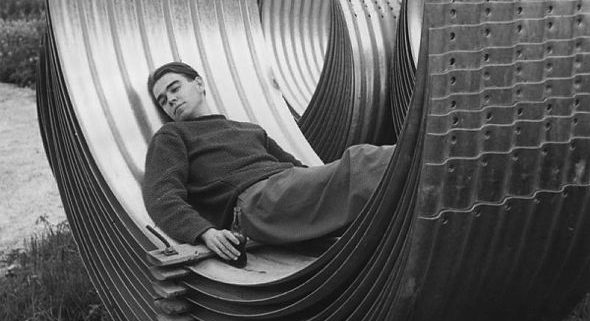
Pentti Saarikoski (1937–1983). Photo: Markku Rautonen / Otava
Born in 1937, Pentti Saarikoski was one of the many Finnish children who were evacuated to safety in Sweden during the Second World War. For almost twenty years – 1958–1975 – he had a sensational career as the enfant terrible of the new wave of post-war Finnish verse and as a translator of classical Greek poetry. Now Saarikoski is once more in Sweden, where he lives in a kind of spiritual and intellectual exile. The vast scope of Saarikoski’s work as a translator reveals the breadth of his interests and poetic skill. Among his translations into Finnish are works by Aristotle, Euripides, Sappho, Theophrastus, Xenophon and Homer’s Odyssey (a free verse translation that has been particularly praised for the freshness it brings to the work). Saarikoski’s translations of J. D. Salinger and Henry Miller have introduced modern urban slang into Finnish literature, and together with his brilliant translation of James Joyce’s Ulysses (1964) epitomise the catholicity of his interests. Saarikoski’s first poems were written in the spirit of ‘Finnish Modernism’: short poems, pleasing in their treatment of language, subtly erotic and ironic, drawing their strength from a fleeting image, metaphor or momentary fancy. Early in the 1960s, Saarikoski emerged from his scholarly retreat. He became a favourite of the yellow press and of television, he was held in the awe normally reserved in other parts of the world for royalty and pop stars. He loved this publicity and the scandal he deliberately created: he saw his function as to provoke the youth of the day to reject established ideas of authority and morality. He further outraged the middle classes (into which he himself was born) by joining the Communist Party.
More…
Poems with rounded corners
30 September 1992 | Archives online, Fiction, poetry
Poems from Talvirunoja (‘Winter poems’, Art House, 1990) and Runot! Runot (‘Poems! Poems’, WSOY, 1992)
A prayer for the trees and the rocks
Around noon I start praying
	 for the trees and the rocks
     to whom we have always been merciless.
What have we done?
    What are we doing?
In the valley of the scribbling species
Man and Woman are two animal species, sufficiently close
to allow procreation.
	They live in a cage called The Human Being,
in a place known as
		the Valley of the Scribbling Species.
    Woman is the more important animal
But Man built the cage.
The dog-man’s daughter
30 December 2001 | Fiction


 Extracts from the radio play Porkkalansaari (‘The island of Porkkala’, the Finnish Broadcasting Company, 1993)
The surface of the earth is the first to freeze; then the still waters. The sea freezes at the shore often at the same time, on the same night, as the slow-flowing brooks. I have watched them for many years. When you live in the same place for a long time, you notice this much: that almost everything just repeats and repeats.
It flows into a plastic tube. I suppose water flows inside it. You could drop matchsticks in on the other side of the road and wait on this side for them to swim through the drum. You’d only have to find one; that would be enough to prove it. More…
A crafty Christmas
9 December 2011 | This 'n' that
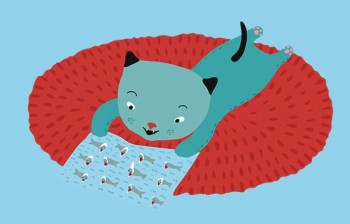
Advent calendar: make one yourself! Illustration: Virpi Penna
December: the street decorations, which have been up for a month, are beginning to look a little tawdry; the office party season is in full swing and most people are beginning to feel a little the worse for wear; there are only – let’s not count them, but far too few, shopping days left till Christmas.
Festive stress has already set in, and we’re not even halfway through the month.
That’s the scene in London, at least.
In Finland, Christmas and the weeks leading up to it are a much more muted, not to say calmer, affair. The customary greeting at this time of year is ‘rauhallisia joulunalusviikkoja’ – ‘peaceful before-Christmas weeks’ (well, who isn’t afraid of Xmas panic…) and Christmas itself has a quiet, candle-lit, somehow pious quality (even for non-believers).
The tone is set by the announcement of the Christmas peace from the city of Turku at noon on Christmas Eve, and many people still begin their celebrations with a visit to the graveyard to set a lighted candle on the graves of nearest and dearest before proceeding to the festivities: the traditional Christmas dinner (with its centrepiece of ham, not turkey), followed by a visit by Father Christmas, preferably in person.
In the harsh weather and short daylight hours of this time of year so far north, staying in has a lot to recommend it, and making things at home in preparation for Christmas has always been a popular pastime – with children in particular. This year the Thisisfinland website together with Tammi publishers, in conjunction with the writer Mysi Lahtinen and the children’s illustrator Virpi Penna, has produced an online advent calendar with a crafts project for each day up to Christmas Eve.
Whether it’s making a snowflake window from cut paper, simply painting birch-twigs white or, if the climate permits, celebrating Finland’s Independence Day (6 December) by making a lantern out of snow and a candle, these are projects that can be tackled by the young, and the young at heart, of any age.
While Joulupukki may feel slightly stressed (but with him, of course, it’s an occupational hazard), we wish you a peaceful pre-Christmas fortnight!
Hilda Husso
31 March 1980 | Archives online, Fiction, Prose
A short story from Kun on tunteet (‘When you have feelings’,1913). Introduction by Irmeli Niemi
A Phone call between Hotels
‘Hello – is that the Francesca?’
‘— — —’
‘I’d like to speak to Mr Aksel Lundqvist, the maître d’hotel, if it’s possible, please.’
‘— — —’
‘Oh, I see, that is Mr Lundqvist. I’m ringing from the Iris Hotel. It’s Hilda Husso here – do you remember me, Mr Lundqvist?’
‘— — —’
‘I used to be at Ekbom’s, as a cleaner, in the Brasserie, and I got pregnant – it was a boy, you may remember?’
‘— — —’
‘Hello, what was that, I can’t hear?’ More…
Upstairs, downstairs
31 March 2000 | Archives online, Fiction, Prose
From Harmia lämpöpatterista (‘Trouble with the radiator’, Gummerus, 1999). Introduction by Tero Liukkonen
The view
From here, I can see straight into their bedroom. The thin man chases the red-haired mountain of lard; round and round the room they go: the man is swinging something in his hand, I can’t see what, while the lard-mountain squeals until the man throws her onto the bed. The same thing happens every night; I can’t see the bed. Too low, and I wouldn’t want to, besides; lewd ugly makes me sick that I can even think of it.
Downstairs a young man is always watching TV, sitting there motionless all evening. The blue flickers, never turns on the light, a young man. He has long, slender legs and arms, but his face I can’t see, it’s too dark. There are painting tools on his window sill. More…
Burgundian rain
30 September 1992 | Archives online, Fiction, poetry
from Burgundiska sviten (‘Burgundian suite’, Schildts, 1966). Introduction by Tuva Korsström
and if we could reach our Burgundian boundaries
you close to mine and I closer to yours than mine
and there see far beyond all boundaries
and there see jar beyond all shores
and there see far beyond all seas
and the ice blocks which this winter’s day
are brought heaving from below and the numbed cliffs
and ice-shattered shores vanish
and before us lies our open
quite open and naked sea More…
On Bo Carpelan
30 September 1977 | Archives online, Authors
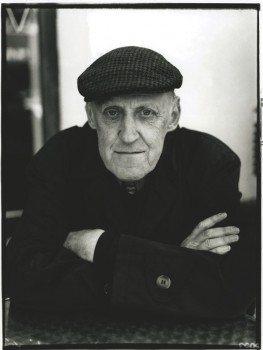
Bo Carpelan. Photo: Ulla Montan
For a small country Finland is richly endowed with poets. Of particular interest, in view of the smallness of the Finland-Swedish population (about 7% of the total), is the number of poets who speak and write Swedish as their first language and consistently produce work of outstanding quality. International recognition of the work of one of these poets came earlier this year with the award of the Nordic Council Literary Prize to Bo Carpelan.
Carpelan’s first volume of verse, Som en dunkel värme (‘Like a dark warmth’) appeared in 1946. Since then he has brought out a further ten volumes of poetry and six prose works (all published by Schildt, Helsinki). It would be difficult, and probably premature, to attempt any detailed analysis of the fusion of influences and inspiration that have come together in Carpelan’s poetry. It is clear, however, that his early work has points of contact with the Finland-Swedish modernism of the 1920s and that he followed with particular interest the 40-talists, a group of Swedish poets active in the 1940s: the influence of their heavy, profuse imagery can be discerned in his early collections.
Critics identify two main periods in Carpelan’s poetry. The first of these is represented by his first volume and by Du mörka överlevande (‘You dark survivor’, 1947), Variationer (‘Variations’, 1950), Minus sju (‘Minus seven’, 1952) and Objekt för ord (‘Objects for words’, 1956). The second period begins with the collection Landskapets förvandlingar (‘The changing landscape’, 1957) and was followed by Den svala dagen (‘The cool day’, 1961), 73 dikter (’73 poems’, 1966), Gården (The courtyard’, 1969), Källan (‘The spring’, 1973) and most recently by I de mörka rummen, i de ljusa (‘In the dark rooms, in the bright ones’, 1976). In all his poetry Carpelan sees life as a mystery, but his approach to this mystery changes and develops. In his earlier works his language is deft, yet at the same time private and intimate, later it becomes sharp and simple. More…
The mighty word
15 November 2012 | Fiction, Prose
‘Mahtisana’, a short story from the collection Lapsia (‘Children’, 1895). Introduction by Mervi Kantokorpi
Mother and Dad hadn’t said a single word to each other since lunchtime. The children, Maija and Iikka, were quiet, too. They sat apart, Iikka on the chair at the end of the sofa, where he could see the moon through the window, and Maija next to the window looking out on the street, where children moved about on skis and sleds. They didn’t dare make a sound, not even a whisper to ask for permission to go outside. It had been so quiet all that Sunday evening that when Mother spoke, encouraging them to go out and play, both of them nearly jumped.
They left without saying a word, Maija creeping quite silently. Even out in the courtyard she and Iikka still spoke in whispers as they decided which hill to go to. They didn’t really want to go anywhere, but when they came out to the street and could hear the happy shouts of children from every direction, it refreshed their spirits. Maija sat Iikka down on the sled and set off at a run, pulling him behind her. She felt as if her gloomy mood was falling away in pieces to be trampled underfoot.
A few streets down there was a large crowd of boys on the corner. They decided to go and see what was happening. More…
Stars above
30 December 1998 | Fiction, Prose
Extracts from the novel Benjamins bok (‘Benjamin’s book’, Schildts, 1997)
There are people who feel they are in contact with the stars. Among those who carry their secret knowledge around with them are both the healthy and the ‘sick’. Now I remember Olli stretching his arm out towards the evening star and seeming to greet it. For others, for me, the starry heavens are a form of distant vertigo. All those milky ways and galaxies, how could they not be inhabited, have developed a culture far older than our own. Perhaps they have watched the development of our planet with distaste, and are waiting for its ruin, which according to their calculation of time will take place in a few years or days from now. If I listen closely I seem to be faintly approached by a celestial choir, composed of indistinct sounds; if I stand on a lonely road in the country, and look up at the sky, the light and faint murmur from a nearby town emerge, and can be separated from the faint voices of the starry heavens. It is probably just my imagination. Perhaps it is an extension of that voice – anonymous, quiet – that I hear when I read a book. A good book is audio-visual. And no harm is done if it gives the reader a mild sense of vertigo. More…