

Search results for "Riikka/2010/10/mikko-rimminen-nenapaiva-nose-day"
Science and fiction
15 September 2011 | Authors, Interviews
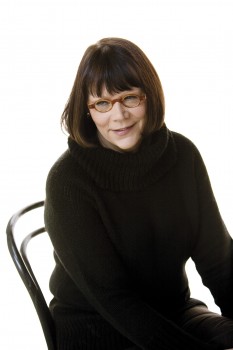
Kristina Carlson. Photo: Tommi Tuomi
Interview with Kristina Carlson, author of William N. Päiväkirja (‘William N. Diary’, Otava, 2011)
‘Monsieur W. Nylander had died alone, his head resting against his desk. We’d known for a long while that your beloved relative was not well, but whenever he was walking along the street and someone enquired as to his health, he always replied that he felt fit and well.’
Finnish-born Monsieur William N. lives in Paris at the end of the 19th century. The grumpy old scientist spends his days studying lichens in his small, dusty apartment and writing bitter comments in his diary about the way of the world, all things meaningless, and the glory and reputation that he never achieved.
William Nylander (born Oulu, 1822 – died Paris, 1899) is a historical figure who truly existed, and the remarks quoted above are taken from a letter sent by William’s housekeeper to his sister Elise in Finland, but other than this William’s diary is entirely the work of Kristina Carlson. The hermetic botanist has now become the protagonist of a novel written in 2011. More…
And he left the road
30 June 1983 | Archives online, Fiction, Prose
Three short stories from Maantieltä hän lähti (‘And he left the road’). Introduction by Eila Pennanen
And he left the road
And he left the road, walking straight ahead across fields and ditches, past barns and through bushes growing in the ditch. From the fields he went on to the forest, climbed a fence, walked past spruce and pine, juniper bushes and rocks, and came to the edge of a forest and to the swamp. He crossed the swamp, going through small groves of trees if they happened to be in his way. He went on walking rapidly across rivers, through forests, over seas and lakes, and through villages, and finally he came back to the very spot from which he had started walking straight ahead.
In the same way he walked at a right angle to the direction he had first taken and after that, a few times between those two directions. Every time he would start from the road and in the end would always come back to the road in the same direction as when he’d started off. On his rounds, after walking a bit, he would stop and look up every now and then, and each time he looked he would see the sky and sun or the moon and stars. More…
The Session
30 June 1982 | Archives online, Fiction, Prose
Pappas flicka (‘Daddy’s girl’, 1982), an extract of which appears below, is published in Finland by Söderstrom & C:o and in Sweden by Norstedt. The Finnish translation is published by Tammi. Introduction by Gustaf Widén
At first I say nothing, as usual.
Dr Berg also sits in silence. I can hear him moving in his chair and try to work out what he’s doing. Is he getting out pen and paper? Or perhaps he has a tiny soundless tape-recorder he is switching on.
Or is he just settling down, deep down into his armchair, one leg crossed over the other, like Dad used to sit? I used to climb up on to his foot. The he would hold my hands and bounce his foot up and down, and you had to say “whoopsie” and finally with a powerful kick, he would fling me in the air so that I landed in his arms.
I have worked it out that the little cushion under my head is to stop us lunatics from turning our heads round to look at Herr Doktor.
It would certainly be nice to sit bouncing up and down on Dr Berg’s foot. His ankle would rub me between my legs …
I soon start feeling ashamed and blush.
“Mm,” says Dr Berg, as if reading my thoughts. Or can he see my face from where he is sitting? I try rolling my eyes up to catch a glimpse of him, but all I can see is the ceiling with all its thick beams.
“I seem to have been here before,” I say. More…
Christel Rönns: Det vidunderliga ägget [A most extraordinary egg]
24 January 2013 | Mini reviews, Reviews
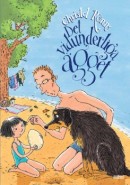 Det vidunderliga ägget
[A most extraordinary egg]
Kuvitus [Ill. by]: Christel Rönns
Helsingfors: Söderströms / Stockholm: Bonnier Carlsen Bokförlag, 2012. 32 p., ill.
ISBN 978-91-638-6857-3
€16.90, hardback
Finnish edition:
Perin erikoinen muna
Suom. [Translated by] Mirjam Ilvas
Helsinki: Tammi, 2012. 30 p., ill.
ISBN 978-951-523-183-3
€15.90, hardback
This is the third work that the graphic designer and illustrator Christel Rönns (born 1960) has written in her own right. With her relaxed and humorous illustration style, Rönns has provided the visual component of some 60 children’s books. This story portrays a family – parents, two little girls and a dog (the author has dedicated her book to the memory of her hovawart dog Freja who died at 14). One summer’s day they find a large egg on the beach and bring it home. But the egg, dropped by accident, reveals a little four-legged creature: named Koi-Koi, it turns out to be delightfully friendly and playful. Nobody actually knows what it is – not even a professor of zoology – but it eats and grows to an enormous size, so the house becomes very cramped (and Koi-Koi’s massive farts send the family running…). But then Koi-Koi begins to disappear at night, and one day he doesn’t come back. Missing a lost pet is a new feeling for the girls (their parents must be secretly relieved, as must the dog!). The story is both funny and gently melancholy, the illustrations detailed and humorous. The book was awarded the Finlandia Junior Prize in 2012.
Love is the only song
7 August 2014 | Fiction, poetry
Poems from Helise, taivas! Valitut runot (‘Ring out, sky! Selected poems’, Siltala, 2014). Introduction by Marja-Leena Mikkola
Who will tell me?
Who will tell me why white butterflies
strew the velvet skin of the night?
Who will tell me?
While people walk, mute and strange
and they have snowy, armoured faces,
such snowy faces!
and the eyes of a stuffed bird.
Who will tell me why in the morning, on the grass,
the thrushes begin their secret game?
Who will tell me?
While black soldiers stand at the gate
in their hands withered roses
such withered roses!
and broken tiger lilies.
Who will tell me, quietly in the sun’s shadow
how to bare my heart?
Who will tell me?
Come to me over the fields
Come close and softly
so softly!
Open the clothes of my heart. More…
Poets, pastries and prizes
5 February 2015 | In the news
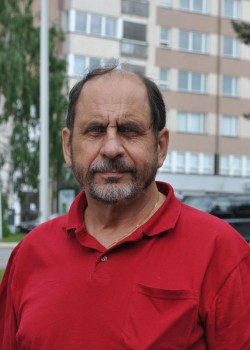
Joni Skiftesvik. Photo: Hilkka Skiftesvik
The Runeberg Prize for fiction is awarded to Joni Skiftesvik (67) for his autobiographical novel Valkoinen Toyota vei vaimoni (‘The white Toyota took my wife’).
Today, 5 February, is celebrated in Finland as the birthday of the poet J.L. Runeberg (1804-1877), known as the Finnish national poet, and writer – among many other things – of the lyrics of the national anthem.
In addition to the eating (in the Books from Finland offices, at least) of the rather delicious Runeberg cakes, it is also marked by the annual award of the Runeberg Prize, worth 10,000 euros.
The book tells the often harrowing story of Skiftesvik’s family, including illness, estrangement and death. In making the award, the jury commented: ‘This story appeals to the emotions, it touches the reader; but most important of all, after the book is closed, a miracle happens: its weighty content lives on in the mind, growing day by day. Many good novels have been written, but a masterpiece is recognised from its lasting effects.’
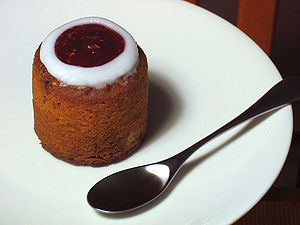
Runeberg’s favourite. Photo: Ville Koistinen
Underage
30 June 1999 | Archives online, Fiction, Prose
A short story from Leiri (‘Camp’, Otava 1972). Interview by Maija Alftan
In the dark and wet the tram seemed like a stale-smelling and badly-lit waiting room at a country station, its Post Office Savings Bank advertisement set out of reach of vandalising underage hands. The conductress was two-thirds out of sight behind her desk: a small person. I glanced at the time stamped on my ticket. My only timepiece.
It was the time of day when you can see your own face in the window and through to the outside as well. I stood in the doorway, hanging onto the bar. As the tram turned into the narrow canyon of Aleksanterinkatu, the street seemed like some kind of cellar. Fantastic, how the world darkens at the end of the year. And then, when it’s at its darkest, everything goes totally white. The low-slung cars seemed to be slinking round the tram’s feet. More…
Kullervo’s story
31 March 1989 | Archives online, Fiction, Prose
Paavo Haavikko wrote this manuscript for the television series Rauta-aika (‘Age of iron’), broadcast in 1982. lt also appeared as a book in 1982, complemented by Kullervon tarina (‘Kullervo’s story’ ) which had been omitted from the original. The text follows the stories of the Kalevala, but they are given a new interpretation: the characters are demythologised, they resign themselves to their fates – they are like ourselves. These extracts are the final scenes in which incest, revenge and death appear in a slightly different guise from Kalevala, or Kivi’s Kullervo.
– Mother, on the road I met your daughter, who is my sister, and took her into my sleigh. She had broken one of her skis. Spring came in one day, the clouds in front of the moon tore themselves to shreds so that two moons passed in one night. Winter went, Spring came, I brought the sleigh back, and I slept on top of the sacks so that not a single grain or seed would be lost. It’s all in the sacks now, saved. The clouds tore off their clothes and washed them in the rivers of rain, and naked, in the dark, they waited for their clothes to dry, those clouds. They even darkened the moon, they would have killed it if they could have reached that far, as it spied on the cloud women who were washing the clothes they had taken off in the waters of heaven, and two moons passed in one night, Kullervo says to his mother, piling up lies like a little boy. Many words. More…
The fairest in the land
26 January 2012 | Children's books, Fiction
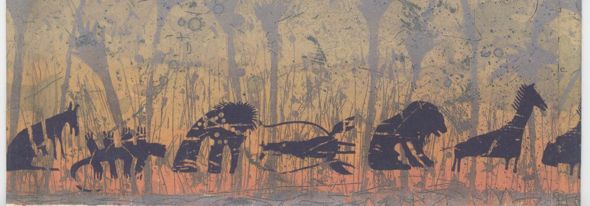 Two fables from Gepardi katsoo peiliin (‘The cheetah looks into the mirror’, Tammi, 2003). Illustrations by Kirsi Neuvonen. (More fables by Hannele Huovi here.)
Lizard
The air rippled above the pile of stones. The lizard twitched her hip and took up an s-shaped pose like an ordinary photo model. After a moment she changed her left side to a convex curve. The movement was quick and graceful; the lizard’s tail swished through a broad arc so quickly you could hardly see it. Her thin, blistery skin pressed against the surface of the stone. The lizard felt the rough, raised patterns through the thin skin of her belly. She felt unpleasant, but otherwise the place was good, and the lizard did not have the energy to look for a better one. She looked through her eyelashes at the fissured sky and saw the golden disc shining at the centre of the dome. She was happy. Everything in her life was good, the weather was pleasantly dry, the temperature exactly suitable. More…
Jussi Pekkarinen: Maailmanluokan tarkkailupaikka. Suomen Lontoon suurlähetystön historia [A world-class observation post. The history of Finland’s London embassy]
28 September 2012 | Mini reviews, Reviews
 Maailmanluokan tarkkailupaikka. Suomen Lontoon suurlähetystön historia
[A world-class observation post. The history of Finland’s London embassy]
Helsinki: Finnish Literature Society, 2012. 380 p., ill.
ISBN 978-952-222-365-4
€ 38, hardback
Finland’s diplomatic mission in London began its formation after the country gained its independence in 1918 and was officially recognised by Britain in 1919. The Embassy has always been important to Finland because of Britain’s leading significance for Finland and because Britain has been one of Finland’s most prominent trading partners. This interestingly written history, based on Finnish and British sources, also portrays the development of relations between the two countries. The ambassadors have been colourful and quick-tongued personalities; Pekkarinen describes some of the blunders caused by staff conflicts and cultural differences. As diplomacy is not merely representation – which in itself is a full-time job – it requires a mastery of issues relating to trade and politics. In addition to its depiction of the day-to-day work of the embassy staff, the book provides more general information about the diplomatic mission. Pekkarinen – a researcher in the Foreign Ministry – covers the period up to the early 1990s, but the concluding part of the book is a review of the embassy’s situation today by the current ambassador.
Translated by David McDuff
Suburban dreams
30 March 2004 | Fiction, Prose
Extracts from the novel Kahden ja yhden yön tarinoita (‘Tales from two and one nights’, Sammakko, 2003)
Reponen, Tane, Aleksi and Little Juha; once we all climbed up the path to the old dump with bows on our backs, our arrows sticking out from the tops of our boots. It was April. In the field above the dump puddles reflected the opaque sky, where we were going to shoot our arrows.
The field was the highest point in our neighbourhood. We could see the shopping centre, the library and the sawdust running track through the school woods. We could see the high-rise flats on Tora-alhontie road and the huts in the allotments. We could make out the thick spruce forest of Sovinnonvuori along the greenish grey coastline at Kapeasalmi. Our homes sat there below us. Softly droning cranes, yellow totem animals of hope, swung back and forth above the unfinished houses. In the distance was the centre of town with all its churches and scars. Here everything was just beginning. The swaggering confidence of ten-year-old boys was straining within us and would carry us far like Geronimo’s bow. More…
On becoming a forest
30 June 2006 | Archives online, Fiction, poetry
Extracts from Ei, siis kyllä (‘No. That’s to say, yes’, WSOY, 2006). Introduction by Anselm Hollo
Propaganda-as-prayer-wheel is a powerful weapon, because it is a
prayer-wheel.
If there is nothing else to write about, it is always possible to write a
biography of Stalin, with all the spices.
A neat composition has always sufficed as good history, one according
to which an administration has done its best when it has elected itself.
Direct and indirect conclusions are impossible.
‘Legitimised historians explicate the nature of documents in a taciturn
manner…’
Scholarship cannot be based on what Aristotle did not say.
What Aristotle did not say is not a fact.
It is useless. Silence alone is a helpful rhetorical figure. But I do not know
how to use it. Nor am I trying to learn.
