

Search results for "harjunpää/2010/10/mikko-rimminen-nenapaiva-nose-day/2011/04/matti-suurpaa-parnasso-1951–2011-parnasso-1951–2011/2009/09/what-god-said"
The rocket
30 September 1988 | Archives online, Fiction, Prose
Raketen (‘The rocket’), a novella from the collection Den segrande Eros (‘Eros triumphant’), 1912. Introduction by George C. Schoolfield
The sun shone straight in through the veranda’s little windows that made the whole ‘villa’ resemble a hothouse. With a sigh, Elsa let the morning paper fall to the floor; she had gotten halfway through the classified ads: ‘Three lads wish to correspond with likeminded lasses.’ ‘If Mr Söders-m does not fetch his effects, left as bond for unpaid rent, within a week, they will be regarded as our property, and his name will be published in toto.’ Now she could stand no more. The air seemed to come from a bakeoven. Listlessly, she watched two flies as they flicked the ceiling paper in their humming dance of love. It seemed as though knives were being thrust into the back of her head; that was the way her sick headaches began. A long walk might stop it, she knew, but she felt too tired.
At last, she was able to make herself get up and open the door for some fresh air. But with the air she got a powerful smell of roasting pork from the baker’s villa; the yells of the children playing cops and robbers up on the rock were doubled in force. A nasty stabbing sensation began in Elsa ears. And so she decided to take a walk after all, but only to the steamboat jetty. More…
Cause of death
30 June 1999 | Archives online, Fiction, Prose
A short story from Åtta kroppar (‘Eight bodies’, Söderströms, 1998). Introduction by Ann-Christine Snickars
It was a bailer, a blue one. There they were, he, she, the bailer and a stormtossed net on the stern board of a hired boat. The boat had come with the cottage and the cottage with ‘Autumn archipelago package. Now nature is aglow.’
And it was aglow.
Masses of foliage and apples, damson and shiny russula spread out around them in all their glory. It happened everywhere, that glowing. Wherever one turned one’s gaze there was something ready to be picked or ready to fall, ready in general. Those first days they had, at least to each other, she to him, feigned enthusiasm about all this ripe richness, but that time was over.
Their time of fire and flames was over. More…
‘ware bears!
30 September 1988 | Archives online, Children's books, Fiction
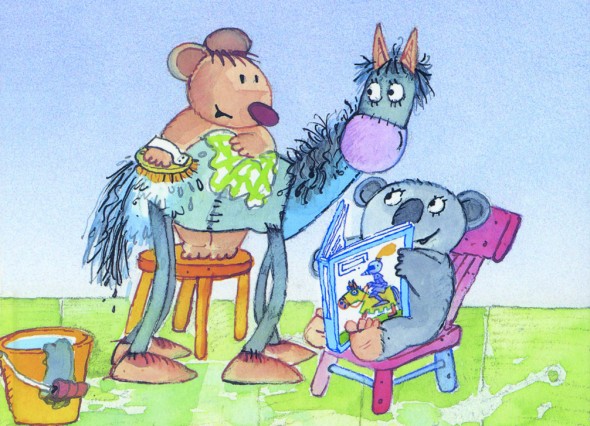
Illustration: Jukka Lemmetty
Urpo and Turpo are a pair of teddy bears. Their family – mother, father and three children – cannot imagine who it is that makes such a mess; the bears live their own absorbing lives in house. Hannele Huovi’s text and Jukka Lemmetty’s illustrations describe the bears’ antics in a way that appeals to the sense of humour of readers of all ages.
In the green house an ordinary family are living a perfectly ordinary life. There’s father, mother, The Big Daughter, The Son, and also The Baby as well. Mother keeps running back and forth all day long shouting, ‘Goodness gracious! Who’s responsible for this?’ For very funny things keep going on in the house. Who on earth is it – always getting up to some sort of hanky-panky?
Father harrumphs and says to The Big Daughter:
‘It was you, wasn’t it?’ But The Big Daughter shakes her head. Father turns to The Son:
‘So it must have been you, then?’ But the son shakes his head. No use asking The Baby. He shakes his head anyway, because he’s always imitating the others. Father and mother are completely stumped. More…
New literary prize
6 May 2011 | In the news
A new literary prize was founded in 2010 by an association bearing the name of Jarkko Laine (1947–2006) – poet, writer, playwright, translator, long-time editor of the literary journal Parnasso and chair of the Finnish Writers’s Union.
The Jarkko Laine Literary Prize will be awarded to a ‘challenging new literary work’ published during the previous two years. The jury, of nine members, will announce the winner on 19 May.
The shortlist for the first prize is made of Kristina Carlson’s novel Herra Darwinin puutarhuri (‘Mr Darwin’s gardener’, Otava, 2009), Juha Kulmala’s collection of poems, Emme ole dodo (‘We are not dodo’, Savukeidas, 2009) and Erik Wahlström’s novel Flugtämjaren (‘Fly tamer’, Finnish translation Kärpäsenkesyttäjä, Schildts, 2010).
The prize money, €10,000, comes jointly from the publishing houses Otava, Otavamedia and WSOY, the Haavikko Foundation, the City of Turku and the University of Turku.
Brighter than darkness
30 June 2002 | Archives online, Fiction, Prose
An extract from the novel Eksyneet (‘The lost’, WSOY, 2001). Interview by Markus Määttänen
It was a white tiled wall. Too white. Sterile. He wondered how long he had been looking at it. In any case long enough to have forgotten it was a wall. It had changed into a vacuum opening up before him and then shrunk into a tunnel through whose irresistible suction he had hurtled toward the painful images of the past. The past. Yesterday. Almost yesterday. He had stared at the nocturnal entrance, clearly divided in two by the street lamps, and not just that, but now saw only a lifeless and, in its lifelessness, repellant wall. He sighed, rubbed his numb face, pushed himself off the floor and stood up.
Jarl Hellemann in memoriam 1920–2010
15 March 2010 | In the news

Jarl Hellemann 1920–2010. Photo: Pertti Nisonen (2009)
One of the grand old men of Finnish publishing, Jarl Hellemann, wrote in one of his own books: ‘Book publishing is by nature personified, a personal activity.
‘Most of the world’s old publishing houses still bear their founders’ names: Bonnier, Collins, Heinemann, Harper, Knopf, Bertelsmann, Werner Söderström, Gummerus. Americans ignorant of the exceptions to this rule among Finnish publishers still occasionally begin their letters, “Dear Mr Otava” or “Dear Mr Tammi”.’ (From Kustantajan näkökulma, ‘A publisher’s point of view’, Otava, published in Books from Finland 3/1999)
Hellemann himself was Mr Tammi for a long time; he started as a publishing editor at Tammi Publishing Company in 1945 and retired as managing director in 1982.
In 1955 he founded Keltainen kirjasto, the ‘Yellow Library’, an imprint of novels published since the First World War by prominent writers from all over the world. The first was Too Late the Phalarope by Alan Paton, the latest – published in 2009 – was The Disappeared by Kim Echlin. The series now contains more than 400 works, among them novels by 24 Nobel prize-winners.
Among the books in Keltainen kirjasto (list, in Finnish), Hellemann’s favourite was James Joyce’s Ulysses, translated by the poet and author Pentti Saarikoski in 1964. Hellemann continued choosing books for Keltainen kirjasto long after he retired.
Born in Copenhagen, Hellemann moved with his family to his mother’s home country, Finland, in the 1930s. Well-travelled and fluent in many languages, Hellemann himself published a novel (at the age of 25), three books on publishing and, in 1996, his memoirs.
Daddy dear
30 June 2004 | Archives online, Fiction, Prose
Extracts from the novel Vanikan palat (‘Pieces of crispbread’, Otava, 2004). Interview by Soila Lehtonen
Dad’s at the mess again. Comes back some time in the early hours. Clattering, blubbing, clinging to some poem, he collapses in the hall.
We pretend to sleep. It’s not a bad idea to take a little nap. After a quarter of an hour Dad wakes up. Comes to drag us from our beds. Crushes us four sobbing boys against his chest as if he were afraid that a creeping foe intended to steal us. We cry too, of course, but from pain. Four boys belted around a non-commissioned officer is too much. It hurts. And the grip only tightens. Dad whines:
‘Boys, I will never leave you. Dad will never give his boys away. There will be no one who can take you from me.’ More…
Finlandia Prize candidates 2011
17 November 2011 | In the news
 The candidates for the Finlandia Prize for Fiction 2011 are Eeva-Kaarina Aronen, Kristina Carlson, Laura Gustafsson, Laila Hirvisaari, Rosa Liksom and Jenni Linturi.
Their novels, respectively, are Kallorumpu (‘Skull drum’, Teos), William N. Päiväkirja (‘William N. Diary’, Otava), Huorasatu (‘Whore tale’, Into), Minä, Katariina (‘I, Catherine’, Otava), Hytti no 6 (‘Compartment number 6’, WSOY) and Isänmaan tähden (‘For fatherland’s sake’, Teos).
Kallorumpu takes place in 1935 in Marshal Mannerheim’s house in Helsinki and in the present time. Laila Hirvisaari is a popular writer of mostly historical fiction: Minä, Katariina, a portrait of Russia’s Catherine the Great, is her 39th novel. Gustafsson’s and Linturi’s novels are first works; the former is a bold farce based on women’s mythology, the latter is about guilt born of the Second World War.
The jury – journalist and critic Hannu Marttila, journalist Tuula Ketonen and translator Kristiina Rikman – made their choice out of 130 novels. The winner, chosen by the theatre manager of the KOM Theatre Pekka Milonoff, will be announced on the first of December. The prize is worth 30,000 euros. It has been awarded since 1984, to novels only from 1993.
The fact that this time all the candidates are women has naturally been the object of criticism: why are the popular male writers’ books of 2011 missing from the list?
Another thing that these novels share is history: five of them are totally or partially set in the past – Finland in 1935, Paris in the 1890s, Russia/Soviet Union in the 18th century and in the 1980s, and 1940s Finland during the Second World War. Even the sixth, Huorasatu, bases its depiction of the present day in women’s prehistory, patriarchy and the ancient myths.
The jury’s chair, Hannu Marttila, commented: ‘This book year is sure to be remembered for a generational and gender change among those who write literature about the Second World War in Finland. Young woman writers describe the war with probably greater diversity than before. From the non-fiction writing of recent years it is clear that the struggles and difficulties of the home front are increasingly being recognised as part of the general struggle for survival, and on the other hand the less heroic aspects of war, the shameful and criminal elements, have also become acceptable as objects of study.’
Marttila concluded his speech: ‘When picking mushrooms in the forest, I have learned that it is often worth humbly peeking under the grass, and that the most glaring cap is not necessarily the best…. Perhaps it is time to forget the old saying that there is literature, and then there is women’s literature.’
Best Translated Book Award 2011
13 May 2011 | In the news
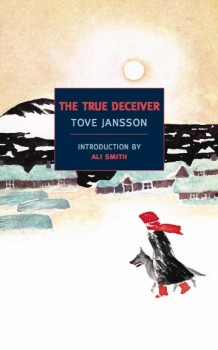 Thomas Teal’s translation from Swedish into English of Tove Jansson’s novel Den ärliga bedragaren (Schildts, 1982), entitled The True Deceiver (published by New York Review Books, 2009), won the 2011 Best Translated Book Award in fiction (worth $5,000; supported by Amazon.com). The winning titles and translators for this year’s awards were announced on 29 April in New York City as part of the PEN World Voices Festival.
Organised by Three percent (the link features a YouTube recording from the award ceremony, introducing the translator, Thomas Teal [fast-forward to 7.30 minutes]) at the University of Rochester, and judged by a board of literary professionals, the Best Translated Book Award is ‘the only prize of its kind to honour the best original works of international literature and poetry published in the US over the previous year’. ‘Subtle, engaging and disquieting, The True Deceiver is a masterful study in opposition and confrontation’, said the jury.
Tove Jansson (1914–2001), mother of the Moomintrolls, story-teller and illustrator of children’s books, translated into 40 languages, began to write novels and short stories for adults in her later years. Psychologically sharp studies of relationships, they are written with cool understatement and perception.
Quality writing will work its way into a wider knowledge (i.e. a bigger language and readership) eventually… even though occasionally it may seem difficult to know where exactly it comes from; in a review published in the London Guardian newspaper, the eminent writer Ursula K. Le Guin assumed Tove Jansson was Swedish.
Poems
31 December 1985 | Archives online, Fiction, poetry
Introduction by George C. Schoolfield
Birds of passage
Ye fleet little guests of a foreign domain,
When seek ye the land of your fathers again?
When hid in your valley
The windflowers waken,
And water flows freely
The alders to quicken,
Then soaring and tossing
They wing their way through;
None shows them the crossing
Through measureless blue,
Yet find it they do.
Unerring they find it: the Northland renewed,
Where springtime awaits them with shelter and food,
Where freshet-melt quenches
The thirst of their flying,
And pines’ rocking branches
Of pleasures are sighing,
Where dreaming is fitting
While night is like day,
And love means forgetting
At song and at play
That long was the way. More…
Landscape
30 June 2006 | Archives online, Fiction, Prose
(Landskap, 1919). Introduction by Juha Virkkunen
12 March
To begin with, there’s a great white field. The field is criss-crossed with low slender fences and little patches of yellow-green stubble peering up through the snow, and hare-tracks slanting away towards the stubble. But we won’t notice the fences and the stubble and the hare tracks. Because we’re going to take a wider, more sort of decorative view.
So we see the great white field. And where the field ends a dark green screen has been drawn. The screen has been cut short rather amusingly in the middle, so one can see yet another white held. This belongs to another village. And this other village itself has crept up timidly to the forest-clad hill and lies close to it, so we don’t notice this other village. Because we want to take a wider view of things. More…
For the love of a city
31 December 2004 | Archives online, Fiction, Prose
Extracts from the novel I väntan på en jordbävning (‘Waiting for an earthquake’, Söderströms, 2004). Introduction by Petter Lindberg
Nonna Rozenberg lived quite near the special school where I was a boarder, in a block nine stories high with a bas-relief to the right of the door. This bas-relief featured a fairy-tale figure – the Firebird or the Bird Sirin.
I often saw Nonna stepping out of a tram carrying a large brown case. She moved carefully, as if afraid of falling.
She played the cello, and resembled that bulky, melodious instrument herself. Women’s figures are often compared to guitars. But Nonna’s appearance never hinted at parties at home with parents away or singsongs around the camp-fire.
She was no beauty. Her slow, precociously mature body was neither graceful nor girlishly delicate. If I’d met her later, when I was working at a gym, I’d have said she was overweight and lacking in self-discipline. More…
In memoriam Bo Carpelan 1926–2011
24 February 2011 | Authors, In the news
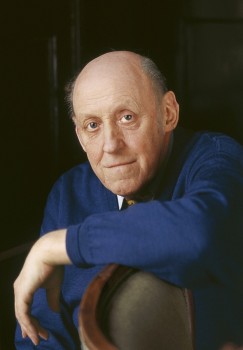
Bo Carpelan. Photo: Irmeli Jung
I write one winter’s day,
write off the day and the night, the planets,
go into my house from a harsh sun
and extend those shadows that are swordlike aimed.
It is a day of drifting snow
and with a voice from that which is I
or was.
(From The Cool Day. English translation by David McDuff, published in Homecoming, Carcanet, 1993)
Bo Carpelan, one of the great names of Finnish literature, died in his home city of Helsinki on 11 February. Carpelan’s first collection of poetry appeared in 1946, his last in 2010.
In his poems and prose he frequently described his childhood in apartment buildings filled with the smell of cooked herring, the noise of quarrels and the sound of the news on the radio. Prosaic life is turned into poetry, images and music, the apartment house is built from the rooms of a dream.
Bo Carpelan loved music. His novel Axel (English translation by David McDuff, 1989), is about his paternal grandfather’s brother, who was a friend of Jean Sibelius and the composer’s first critic. Axel was an unsuccessful musician who chose to live through someone else, and Carpelan relates him to the theme of the dignity of rejected human beings. More…
Lest your shadow fade
31 March 1987 | Archives online, Fiction, Prose
An extract from the novel Jottei varjos haalistu (‘Lest your shadow fade’, 1987). Interview by Erkka Lehtola
‘… learn, then, to like yourself.
Dancing beside your shadow, laugh and play.
Dance always in the sunlight, lest your shadow fade.’J. Fr. Erlander, 1876 (Erika Kuovinoja’s grandfather)
‘Tis in life’s hardness that its splendour lies.’
J. Fr. E., 1890
Three days before the date fixed for the funeral, the minister directed his steps towards the home of the deceased, trying, as he walked, to compose his thoughts, which were full of righteous Lutheran anger. There were many good reasons for this. On the other hand, nothing that had happened in the past ought to make any difference, now that he was on his way to visit a house of mourning. A visit that called for the exercise of understanding, and even, if possible, kindness. It was a lot for anyone to expect, even of a clergyman. It was not by his own desire that he was paying this call: it was a matter of duty. And this time he was the protagonist. Petulantly, his shoes crunched the gravel. More…