

Search results for "kjell west"
The snake
31 March 1998 | Fiction, Prose
In this horror story by the Finland-Swedish author Kjell Lindblad (born 1951), a man believes he is wandering among art installations in an apartment block – but the reality he is experiencing turns out to be much more sinister. From the collection of short stories Oktober-mars (‘October-March’, Schildts, 1997)
I only noticed the poster on the notice board in the vegetarian restaurant because it was so obviously different from the rest of the colourful items there, with their large headlines offering everything from Atlantic meditation to Zen ping-pong, together with promises of a new and fulfilled life in harmony with the soul and the cosmos. Poster is perhaps an overstatement it was a white sheet of paper with an egg-shaped oval in the middle. Inside the oval there was a horizontal row of seven numbers. For some reason, perhaps because the row of numbers was the only information on the piece of paper, it stuck in my memory and when I got home I had a compulsive desire to find out if it was a phone number. So I dialled the number and a tape-recorded voice that could have belonged to a man but equally well to a woman, said:
‘We bid you welcome. Please don’t write down the address just memorise it….’ More…
Round and round
2 December 2011 | Essays, Non-fiction
In this essay, Olli Löytty imagines himself in a revolving door that is able to spin his old family home and its inhabitants backwards in time – as far as prehistory. In addition to his own family’s past, Löytty zooms back into the history of the world’s great changes, for a moment playing the part of a cosmic god examining our globe
An essay from Kulttuurin sekakäyttäjät (‘Culture-users’, Teos, 2011)
If a film camera had stood outside my home from the time when it was built, I would rewind the movie it made from the end to the beginning. The story would begin with my children, one autumn morning in 2011, walking backwards home from school. The speed of the rewind would be so fast that they would quickly grow smaller; I, too, would get thinner and start smoking. I would curiously seek out the point where my wife and I are seen together for the last time, stepping out of the front door, back first, and setting out on our own paths, to live our own separate young lives.
At that time my grandmother still lives in the house with her two daughters and their husbands, and lodgers upstairs. The next time I would slow the rewind would be the point where, at the age of 18, finally move out of the house. The freeze-frame reveals a strange figure: almost like me, but not quite. In the face of the lanky youth I seek my own children’s features.
When I let the film continue its backwards story, I seek glimpses of myself as a child. Even though we lived in distant Savo [in eastern Finland], we went to see my grandmother in the city of Tampere relatively often. We called her our Pispala grandmother, although her house was located to the west of the suburb limit, in Hyhky. I follow the arrival of my grown-up cousins, their transformation into children, the juvenation of my grandmother and her daughters, the changing lodgers. At some point the film becomes black-and-white. More…
Life through the lens
22 December 2010 | Extracts, Non-fiction
Let’s go on a little pictorial journey in time with the photographer Erik Hägglund, whose camera went on clicking for 50 years: gentlefolk, peasants, children, old people and village views, beginning almost a hundred years ago in rural western Finland
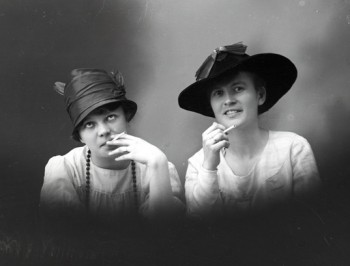
Ladies in hats: in the 1920s Vörå hats were only used by gentlewomen (and smoking was perhaps a little risqué). Photo: Erik Häggblom
Blickfång. En tidsresa med Vöråfotografen Erik Hägglund (‘In focus. A journey in time with the photographer Erik Hägglund from Vörå’. Red. [Ed. by] Katja Hellman, Meta Sahlström & Monica West. Helsingfors: Svenska litteratursällskapet i Finland, 2010
Old photographs may prove that what is utterly local can be perfectly universal.
That’s certainly the impression the reader gets by looking at the pictures taken by Eric Hägglund between 1910 and 1960.
The village of Vörå (in Finnish, Vöyri) on the west coast of Finland, near the Ostrobothnian city of Vasa (in Finnish, Vaasa) is traditionally mostly a Swedish-speaking community. Erik Hägglund, born 1884, lived, photographed and died there in 1962. More…
Toward good management practice
31 December 2003 | Archives online, Fiction, Prose
A short story from the collection Värjättyä rakkautta (‘Dyed love’, Otava, 2003). Introduction by Harry Forsblom
Because queries from the field have recently been received concerning the allocation of investment resources in our production facility in a business environment that is undergoing pressures for change, we have in close collaboration with other production organisations, drawn up a booklet on good management practice whose intention is in broad outline and by production sector to delineate in what way the current market situation should be taken into account in the practising of our trade.
The booklet Toward good management practice. Functional spatial planning, utility-oriented measures and allocation of production aims, in keeping with its subtitle, to present, by utility sector, the latest research-based knowledge in the field and thus offer our membership aids to decision-making in designing organisational innovations that demand investment. More…
Writers meet again in Lahti
14 May 2009 | In the news
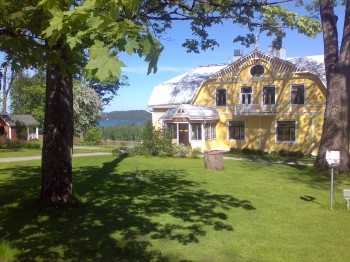
In other words: LIWRE at Messilä Manor
The Lahti International Writers’ Reunion (LIWRE; www.liwre.fi) will be held this year between 14 and 16 June.
In the politically and culturally active 1960s, marked by the confrontation between East and West, an idea was born to found an international, bi-annual rendezvous where writers from all over the world could freely engage in discussions on various themes.
Summer child
30 September 1988 | Archives online, Fiction, Prose
A short story from Resa med lätt bagage (‘Travelling light’, 1987). Introduction by Marianne Bargum
From the very beginning it was quite clear no one at Backen liked him, a thin gloomy child of eleven; he looked hungry somehow. The boy ought to have inspired a natural protective tenderness, but he didn’t at all. To some extent, it was his way of looking at them, or rather of observing them, a suspicious, penetrating look, anything but childish. And when he had finished looking, he commented in his own precocious way, and my goodness, what that child could wring out of himself.
It would have been easier to ignore if Elis had come from a poor home, but he hadn’t. His clothes and suitcase were sheer luxury, and his father’s car had dropped him off at the ferry. It had all been arranged over the phone. The Fredriksons had taken on a summer child out of the goodness of their hearts, and naturally for some compensation. Axel and Hanna had talked about it for a long time, about how town children needed fresh air and trees and water and healthy food. They had said all the usual things, until they had all been convinced that only one thing was left in order to do the right thing and feel at ease. Despite the fact that all the June work was upon them, many of the summer visitors’ boats were still on the slips, and the overhaul of some not even completed. More…
A spot of transmigration
13 January 2011 | Fiction, Prose
A short story, ‘Sielunvaellusta’, from the collection Rasvamaksa (‘Fatty liver’, WSOY, 1973)
‘Where will you be spending Eternity?’ a roadside poster demanded as Leevi Sytky sped by in his car.
‘Hadn’t really thought about it,’ Leevi muttered , as if in reply, and lit a cigarette.
But at the next level crossing, a kilometre or so further on, he was run down by a train, whose approach he had failed to notice. His attention had been distracted by the sight of a young woman who was picking black currants by the side of the track, and who happened to be bending forward in his direction. Intent on obtaining a better view of her ample bosom by peering over the top of her blouse, Leevi neglected to look both ways, and death ensued. Damned annoying, to say the least.
In due course he secured an interview with God, who turned out to be a biggish chap, about a hundred metres tall, wearing thigh-boots and sitting behind a large desk.
‘Well, and how’s Leevi Sytky getting along?’ God asked, lighting his pipe.
‘Mustn’t grumble,’ said Leevi politely.
‘And how are you thinking of spending Eternity?’ God inquired, sucking at his pipe and puffing out his cheeks. More…
Blowing in the wind
26 November 2010 | Reviews
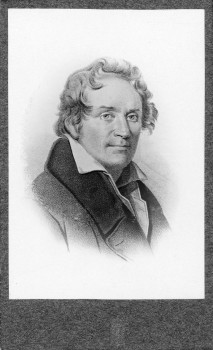
Clarinettist who travelled: Bernhard Crusell
Bernhard Crusell: Keski-Euroopan matkapäiväkirjat 1803–1822
[Bernhard Crusell: Travel Diaries from Central Europe, 1803–1822]
Suom. ja toim. [Translated into Finnish and edited by] Janne Koskinen
Helsinki: Suomalaisen kirjallisuuden seura [Finnish Literature Society], 271 p., ill.
ISBN 978-952-222-090-5
€28, hardback
Born the son of a poor bookbinder on the west coast of Finland, Bernhard Crusell (1775–1838) had talents as a clarinettist and composer that brought him considerable fame, both in his native country and further afield. Hannu Marttila reads the diaries he wrote on his travels in Europe, where his meetings with the great and the good chart the emergence of the new Romantic sensibility
‘Felix is a most beautiful child, and he is also said to be very unassuming. In his compositions one immediately recognises the signs of genius and good training. He continues to study under Zelter, and, thanks to an anticipated large inheritance, he, too, may become an independent composer. People here think he may even become another Mozart.’ More…
Chill climates
30 June 1984 | Archives online, Authors, Interviews
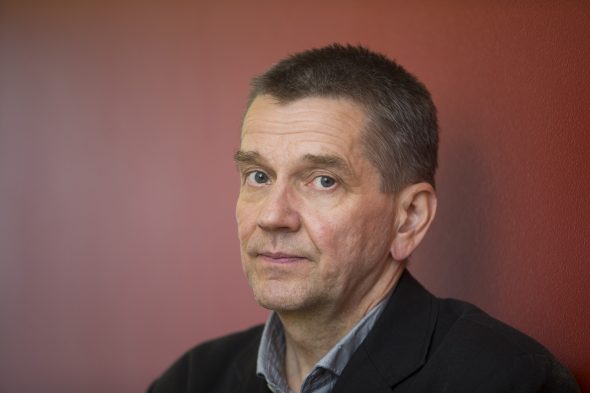
Olli Jalonen. Photo: Pekka Nieminen.
Olli Jalonen was born in 1954 and lives in Hämeenlinna. His first work, a collection of short stories entitled Unien tausta (‘The background of dreams’, 1978) and two later novels, Sulkaturkki (‘Feather coat’, 1979) and Ilo ja häpeä (‘Joy and shame’, 1981) were reviewed with exceptional warmth by the critics. His latest novel, Hotelli eläville (‘Hotel for the living’, 1983) brought him a State Prize for Literature in 1984. The awarding committee commented that the novel is ‘a representative of that rare genre in Finnish literature, the grotesque novel’. Jalonen also received the ‘Spurs of Criticism’, the annual prize awarded by the Finnish Critics’ Association. The hotel for the living is the book’s ironic name for a nuclear shelter that is being quarried into the living rock of Finland; Jalonen sets up a situation that allows him to examine the crevices of his characters’ personalities. He studies their attitudes to life with cool satire – they live in the bleak climate of buying and selling, the struggle for power and material goods, the domination of others, and submission to their fates. Interview by Markku Huotari
‘Poetry in a world under threat’ was the headline for a survey of Finnish poetry by poet and critic Väinö Kirstina that appeared in the Tampere daily newspaper Aamulehti in 1981.
Two years later that headline is just as bitingly relevant. Only one alteration is necessary: to poetry must be added prose, for prose, too, is addressing itself to that future, difficult enough to imagine, in which the threat of nuclear war may involve Finland, living in the shadow of the super powers, in a conflict in which she wishes no part.
One of the scenes in Olli Jalonen’s novel Hotelli eläville (‘Hotel for the living’) is set in a nuclear shelter that is being built inside the living rock on which Helsinki stands. Even now the planners of that ‘shelter’ use the fear of other people to their own ends, and divide them into those who will be saved and those who will perish.
A sermon on the day of judgement? Cliche? Milking of a fashionable subject? More…
Poetry written aloud
20 May 2011 | Reviews
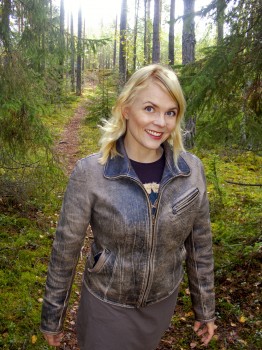
Heli Laaksonen. Photo: Otava/Irmeli Jung
In the 21st century, poetry written in various dialects has drawn new audiences to poetry readings. A common feature of, for example, Sinikka Nopola’s short prose about the family, written in the dialect of the Tampere area, and Heli Laaksonen’s poetry, which is written in the dialect of south-west Finland, is the enormous popularity of live performances by the authors. Their audiences love to hear them read in dialect, because the texts are funny, and they sound even funnier when read aloud.
Heli Laaksonen (born 1972) has, ever since her first collection, Pulu uis (‘Pigeon swimming’, 2000), been Finland’s best-selling poet. Her three collections and audio books have achieved sales figures that are astonishing in the Finnish context – tens of thousands of copies. Her fourth collection, Peippo vei (‘The chaffinch took it’, Otava, 2011), has been at the head of bookseller’s sales lists throughout March and April. More…
Manmother
31 December 2002 | Archives online, Fiction, Prose
Extracts from the novel Granaattiomena (‘Pomegranate’, WSOY, 2002). Introduction by Kristina Carlson
The journey
Mother had sent her son to the island of Rome.
She’d sent him for pleasure and recreation, and also to have a little time by herself. Even though their life together was on an even keel, it was sensible to have some time away from each other. She herself was sixty-eight, and her son an unmarried hermit in his thirties, on sickness allowance for the last couple of years. He was afflicted with chronic depression. The doctors had been unable to identify the cause. The origin of a disorder of that sort was often looked for in some infant trauma; but the boy’s childhood, from all appearances, had been harmonious. One doctor suspected the time of his father’s terminal illness, when the boy had had to nurse his father for a long while. More…
Briefcase man
31 December 2000 | Archives online, Fiction, Prose
Extracts from the novel Aura (Otava, 2000). Introduction by Mervi Kantokorpi
He was born in the Russian Grand Duchy of Finland the year the world caught fire. He learned to read the year of the revolution, and spoke two languages as his mother tongue border – language and enemy language, as he often used to say. He was proud of only one of his languages; the other, he loved secretly. He spoke one loudly, the other softly, almost in a whisper.
At night, on the telephone, he spoke far away – you could see it, even in the dark, from his expression, his half-closed eyes sometimes breaking into song. It was so beautiful and soft that I wept under the blankets and hated myself because of the effect that language had on me.
Stinking tinker Karelian trickster Russian drinker, little Russky’s dancing in a leather skirt, skirt tears and oh! little Russky’s hurt.
Count to ten, he said. But count in Finnish. Or Swedish, that’ll baffle them. And if they call you a Swedish bastard, it’s not so bad. I’ve taught you the numbers in Arabic and Spanish, too, but I don’t think you’ll be able to remember them yet. More…
The Last War Hero
31 March 1981 | Archives online, Fiction, Prose
An extract from 30-åriga kriget (‘The Thirty Years’ War’). Introduction by Markku Envall
First he heard the noise.
It was an unfamiliar noise and therefore doubly dangerous. Viktor grabbed his machine-pistol. It was a sputtering noise, like that of a cracked machine-gun. But it came from above. And what came from above could be dangerous, Viktor knew.
Then he saw the helicopter, flying just above the tree-tops. He had never seen a helicopter before. Nor had he ever seen the circular markings carried by the aircraft as a sign of the nationality. More and more nations were getting involved, he had had a visit from an American, for all he knew this might be a plane from Australia. The Russians must be in a tight corner if they had to keep sending their allies into the firing line.
He bitterly regretted having let the American sergeant get away.
Now they were after him in real earnest. It must have been the Yankee who had sent them.
Viktor directed a long burst of fire at the plane, which was now hovering almost motionless in the air, like a bee over a flower. The bullets shattered the roboter blades, splinters flew in all directions, and the helicopter dived at a steep angle and plunged into the lake. Viktor leapt to his feet and shouted “Hurrah!” and proceeded to execute a gleeful victory dance. He had shot down an enemy aircraft. More…