

Search results for "tommi+musturi/2010/05/song-without-words/2009/09/what-god-said/2011/04/matti-suurpaa-parnasso-1951–2011-parnasso-1951–2011"
Mortal song
30 December 2005 | Authors, Reviews

Photo: Irmeli Jung
Names or cultural references suffice to convey meaning to the reader: classics, movie stars, brand names, myths and Joe Bloggs coexist in them. In this sense, Jarkko Laine’s poems are ‘cultural’ and testify to a belief in a shared cultural reality and in the existence of a shared civilisation. Furthermore, they assert, in an Eliotian spirit, that the canon of ‘great books’ and great works is still alive. In the manner of a learned humanist, Laine is not afraid to appear pedantic but is willing to emphasise his points with italics or footnotes whenever necessary. More…
Pauliina Rauhala: Taivaslaulu [Heaven song]
12 December 2013 | Mini reviews, Reviews
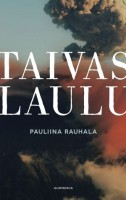 Taivaslaulu
[Heaven song]
Helsinki: Gummerus, 2013. 281 pp.
ISBN 978-951-20-9128-7
€29.90, harcback
A religious revivalist movement is the framework for this skilfully written first novel. A young couple, Vilja and Aleksi, dream of a brood of children. Nine years and four children later Vilja feels that all joy and strength has drained away from her life. Living the reality of their religion’s ban on family planning, the couple is hit hard by the fact that Vilja is expecting twins. This is too much for her; she feels crushed by anxiety and fatigue. The ethical ground of parenthood, the good and bad sides of a religious community as well as the myths and expectations surrounding motherhood are Rauhala’s main themes. This impressive tale also contains a love story; Aleksi is a credible and sympathetic husband who first and foremost wants to believe in his wife and his family.
Mikko-Olavi Seppälä & Riitta Seppälä: Aale Tynni. Hymyily, kyynel, laulu [Aale Tynni. A smile, a tear, a song]
16 January 2014 | Mini reviews, Reviews
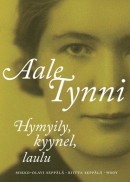 Aale Tynni. Hymyily, kyynel, laulu
[Aale Tynni. A smile, a tear, a song]
Helsinki: WSOY, 2013. 488 pp., ill.
ISBN 978-951-0-38306-3
€37, hardback
The poet, author and translator Aale Tynni (1913–1997), an Ingrian Finn who came to Finland as a refugee after the First World War in 1919, published 15 collections of poetry between 1938 and 1987. Among her translations are works by Ibsen, Shakespeare, Yeats and Racine. This extensive biography, compiled and written by Tynni’s daughter Riitta Seppälä and her grandson, historian Mikko-Olavi Seppälä, is an in-depth, lively portrait of a poet who, in her time, was both admired and criticised for her choices of form and content. Tynni felt that classical metrical tradition was closest to her, and patriotism was one of her themes; however, in the postwar years the freedom of rhythm of Finnish modernism began to flourish, and politics also gained strength in the literary world. In 1948 Tynni won the gold medal for literature in the – rather bizarre and short-lived – art competitions at the Summer Olympics in London with her poem ‘Laurel of Hellas’. Tynni experienced dramatic turns in her personal life; she underwent a prolonged divorce from her first husband who bitterly fought it. Two of her three children committed suicide in adulthood. She was finally free to marry the widowed poet Martti Haavio (aka P. Mustapää) in 1960, a marriage of soulmates that lasted until Haavio’s death in 1973.
One hell of a time
31 December 1997 | Archives online, Fiction, Prose
Extracts from Lanthandlerskans son (‘Country shopkeeper’s son’, Söderströms, 1997). Brooklyn Bridge, Christmas Eve: Otto, a Finland-Swede, attempts to start a new life in 1930s America, where swindlers and even gangsters can, he finds, be duped – even Al Capone. Otto’s grandson listens to his story on tape
I have always loved that sight. A city that you see from the air at night, all lit up. It’s’ beautiful – and at the same time so frightening. I don’t really know how to describe it.
Well, it was Christmas Eve. I was wandering around New York. I had eaten at an automat. Do you know what that is? They don’t exist any more, but in the Twenties and Thirties they were common in America. It’s a cafe, but they didn’t have any staff or waiters, instead the walls were full of little glass boxes where the food was on display. You could select what you wanted – sandwiches and pies and salads, anything. Then you put your nickels and dimes in a slot beside the box and the glass opened and’all you had to do was take out the plate. I was fond of the automats. I liked just sitting there and watching other people eat, no one bothered about you, you were left alone and that suited me. When I’d finished eating I went outside again and somehow or other I wandered upon to Brooklyn Bridge. There was a lot of traffic, people were on their way home. Well, just as I was walking there alone in the company of my thoughts I heard someone shouting ‘Help! Help me!’ More…
An eye of the unseen
30 June 2007 | Archives online, Fiction, poetry
Poems and aphorisms by Aaro Hellaakoski. Introduction by Pertti Lassila
Evening
How tranquilly the evening’s darkening,
dusk deepening beneath the trees.
Consult the long alleyways of the skies
for the gift of this evening
and the cause of your ease.
But the waste! the pain and stress –
those reachings into secrets of the dark –
quarrying endlessness,
plummeting bottomlessness,
quizzing every question mark.
Why this rummaging into whence and why?
Empty let’s be. Open and free.
Let secrets come, or let them fly
away, diffuse like cloudscapes
or whisperings through a tree.
Eyes must glow as your spirits peer
through a wakeful cranny in where you are.
Only the silent have ears to hear.
When the doorstep feels the touch of a toe
only the vigilant’s door is ajar.
Huojuvat keulat (’Swaying prows’, 1945) More…
In the same boat
29 May 2012 | Authors, Interviews, Reviews
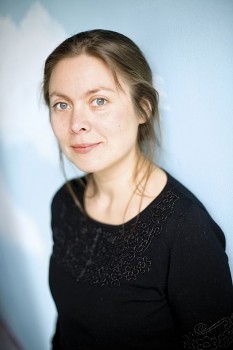
Pauliina Haasjoki. Photo: Tommi Tuomi
For the poet Pauliina Haasjoki, a writing process can begin in many ways, but particular periods – residencies, for example – are dedicated to writing. She attempts to create a cross-swell of influences in which she may read, watch movies, listen to music, have conversations and wander, collecting memories.
In the end, beginning to write becomes easy. Haasjoki may put music on to play, for example, for a certain time and use it to write ‘the poetry that belongs to that time, which sort of jostles there, waiting, because I have put it there.’
Haasjoki’s writing career began in Turku in the 1990s: she was studying literary theory at the university and was a witness to the birth of the poetic movement that developed there. Haasjoki has published five volumes of poetry, of which the latest, Aallonmurtaja (‘Breakwater’), was published in 2011. More…
Hotel for the living
30 June 1984 | Archives online, Fiction, Prose
An extract from Hotelli eläville (‘Hotel for the living’, 1983). Introduction by Markku Huotari
Raisa and Pertti are a married couple with three children, Katrielina, Aripertti and Artomikko. When she discovers she is to have another, whom she names Katjaraisa, Raisa decides to have an abortion, because another child, even if welcome, would now jeopardise her career – she has been offered a job with an international company at the very top of the advertising world. Raisa is the successful entrepreneur of the novel – on the one hand coldly calculating, without feeling, on the other superficially sentimental, perhaps the most startlingly ironic of the characters in Jalonen’s novel. His image of the brave new woman?
During her lunch hour Raisa took a walk via the laboratory, asked reception for the envelope and thrust it unregarded into her handbag. She was aware of her already knowing, but short of the envelope, there would as yet be no restrictions, nor were there any decisions that would have to be made. She had called Tom Eriksson, discussed yet again the same points and particulars, and ended tracing a finger over the two beautiful pictures on her wall. ‘The loveliest of seas has yet to be sailed’ and ‘I am life! For Life’s sake.’
She thought of Katjaraisa, her features, the palms the breadth of two fingers, just as Katrielina’s had been, and the same button-eyed gazing look as Katrielina. More…
The monster reveal’d
31 March 1997 | Archives online, Fiction, Prose
Extracts from the novel Frankensteinin muistikirja (‘Frankenstein’s notebook’, Kirjayhtymä, 1996). Ern(e)st Hemingway and Gertrud(e) Stein – the narrator in these extracts – meet the famous creature in Paris. According to Juha K. Tapio in this, his first novel, Mary Shelley’s monster has been leading an interesting life during the past few centuries
My first impression was that there wasn’t anything particularly monstrous about him. I have already said that his age was hard to determine, but there was something about him that tempted one to apply the word ‘elderly’ to him. He was up in years, no doubt about that, but in a rather special, indefinable way – which made it hard to infer, at least from his outward appearance, what stage he had reached in terms of normal human life. It had to do with something outside of time. He was tall and a little more raw-boned than the average person, and this made one wonder, looking at him, what kind of body his very fashionable clothing concealed his suit and tie conformed to the latest style. This was certainly not the misshapen and monstrous creature I vividly remembered from Mary Shelley’s description.
It was obvious that the past decades had brought about an inevitable evolution. More…
Everyday life at the Science Forum 2011
20 January 2011 | In the news
‘Everyday life’ in focus: scientific approaches. Picture: Elina Warsta
This year’s Science Forum took place in Helsinki between 12 and 16 January. This biennial science festival – which has existed in its current format since 1977 – invites a wide audience to lectures, debates, discussions and various other events where scholars introduce their branch of research and science. This time the theme was ‘Science and everyday life’.
The Science Forum is organised by the Federation of Finnish Learned Societies, the Finnish Academies of Sciences and Letters and the Finnish Cultural Foundation.
In Finnish, the word for ‘everyday life’ is arki. Professor of Consumer Economics Visa Heinonen defined arki as follows: ‘Scientifically arki cannot be defined undisputably. An individual experiences the everyday as a ‘stream’ of life. Arki is mostly the recurrence of the small basic elements of life and the constant renewal of the prerequisites of existence. The everyday contains much that is routine as well as small moments of joy. Carpe diem, seize the moment, might be a good guideline to life.’
Among the Forum’s topics were the everyday work of scientific research and its significance for the development of everyday life in society, dimensions of consumer culture, multicultural society, religion, the arts and the media, technological advances in food production and the built environment, future energy sources and the global economy.
The Science Forum attracted 18,000 visitors, in addition to the 3,000 who participated in the Forum via the Internet. The five most popular topics, or sessions, were those entitled ‘Good life’, ‘Ageing as a biological phenomenon’, ‘Nanotechnology changing everyday life’, ‘Sleep – a third of life’ and ‘Food and everyday chemistry’.
Turku, city of culture 2011
21 January 2011 | In the news
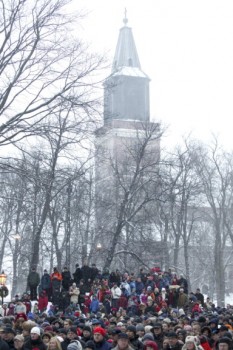
Passing the peace: citizens of Turku gathering to listen to the traditional declaration of peace at Christmas in front of the Cathedral. Photo: Esko Keski-oja
Since 1985, cities in the countries of the European Union have been chosen as European Capitals of Culture each year. More than 40 cities have been designated so far; a city is not chosen only for what it is but, more importantly, what it plans to do for year and also for what will remain after the year is over – the intention is that citizens and the local culture should profit from the investments made.
This year the two cities are Tallinn in Estonia and Turku, the oldest city and briefly (1809–1812) the capital of what was then the Grand Duchy of Finland, on the coast, 160 kilometres west of Helsinki. The pair will also co-operate in making this year a special one in their cultural lives.
The city of Turku declared its Cultural Capital year open on 15 January with a massive firework display glittering over the River Aura. This cultural capital enterprise, with a budget of 50 million euros and an ambitious programme will, hopefully, involve two million participants in the five thousand cultural events and occasions.
And he left the road
30 June 1983 | Archives online, Fiction, Prose
Three short stories from Maantieltä hän lähti (‘And he left the road’). Introduction by Eila Pennanen
And he left the road
And he left the road, walking straight ahead across fields and ditches, past barns and through bushes growing in the ditch. From the fields he went on to the forest, climbed a fence, walked past spruce and pine, juniper bushes and rocks, and came to the edge of a forest and to the swamp. He crossed the swamp, going through small groves of trees if they happened to be in his way. He went on walking rapidly across rivers, through forests, over seas and lakes, and through villages, and finally he came back to the very spot from which he had started walking straight ahead.
In the same way he walked at a right angle to the direction he had first taken and after that, a few times between those two directions. Every time he would start from the road and in the end would always come back to the road in the same direction as when he’d started off. On his rounds, after walking a bit, he would stop and look up every now and then, and each time he looked he would see the sky and sun or the moon and stars. More…
When the viewer vanishes
26 May 2015 | Essays, Non-fiction
 For the author Leena Krohn, there is no philosophy of art without moral philosophy
I lightheartedly promised to explain the foundations of my aesthetics without thinking at any great length about what is my very own that could be called aesthetics. Now I am forced to think about it. The foundations of my possible aesthetics – like those of all aesthetics – lie of course somewhere quite different from aesthetics itself. They lie in human consciousnesses and language, with all the associated indefiniteness.
It is my belief that we do not live in reality, but in metareality. The first virtual world, the simulated Pretend-land is inherent in us.
It is the human consciousness, spun by our own brains, which is shared by everyone belonging to this species. Thus it can be called a shared dream, as indeed I have done. More…
The attentive lover
31 December 1988 | Archives online, Fiction, Prose
In this short story, from his collection Pronssikausi (‘The bronze age’, 1988, on the Finlandia Prize shortlist in 1989), Martti Joenpolvi takes up the subject of the problematic transportation of a human cargo
He braked abruptly; the woman lurched forward, straining against the seat belt, and the car drove into the parking space. The only vehicle parked there was a solitary trailer loaded with timber: a resinous pulpwood-odour came wafting through their open window, so physical, it was as if someone were snooping into the car’s most intimate interior. When they stopped, they got the whiff of a yellow refuse bin, incubated in the heat of the day.
‘What’s up?’
‘We’ve got a problem.’ More…