

Search results for "tommi+musturi/2010/05/song-without-words/2009/09/what-god-said/2011/04/matti-suurpaa-parnasso-1951–2011-parnasso-1951–2011"
Daughter of Cain
30 June 1985 | Archives online, Fiction, Prose
An extract from the novel Kainin tytär (‘Daughter of Cain’, 1984). In the following extract Anna and Risku spend a single night recalling the early days of their relationship; Anna is in the country, Risku is in the city. Introduction by Soila Lehtonen
Anna
The moon hangs before the bosom of the sky, a slender crescent, but giving light all the same.
On the horizon a black, glimmering line emerges from the water. It is the skerry, a low, lone rock.
I shut off the motor. The sea laps minutely against the side of the boat. This far out there are no longer any birds.
The silence here is deeper than even that of an empty room.
The skerry is as black and glistening as the back of a pike.
Light is matter, it’s never steady.
Whatever is understood in life is understood in a sudden blue illumination, like lightning cleaving the night to expose the landscape – shadows, hollows and all. More…
The guest event
12 November 2010 | Fiction, Prose
A short story from Vattnen (‘Waters’, Söderströms, 2010)
It was a lagoon. The water was not like out at sea, not a turquoise dream with white vacation trimming on the crests of the waves. This water was completely still and strange, brown yet clear, sepia and umber, perhaps cinnamon, possibly cigar with the finest flakes of finest wrapper. Clean. This water of meetings was clear and clean in a non-platonic, remarkably earthbound way.
Sediment and humus, humus floating about in the morning sun.
It felt comforting, as if the water didn’t repel the foreign bodies as a matter of course, didn’t immediately suppress the other particles and sanctimoniously hasten to force anything that wasn’t water, anything that could be interpreted as pollution and encroachment, down to the bottom and let it dissolve and die all by itself. This water sang its earth-brown song of unity without thereby becoming any less water than water-water was.
Helena felt cold. More…
On the bridge
30 June 1993 | Archives online, Fiction, Prose
From Saksalainen sikakoira (‘Schweinehund’, WSOY, 1992). Introduction by Tuva Korsström
From somewhere beneath the bridge – I still hadn’t managed to get across it, which may sound pathetic, or even ridiculous, unless you take into account my exceptional state of mind – or, rather, to one side, I heard a dragging, ominous grinding and rumbling. It stopped for a moment; then, after a short but clearly defined pause, there was a heavy splash. A snow-plough was emptying its load into the bay from the end of the pier. The mounds of snow sank deep into the black water; the tightly packed, sticky snow rose slowly to the surface in greyish-yellow blocks and clods; loose pieces of snow boiled and foamed in the eddies and melted before my eyes. My time was melting away, too, being junked, my remaining time… More…
I’ll never forget you
30 September 2000 | Fiction, Prose
An extract from the novel Mariposa (Schildts, 1999)
Roza and Melancholie were sitting in a bar drinking beer. They hadn’t met for a long time because they bored each other. But they were best friends nonetheless. What do you do when you can’t stand meeting your best friend? You switch on your answerphone and tell lies. Today by mistake one of them had answered the phone.
Roza was dressed in her brother Armand’s old clothes, a bad habit which irritated people but which she found hard to break. Her brother had vanished long ago leaving his clothes behind. They smelled of tobacco and sweat. Roza used them to keep him alive. She could spend whole evenings going through his wardrobe. There was a dress shirt, not that you’d have expected it.
The two young women studied each other. Melancholie noted that Roza had bitten down her cuticles again.
‘How’s life?’ she asked.
‘So-so. And you?’ More…
Sensitivity session
30 June 1978 | Archives online, Fiction, Prose
An extract from the novel Ja pesäpuu itki (‘And the nesting-tree wept’). Introduction by Pekka Tarkka
Taito Suutarinen knew quite a bit about Freud. Where Mannerheim’s statue now stands, Taito felt that there ought instead to be an equestrian statue of Sigmund Freud. It would be like truth revealed.
Freud, urging on his trusty stallion Libido, would be clad from head to foot in sexual symbols – hat, trousers, shoes: one hand thrust deep into his pocket, the other grasping a walking-stick. The stick would point eloquently in the direction of the railway tracks, where the red trains slid into the arching womb of the station.
Taito had also attended a couple of seven-day sensitivity training courses, where people expressed their feelings openly, directly and spontaneously. By the end of the first course Taito was so direct and spontaneous that he couldn’t get on with anybody. By the end of the second he was so open that everyone was embarrassed. Every member of the group had cried at least once, except the group leader. Never before had Taito witnessed such power. He could not wait to found a group of his own. Taito’s group met in a basement room, where they reclined on mattresses to assist the liberation process. Everyone was free to have problems, quite openly. You were not regarded as ill: on the contrary, if you realized your problem you were more healthy than a person who still thought he mattered. Moreover, as Taito, fixing you with his piercing gaze, was always careful to emphasize, every problem was ultimately a sexual problem. Taito would spontaneously scratch his crotch as he spoke, making it clear that he himself had virtually no problems left. More…
What if?
30 December 2001 | Articles, Authors

 For an extraordinary period between 1944 and 1956 part of Finland – the Porkkala peninsula, close to Helsinki – was leased to the Soviet Union as a military base. Inspired by the photographs by Jan Kaila, Olli Jalonen explores those silenced and mysterious years, which prompted Finns to ask the question: what if the whole of Finland had succumbed to the same fate?
In the autumn of 1944, the Soviet Union set up an enormous military base close to Helsinki. The Porkkala area, which had been forcibly leased from Finland for 50 years, was returned to the Finns early, in 1956. Completely divorced from its surroundings and strongly armed, the foreign power’s base was like a bear sleeping in Finland’s back yard. It has left in the minds of Finns hidden images of silence, fear and mystery. More…
The gender of the soul
Scenes from the play Kuningatar K / Queen C
Characters:
Christina, the Queen
Friend
The Queen Mother
Karl Gustav, the Count [Christina’s suitor, the King-to-be]
Descartes, philosopher
Official
Man
The King
Oxenstierna, Per Brahe
A choir of midwives
The play can be performed with six actors (3 female, 3 male). Other ways of dividing the roles are possible. All stage directions may be altered.
1. Prologue
The eels’ court
CHRISTINA
If eels had a court then a great female eel would sit in the centre and the little males would writhe about like seaweed around the throne. However they would not be envious of the queen, because they would know that if they swam up into rivers and lakes, into fresh waters, they themselves would gradually become females, great and heavy, and would be able to rule and close into their great embrace all the small little gentlemen. They just have to wait.
KARL GUSTAV
I don’t know. What I do know is that a great black eel, as thick as a rope, was pulled out of the well last night and the Queen looked at its silver stomach and its thrashing tail, but the eel looked the Queen in the eyes and in the heart and since then she has never been the same. More…
Grim(m) stories?
30 April 2010 | Letter from the Editors
 ‘There’s not been much wit and not much joy, there’s a lot of grimness out there.’
This comment on new fiction could have been presented by anyone who’s been reading new Finnish novels or short stories. The commentator was, however, the 2010 British Orange Prize judge Daisy Goodwin, who in March complained about the miserabilist tendencies in new English-language women’s writing. More…
The balance of grief
19 December 2011 | Authors, Reviews
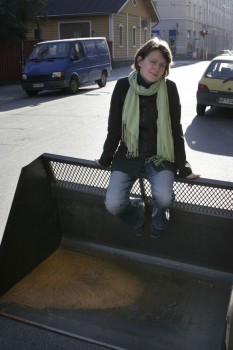
Henriikka Tavi. Photograph: Heini Lehväslaiho
In recent years volumes of contemporary Finnish poetry have offered readers the chance to enjoy excellent cover artwork. Right down to the typographical layout, the visual aspects of recently published volumes of poetry – by small and large publishers alike – have turned these books into highly refined, almost holistic works of art.
In such a way the poetics of the language and, in particular, the thematic starting point of the poems are lent a platform that both enhances and strengthens them.
Decorated with images of butterflies, the mournful grey jacket sleeve of Toivo (‘Hope’, Teos 2011), the third volume of poetry by Henriikka Tavi (born 1978), conceals the book’s bright yellow covers and an illuminated woodland path winding its way across them.
In this way the troubled central theme of this multi-disciplinary, collage-style work is immediately reflected in Camilla Pentti’s cover design. More…
Gatecrashing the universe: the poems of Ilpo Tiihonen
4 December 2009 | Authors, Reviews
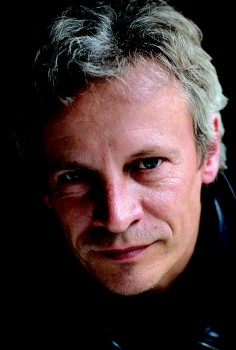
Ilpo Tiihonen – Photo: Irmeli Jung
Ilpo Tiihonen defies definition: he is, at one and the same time, a cosmopolitan poet who draws his influences from Latin America and the early Soviet avant garde, and a local poet for the whole of Finland, a fabulist who plays with language and a rough-hewn romantic of everyday life.
In Tiihonen’s selected poems, Lyhyt oodi kaikelle (‘A short ode to everything’, 2000), readers are invited to admire the prospekts of Moscow and Paris’s Montparnasse.
Most fondly pictured, however, are spring work-days wherever Tiihonen (born 1950) is living – in recent years, the working-class Helsinki suburb of Kallio, which has on the one hand scrubbed up to become a favourite of students and the more bohemian middle-class and on the other gained notoriety for its bread-lines, prostitutes and street winos. More…
In one hundred springtimes
23 November 2012 | Extracts, Non-fiction
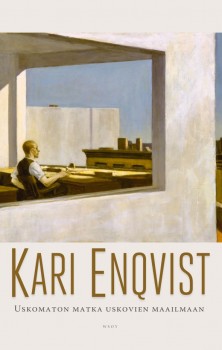 Extracts from Uskomaton matka uskovien maailmaan (‘An unbelievable journey into the world of the believers’, WSOY, 2012)
In his new book the writer, professor of cosmology, a scientist without a religion Kari Enqvist explores religiosity, how it manifests itself in present-day Finland, in various churches and parishes. How will the expanding scope of science and secularisation change the world and the forms of spirituality in the course of the next century?
When, in July 1969, Neil Armstrong climbed down the ladder on to the surface of the Moon, it was a huge propaganda coup for both the United States and the scientific world view. Manned space flights as a way of gaining knowledge are both ineffective and brain-numbingly expensive, but it is hard to imagine a stronger individual and universally understandable demonstration of the superiority of the scientific world view than an astronaut on the surface of a foreign celestial body. Everyone can recognise it as a triumph of both engineering technology and the hard sciences.
But the astronaut solution has been tested already, and I do not believe that space travel will expand our consciousnesses in the next century. It is possible that we will not even have visited Mars. Fantasies about manned flights to other stars are, in my opinion, utopian in the extreme and I do not really believe that humans as physical beings will ever leave the solar system. Journeys to the stars are inconceivably long and so expensive that they cannot be embarked on merely in order to fulfil the Buck Rogers fantasies of teenage boys. Carrying humans to the closest one, alpha Centauri, a mere four light years away, would take, at best, hundreds of years (we can dismiss rockets that travel at the speed of light as mere scientific fantasy). Even if deep-freezing to slow vital functions were possible, it would make as much sense to pay hundreds of billions to freight pig carcasses to the planets. For everything that human beings can do can be done better – and, more importantly, more cheaply – by machines. Even if the spirit were willing, the flesh is so weak that silicone beats it hollow.
So it is my guess that in place of the macrocosmos the scientific world view will seek consolidation in the microcosmos. As a cosmologist, I am not happy to admit this, but admit it I must. More…
In the starry heavens
31 March 1987 | Archives online, Fiction, Prose
An extract from Tähtien tarhoissa (‘In the starry heavens’, 1912). Introduction by Matti Apunen
The sun sank and the evening began to draw in. It was a Wednesday towards the end of October, 2140. At Teuvo’s house the electric lights were being switched on.
Teuvo lived in Helsinki on what had once been Korkeavuori Street. Now it had no particular name. It was just Street No 311, for during the course of time there had been so many new streets that it had become impossible to name them all and numbering became necessary.
Teuvo’s home was on the thirtieth storey. But of course it was not important how high up you lived, because no one used stairs. Lifts had replaced the old flights of stairs, and even they were only seldom necessary.
Every storey had an airship stop, and since everyone, even the smallest children, had a pair of wings made of fine aluminium, it was very easy to go from one floor to another without using stairs.
Teuvo looked out of the window. There was a wide space between houses. On the right hand side of the road traffic was flying towards the centre of town, on the left in the opposite direction. What a lot of people there were! He could hear the even whisper of their wings. All kinds of people, old and young, were flying along. More…
Suburban dreams
30 March 2004 | Fiction, Prose
Extracts from the novel Kahden ja yhden yön tarinoita (‘Tales from two and one nights’, Sammakko, 2003)
Reponen, Tane, Aleksi and Little Juha; once we all climbed up the path to the old dump with bows on our backs, our arrows sticking out from the tops of our boots. It was April. In the field above the dump puddles reflected the opaque sky, where we were going to shoot our arrows.
The field was the highest point in our neighbourhood. We could see the shopping centre, the library and the sawdust running track through the school woods. We could see the high-rise flats on Tora-alhontie road and the huts in the allotments. We could make out the thick spruce forest of Sovinnonvuori along the greenish grey coastline at Kapeasalmi. Our homes sat there below us. Softly droning cranes, yellow totem animals of hope, swung back and forth above the unfinished houses. In the distance was the centre of town with all its churches and scars. Here everything was just beginning. The swaggering confidence of ten-year-old boys was straining within us and would carry us far like Geronimo’s bow. More…
Really existing?
30 March 2007 | Fiction, Prose
Extracts from the novel Mehiläispaviljonki. Kertomus parvista (‘The Bee Pavilion. A story about swarms’, Teos, 2006)
There are few old buildings in this town. Most are demolished to make way for new ones long before they reach the end of their first century.
Nevertheless, one brick building in our part of town, built at the beginning of the last century, was spared demolition for a long time. The two-storey building functioned as a Support Centre for the Psychically Ill and later on, for a couple of winters, as a shelter for alcoholics. The board fence that had surrounded the building for decades was taken down long before the building itself, but the maples on the sidewalk cast their shadows on its windows to the very end. When the lilacs and dogwoods in the back garden were in bloom, their heavy racemes shed purple and white on the sand. More…
Back in the USSR
3 October 2011 | Fiction, Prose
Extracts from Rosa Liksom’s novel Hytti nro 6 (‘Compartment no 6’, WSOY, 2011). Review by Mervi Kantokorpi
Moscow hunched itself in the dry, frosty March night, protecting itself from the touch of the icy red sun as it set. The girl entered the train’s last sleeping carriage, found her compartment, compartment number six, and breathed deeply. There were four beds in the compartment, the upper ones folded agains the wall, while between the beds was a small table, on the table a white table cloth and a plastic flower vase containing a bunch of pink paper carnations, faded by time; the shelf above the end of the bed was full of large, untidily secured parcels. The girl shoved her modest old suitcase, the one she had got from Zahar, into the metal luggage space under the hard, narrow bed; her small backpack she threw on the bed. When the station bell sounded for the first time, the girl went to stand by the corridor window. She breathed in the scent of the train, iron, coal-dust, the smells left behind by dozens of cities and thousands of people. Travellers and those who had come to see them off pushed past her, shoving her with their cases and parcels. The girl touched the cold window with her hand and looked at the platform. This train would take her through villages inhabited by deportees, through the open and closed towns of Siberia to the capital of Mongolia, Ulan Bator. More…