

Search results for "tommi+musturi/2010/05/song-without-words/2009/09/what-god-said/2011/04/matti-suurpaa-parnasso-1951–2011-parnasso-1951–2011"
Helsinki: World Design Capital 2012
13 January 2012 | This 'n' that
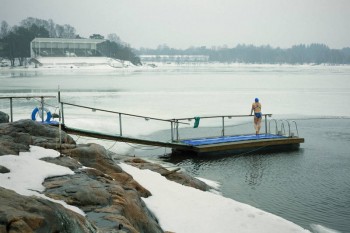
Swimming in the rain: winter joys of Helsinki. Photograph: Valtteri Hirvonen – Eriksson & Co.
After Turin (Italy, 2008) and Seoul (Republic of Korea, 2010), 2012 Helsinki is the third World Design Capital, selected in 2009 by the International Council of Societies of Industrial Design (ICSID).
Helsinki was considered to be a city where ‘design has for decades been a pivotal enabler to building an open city’.
The theme is ‘Open Helsinki – Embedding Design in Life‘. The idea is to improve the everyday life and environment of the citizens and the development of both public services and private enterprises.
In addition to Helsinki, the realisation of the Design Capital year will be carried out by four other cities: neighbouring Espoo, Vantaa and Kauniainen as well as Lahti (some hundred kilometres north of the capital). The Finnish government, two ministries, 21 commercial companies and some universities will co-operate in this project, which has a budget of 16 million euros (2010–2013).
The programme includes some 300 different events, half of them development projects, themed ‘The changing city’ or ‘New solutions’; the other half consists of various exhibitions and encounters for the citizens of Helsinki, tourists and design people.
The ultimate goal of this all is said to be ‘permanent change’. Whatever that really means – good luck!
However, as writer and design critic Kaj Kalin noted in a review in Helsingin Sanomat newspaper (30 December), Finland is full of well-educated designers, but lacks both investment money prepared to take risks and working industry: soon all production will have moved to cheaper countries – and nobody will be able to produce anything. New Finnish design, Kalin argues, mostly approximates merely to ‘a show parade of models and prototypes’.
Sealspotting
14 June 2009 | Reviews
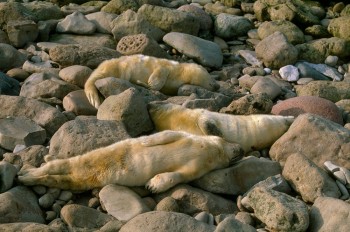
Zzzzzzz! In the grey seal kindergarten babies take a nap after dinner. – Photo: Seppo Keränen
Taskinen, Juha
Paluu Saimaalle
[Return to Lake Saimaa]
Helsinki: WSOY, 2009. 204 p., ill.
ISBN 978-951-0-33745-5
€ 38.90, hardback
Keränen, Seppo & Lappalainen, Markku
Hylkeet [The seals]
Helsinki: Maahenki, 2009. 151 p., ill.
ISBN 978-952-56-5266-6
€ 45, hardback
Sälar
Helsingfors: Söderströms, 2009.
151 p., ill.
Swedish translation: Annika Luther
ISBN 978-951-52-2603-7
€ 45, hardback
The private life of the species of seal that lives only in Lake Saimaa has been carefully investigated lately. Almost everything about this highly endangered species has been revealed, thanks to technological devices such as transmitters that can be glued to their backs…
STOP! WARNING: as I realise that not everybody wants to know what pinnipeds do in their spare time, I suggest you quit reading now, if you aren’t interested in the lives and fates of an obscure group of about 260 mammals that live in a lake in the remote west of Finland.
In a class of one’s own
18 December 2009 | Reviews
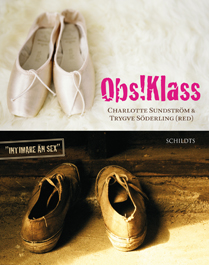 Obs! Klass
Red. [Ed. by] Charlotte Sundström & Trygve Söderling
Helsingfors: Schildts, 2009. 288 p.
ISBN 978-951-50-1891-5
€27, paperback
De andra. En bok om klass
Red. [Ed. by] Silja Hiidenheimo, Fredrik Lång, Tapani Ritamäki, Anna Rotkirch
Helsingfors: Söderströms, 2009. 288 p.
ISBN 978-951-522-665-5
€26.90, paperback
Me muut. Kirjoituksia yhteiskuntaluokista
Helsinki: Teos, 2009. 267 p.
ISBN 978-951-851-259-5
€27.90, paperback
At some time in their lives, all members of the Swedish-speaking minority in Finland have been confronted with the phrase ‘Swedish-speaking better people’ [Svenska talande bättre folk], uttered in tones of contempt. Encouraged by news and entertainment media with little regard for the consequences, Finland’s Finnish-speaking majority is hopelessly fascinated by the image of us Finland-Swedes as a uniform and monolithic haute bourgeoisie that resides in the coveted Helsinki neighbourhoods of Eira and Brunnsparken. More…
Finding a voice
13 November 2014 | Authors, Reviews

Pajtim Statovci. Photo: Tommi Tuomi
Here it is, finally: Pajtim Statovci’s debut novel is the first book of literary merit written in Finnish by an author who originally came to Finland from the former Yugoslavia, Kosovo. Kissani Jugoslavia (‘Yugoslavia, my cat’, Otava, 2014) is a wild depiction of identity, told simultaneously from the perspectives of the mother of an immigrant family and her son. Statovci builds a keen sense of tension between the narrative of the Albanian woman and that of her youngest son.
Born in Podujevë, Kosovo, in 1990, Statovci came to Finland at the age of two. He is studying comparative literature at the University of Helsinki and film and television scriptwriting at the Aalto University. The French and Norwegian translation rights to Kissani Jugoslavia were sold before the book had even been published. More…
Runeberg Prize 2013 for poetry
8 February 2013 | In the news

Olli-Pekka Tennilä. Photo: Aleksis Salusjärvi, 2012
The Runeberg Prize for fiction, awarded on 5 February, this year for the twenty-seventh time, went to a book of poetry by Olli-Pekka Tennilä (born 1978).
Tennilä’s second work, Yksinkeltainen on kaksinkeltaista (‘Doubly simple’, a pun: yksinkertainen = simple, kaksinkertainen = double, keltainen = yellow), published by Poesia, makes use of a child’s open-minded use of language and studies the world of the bees. Tennilä is one of the founding members of Osuuskunta Poesia, a poetry cooperative, and is currently its publishing director.
The prize, worth €10,000, was awarded on 5 February – the birthday of the poet J.L Runeberg (1804–1877) – in the southern Finnish city of Porvoo.
The jury, writer Tommi Melender, critic Siru Kainulainen and theatre manager Dan Henriksson – representing the prize’s founders, the Uusimaa newspaper, the city of Porvoo, both the Finnish and Finland-Swedish writers’ associations and the Finnish Critics’ Association – chose the winner from a shortlist of eight books. In their opinion the winning work is both ‘a structurally controlled and expressively vital whole; it demonstrates how the linguistic logic of a small child can be employed again as an adult.’
The other seven finalists were a book of essays, Toinen jalka maassa ja muita esseitä (‘One foot on the ground and other essays’, WSOY) by Markku Envall, two poetry collections, Keisarin tie (‘The emperor’s road’, Otava) by Lassi Hyvärinen and Kuolinsiivous (‘Death cleaning’, WSOY) by Eeva Kilpi, two collections of short stories, Kadonnut ranta (‘Lost shore’, WSOY) by Tiina Laitila Kälvemark and Till dig som saknas (‘To you who are missing’, Schildts&Söderströms) by Peter Sandström, as well as two novels, Rikosromaani (‘Crime novel’, Otava) by Petri Tamminen and Neuromaani (‘Neuromane’, Otava) by Jaakko Yli-Juonikas.
Kirja muuttuvassa tietoympäristössä [The book in a changing information environment]
21 August 2014 | Mini reviews, Reviews
 Toim. [Ed. by] Markku Löytönen, Tommi Inkinen, Anne Rutanen
Helsinki: Suomen tietokirjailijat ry. [The Finnish Association of Non-Fiction Writers], 195 p., ill.
ISBN 978-952-67356-3-4
paperback; available also online:
http://www.suomentietokirjailijat.fi/jasenyys/julkaisut/kirja-muuttuvassa-tietoymparisto/
In the Western world the experience of reading is undergoing a critical change. There is even talk of a third information revolution. Books are increasingly acquiring electronic form, and the future of the printed book is being called into question. Kirja muuttuvassa tietoympäristössä contains the considered opinions of 18 experts on what is taking place in the field of non-fiction, and gives an overview of the literature on the current situation, which is seen from the point of view of the bookstore, the library, the author and the publisher. There is a discussion of intellectual property issues, developments in technology, and changes in the use of teaching materials, language, and reading habits. Finland is a leading country in both literacy and reading. The number of books has slowly declined in recent years, but it seems that the country’s youth has maintained an interest in books, and in fiction in particular. Although printed reference works of the encyclopedia type have given way to the information provided by the Internet, it is likely that literature and reading will preserve their status as a part of human culture.
Translated by David McDuff
Crime, no punishment
24 June 2014 | In the news
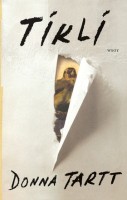 Summer is the season for crime – where buying and reading books is concerned. When spring ends and summer begins, several whodunits and thrillers appear on the list of best-selling books compiled by the Finnish Booksellers’ Association. However, on the translated fiction list Donna Tartt rules with her novel The Goldfinch (Tikli, WSOY).
For the third time since March, number one on the Finnish fiction list in May was Tommi Kinnunen’s first novel, Neljäntienristeys (‘The crossing of four roads’, WSOY). In March this title reached the top after favourable reviews – in the Helsingin Sanomat daily paper in particular.
The narrative spans a century, beginning in the late 19th century, and is set mainly in Northern Finland. The Swedish publisher Norstedts was the first to buy the translation rights.
The next two on the list are crime novels: Cowboy (Otava) by Reijo Mäki and Mustat sydämet (‘Black hearts’, Crime Time) by Seppo Jokinen. The new ‘granny crime’ book by Minna Lindgren, the sequel to her Kuolema Ehtoolehdossa (‘Death at Twilight Grove’, 2013, Teos), entitled Ehtoolehdon pakolaiset (‘Twilight Grove refugees’) is number five; the resourceful 90-year-plus protagonists may not be criminals themselves, but odd things are certainly happening in the home for the elderly again. Lindgren’s first book is making its way into other languages as well.
Soiva laulukirja (‘The singing songbook’, Tammi), edited by Soili Perkiö, tops the list of books for children and young people: the push of a button delivers a piano accompaniment to any one of 50 Finnish songs. It may prove to be particularly popular with parents as entertainment for their kids on long car journeys.
Five of the other nine of the best-selling books on the translated fiction list – on which Tartt was number one – are about serial killers and other murderers.
The non-fiction list is headed by a collection of messages from the spiritual world: the pop star Katri Helena (born 1945) who debuted in 1963, has written down what she feels her dead loved ones have chosen to tell her. Taivaan tie (‘Heaven road’, Otava) deals with love, conscience, good deeds and the good life. One might wonder though why this selection of aphoristic observations is included in the non-fiction category.
On the list there are also books on baking cakes and cooking, and, as usual in summer, on nature, as people retreat to their summer homes to lie in hammocks to listen to birdsong and read about serial killers.
Gorgonoids
31 March 1993 | Archives online, Fiction, Prose
From Matemaattisia olioita tai jaettuja unia (‘Mathematical creatures, or shared dreams’, WSOY, 1992). Introduction by Soila Lehtonen
The egg of the gorgonoid is, of course, not smooth. Unlike a hen’s egg, its surface texture is noticeably uneven. Under its reddish, leather skin bulge what look like thick cords, distantly reminiscent of fingers. Flexible, multiply jointed fingers, entwined – or, rather, squeezed into a fist.
But what can those ‘fingers’ be?
None other than embryo of the gorgonoid itself.
For the gorgonoid is made up of two ‘cables’. One forms itself into a ring; the other wraps round it in a spiral, as if combining with itself. Young gorgonoids that have just broken out of their shells are pale and striped with red. Their colouring is like the peppermint candies you can buy at any city kiosk. More…
Misery me
Extracts from the collection of short prose, Mielensäpahoittaja (‘Taking offense’, WSOY, 2010)
Past pushing up daisies
Well, yeah, so I took offense when the doctor said that considering my age I’m in tip-top shape. His theory was that my 25-kilometre ski circuits would keep an old coot like me in shape, if they didn’t kill me first. He said if I were to start just sitting on the couch and waiting, then the Reaper would be on my back in no time.
I don’t ski for my health. I ski because it’s pretty in the forest, and when a body is sweating he doesn’t think a whole lot. More…
A long dream
9 October 2009 | Fiction, Prose
A short story from Jälkikasvu (‘Offspring’, Otava, 2009)
‘I was eating a late breakfast, without a care in the world, when it happened.’
He snaps off the recorder. He has said the same thing three times now, but he always loses his train of thought right there. Why is it so difficult to continue? In his mind, the next part feels quite clear, but the words simply won’t come out of his mouth. He ought to say that his wife left him yesterday, on the twelfth of February, at 10:48 AM, following a three-minute fifteen-second briefing. More…
We’re all perfect
31 December 1990 | Archives online, Fiction, poetry
Poems from Laki (‘The law’, 1990)
The Law
No one’s stupid – there are
people deprived of the wise,
and those with self-respect
knocked flat. No one’s
hardened – there are people with
calloused wounds.
No one’s blind – there are
people cataracted by custom. Be different:
heal wounds and look up – wake
your dear one in mid-sleep, hug her.
(We’re all perfect.) More…
Graphic success
10 May 2012 | In the news
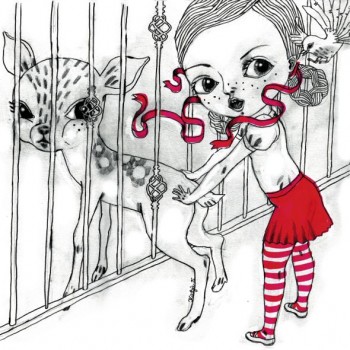
Finnish Comics Annual: picture by Katja Tukiainen
The 2012 Finnish Comics Annual, edited by Reija Sann, was published in May by HuudaHuuda and the Finnish Comics Association. The book focuses on everyday realism, featuring eleven artists: Terhi Ekebom, Grönroos & Rantio, Matti Hagelberg, Pauli Kallio, Tarmo Koivisto, Mika Lietzen, Petteri Tikkanen, Tiitu Takalo, Katja Tukiainen and Riitta Uusitalo. In their work the limits of the individual and the collective, the local and the universally human are explored by means of fantasy.
The first Finnish Comics Annual, featuring Finnish comics and graphic novels in English, was published last year. The editor was Ville Hänninen.
This year’s Finlandia Comics Prize, worth €5,000, awarded by the association Tampere Kuplii (‘Tampere bubbles’) at a comics festival of the same name in Tampere on 4 May, went to graphic designer and illustrator Ville Tietäväinen for his voluminous graphic novel Näkymättömät kädet (‘Invisible hands’, WSOY, 2011). Ten finalists were chosen by a jury out of 68 candidates, and the final choice was made by actor Armi Toivanen.
Näkymättömät kädet is the story of a Moroccan tailor, Rashid, who loses his job and has to leave his family to look for work in Europe. For an illegal alien life in Spain is unbearably difficult. Introducing the work in the article ‘Funny peculiar’ (there is also a sample from Tietäväinen’s work) Heikki Jokinen comments: ‘Through the story of one person, Tietäväinen speaks of important matters: poverty, human value and what keeps us going, hope.’
Annika Luther: De hemlösas stad [The city of the homeless]
17 January 2012 | Mini reviews, Reviews
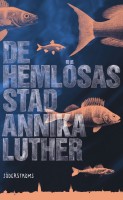 De hemlösas stad
[The city of the homeless]
Helsingfors: Söderströms, 2011. 237 p.
ISBN 978-951-522-846-8
€ 21.10, paperback
Kodittomien kaupunki
Suomennos [Translation from Swedish into Finnish]: Asko Sahlberg
Helsinki: Teos, 2011. 240 p.
ISBN 978-951-851-404-9
€ 33.10, paperback
Annika Luther’s novel is an example of the popular genre of dystopia. Its ecocritical overtones prompt radically new ways of thinking about the effects of climate change. In 2050, the bulk of the earth’s surface is under water, and people from various corners of the earth have been evacuated to Finland. The majority of the residents in Helsinki are Indian and Chinese. Finns are in the minority, and most of them are hopelessly addicted to alcohol. Fifteen-year-old Lilja lives in the city of Jyväskylä with her family, in a protected and tightly controlled neighbourhood. She becomes interested in her family history and decides to find out about her aunt, a marine biologist who remained in flooded Helsinki. Gradually, the mysteries of the past open up to her. The novel is about survival and adaptation. Luther is an original writer, uncompromising in her ethical stance. As in her previous novel, Ivoria (2009), she describes Helsinki with affection: despite the ruined landscape, the city maintains its proud bearing.
Translated by Fleur Jeremiah and Emily Jeremiah
Close encounters
31 March 2003 | Archives online, Fiction, Prose
Stories from Konservatorns blick (‘A conservator’s gaze’, Schildts, 2002). Introduction by Fredrik Hertzberg
Unmarried and randy in a hotel foyer
The hotel foyer in Baghdad was swarming with people as anxious to advertise themselves as westerners at the opening of an art exhibition. I bumped into a man who quickly introduced himself, handed me his card and wondered whether I had an engagement that evening.
‘No,’ I said, truthfully.
‘Then kindly come home with me at nine,’ he said, with a florid gesture in the direction of my breasts.
‘No thank you,’ I answered. ‘I do have an engagement, I’ve just remembered.’ More…
Money makes the world go round
31 August 2012 | Fiction, Prose
Extracts from the novel Mr. Smith (WSOY, 2012). Introduction by Tuomas Juntunen
I have a confession to make.
I couldn’t have lived on my salary. Most people would solve this by taking out a loan, living on credit. I’ve never lived in debt. Instead I’ve had to make my modest capital grow by investing it – through the company, of course, because irrespective of their colour governments generally understand companies better than small investors. You have to make money somewhere other than the Social Security Office.
Work doesn’t make money; money makes money.
You have to let money do the work.
This is nothing short of a profound human tragedy: most people are forced to waste the majority of their lives, to use it in the service of complete strangers, for unknown purposes, doing something for money that they would never do if they didn’t have to. The most shocking thing is that people actively seek out this state of affairs, strive towards it; it is a goal towards which society lends us its full support, no less.
Such wage slavery is called ‘work’. More…