

Search results for "tommi+musturi/2010/05/song-without-words/2009/09/what-god-said/2011/04/matti-suurpaa-parnasso-1951–2011-parnasso-1951–2011"
Pekka the brave
31 December 1983 | Archives online, Children's books, Fiction
An extract from Pekka Peloton (‘Pekka the brave’, 1982). Introduction by Leena Kirstinä
The other ghost was now very close to the Bear. The inhabitants of the Green Woods had pulled back out of its way in terror but the poor Bear couldn’t even get himself to budge. Miserable, he had covered his eyes and slumped down in his own fur.
‘Psst,’ the ghost whispered. ‘Hi, Bear, it’s only me.’ And the ghost poked the Bear in the ribs. ‘It’s me, Pekka. Come on, open your eyes!
But the Bear didn’t make a move to do what Pekka had asked and Pekka began to get worried. He knew the Wolf wouldn’t stay put for a very long time and little by little would start to wonder what this was all about. ‘Dear Bear,’ Pekka said in a louder voice, and punched him as hard as he could. ‘Get up! We haven’t much time … ‘ Pekka’s voice was trembling. ‘Look! I’ve got the key to your courage right here … ‘ More…
Besotted with colour
30 June 2007 | Authors, Interviews

Photo: Otava/Petri Puromies
Colours, smells and sounds paint a vivid word-picture of a small, northern Finnish town in the 1950s in Hannu Väisänen’s first novel, Vanikan palat (‘The pieces of crispbread’, 2004; see Books from Finland 2/2004).
Little Antero, the novel’s protagonist, is an alter ego of the painter and graphic artist Hannu (born 1951). Antero has three brothers, a sister and an alcoholically inclined widower NCO father. The queue of potential stepmothers is a long and tragicomical one. The title of the novel refers to the stone-hard, thick rye crispbread produced for army consumption; the greyness of barracks life and a small town with incredibly harsh winters did not add up to a colourful life.
But Hannu became an artist to whom colour speaks. More…
Hare-raising
13 February 2015 | Reviews
In this job, it’s a heart-lifting moment when you spot a new Finnish novel diplayed in prime position on a London bookshop table – and we’ve seen Tuomas Kyrö’s The Beggar & The Hare in not just one bookshop, but many. Popular among booksellers, then – and we’re guessing, readers – the book nevertheless seems in general to have remained beneath the radar of the critics and can therefore be termed a real word-of-mouth success. Kyrö (born 1974), a writer and cartoonist, is the author of the wildly popular Mielensäpahoittaja (‘Taking umbridge’) novels, about an 80-year-old curmudgeon who grumbles about practically everything. His new book – a story about a man and his rabbit, a satire of contemporary Finland – seems to found a warm welcome in Britain. Stephen Chan dissects its charm
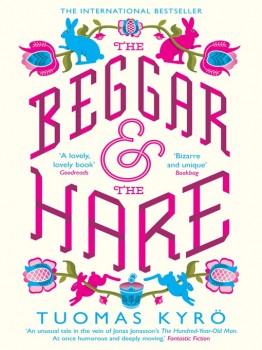 Tuomas Kyrö: The Beggar & The Hare
(translated by David McDuff. London: Short Books, 2011)
Kerjäläinen ja jänis (Helsinki: Siltala, 2011)
For someone who is not Finnish, but who has had a love affair with the country – not its beauties but its idiosyncratic masochisms; its melancholia and its perpetual silences; its concocted mythologies and histories; its one great composer, Sibelius, and its one great architect, Aalto; and the fact that Sibelius’s Finlandia, written for a country of snow and frozen lakes, should become the national anthem of the doomed state of Biafra, with thousands of doomed soldiers marching to its strains under the African sun – this book and its idiots and idiocies seemed to sum up everything about a country that can be profoundly moving, and profoundly stupid.
It’s an idiot book; its closest cousin is Voltaire’s Candide (1759). But, whereas Candide was both a comedic satire and a critique of the German philosopher and mathematician Gottfried Wilhelm Leibniz (1646-1716), The Beggar & The Hare is merely an insider’s self-satire. Someone who has not spent time in Finland would have no idea how to imagine the events of this book. Candide, too, deployed a foil for its eponymous hero, and that was Pangloss, the philosopher Leibniz himself in thin disguise. Together they traverse alien geographies and cultures, each given dimension by the other. More…
Make or break?
17 November 2011 | This 'n' that
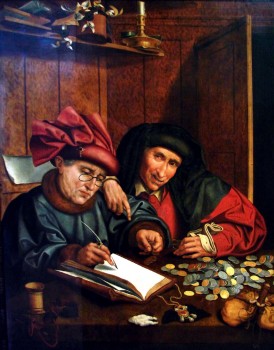
Two tax collectors: anonymous painter, after Marinus van Reymerswaele (ca. 1575–1600). Musée des Beaux-Arts de Nancy. Wikimedia
In Finland, tax returns are public information. So, every November the media publish lists of the top earners in Finland, dividing them into the categories of earned and investment income. Every November it is revealed who are millionaires and who are just plain rich.
The Taloussanomat (‘The economic news’) newspaper offers a list (Finnish only) of the 5,000 people who earned most last year (in terms of both earned and investment income, together with the proportion of income they have paid in tax). You can also search lists of various status and professions: rock/pop stars, media, sports, MPs, celebrities, politicians of various political parties…
So let’s take a look at Taloussanomat’s selected list of authors: number one is the celebrity author Jari Tervo (309,971 euros, tax percentage 45); number two, the internationally famous Sofi Oksanen (302,634 euros, 46 per cent); the next two are Sinikka Nopola, writer of children’s books, (264,000) and Arto Paasilinna (262,300; now after an illness, retired as a writer), translated into more than 30 languages since the 1970s. (The film critic and author Peter von Bagh made almost 900,000 euros – not by writing books, but by selling his share of a music company to an international enterprise.)
As tax data are public in Finland, there’s vigorous and decidedly informed public debate on how much money, for example, directors of public pension institutions and government offices or ministers and other top politicians are paid, and how much they should be paid: what is equitable, what is reasonable? A million dollar question indeed…
Among the European Union countries, it is only in Finland, Sweden and Denmark that there is no universal minimum wage. Here, wages are determined in trade wage negotiations. The average monthly salary in the private sector in 2010 was approximately 3,200 euros. In contrast to that, Olli-Pekka Kallasvuo, the Nokia CEO and President, who tops the 2010 tax list, earned a salary of 8 million last year, because – and precisely because – he was sacked (and replaced by the Irishman Steven Elop).
The CIA’s Gini index measures the degree of inequality in the distribution of family income in a country. The more unequal a country’s income distribution, the higher is its Gini index. The country with the highest number is Sweden, 23; the lowest, South Africa, 65 (data from both, 2005). Finland’s figure is 26.8 (2008), Germany 27 (2006), the European Union’s 34. The United Kingdom stands at 34 (2005), and the USA at 45 (2007). The figure in Finland seems to be on the rise though, as the figure back in 1991 was 25.6.
There’s been plenty of research and debate on economic inequality and the ways it harms societies. This link takes you to a fascinating video lecture (July 2011 – now seen by almost half a million people) by Richard Wilkinson, British author, Profefssor Emeritus of social epidemiology.
Hip hip hurray, Moomins!
22 October 2010 | This 'n' that
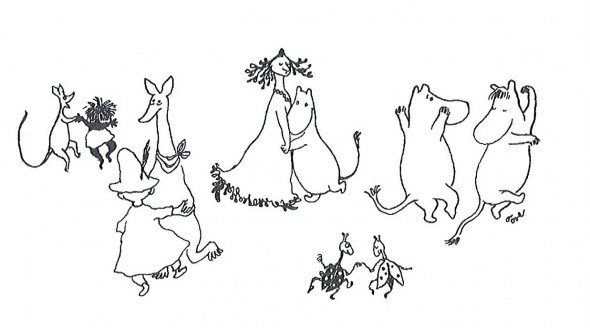
Partying in Moomin Valley: Moomintroll (second from right) dancing through the night with the Snork Maiden (from Tove Jansson’s second Moomin book, Kometjakten, Comet in Moominland, 1946)
The Moomins, those sympathetic, rotund white creatures, and their friends in Moomin Valley celebrate their 65th birthday in 2010.
Tove Jansson published her first illustrated Moomin book, Småtrollen och den stora översvämningen (‘The little trolls and the big flood’) in 1945. In the 1950s the inhabitants of Moomin Valley became increasingly popular both in Finland and abroad, and translations began to appear – as did the first Moomin merchandise in the shops.
Jansson later confessed that she eventually had begun to hate her troll – but luckily she managed to revise her writing, and the Moomin books became more serious and philosophical, yet retaining their delicious humour and mild anarchism. The last of the nine storybooks, Moominvalley in November, appeared in 1970, after which Jansson wrote novels and short stories for adults.
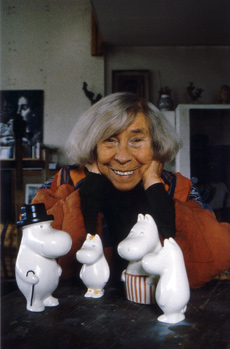
Tove Jansson with her creations (Photo: www.moomin.com/tove/travel, 1993)
Tove Jansson (1914–2001) was a painter, caricaturist, comic strip artist, illustrator and author of books for both children and adults. Her Moomin comic strips were published in the daily paper the London Evening News between 1954 and 1974; from 1960 onwards the strips were written and illustrated by Tove’s brother Lars Jansson (1926–2000).
Tove’s niece, Sophia Jansson (born 1962) now runs Moomin Characters Ltd as its artistic director and majority shareholder. (The company’s latest turnover was 3,6 million euros).
For the ever-growing fandom of Jansson there is a delightful biography of Tove (click ‘English’) and her family on the site, complete with pictures, video clips and texts.
The world now knows Moomins; the books have been translated into 40 languages. The London Children’s Film Festival in October 2010 featured the film Moomins and the Comet Chase in 3D, with a soundtrack by the Icelandic artist Björk. An exhibition celebrating 65 years of the Moomins (from 23 October to 15 January 2011) at the Bury Art Gallery in Greater Manchester presented Jansson’s illustrations of Moominvalley and its inhabitants.
In association with several commercial partners in the Nordic countries Moomin Characters launched a year-long campaign collecting funds to be donated to the World Wildlife Foundation for the protection of the Baltic Sea. Tove Jansson lived by the Baltic all her life – she spent most of her summers on a small barren island called Klovharu – and the sea featured strongly in her books for both children and adults.
Lemminkäinen unfazed
30 September 2000 | Archives online, Fiction, poetry, Prose
An English translation by Anselm Hollo of Runo XI from Kalevala 1999, Kai Nieminen’s new translation of the national epic (1849), into contemporary Finnish. Interview with Kai Nieminen by Anselm Hollo
But now it is time to tell about Lemminkäinen, a.k.a. Ahti the Islander. Young Ahti was handsome and cheerful. His mother raised him on the shores of a headland where he went fishing, ate fish and grew up strong smart and straight. But his character had a flaw: a womanizer is what he became, our Lemminkäinen (also known as Wandering Mind). He spent his days chasing the girls, his nights making love to them.
Comic prize
26 March 2010 | In the news
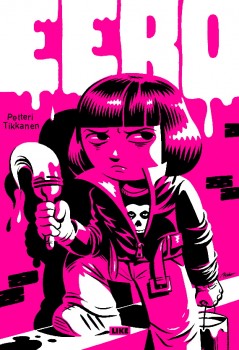
Eero the hero: the winner of the Sarjakuva-Finlandia comics prize 2010
Sarjakuva-Finlandia, worth €5,000, is the name of a prize created in 2007 for Finnish graphic novels or comic books. (Sarjakuva, literally ‘serial picture’, refers to both comic strips and books as well as graphic novels.)
It is awarded annually at the Tampere comics festival (and has nothing to do with the Finlandia prizes for literature, awarded by the Finnish Book Foundation).
Out of 56 contestants, ten made it into the final run, and the winner, Eero, by Petteri Tikkanen, was chosen by the thriller writer Matti Rönkä.
Petteri Tikkanen (born 1975) is a graphic artist who has published several books. In his previous graphic novels about a girl named Kanerva, Eero has appeared as her friend. Now Eero is the central character, and it seems childhood is over. Kanerva likes to chill out with her girlfriends only – what is a boy to do?
Henrik Meinander: Kekkografia. Historiaesseitä [Kekkography. History essays]
1 April 2011 | Mini reviews, Reviews
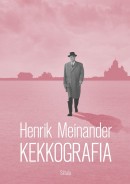 Kekkografia. Historiaesseitä
[Kekkography. History essays]
Suomentanut [Translated into Finnish from the original Swedish texts by] Matti Kinnunen
Helsinki: Siltala, 2010. 229 p.
ISBN 978-952-234-040-5
€ 34, hardback
Professor Henrik Meinander examines the forces that have shaped Finnish history and the controversial issues that have marked its development; Finnish history and culture were formed by chain reactions in European power politics. Finland did not emerge as a nation until the 19th century, as a by-product of the Napoleonic wars, and the independence of 1917 was not the result of an autonomous process of national development but rather a consequence of events elsewhere, especially in Russia. The history of independent Finland is roughly equal in length to that of the Soviet Union; in the early 1990s the Soviet Union collapsed, and Finland joined the European Union. The author does not take a position on the desirability of this development, and points out that the increasing integration and globalisation Finland’s era of independence may appear to be only a transitory phase. President Urho Kekkonen (1900–1986), who influenced Finnish politics for half a century and whose name gives the work its title, figures in approximately half of the texts.
Translated by David McDuff
Utopia or cacotopia?
19 August 2011 | Extracts, Non-fiction
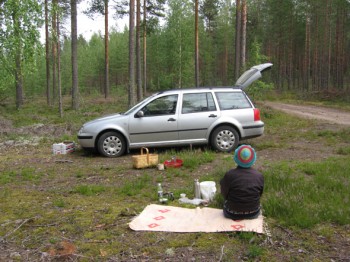
Viljakansaari, Finland, 2008. ©Merja Salo
Do we live in the age of autopia, and if we do, what does that mean? On this earth there are now perhaps 800 million cars, all vital to our modern lifestyles. Professor and photographer Merja Salo observes landscapes through her camera with this question in mind
Extracts and photographs from Carscapes. Automaisemia (Edition Patrick Frey & Musta Taide, 2011. Translation: Laura Mänki)
The car may be the vehicle for the everyman, but not every man is a good driver. According to Hungarian- born psychoanalyst Michael Balint, good drivers have the psychological structure of philobats. With their sense of sight, they perceive space well and control it by steering their vehicle skilfully. Ocnophiles, on the other hand, are more at home as passengers. They structure the world through intimacy and touch. When driving, they cling anxiously to the steering wheel and do not perceive the continously changing situations in traffic.
Reality versus morality
30 September 1982 | Archives online, Authors
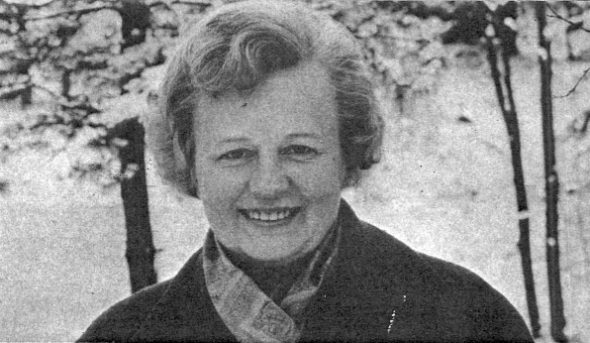
Eila Pennanen. Photo: Anonymous (Suomen Kuvalehti 1965) via Wikimedia Commons
Reviewing Eila Pennanen‘s second collection of essays, which appeared earlier this year under the delightfully ambiguous title of Kirjailijatar ja hänen miehensä (‘The authoress and her… man? … men? … husband?… husbands?’), a critic called attention to the heading she had chosen for her essay on Bernard Malamud: ‘Malamud’s ignoble hero’. His comment on this was that the moral judgment implicit in such a title would be both pointless and valueless if Pennanen had maintained it with logical consistency throughout the essay. If in fact she does no such thing, it is because she knows how to look at a character, however ignoble, with an eye for subtleties and a great deal of psychological insight. This is something one often notices about Eila Pennanen: she is apt to begin by labelling somebody or something ‘good’ or ‘bad’, and even to sound quite defiant about it, but she is never, in the end, content to leave it at that. I once heard her give a lecture on Joel Lehtonen. She startled her audience by the vehemence with which she avowed the feelings of loathing or sympathy aroused in her by characters or events in Lehtonen’s books. Her cheeks blazed as she talked. Then, just as unexpectedly, she chided herself for exaggerating, took back a lot of what she had said, laid bare the reasons for Lehtonen’s contradictoriness, and left her hearers in a condition of fruitful perplexity. Whatever they may have thought or felt about the ‘moral approach’ to criticism, they were left in no doubt as to the wit and intelligence of its leading Finnish exponent. More…
Finland, cool! The Frankfurt Book Fair 8–12 October
30 September 2014 | Articles, Non-fiction

Finnland. Cool. pavilion in Frankfurt, designed by Natalia Baczynska Kimberley, Nina Kosonen and Matti Mikkilä from Aalto University
It starts next week: Finland is Guest of Honour at the Book Fair in the German and global city of Frankfurt. This link will take you to it all.
Approximately 170,000 professionals from the literary world are expected to visit the exhibition halls from Wednesday to Friday; the weekend is reserved for the general public, c.100,000 visitors. Since 1980s different countries have been in focus each year. More…
Jari Tervo: Koljatti [Goliath]
23 October 2009 | Mini reviews, Reviews
 Koljatti
[Goliath]
Helsinki: WSOY, 2009. 317 p.
ISBN 978-951-0-35610-4
25 €, hardback
Jari Tervo (born 1959) writes comic, swiftly paced, linguistically accomplished prose with touches of historicism, philosophy and social commentary. Koljatti is a contemporary satire that prompted a great deal of fuss in the Finnish press for its perceived nastiness: the similarities between its character Pekka Lahnanen, an isolated and beleaguered prime minister, and Matti Vanhanen, the current Finnish Prime Minister, are clear. This novel outlines some crude caricatures, but its critical barbs are aimed not at politics, but rather at the relationship between the media and politics. This book, which describes the events of a single fast-paced weekend, portrays politics as theatre, in which the only thing that matters is how things appear; the media will drop any substantive questions in their relentless pursuit of new sensationalist headlines of politicians’ private lives. The news may not look the same after reading this novel. Tervo is one of Finland’s most popular authors; three of his novels have appeared in translation, in four languages. [Read a short story here.]
Dear Reader!
13 January 2011 | This 'n' that
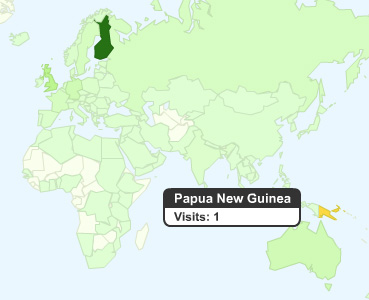
Reading Books from Finland here, there and... Photo: Google Analytics
2011 is well underway, and it’s back to business – reporting on good books from Finland, that is!
The new year also marks the beginning of our third year online: we are very pleased to note that last year visits to this site increased by 187 per cent compared to 2009!
Our foreign readers hail from a total of 149 countries, although the majority are in the United States and the United Kingdom – with a surprisingly large number of neighbourly visits from readers in Finland.
There are some countries where only one reader has taken a look at Books from Finland last year; greetings to our own readers in Honduras and Papua New Guinea…. But, on the other hand, readership in Belarus has grown by 2.400 per cent, from just one in 2009 to a grand total of 25!
We’ve been very glad to have your online feedback, which prompted us to think that since we haven’t done a reader survey for a longish time, we might take the opportunity to run another one now – so we’ll be quizzing you about your views of the contents of the journal on this page soon.
We hope to offer you more that is diverting, entertaining and thought-provoking this year than ever before. Remember, you can also keep abreast of what’s going on on the Books from Finland website by subscribing to our RSS and e-mail delivery services (and we’re on Facebook, too).
Happy new year, and good reading!
The editors
Soila Lehtonen (Helsinki)
Hildi Hawkins (London)
Sound and meaning
20 January 2012 | Essays, Non-fiction
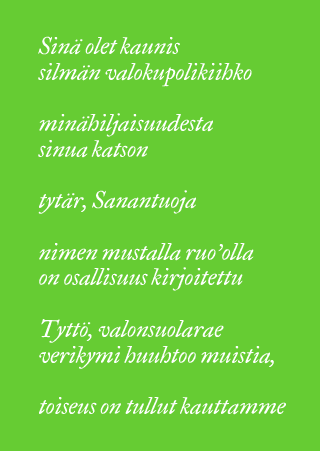
Harri Nordell’s poem from Huuto ja syntyvä puu (‘Scream and tree being born’, 1996)
Translating poetry is natural, claims Tarja Roinila; it is a continuation of writing it, for works of poetry are not finished, self-sufficient products. But is the translator the servant of the meaning – or of the letter?
I am sitting in a cafe in Mexico City, trying to explain in Spanish what valokupolikiihko, ‘light-cupola-ecstasy’, means. And silmän valokupolikiihko, ‘the light-cupola-ecstasy of the eye’.
I take to praising the boundless ability of the Finnish language to form compound words, to weld pieces together without finalising the relationships between them, never mind establishing a hierarchy: the eye is a light-cupola, the eye is ecstatic about light-cupolas, light creates cupolas, the cupola lets out the light, the eye, in its ecstasy, creates a light-cupola. More…
A musical advent calendar
9 December 2011 | This 'n' that
The Finnish Broadcasting Company has delved into its vast archives, and its website, YLE Areena, is throughout December featuring a series of musical numbers, many with reference to Christmas, sung or played Finnish singers and musicians. These inserts are being broadcast on each day, from 1 to 24 December, and they can be listened to via the Internet (although be warned, the information is given in Finnish only).
Among the Finnish composers are, among others, Oskar Merikanto (1868–1924), Erkki Melartin (1875–1937), Toivo Kuula (1883–1918) and Jean Sibelius. The sopranos Irma Urrila and Helena Juntunen are presented, singing Mozart and Gounoud respectively.
For example: on 6 December, the Finland’s Independence Day, one of the three inserts is a piano piece, entitled Pankakoski, by composer Heino Kaski (who died a day earlier than Sibelius, in September 1957), played by Juhani Lagerspetz (1995). The other two are Andante Festivo (1922), a work originally composed for a string quartet, by Jean Sibelius, played by the Radio Symphony Orchestra (1995) and a song from the 1970s opera Punainen viiva (‘The red line’) by Aulis Sallinen, sung by Matti Salminen (1984).
Fifteen more days to go…
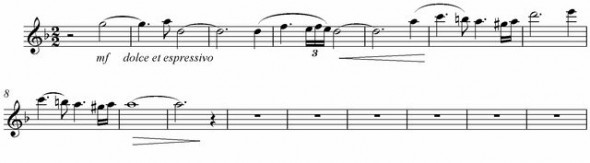
Dolce et espressivo: Violin concerto by Sibelius, 1st movement (1905). Photo: Wikimedia