

Search results for "tommi+musturi/2010/05/song-without-words/2009/09/what-god-said/2011/04/matti-suurpaa-parnasso-1951–2011-parnasso-1951–2011"
Too much, too soon?
20 January 2012 | This 'n' that
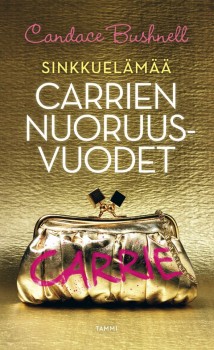 Candace Bushnell’s Summer & the City (about Carrie Bradshaw’s first years in NYC, published last year) is categorised among books for children and young people on the Finnish best-sellers’ list. The Finnish translation occupied the eighth place in December.
But hang on, wasn’t this Carrie in the fantastically famous HBO television adaptation of Bushnell’s novel Sex and the City very much in her thirties, as were her three best friends – all with, yes, quite active ‘adult’ sex lives…? In Finland the series had a rather silly title, Sinkkuelämää, ‘Single life’.
Well, of course it would be foolish not to continue the fantasticaly famous money-spinning saga, so Bushnell has gone back in time, first to Carrie’s school years in small-town America in The Carrie Diaries (2010), then to her first years in NYC in Summer & the City (2011) – and HarperCollins has pigeonholed them among its ‘teen books’.
Confusingly, the Finnish titles of these two books also contain the word referring to the television series: Sinkkuelämää – Carrien nuoruusvuodet and Sinkkuelämää – Ensimmäinen kesä New Yorkissa. As the Finnish publisher Tammi has attached TV title to them, the customer assumes these are books for ‘adults’ – as indeed was the original Sex and the City.
This makes one wonder what exactly ‘books for young people’ are. The main characters are teens themselves? If Bushnell goes still further back in time, we shall be reading about naughty Li´l Carrie hitting another toddler on the head with her doll, in a board book.
Asko Sahlberg: Häväistyt [Disgraced]
2 February 2012 | Mini reviews, Reviews
 Häväistyt
[Disgraced]
Helsinki: WSOY, 2011. 331 p.
ISBN 978-951-0-38275-2
€ 33, hardback
The tenth novel by Asko Sahlberg (born 1964) is reminiscent of the earlier works of this distinctive author: its principal characters are hardened by experience and lead their lives somewhere in the Finnish countryside during a recent period of the country’s history. The sentences are beautifully constructed, and the pace of the narrative is very slow – sometimes even too slow. The main role is played by a middle-aged man who is running away with a woman and a small boy. What they are running away from for a long time remains a puzzle, as does the question of who they are looking for, a man called The Master. In the flashbacks of the last part of the book all is explained, and the rhythm of the story quickens. Considering the book’s desolate, even fatalistic view of the world, it is slightly surprising that everything eventually turns out as happily as in a fairytale. But perhaps this is Sahlberg’s tribute to his characters, and to all of us human beings, for whom he seems to care a great deal? His novel He (2010) will be published in February in England under the title The Brothers (Peirene Press).
Translated by David McDuff
Christmas best-sellers in Finnish fiction
13 January 2012 | In the news
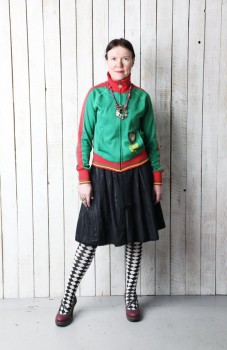
Rosa Liksom. Photo: Pekka Mustonen
Most new Finnish books are printed and sold in the autumn, and sales pick up considerably in December. The number one on the December list link: in Finnish only) of best-selling fiction titles in Finland, compiled by the Finnish Booksellers’ Association, is the Finlandia Fiction Prize-winning novel Hytti nro 6 (‘Compartment number 6’, WSOY, 2011) by Rosa Liksom (this is her homepage, also in English).
The Finlandia winner was announced on 1 December, upon which the book shot – from nowhere – to the top of the list.
Laila Hirvisaari’s historical novel, Minä Katariina (‘I, Catherine’, Otava), climbed up from the third place to the second. Number three was a newcomer, a tragic love story entitled Kätilö (‘The midwife’, WSOY), by Katja Kettu, set in the last phase of the Finnish Continuation War (1941–1944).
Jari Tervo’s Layla (WSOY) was in fourth place, while November’s number one, Ilkka Remes’s thriller Teräsleijona (‘Steel lion’, WSOY), came fifth.
In November Tuomas Kyrö occupied both the fourth and the tenth place with his novels Kerjäläinen ja jänis (‘The beggar and the hare’, Siltala – a pastiche-style story inspired by Jäniksen vuosi / The Year of the Hare by Arto Paasilinna, 1975) and Mielensäpahoittaja (‘Taking offence’, WSOY, 2010). In December they were numbers six and seven, in reverse order.
Funny ha ha?
3 March 2010 | This 'n' that
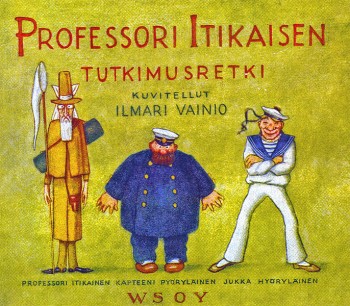 Comic books, graphic novels: the popularity of stories in pictures keeps on growing everywhere – and they may or not may be ‘comical’.
In Finland, sarjakuva (lit. serial picture) will celebrate its 100th anniversary in 2011. The first Finnish picture story, Professori Itikaisen tutkimusretki (‘Professor Itikainen’s expedition’, WSOY), by Ilmari Vainio, was published in 1911.
Ilmari Vainio (1892–1955) was a customs official who later also published two fairy tales and two handbooks for boy scouts. Professor Itikainen is a scientist who sets out on the sea and then finds himself, together with two brave seamen, facing various dangers in Africa, China and on the North Pole. A happy ending ensues in the form of safe arrival back in Helsinki on page 48. More…
Indifference under the axe
9 March 2012 | Essays, Non-fiction
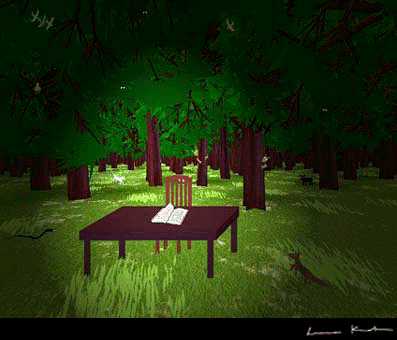
In the forest: an illustration by Leena Krohn for her book, Sfinksi vai robotti (Sphinx or robot, 1999)
The original virtual reality resides within ourselves, in our brains; the virtual reality of the Internet is but a simulation. In this essay, Leena Krohn takes a look at the ‘shared dreams’ of literature – a virtual, open cosmos, accessible to anyone, without a password
How can we see what does not yet exist? Literature – specifically the genre termed science fiction or fantasy literature, or sometimes magic realism – is a tool we can use to disperse or make holes in the mists that obscure our vision of the future.
A book is a harbinger of things to come. Sometimes it predicts future events; even more often it serves as a warning. Many of the direst visions of science fiction have already come true. Big Brother and the Ministry of Truth are watching over even greater territories than in Orwell’s Oceania of 1984. More…
A light shining
28 July 2011 | Essays, Non-fiction
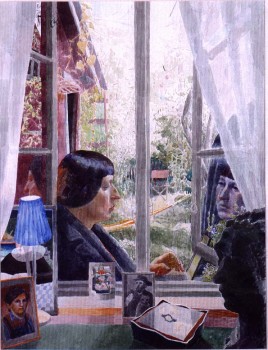
Portrait of the author: Leena Krohn, watercolour by Marjatta Hanhijoki (1998, WSOY)
In many of Leena Krohn’s books metamorphosis and paradox are central. In this article she takes a look at her own history of reading and writing, which to her are ‘the most human of metamorphoses’. Her first book, Vihreä vallankumous (‘The green revolution’, 1970), was for children; what, if anything, makes writing for children different from writing for adults?
Extracts from an essay published in Luovuuden lähteillä. Lasten- ja nuortenkirjailijat kertovat (‘At the sources of creativity. Writings by authors of books for children and young people’, edited by Päivi Heikkilä-Halttunen; The Finnish Institute for Children’s Literature & BTJ Kustannus, 2010)
What is writing? What is reading? I can still remember clearly the moment when, at the age of five, I saw signs become meanings. I had just woken up and taken down a book my mother had left on top of the chest of drawers, having read to us from it the previous day. It was Pilvihepo (‘The cloud-horse’) by Edith Unnerstad. I opened the book and as my eyes travelled along the lines, I understood what I saw. It was a second awakening, a moment of sudden realisation. I count that morning as one of the most significant of my life.
Learning to read lights up books. The dumb begin to speak. The dead come to life. The black letters look the same as they did before, and yet the change is thrilling. Reading and writing are among the most human of metamorphoses. More…
Is it a play, is it a book?
25 February 2011 | This 'n' that
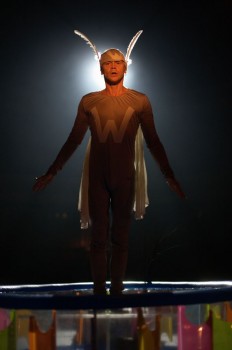
On the way to fame: Walt the Wonder Boy in Kristian Smeds's stage adaptation of Paul Auster's novel Mr. Vertigo at the Finnish National Theatre (2010). Photo: Antti Ahonen
Dramatisations of novels are tricky. Finnish theatremakers like adapting novels for the stage, which often results in a lot of talking instead of action – and action here doesn’t refer to just physical movement but to the subtext, to what happens under and behind the words.
Currently an adaptation of an American novel is running on the main stage of the Finnish National Theatre in Helsinki. Mr Vertigo (1994), Paul Auster’s seventh book, tells the story of an orphan boy in the 1930s St Louis. After harsh years as the long-suffering apprentice of the mysterious Master Yehudi, Walt becomes the sensational Wonder Boy by learning how to levitate.
In theatremaker Kristian Smeds’s adaptation, Auster’s whimsical, rambling novel becomes a capricious, illusory journey about illusions, freedom, and the unattainability of love. Walt (the highly expressive, athletic Tero Jartti) interprets, with hilarious comedy as well as with touching desperation, both the dizzyingly powerful experience of creativity and the ridiculous hubris of the artist. More…
What grade is your kid in?
29 October 2010 | Non-fiction, Tales of a journalist

Illustration: Joonas Väänänen
Should a journalist show his hand? Columnist Jyrki Lehtola ponders the pros and cons of showing one’s true political colours
What’s the best way to present an initiative that would get the cynical, lazy news media to take an interest in the outside world?
The easiest way is to make a proposal in which the outside world is actually defined as the news media itself.
This is exactly what Matti Apunen did early this autumn: Apunen, a long-time journalist and the former editor-in-chief of the Aamulehti newspaper, had just left the paper to lobby for Finnish industry and trade interests as director of the Finnish Business and Policy Forum EVA.
He presented the Finnish media with a straw poll, following the Swedish model, in which reporters would anonymously answer questions about their political leanings. More…
C.L. Engel. Koti Helsingissä, sydän Berliinissä. C.L. Engel. Hemmet i Helsingfors, hjärtat i Berlin [C.L. Engel. Home in Helsinki, heart in Berlin]
23 February 2012 | Mini reviews, Reviews
 C.L. Engel. Koti Helsingissä, sydän Berliinissä. C.L. Engel. Hemmet i Helsingfors, hjärtat i Berlin
[C.L. Engel. Home in Helsinki, heart in Berlin]
Tekstit [Texts by]: Matti Klinge, Salla Elo, Eeva Ruoff
Valokuvat [Photography]: Taavetti Alin & Risto Törrö
Översättning [Translations from Finnish into Swedish]: Ulla Pedersen Estberg
Helsingfors: Schildts, 2012. 140 p., ill.
ISBN 978-951-50-2183-0
€ 31.50, hardback
The life and works of the German architect Carl Ludvig Engel (1778–1840) are portrayed in four articles by specialists in Finnish history, the history of Helsinki and the history of gardens. Engel spent almost 24 years in Helsinki, transforming it with his architectural designs. For eleven of those years, he and his family lived in a house surrounded by a large garden, both of them his own creations. Looking for work, the young Engel finally found it in the tiny northern town that was pronounced the new capital of the Grand Duchy of Finland in 1812 – both Tsar Alexander I and his successor, Nikolai I, favoured him. From 1816 onwards he designed more than twenty neo-classical buildings, among them nationally important landmarks: the Cathedral, the City Hall, the National Library and the University. Despite his mostly rewarding job as a highly regarded city planner, Engel found Helsinki cold, small and quiet, and he constantly longed for his native Berlin, which he never saw again. However, his flourishing garden gave him great pleasure. Richly illustrated with photographs, the book gives the reader an thorough and interesting picture of this city-changing man and his era.
Reading matters? On new books for young readers
9 January 2014 | Articles, Children's books, Non-fiction
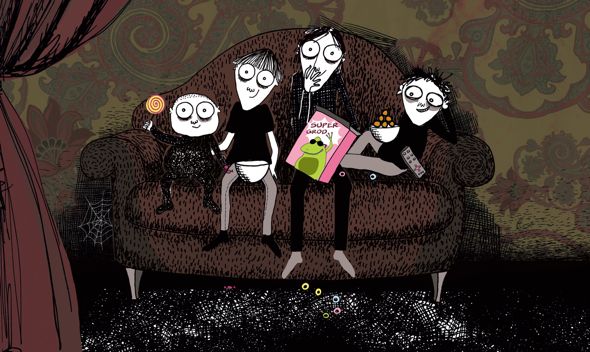
The Pixon brothers don’t read books, they love the telly: story by Malin Kivelä, illustrations by Linda Bondestam (Bröderna Pixon och TV:ns hemtrevliga sken, ‘The Pixon brothers and the homely shimmer of the telly’)
Finnish picture books for children have long been reliable export goods around the world. In the last few years, a number of novels for children have come along in their wake: works by authors such as Timo Parvela and Siri Kolu have been translated into a good many languages.
Now young adult literature has also blazed a trail on to the international market – in what also seems to be almost a matter of precision timing with regard to the Frankfurt Book Fair 2014. Finnish publishers have been investing in their home-grown lists of children’s and young adult books ever since the turn of the millennium, and now the time has come to harvest the fruits of their long-term efforts.
Home alone?
30 June 2003 | Authors

Photo: Veikko Somerpuro
Kari Hotakainen’s novel Juoksuhaudantie (‘The Trench Road’, WSOY, 2002), has sold more than 100,000 copies, an enormous number in Finland, and more than any other Finlandia Prize-winning work since 1986. Why?
Matti Virtanen is close to being the most common man’s name in Finland. In Kari Hotakainen’s sixth novel, this on the one hand ordinary but on the other extraordinarily obsessive Virtanen chances, in a state of agitation, to hit his wife, as a result of which the wife and their daughter leave. Virtanen gets it into his head that the only way to win forgiveness and get his family back again is to get them a home of their own. Virtanen believes himself to be a blameless ‘home-front man’, the opposite of the wargoing generation of his father and grandfather:
‘A home veteran looks after all the housework and understands women. Throughout our marriage I have done everything that our fathers did not. I did the laundry, cooked the food, cleaned the flat, I gave her time to herself and protected the family from society…. I listened, I understood,I caressed, I foreplayed and kept the mood going after intercourse. I had had no education in any of this, nor was there any kind of example for me tofollow.’ More…
The way to anywhere
30 September 2003 | Archives online, Fiction, poetry
Poems from Parittelun jälkeinen selkeys (‘Post-coital clarity’, WSOY, 2003). Introduction by Matti Saurama
Enlightenment needs no tools
1.   And I laughed at everything
           and didn’t want to see anything old
there was a fingernail-sized buddha and I walked by it
in the room, trying to find the ceiling,
                           camping out in life, fag in mouth
the soft letters of the clouds, and a blowing skysign
         oh sky
2.    I stand on the street corner
       illuminated like a phone box.
       On the way to anywhere
       and always there already.  More...
Springtime in Paris: Nordic writers on a French visit
25 March 2011 | In the news
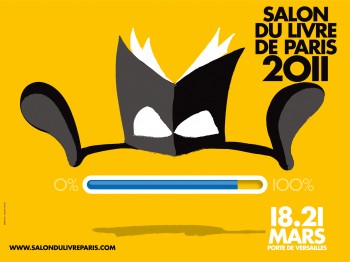 With an icy northerly wind at my back I took off from Helsinki and landed in Paris, where it was springtime and the cherry trees were in bloom. The aim of my trip was to join eleven translators from Finnish into all the main Nordic languages in examining the trickiest corners of the Finnish language and discussing the actual working conditions of literary translators, as well as the possibilities for Nordic literature to assert itself in the world.
I was also going to meet with and listen to more than sixty writers from all the Nordic countries. Why did I have to go to Paris to do it? Because this was where Bokskogen, the Forest of Books, had grown.
At the Salon du Livre held in Paris from 18 to 21 March, at which the Nordic countries were the guests of honour, FILI (the Finnish Literature Exchange) was in charge of coordinating the Nordic pavilion, some 400 square metres in area.
The airy Scandinavian Forest of Books was filled with the murmur of Parisians in search of something Nordic to read and intent on having their newly purchased books signed by authors like Sofi Oksanen, Kari Hotakainen, Matti Rönkä, Monika Fagerholm, Katarina Gäddnäs, Seita Parkkola, Aira Savisaari, Johanna Sinisalo, Aino Havukainen and Sami Toivonen.
Before the official inauguration by France’s Minister of Culture Frédéric Mittérand the programmes had already been underway for four days. Just over a hundred professional people – publishers, translators and other cultural figures and institutions from across the Nordic countries – took part in various workshops to discuss common focal points and share experiences and best practices with each other and their French colleagues.
One of the major events was the Cultural Forum, a collaboration between FILI, the Nordic Council of Ministers and the Finnish presidency of the Nordic Council of Ministers. Its theme was the training of translators, and also the book industry in a global context.
In early March a dozen French journalists and booksellers toured Helsinki and Tammisaari (Ekenäs) in order to meet Finnish authors and interview them as a prelude to the big show. As a result Nordic literature also made its presence felt in France’s press and bookstores.
Translated by David McDuff
Jukka Sarjala: Kotomaamme outo Suomi [Finland, our strange homeland]
4 April 2013 | Mini reviews, Reviews
 Kotomaamme outo Suomi
[Finland, our strange homeland]
Helsinki: Teos, 2013. 264 p.
ISBN 978-951-851-440-7
€ 27, paperback
Jukka Sarjala, ex-director general of the Finnish National Board of Education and bibliophile, is the author of several works of non-fiction, mainly in the field of history. In this book he focuses on the phenomena and events that characterised early twentieth-century Finland, some of them rather peculiar. In a couple of dozen chapters written in a humorous and conversational style the author does not conceal his own opinions, for example, on the foolishness of politicians. Much of the writing is devoted to the era of Finnish independence and the Finnish Civil War, as well as to episodes from political history, such as the story of the attempt to import to the newly independent country a German-born prince as King of Finland, the vagaries of the political far right and far left, the recruitment of Finnish Reds into the British Army – and the horse that gave rise to a small rebel movement. Sarjala draws many fascinating portraits of early twentieth-century figures, for example the utopian socialist Matti Kurikka and the founder of a party that in some ways anticipated the present-day True Finns [Perussuomalaiset], the talkative politician Veikko Vennamo (1913–1997). Although the book lacks footnotes and a bibliography, it demonstrates its author’s extensive reading.
Translated by David McDuff