

Search results for "tommi+musturi/2010/05/song-without-words/2009/09/what-god-said/2011/04/matti-suurpaa-parnasso-1951–2011-parnasso-1951–2011"
Not a world language, and yet….
16 January 2015 | Articles, Non-fiction

The editors (Hildi Hawkins and Soila Lehtonen) at the screen: we begun publishing material on our website in 1998. Photo: Jorma Hinkka, 2001
Longevity may not generally be a virtue of literary magazines – they tend to come and go – but Books from Finland, which began publication in 1967, has stuck around for a rather impressively long time. Literary life, as well as the means of production, has changed dramatically in the almost half-century we have been in existence. So where do we stand now? And what does the future look like?
This is the farewell letter from the current Editor-in-Chief, Soila Lehtonen – who began working for the journal in 1983
‘The literature of Finland suffers the handicap of being written in a so-called “minor” language, not a “world” language…. Finland has not entirely been omitted from the world-map of culture, but a more complete and detailed picture of our literature should be made available to those interested in it.’
Thus spake the Finnish Minister of Education, R.H. Oittinen, in early 1967, in the very first little issue of Books from Finland, then published by the Publishers’ Association of Finland, financed by the Education Ministry.
Forty-seven years, almost 10,000 printed pages (1967–2008) and (from 2009) 1,400 website posts later, we might claim that the modest publication entitled Books from Finland, has accomplished the task of creating ‘a more complete and detailed picture’ of Finnish literature for anyone interested in it. More…
Sisters beneath the skin — the letters of Edith Södergran and Hagar Olsson
11 February 2009 | Articles, Authors, Extracts
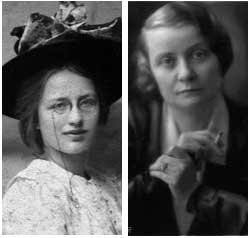
Edith Södergran and Hagar Olsson. – Photos: Svenska litteratursällskapet i Finland, Åbo Akademis bildsamlingar.
Almost one hundred years ago, a small Karelian village close to St Petersburg, near the Finno-Russian border, saw the birth of a fearless new form of modern poetry.
The Finland-Swedish poet Edith Södergran (1892–1923) began writing her burning lines inspired by Friedrich Nietzsche’s ideal of the new man and his philosophy of creativity. Södergrans’ poems were free of any traditional pattern and full of strong images. Her work, which ran to six collections of poems, later achieved classic status in the modernist traditon that she presaged.
Cut time, paste space
12 September 2013 | Articles, Non-fiction
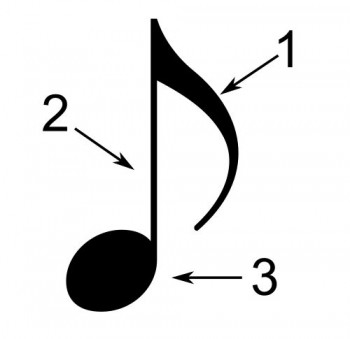
Back to basics. Parts of a musical note. Picture: Wikimedia
How different are the art of words and the art of sounds, author Teemu Manninen ponders, as he unexpectedly finds himself in the role of a musician in a performance. Time, space or both?
Some time ago I got the chance to participate in an unusual concert – as a performer: six players, myself included, were grouped around a table with a triangle in one hand and a glove in the other. Pieces of dry ice and a bucket of water were placed in front of each of us.
The performance began: we took a piece of dry ice and pressed it against the triangle. As the metal cooled, it burned through the ice, releasing gas, which in turn made the metal vibrate very fast. This produced a keening sound that filled the room. More…
Getting by
18 May 2012 | Non-fiction, Reviews
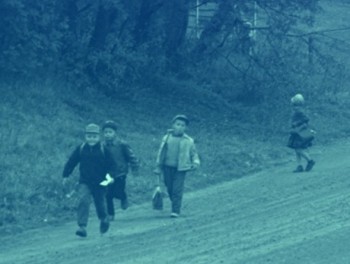
To school: children on the march – no buses or taxis in the Finnish countryside after the war. Photo: the cover of Kauaksi kotoa
Kauaksi kotoa. Muutoksen sukupolvi kertoo
[Far from home. Stories of the change generation]
Toim. [Ed. by] Anja Salokannel & Kaija Valkonen
Helsinki: Kirjapaja, 2012. 320 p.
ISBN 978-952-247-291-5
€32.90, hardback
The post-war period in Finland was a time of hope and reconstruction, of procreation and tough, grey heroism. Finland picked itself up by the bootstraps, as fathers who had been ‘driven mad in the war’, who took to drink or spat blood because they had shrapnel in their lungs, built veterans’ houses around the small towns and cleared fields in the backwoods. More than 83,000 men were killed in the wars (Winter War 1939–1940, Continuation War 1941–1944).
Mothers worked like men. The baby boomers – the demographic peak which consists of those born between the war years and 1950 (in 1946–1949 more than 100,000 babies were born each year, compared to some 60,000 in 2011) – had to be fed and clothed and educated for a better and more prosperous future.
Now the baby boomers have started to retire. Editors Anja Salokannel and Kaija Valkonen (baby boomers themselves) have compiled the book Kauaksi kotoa. Muutoksen sukupolvi kertoo (‘A long way from home. Stories of the change generation’), in which 21 men and women talk about their lives during the decades of change. More…
Special effects
14 June 2012 | Authors, Reviews
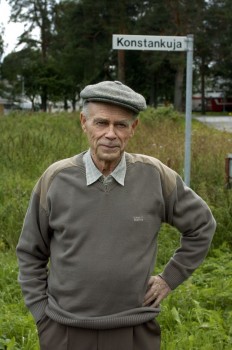
Veikko Huovinen. Photo: Harri Nurminen
Depictions of simple country folk who live close to nature, diabolical satire of the powers that be, playful rambling tales.
The humour of Veikko Huovinen has two dimensions: it is learned, intelligent, and insightful, but it is also exuberant and folksy. Critics have made comparisons to Nikolai Gogol and Mark Twain, and not without reason.
Huovinen (1927–2009) began writing stories in 1949 and published his final work in 2007, two years before his death. This half century saw the birth of a broad and multifaceted library, including a good number of works that do not fit any genre as such – Huovinen called his works that lay in the interstices between the short story, causerie and satire ‘short specials’. More…
Johan Leche & Johan Grysselius
The birds and the bees
2 May 2011 | Non-fiction
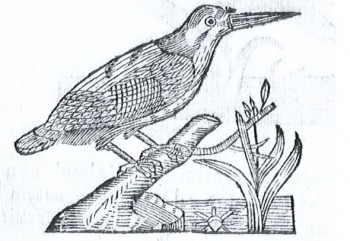
Halcyon or Ispida (kingfisher)? A picture of this mythical bird from a 17th-century thesis, published in Suomen lintutieteen synty
Halcyon or Ispida (kingfisher)? A picture of this mythical bird from a 17th-century thesis, published in Suomen lintutieteen synty
The famous Swedish scientist Carl von Linné claimed in his doctoral thesis in 1757 that swallows spend their winters underwater.
Two of Linné’s countrymen, working at Åbo Academy in Finland, proved him wrong seven years later by giving evidence of migration, but to no avail: the silly theory prevailed until the 19th century.
In these extracts doctors Leche and Grysselius eloquently present a ‘Well-Intended Reader’ with errors of humanity that become epidemic
Extracts from ‘An Academic Treatise on The Wintering and Migration of Swallows’ by Johan Leche & Johan Grysselius (1764), published in Finnish (translated from Latin by Sari Kivistö) in Suomen lintutieteen synty. Turun Akatemian aika (‘The birth of the Finnish ornithology. The era of the Åbo Akademi’, Faros, 2009), edited by Esa Lehikoinen, Risto Lemmetyinen, Timo Vuorisalo & Sari Kivistö
Preface
As we know, humanity is no less inclined to err in matters pertaining to nature than in matters of morals. With regards to errors concerning the natural world, even the most experienced scholars are not always immune. The common people, for their part, have not learned to avoid such pitfalls and are thus constantly bumping into them. This is no wonder, since they are not accustomed to using the help of natural science or mathematics, and are thus unable to perform appropriate tests, to correctly assess future eventualities, or to observe phenomena closely unless they concern something already familiar to them. More…
Mother-days
30 June 2006 | Fiction, poetry
Poems from Yhtä juhlaa (‘It’s all a big celebration’, WSOY, 2006)
(a square metre, 3.)
Now for the-kick-of-being-the-good-mum:
after the rye porridge
after the sons washed with camomile foam
and slipped into clean sheets
with mummy singing a sweet song.
Something about shadowed snow
and how at the blue twilit-moment one can
go inwards. If you’re up to looking. All that garbage and slag:
ash from the too-small days, clotted with
non-combustible blots, even though here
the sky’s clear
and the windows open to the winds.
Good grief, here we’re making new people.
But all I’d time for
was the track from the dishcloth to the nappy bin,
and back from the children’s painting-table
to the sink. No job
for spoilt girls, this: the prissiest minx
would soon turn woman in this fix:
kids coming next after next,
years of full-time labour
in a square metre where
you make no point about peccadilloes,
because so much is at stake.
You’re no longer a rose,
pimpinella, rosabella,
but subsoil: loam
and spots of unrottable compost.
A feebler person would have reversed on
the first tantrum;
the child’s learnt to say things
and is saying things
I never thought would come. More…
A happy day
12 August 2010 | Fiction, Prose
‘Muttisen onni eli laulu Lyygialle’ (‘Muttinen’s happiness, or a song for Lygia’‚) a short story from Kuolleet omenapuut (‘Dead apple trees’, Otava, 1918)
‘Quite the country gentleman, eh, what, hey?’ says Aapeli Muttinen the bookseller. ‘Like the poet Horace – if I may humbly make the comparison, eh, dash it? With his villa at Tusculum, or whatever the place was called, given to him by Maecenas, in the Sabine hills, wasn’t it? – dashed if I remember. Anyway, he served Maecenas, and I serve – the public, don’t I? Selling them books at fifty pence a copy.’
Muttinen’s Tusculum is his little plot of land in the country. A delightful place, comforting to contemplate when the first signs of summer are beginning to appear, after a winter spent in town in the busy pursuit of Mammon, under skies so grey that the wrinkles on Muttinen’s forehead must have doubled in number. A summer paradise of idleness… More…
The path-walker
A short story from Sisustus (‘Interior decoration’, Tammi, 2000)
I do not know where I came from. Suddenly, I was just there. I stood on my feet. They support me. I look out of my eyes. I do not see them.
Sounds arrive in my ears. Moment by moment, I distinguish them better. I see the landscape through which I am walking. I distinguish the trees from each other. The path runs between them, and I stare at them, as if staring into a twilight that, when you look more closely, splits into trees, bushes, birds. I feel the roots through the soles of my shoes. I feel the softness of the moss, the pine-cones and the little stones. More…
The Earth is a snowball
31 March 1995 | Archives online, Prose
A short story from Resa runt solen (‘Journey round the sun’, Schildts, 1994). Introduction by Ann-Christine Snickars
It is a day in August and even though I can sense that the end of the summer is nearer than the beginning, my hours are still as long as days. I am a child and live in the midst of summer’s eternity.
This morning I wake up earlier than anyone else. It isn’t usually that way. Usually Mårten is the first of us two to get up, but now he is asleep with his face turned to the wall. I stay in bed for a while, listening. It is also quiet in the other room, where Mama is asleep. Now I remember that it’s today Papa is coming out to see us after working in the town all week.
I open the curtain a little and see that the sky is blue and not grey with heavy rainclouds as it has been these past few days. I quickly put on my few clothes, a thin striped cotton sweater, my shorts and my brown plimsolls. I push the door open, stand on the steps and breathe a morning air that still smells more of summer than of autumn. I listen to the familiar sounds: twittering birds, the wind in the treetops and crying gulls over the bay. More…
The only time for loving
31 December 1998 | Archives online, Fiction, poetry
Poems from Iloiset harhaopit (‘Happy heresies’, WSOY, 1998). Introduction by Herbert Lomas
Thief
Down from the top floor crept
a kind thief
and loaded a bed with silver,
nicked from a house in the harbour.
‘Ah,’, he said, like Weiss: ‘an
impecunious lot – no hope of swag.
The lady’s purse is empty, nothing but
matches, sugar, a teabag.
Too few frocks in the wardrobe too
for a pretty lady.’
Morning, and the bedside chair
is piled with frocks from the neighbour’s line.
A proper thief is smitten
and shows his philosophy of crime,
and I’m a poet!
Neither foxes nor police dogs stir my heart
but I do love the sheer out-and-out howling
dottiness of our time. More…
Night decorator
31 March 2007 | Archives online, Fiction, Prose
A short story from the collection Yönseutuun (‘Around nighttime’, WSOY, 2006). Introduction by Jani Saxell
Hardly a night went by.
I didn’t want to offend him in any way by my indifference, but as I went to bed I was totally beat, squeezed dry by my day. My most important chore at home was to guard my own rest; people’s survival depended on it being consistent and nourishing. I didn’t concentrate on anything else in my free time.
But often when I was ready for bed, a sharp metal ‘zzzip’ would come from the direction of the living room. A little later I would hear a drawn-out ‘clllack!’, which told me the measuring tape had retracted into its case, the newest interior design had taken shape on the back of some receipt, and Y would soon be coming to see if I was awake and open to suggestions. More…
Writing silence
6 June 2013 | Fiction, poetry, Reviews
In contemporary poetry the ‘lyric I’ of previous decades often hides behind language; the poem’s speaker is not the poet him/herself, narrative is not the norm. The website of a Finnish family magazine in 2007 discussed this: ‘OMG, this thing called contemporary poetry – crap!’; ‘Who knows what kind of psychopharma the writer’s on!’; ‘No meanings, just words one after the other. Why can’t people write something sensible?’ But the writer – and the reader – of contemporary poetry deliberately ventures onto the boundaries of language, and art requires readers (listeners, viewers) to make the decision of what they consider ‘sensible’. Mervi Kantokorpi explores and interprets two new collections of poetry
I read two of this spring’s new collections of poetry one after the other: Kivirivit (‘Stone lines’, Otava 2013) by Harry Salmenniemi and Pysty hiljaisuus (‘Vertical silence’, Teos 2013) by Miia Toivio. The experience was perplexing.
These two works are completely different from one another as regards their individual poetics, and yet the similarities between the themes that arise from them was arresting. Both works seem to inhabit an internal world of sorrow and depression, a world where the function of poetry is to forge and show its readers a path out of the anxiety. In their silence – and even emptiness – both collections have two faces: one lit up, the other darkened by grief. More…