

Search results for "tommi+musturi/2010/05/song-without-words/2009/09/what-god-said/2011/04/matti-suurpaa-parnasso-1951–2011-parnasso-1951–2011"
How I saved the world for communism
30 September 1996 | Archives online, Fiction, Prose
Extracts from the novel Kreisland (WSOY, 1996). Rosa Liksom’s first novel is a picaresque story of a heroine whose adventures range through Finland, Soviet Russia and America. Introduction by Soila Lehtonen
Maid Agafiina: Got myself some shiny black rubber boots, the kind with the red felt lining, and a colorful crepe de chine dress and a rayon coat, and while shopping for all that I checked out the four wonders of Moscow: a bell that doesn’t ring, a cannon you can’t fire, a ruler who doesn’t speak, and money that doesn’t stink.
In no time at all I made up a new personality, learned the language real good, and obtained a Soviet citizen’s passport. I was totally excited by everything I’d seen. My cheeks were as red as the flag. I wanted to find out about everything and see every achievement of this huge Soviet land. More…
Timeless time
30 December 2005 | Fiction, poetry
Poems from Jumala saalistaa öisin eli Jobin kirjaan meidän on aina palaaminen. Osittain kursivoituja runoja (‘God hunts at night, or, we shall always return to the Book of Job. Partly italicised poems’, Otava, 2005)
Greek delights
I eat Giorgios D. Haniotis'
                    small joys
     buried in powdered sugar,
vanilla, rose petal and strawberry,
           as if wooing his three daughters,
reading Angelos Sikelianos' poem
                         'A country wedding':
and it is a beautiful blue day, Sunday,
the strange charm of Greek letters: i kiriaki,
hazelnut kernels dipped in thyme honey,
white herb ashes from the roadside,
a cigarette taste deep as sin,
tobacco smoke the only haze one can stand looking at,
a little quarrelsome noise, bus station flu,
promises made by Turks,
the threadbare pile carpet of the entrance hall as a word of honor, More…
The solitary walker
30 June 1983 | Archives online, Authors
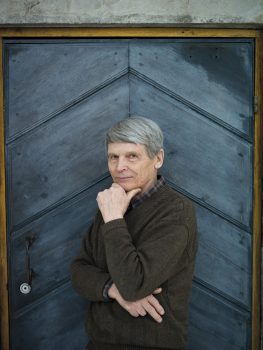
Antti Hyry. Photo: Jouni Harala
Antti Hyry, born in 1931, is a writer from northern Finland. His work is coloured by elements characteristic of the region near the Arctic Circle: rugged nature, wintry frost, the light of long summer nights, the Laestadian fundamentalist Christian sect, and the strict rules of an agrarian community.
Hyry is an engineer by training, and although he has never worked as an engineer, his world view has been built on a physical and technological foundation. This orientation, together with a basic intuition which is close to nature, has created in his works a world of fascinating conflict in which troubled man, weighed down by responsibilities, studies his environment as if to test whether it exists, and to discover what laws govern it. More…
This journey
30 September 1995 | Archives online, Fiction, poetry
Poems from Tämä matka (‘This journey’, 1956). Introduction by Jukka Petäjä
You took a planet
For Erik Lindegren
The stars arranged themselves
round a red magnet
by request,
and shaped fugitive systems and mirror reflections,
space’s sonorous grammar.
Oh, those hatched-out faces of the apathetic! –
and the grudge of those who can no longer read
(apart from cruel bibles, containing pressed roses and corpses).
Oh, ourselves! – here in the lonely sublunar place,
hair and eyes in the wind, in our hands
	                                                ignorance and boomerang-echoes.
Oh, these vaultings of the word! – changing skies
where the glyphs rise like distress flags.
I looked for a question
	                    whose answer is this mutabor.

I kneel
	   to gather up the shattered fragments of a glyph
scored with the brilliant wounded secret
where I lost my wings
	               before my choosing fingers were formed.
More…
Virtual realities
30 September 1993 | Archives online, Fiction, Prose
Prose pieces from Bamalama (WSOY, 1993)
After eating his family, he went abroad. There was a heatwave in Torremolinos. The sandy beaches were empty despite the Mediterranean waves’ enticing glitter. Although it was so hot, not a trace of the sun could be seen in the sky, and no clouds either. He sat in an armchair in his modest hotel room and breathed deeply. He thought about the pretty young girls on the beaches just waiting to be casually plucked, bony adolescent bodies, opulent and luscious adult female forms, and lips beyond all powers of description. He sat there, and time passed. Soon darkness spread over the beach, and he could see nothing but velvety black nothingness stretching out to the horizon. He was overcome by a powerful sense of fear, caused by the bleak desolation of the scene, this gloomy darkness that covered and hid the millions of shades of natural colors. He accepted his feelings and let them flow into himself, because he knew that morning, sunrise, and the play of nature’s colors down there on the beach boulevards, would resuscitate within him a great dreamer, impervious to the storms of the world. More…
Out of my hands
10 November 2011 | Articles, Non-fiction
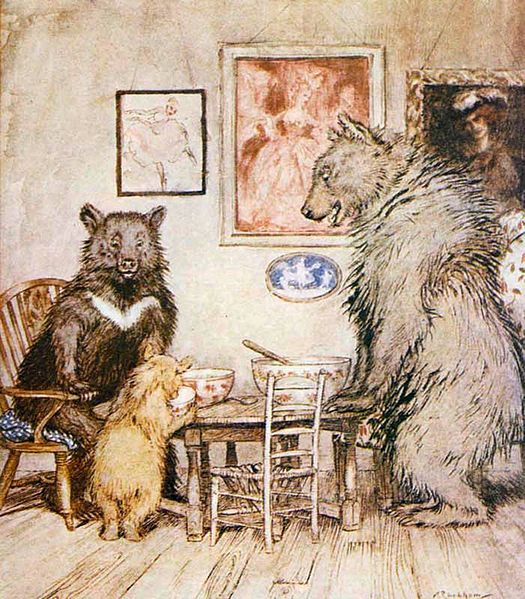
Who's been eating my porridge? From ‘English Fairy Tales’ by Flora Annie Steel (1918), illustrated by Arthur Rackham. The Project Gutenberg e-Book
In the classic fairy-tale, on finding their belongings were not as they had left them, the three bears exclaimed: ‘Who’s been eating my porridge?’ When our technology correspondent Teemu Manninen found someone else’s underlinings in the electronic text he was reading, he wondered: ‘Who’s been tampering with my ebook?’ Which led him to ponder how similar books and their virtual counterparts really are – and could his ebook really be called ‘his’?
A few months ago I was reading an ebook on my iPad when I came across an underlined passage. For a moment I felt strangely disturbed. My initial thought was that I had not made the underlining, and therefore this had to be a glitch, an error in the computer program that was the book, which meant that there was something wrong with my book. What made this thought disturbing was the realisation that the kinds of harm that can befall digital books – and the measures that one can take to prevent them – are no longer ‘in my hands’: that the book is no longer physical, but virtual. More…
Breadcrumbs and elephants
27 March 2014 | Essays, On writing and not writing
In this series, Finnish authors ponder the pros and cons of their profession. Alexandra Salmela operates in two languages, her native Slovakian and Finnish, which has become her literary language. Adventure and torture alternate as she attempts to shape reality into writing
I had started to write before I knew how. With fat wax crayons, in big stick-letters, I scratched my stories in old diaries. There were lots of pictures. From the very beginning, I wrote both poetry and prose. At 11 I didn’t finish my great sea-adventure novel, but at 12 I was already writing my memoirs. They, too, somehow remained unfinished.
Writing is… I wanted to write fun, but in the end I’m not quite sure about that. Writing is adventure and liberation and terribly hard work. Torture of the imagination and the pale copying of real events. Reading is a way to escape reality and at the same time a route to the sources of reality. By writing, you can shape reality in your own image: it’s your own character fault if the result is ugly and depressing.
If I were to write a pink world, it would be so sugary that it would make everyone sick, me and other people. More…
Beyond good and evil?
30 June 1987 | Archives online, Authors, Interviews
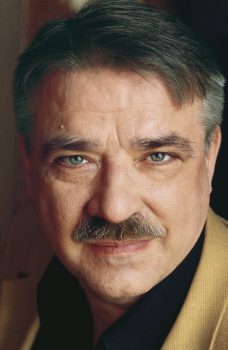
Esa Sariola. Kuva Irmeli Jung
Markku Huotari interviews Esa Sariola
A stylish restaurant in the Stock Exchange building in Helsinki. Esa Sariola and I order a businessmen’s lunch. We talk about hard-nosed success stories. About technocracy, casino economics.
About profit.
A steely-eyed businessman enters the room from the stock exchange and sees us two soft-talkers, even if we look like men, wasting time. The ruthless gambler bolts down his lunch and disappears to the upper floor again, where he is making money.
We remain.
We’re just talking.
And there’s no money accruing in our wallets.
All the same we have a grip on that investor. Esa Sariola has already laid siege to people like him in three books: Väärinkäsityksiä (‘Misconceptions’, 1983), a collection of short stories, and two novels: Rakas ystävä (‘Dear friend’, 1985) and Kuolemaani saakka (‘Until my dying day’, 1986). More…
Suddenly here, fully present
5 April 2011 | Fiction, poetry
The women in mirrors who recur in the work of Aila Meriluoto (born 1924) are poetic figures who have featured in her poetry since her first collection, published in 1946. In these new poems, from Tämä täyteys, tämä paino (‘This fullness, this weight’), she also describes women who are ‘alive to the brim’ or ‘extreme ballerinas’. Introduction by Mervi Kantokorpi
We live in strange times
my skull full of echoes.
The rose has throbbed
the heart flowered.
In the mirror a girl on her head,
from the wall steps an old woman,
all of them familiar,
none remembered.
Suddenly here.
Fully present.
Eighty-five years.
Hands wrinkled, shaky legs.
And alive to the brim.
And over. Dripping.
Surging. More…